
I have mixed feelings about yesterday's election. On one hand, I am genuinely delighted. On the other, I have little enthusiasm for the political alternative that just won.
The Democrats' sweeping victory in the 2026 midterms, taking control of both the House and the Senate, is vital news for American democracy. It may well prove to be the most consequential political development of Donald Trump's second presidency. Yet I am not celebrating because I believe Democrats have suddenly discovered the right answers. I am celebrating because divided government may be the best government America can hope for today.
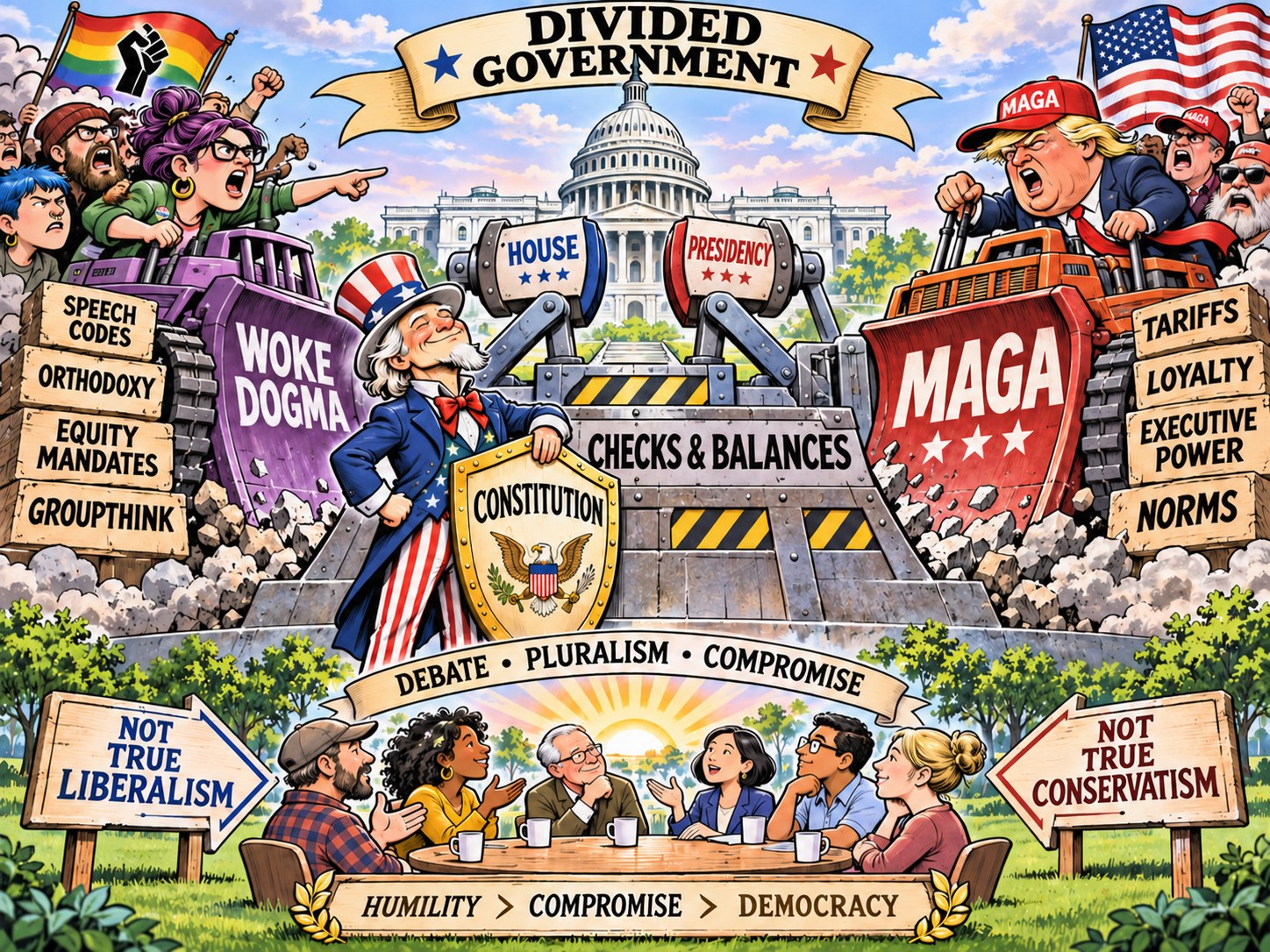
When neither political party can be trusted with unchecked power, preventing either from exercising it becomes a virtue.
1. America May Have Just Escaped Its Erdoğan Moment
Having watched what happened to Turkey under Recep Tayyip Erdoğan, I have been deeply disturbed by America's recent political trajectory. The parallels are not exact—American institutions are older and stronger, and the United States is not Turkey. Still, the underlying pattern is unmistakably familiar: a populist leader presents himself as the sole embodiment of the people, treats independent institutions as enemies, demands personal loyalty, attacks expertise, and steadily erodes the constraints on executive power.
This is not ordinary conservatism. It is a fundamentally different conception of government. Over the past two years, Trump has inflicted repeated shocks on the country through sweeping tariffs, erratic policy reversals, attacks on institutional independence, and a willingness to trade long-term economic credibility for short-term political theater. What troubles me even more than the economic damage is the political precedent: the normalization of governance by personal whim rather than by stable institutions and predictable rules.
Yesterday's election changes that equation. With Democrats assuming control of Congress in January, the White House will finally face meaningful oversight, investigations, and legislative constraints. The president will still wield immense executive authority, but he will no longer enjoy a compliant Congress controlled by his own party.
Divided government cannot by itself guarantee the preservation of democracy, but it places vital obstacles in the path of its erosion. With Congress no longer acting as a rubber stamp, the acute danger to American institutions has been cut at least in half—and if constitutional checks work as intended, perhaps even more. For the first time in nearly two years, there is genuine reason for optimism.
2. MAGA Is Not Conservative
One of the great intellectual confusions in contemporary American politics is describing MAGA as conservative. Traditional conservatism is rooted in prudence, continuity, institutional stability, skepticism toward radical change, and respect for inherited structures.
MAGA is almost the exact opposite. It is a reactionary movement built on the premise that modernity has destroyed American greatness and that radical action is required to restore an imagined past. Its methods are revolutionary: dismantle institutions, purge bureaucracies, overturn established norms, impose sweeping economic interventions, and concentrate power in the executive branch.
There is nothing conservative about treating the nation's institutions as disposable whenever they obstruct one's political ambitions. Nor is there anything economically conservative about across-the-board tariffs, arbitrary state intervention in private markets, or economic policy driven by political impulse rather than predictable principles.
MAGA is reactionary, not conservative. It seeks radical disruption in the name of reversing change.
That distinction matters. America's traditional conservative principles—limited government, fiscal responsibility, individual liberty, and institutional restraint—deserve serious representation in public life. MAGA has not preserved that tradition; it has hijacked it.
3. But Woke Is Not Liberal Either
My relief over the election results, however, does not translate into enthusiasm for the ideological left. The progressive movement commonly labeled "woke" harbors its own troubling impulse toward intellectual authoritarianism.
I use woke here in a precise sense: not the recognition that discrimination exists or that all people deserve equal rights, but the insistence that complex moral and social questions are already settled—and that dissent must be punished rather than debated. Classical liberalism rests on free expression, individual rights, tolerance, equality before the law, and the right to disagree. The more dogmatic wing of modern progressivism routinely substitutes ideological conformity for those core principles.
The tension between equality and equity illustrates the problem. Equality before the law and equal opportunity are foundational liberal ideals. When equity turns into a mandate to engineer equal outcomes through group-based preferences, bureaucratic quotas, and ideological enforcement, it collides directly with individual rights and meritocracy. Good intentions do not automatically produce just institutions.
We witnessed the consequences during the cultural battles of 2020–2024: speech policing, ideological litmus tests, institutional groupthink, and the pervasive assumption that questioning progressive orthodoxy was evidence of moral failure. The result was entirely predictable—widespread resentment, cultural backlash, and a potent recruiting tool for the populist right.
Beneath their surface differences, MAGA and the dogmatic progressive left share striking intellectual habits. Both insist that society is fundamentally broken and must be remade from above. Both divide the public into the enlightened and the dangerous, treating political opponents not as fellow citizens to persuade, but as obstacles to overcome. One seeks to force society backward; the other seeks to force it forward. Neither is willing to let society evolve organically through persuasion, compromise, experimentation, and democratic consent.
To be clear, the two movements are not equivalent in power or immediate danger. A faction wielding the presidency and the coercive machinery of the state poses a far graver institutional threat than ideological conformity inside universities, corporations, or cultural institutions. Yet their shared rejection of intellectual pluralism is worth confronting, even when the threats differ in scale.
MAGA isn't conservative. Woke isn't liberal. Both have abandoned the best of the traditions they claim to defend.
4. Democrats Have Won an Election. Have They Found a Direction?
This brings me to my second reaction to the midterms: skepticism. I remain unconvinced that the Democratic Party offers a coherent, compelling governing vision for the country. It has plenty of policy proposals, certainly, but a laundry list of programs is not a governing philosophy.
Bernie Sanders, Alexandria Ocasio-Cortez, and the party's democratic-socialist wing raise valid concerns about inequality, health care, and economic insecurity—problems that demand serious answers. Still, if one faction's reflex to every economic challenge is simply more redistribution, heavier spending, and a larger state, it will undermine the dynamism that drives American prosperity. Markets are not inherently suspect, and government intervention should not be the default answer to every social ill.
Similarly, if the party's cultural agenda remains captive to identity politics, equity mandates, and the policing of social norms, Democrats risk reigniting the very culture wars that propelled MAGA's rise in the first place. America cannot thrive if its only choices are an economically interventionist, culturally reactionary right and an economically interventionist, culturally dogmatic left.
The country deserves better. It needs leaders who recognize that free markets and smart regulation can coexist; that compassion does not require socialism; that equality does not require enforced sameness; and that protecting minorities does not require silencing dissent. It needs voices capable of addressing economic growth, innovation, fiscal discipline, education, and health care without turning every policy debate into a moral crusade.
Perhaps this midterm sweep—built on victories across politically diverse districts and states—will empower more pragmatic leaders within the Democratic coalition. I hope it does. Even so, an electoral wave is not proof of ideological wisdom. Rejecting Trump's style of governance is not the same as endorsing the progressive left's agenda. Democrats would make a profound mistake if they confused the two.
5. The Political Center Is Not a Lack of Conviction
What America needs most today is neither a more militant right nor a more dogmatic left, but a revival of liberal, pluralist, centrist politics.
By centrist, I do not mean mechanically splitting every policy difference down the middle. Some ideas are right, others are wrong, and splitting the difference is not always wisdom. Rather, I mean an ethos grounded in intellectual humility—leaders who recognize the limits of their own knowledge and the limits of their legitimate authority over other people's lives.
A free society cannot demand that every citizen share a single worldview. People must be free to live differently, worship differently, raise their children differently, voice unpopular opinions, and disagree sharply about politics without being branded enemies of the state or of morality. The true test of liberalism is our willingness to defend the liberty of people whose choices we dislike.
A pluralist politics also recognizes that most governing dilemmas involve genuine trade-offs rather than Manichean struggles between good and evil: economic growth versus redistribution, security versus privacy, tradition versus reform, individual merit versus remedies for historical disadvantage. These questions are difficult precisely because reasonable people of goodwill can weigh them differently. A healthy democracy debates those trade-offs openly; an unhealthy one turns them into loyalty tests.
Properly understood, the political center is not an absence of conviction. It is an active commitment to individual freedom, empirical evidence, institutional restraint, and the possibility that we might be wrong.
6. My Hope: Less Ideology, More Humility
In an earlier essay, Explaining Extremism in American Politics: How Did We Get Here?, I argued that America's polarization is driven not merely by voters moving to the fringes, but by political sorting, rapid cultural dislocation, and media and party institutions that reward the loudest, most confrontational voices.
Both MAGA and the progressive vanguard are reactions to a world changing faster than many citizens can comfortably absorb. One movement wants to turn back the clock; the other wants to force the clock forward. Both vastly underestimate the complexity of a free society and overestimate their own ability to redesign it from the top down.
Neither holds the answers. The lesson of this election is not that we should replace one ideological certainty with another, but that we must preserve a constitutional order in which no faction has enough power to impose all of its certainties on everyone else.
Doing so requires intellectual humility. It requires acknowledging that fellow citizens with very different beliefs may still have legitimate grievances. It requires defending institutional rules even when they frustrate our own preferred outcomes. Above all, it requires keeping our minds open.
I want to live in an America where a socially liberal entrepreneur can champion free markets without being caricatured as a left-wing or right-wing extremist, and where citizens can criticize both Donald Trump and progressive orthodoxy without being forced into a partisan tribe. That America should not be so hard to imagine.
Yesterday's election does not restore that political culture overnight, but it gives the country the breathing room to find its way back. I remain skeptical of both political extremes, yet today I am genuinely relieved and hopeful.
This election is a victory not because the Democrats have all the answers, but because no party should be allowed to govern as though it does. For America today, divided government is the best government, and that is worth celebrating.
Comments