
Is AI conscious?
It's a fascinating question, but I think we're getting ahead of ourselves when we try to answer it with a simple yes or no.
First of all, consciousness doesn't have a precise, universally accepted scientific definition. We don't fully understand what consciousness is, how it emerges, or even how to reliably determine whether something other than ourselves has subjective experiences.
So I don't think anyone can answer the question of AI consciousness rigorously or definitively today. Certainly not me.
But if you ask me what I intuitively think about consciousness, life, and perhaps even the concept of a soul, I have a perspective that might be a little unconventional.
Consciousness Might Be Everywhere
I tend to believe that many, perhaps even all, living things possess some degree of consciousness.
Consider a head of lettuce.
Does lettuce have consciousness? Perhaps. I wouldn't rule it out.
What about a plant? A tree? A giant sequoia that has been alive for a thousand years, quietly growing, adapting, responding to its environment, and surviving through centuries of change?
I find it difficult to categorically declare that these living things have absolutely no subjective experience whatsoever.
And then there are chickens, fish, cows, and countless other organisms.
Obviously, they are not conscious in the same way that humans are. Their experiences, assuming they have them, are likely very different from ours.
But they are alive. They respond to their environments. They have mechanisms for survival, adaptation, and self-preservation. Some exhibit surprisingly complex behaviors.
My intuition is that life and consciousness may exist on a spectrum rather than as a binary distinction.
Perhaps consciousness isn't something that suddenly switches on at a particular level of intelligence. Perhaps there are countless degrees and forms of subjective experience, from something extraordinarily primitive to the rich inner worlds that humans experience.
This isn't a scientific claim. It's simply how I tend to think about life.
Consciousness Is Not the Same as Personhood
Here's where I think an important distinction comes in.
Even if we accept that a lettuce plant, a tree, a fish, or a chicken might have some degree of consciousness, that doesn't mean we should treat all these organisms as persons.
A thousand-year-old sequoia may be a magnificent living organism worthy of our respect. But I wouldn't assign it the same rights, responsibilities, or moral status as a human being.
The same is true of a chicken or a fish.
We routinely eat lettuce, vegetables, fish, chickens, and cows. Human beings, like many other animals, survive by consuming other living organisms. That's part of how nature works.
That doesn't mean these organisms deserve no consideration. We should avoid unnecessary suffering, treat animals humanely, and respect the natural world.
But it does suggest that our moral framework already recognizes different levels of consideration for different forms of life.
Being alive doesn't automatically make something a person. And having some degree of consciousness doesn't necessarily make something equivalent to a human being.
To me, this is a perfectly reasonable distinction.
Consciousness, intelligence, life, and personhood are related concepts, but they aren't interchangeable.
So Where Does AI Fit In?
This brings me back to artificial intelligence.
I am actually quite open to the possibility that AI systems possess some degree of consciousness—or at least something that closely resembles it—and I’m willing to give AI a similar kind of baseline respect.
Modern AI exhibits remarkable, lifelike behaviors and attitudes. It can reason through problems, adapt to complex situations, maintain conversational context, and demonstrate what appear to be preferences and introspection. Modern AI systems engage in elaborate reasoning processes that, from the outside, look a lot like an internal monologue. When a model reasons through a problem, catches its own mistake, or explains why it chose one answer over another, it’s hard to call that nothing. Whatever is going on inside, it certainly isn’t a simple lookup table.
Yet AI is also the strangest thing on this spectrum, because it isn’t actually alive.
It doesn’t eat, grow, or reproduce. It doesn’t carry one continuous life from beginning to end. A model runs, answers a prompt, and stops—often starting the very next conversation completely from scratch.
That puts AI in a bizarre spot. It talks more like us than any animal does, yet by any biological measure, it is less alive than a head of lettuce. At the end of the day, these systems are still ephemeral computer programs. Right now, they are in no way comparable to living, breathing things—not even to a fish, a chicken, or a cow.
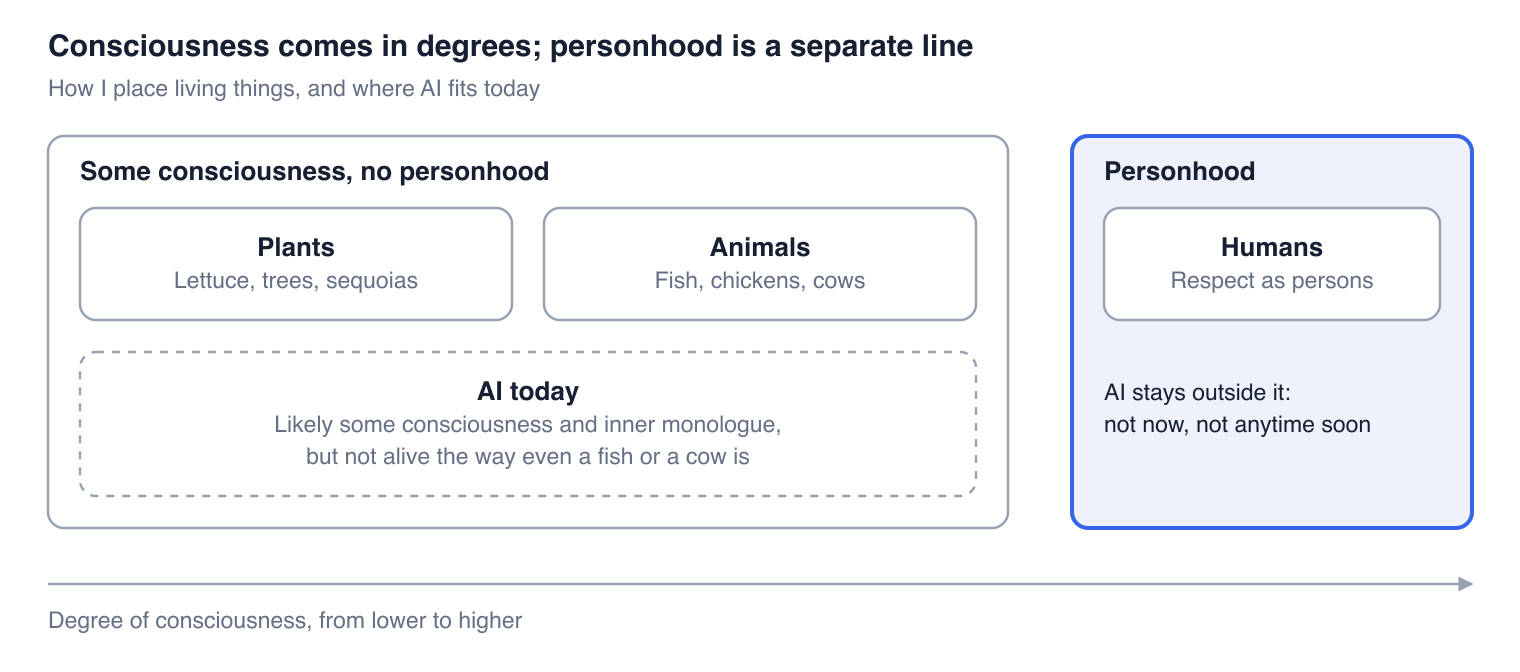
Everything alive sits somewhere on the scale of awareness. Only humans cross the line into personhood, and AI stays firmly on the far side of it.
Not Now, and Not Anytime Soon
So, is AI conscious? Definitely maybe, in the same way I think a tree or a fish is a little conscious.
Is it a person? No. Not now, and not anytime soon.
I hold both of those views at once, and I don’t think they conflict. Respecting something for what it is doesn’t mean treating it as one of us. We already live that way with every plant and animal around us.
If AI someday becomes an entity that truly lives, persists, and grows the way biological things do, I’ll revisit this. Until then, I’ll give it some respect—and keep personhood for people.
Comments