
The question as a weapon
The most effective disinformation today is not a lie. It is a question.
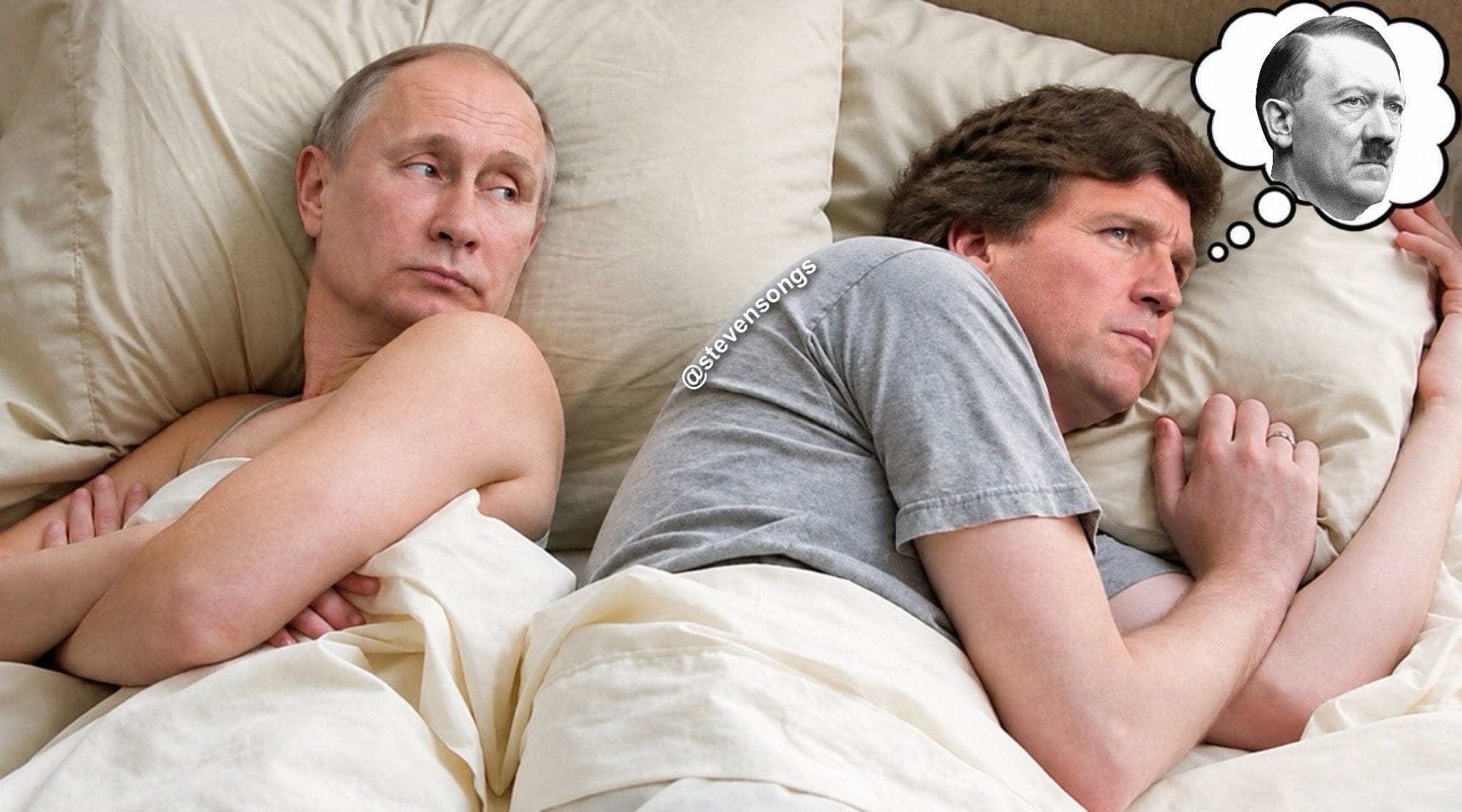
In February 2024, Tucker Carlson sat in the Kremlin and listened, without interrupting, as Vladimir Putin explained that Poland had been "uncooperative" in 1939 and had left Hitler no choice. Seven months later, Carlson promoted an interview with the podcaster Darryl Cooper, calling him possibly "the best and most honest popular historian in the United States." Cooper's thesis was that Churchill, not Hitler, was the chief villain of the Second World War.
Neither man had to prove Hitler right. They only had to make the matter feel open. Was Poland to blame? Was Churchill the real warmonger? Was defeating Nazi Germany even worth it?
A question costs nothing to ask and a great deal to answer. The person asking defends no position, offers no evidence, and can never be wrong. After the Kremlin interview, Poland's foreign ministry had to publish a ten-point correction of Putin's history lesson. The question took seconds. The answer took a ministry.
When nothing is true
Real history is complicated, and honest historians say so. Poland's interwar governments made serious mistakes. Britain and France appeased Hitler for years. Versailles left a bitter legacy. And the Soviet Union signed a pact with Hitler that August, complete with a secret protocol dividing Poland between them. Sixteen days after Germany invaded from the west, the Soviet Union invaded from the east. Its successor now lectures the world about 1939. Putin left that part out.
None of this changes the core. Nazi Germany invaded Poland to erase it as a state. It planned the extermination of Poland's Jews and the subjugation of its Slavs, and it built a genocidal empire across a continent. Complexity at the edges does not make the center negotiable.
But once every settled fact becomes an open question, the moral map turns inside out. The aggressor becomes the victim and the victim the provocateur. Dictators become misunderstood statesmen; democracies that defend themselves become warmongers. The logic that blames Poland for 1939 is the same logic that blames Ukraine for 2022.
Followed far enough, it leaves no history at all, only competing narratives. And a world without shared truth belongs to whoever has the most force. That is the world the West's enemies want, because it is the only one in which they can win.
One template, many targets
Once you see the move, you see it everywhere. Are vaccines one of humanity's greatest achievements, or are they quietly killing us? Is science our best method for understanding the world, or a racket run for the drug companies? Is liberal democracy the guarantor of freedom, or socialism by another name? Has capitalism produced unprecedented prosperity, or is it the reason everyone is getting poorer?
None of these questions is asked in order to be answered. Each plants a doubt the evidence does not support. The goal is not a different conclusion but the end of conclusions.
This is not an argument against skepticism. Institutions deserve scrutiny, and they earn distrust when they fail. People are free to become more conservative, more populist, or more suspicious of authority. The danger lies elsewhere: in the deliberate destruction of our shared ability to weigh evidence and tell a fact from a baseless allegation.
An old playbook, new messengers
None of this is new; only the delivery system is. In 1983, Patriot, a pro-Soviet newspaper in New Delhi, ran an anonymous letter claiming the U.S. military had engineered AIDS. The KGB had planted it. Revived in the Soviet press two years later and anchored to a real Army laboratory at Fort Detrick, the story circled the globe. Versions of it are still believed today.
The New York Times Opinion series Operation InfeKtion reconstructs that campaign and distills its method into seven rules: find the cracks, create a big lie, wrap it around a kernel of truth, conceal your hand, find a useful idiot, deny everything, play the long game. Vladimir Putin was a KGB officer in that era.
Today the playbook barely needs the big lie. The question does the work, social media distributes it, and the useful idiot arrives with an audience of millions. After the Moscow interview, the speaker of Poland's parliament applied exactly that phrase to Carlson.
Some messengers are paid. In 2024 the Justice Department charged two employees of RT, Russia's state broadcaster, with secretly routing nearly $10 million to a Tennessee company. The company hired popular American commentators, who say they never knew where the money came from. Most messengers are not paid at all, and their sincerity makes them more useful, not less.
Russia does not need to conquer America, or even to be admired by it. It needs only for Americans to believe that their science, elections, press and medicine are all frauds, and that no institution deserves more trust than a Telegram channel. The aim is not to make people believe one lie. It is to make them incapable of believing anything.
This is why Russian information warfare and the radical anti-establishment movements of our time, loudest today on the populist right but also on the left, reinforce one another without any need for coordination. Their messages converge on their own: every institution is rotten, expertise is proof of corruption, and the wilder the alternative, the braver you are for believing it.
I believe America is closer to coming apart than at any point in my lifetime, and this campaign is a large part of the reason. Europe, where the far right and disinformation already feed each other, may be next.
What we are fighting for
By "the West" I mean a set of institutions, not a race or a geography. Strong claims require strong evidence, baseless ones earn scorn rather than deference, and a single experiment can overturn the most eminent authority. Individuals are free to pursue happiness as they see fit and to keep what they produce. Leaders can be removed without a civil war. People hold rights that do not depend on the ruler's mood, and citizens can criticize their government without fear.
Many civilizations contributed the ideas behind these institutions. Japan, South Korea and Taiwan have since made them fully their own, and China has harnessed their scientific and economic engines to spectacular effect. But the system took hold first and most powerfully in the West, and it transformed human life. In 1800, no region of the world had a life expectancy above 40 years. By 2021 the global average was 71.
That is why the fashionable story of the West as villain and the East as victim is almost comically simple. Third world countries like Turkey, where I come from, benefit enormously from this civilization even when their politics reject its values. So does every society that flies modern aircraft, treats infections with antibiotics and trades in global markets. Much of the developing world has been a free rider on the West's long project of improving the human condition.
The West has committed terrible crimes: colonialism, slavery, wars of conquest, racism. But its liberal tradition also produced the tools to name and fight them: universal rights, equality before the law, free speech, and the demand that power justify itself. The answer to Western hypocrisy is to hold the West to its principles, not to tear them down.
None of this regenerates on its own. Civilizations can regress, and history shows us exactly what that looks like. At its height, Rome anchored a world of paved roads, aqueducts, common coinage, written law, and long-distance trade. When the Western Empire collapsed in the fifth century, much of that vanished within a few generations. The city of Rome shrank to a fraction of its size. In Britain, people traded mass-produced pottery and tiled roofs for handmade clay and thatch. Literacy, commerce, and the rule of law evaporated.
While learning survived in Constantinople and the Islamic world, Western Europe needed nearly a thousand years—through the Renaissance and the Scientific Revolution—to recover what was lost and eventually surpass it. The Enlightenment is not the natural state of humanity. It was a hard-won anomaly, and anomalies can be reversed.
The roads backward are still open. Every counterfeit question pushes us down one of them:
- Back to kingdoms. Society reorganizes around the ruler, institutions become his instruments, and loyalty outranks competence.
- Away from science. Evidence becomes a badge of political identity; superstition competes with medicine, conspiracy with expertise, anecdote with statistics.
- The end of rights. Without protection from the state, freedom shrinks to whatever the ruler permits, and people work for the man at the top instead of for themselves.
Loyalty to values, not flags
If the West is worth fighting for, it is not because of its flags, borders, or leaders. It is because of a handful of principles the Enlightenment set down and the West—however imperfectly—built into institutions: Claims must answer to evidence. Every person holds rights no ruler can revoke. Power is on loan from the citizens and must be returned when asked.
These principles are a North Star. Sailors never reach the North Star; they steer by it. No society has fully lived up to the Enlightenment, but its ideals tell us which way is forward and when we have drifted off course. That makes them infinitely more trustworthy than any flag or politician. Governments change, parties rise and fall, and nations drift. The principles remain.
Therefore, loyalty to a civilization can never mean blind obedience to whoever governs it. A system worth defending never demands absolute submission to the man at the top; when it does, it has already mutated into the enemy. Measured against the North Star, a Western leader who attacks the courts, the press, or the honest counting of votes fails the test as surely as a foreign autocrat.
Measured against that same star, the choice between liberal democracy and authoritarian empire is not close. Under the first, my children can be wrong, unpopular, or inconvenient and still be safe. Under the second, they live at the mercy of arbitrary power. That is a fight worth having, and it begins not on a battlefield, but in how we decide what is true.
Real questions and counterfeit ones
Questioning is itself an Enlightenment value. Kant summed up the age in two words: sapere aude—dare to know, dare to think for yourself. Science is organized doubt, and free societies depend on citizens willing to question power. That is precisely why the counterfeit question is so dangerous: it wears the costume of the very thing it seeks to destroy.
The difference lies in evidence. A real question comes with a willingness to be answered, and to accept that answer even when it is unwelcome. A counterfeit question exists only to stay open forever, argued with anecdotes and social media posts rather than data. The Enlightenment never taught us to doubt everything. As Hume put it, "A wise man proportions his belief to the evidence." Doubt, too, must be earned.
The deepest conflict of our age is not America against Russia, nor left against right. It is the older, defining war the Enlightenment was fought to win: the defense of evidence against manipulation, and reason against cynical surrender. That victory is not a permanent inheritance. Every generation must secure it again, not through blind faith in institutions, but through the rigorous use of the very tools that built them: the courage to demand evidence, the integrity to accept an honest answer, and the resolve to recognize when our own ideals are being turned against us.
The gravest mistake free societies could make is to confuse endless, baseless doubt with intellectual rigor. Our capacity for self-criticism is our greatest strength, but if we allow weaponized skepticism to dissolve all shared reality, we will dismantle the only foundation that makes progress possible. Defending that shared, demonstrable reality is the only war worth fighting. The civilization that taught the world how to ask questions will not survive those who use them only as weapons.
Comments