
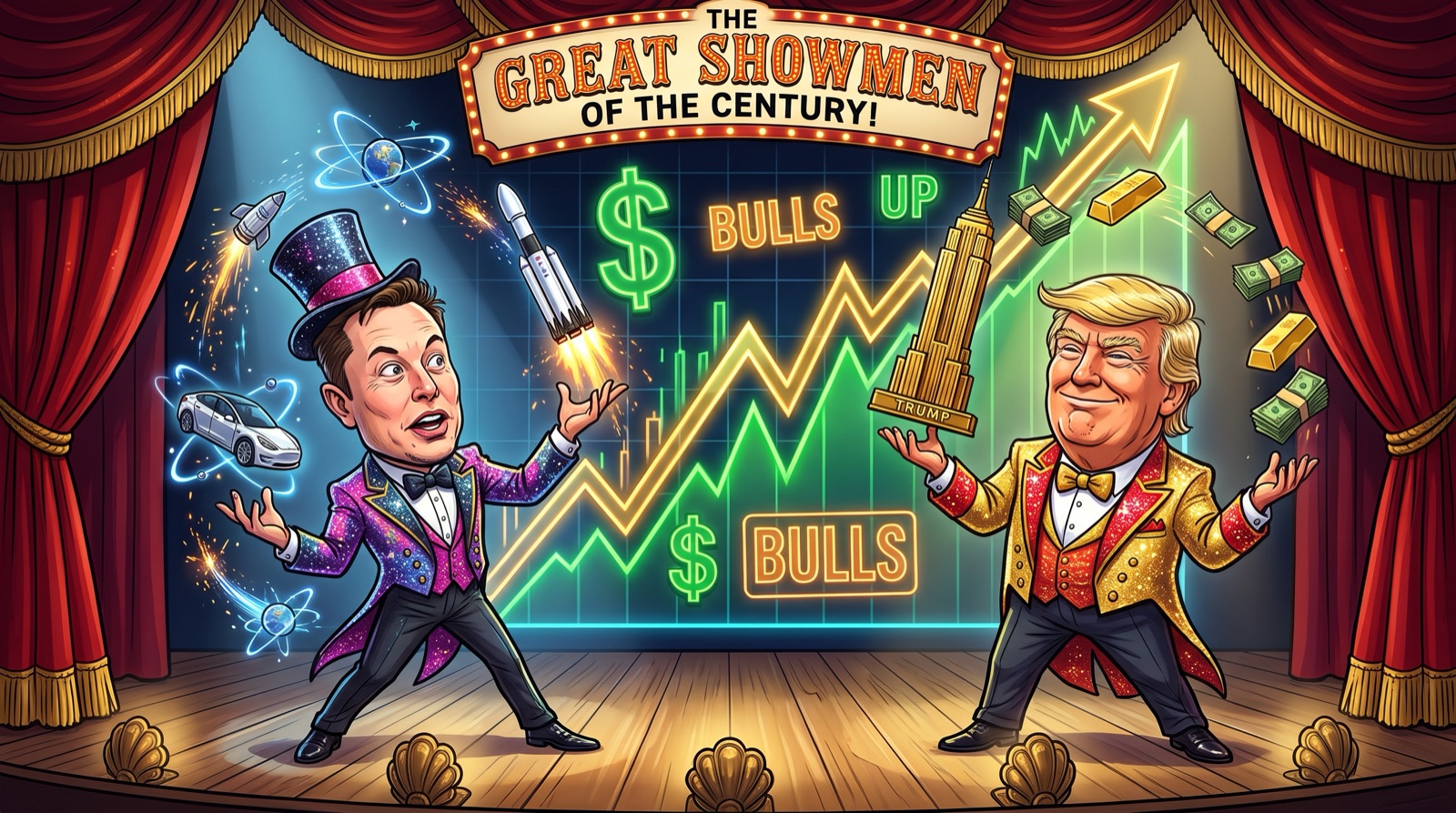
In modern business and politics, few figures command attention—or polarize observers—quite like Elon Musk and Donald Trump. Over the past decade, and particularly as their orbits converged in Washington and on Wall Street, a provocative thesis has gained traction among financial skeptics, short-sellers, and media commentators: Are Elon Musk’s companies essentially the Donald Trump of Silicon Valley?
At the heart of this comparison is a critique of how modern markets value narrative over fundamentals. Critics argue that Musk’s corporate empire—spanning Tesla, SpaceX, xAI, and X—relies on the same playbook Trump famously deployed in real estate, media, and politics: relentless self-promotion, grandiose promises that rarely arrive on schedule, and astronomical paper valuations propped up by a devoted following rather than proportional bottom-line profits and financial results.
Yet, when one looks closely at the balance sheets, factories, and launchpads of late 2026, the comparison reveals both striking psychological parallels and profound operational differences.
The Case for the Parallel: Showmanship, Missed Deadlines, and Valuation Gaps
To understand why critics draw a line between Manhattan’s most famous developer and Silicon Valley’s wealthiest entrepreneur, observers point to three recurring patterns.
1. The Primacy of Personal Branding
Media critics and business historians have long noted that both Trump and Musk transformed their personal personas into their primary financial assets. In Trump’s business career, the "Trump" name became a licensing engine—a symbol of luxury and success that often carried more weight than the underlying real estate cash flows, a dynamic echoed in the multi-billion-dollar market valuations of Trump Media & Technology Group (DJT) despite modest revenues.
Similarly, Tesla and SpaceX trade not on traditional industrial metrics, but on the "Musk premium." Following SpaceX’s historic June 2026 initial public offering—which debuted at a $1.78 trillion valuation and climbed past $1.9 trillion—and amid reports of potential merger talks between SpaceX and Tesla that could create a $3.4 trillion behemoth, any rational observer will conclude that investors are buying into Musk’s personal mythology rather than conventional discounted cash-flow models.
2. A Ledger of Shifting Timelines
The sharpest arrow in the critics' quiver is Musk’s track record of unfulfilled deadlines. Financial publications and Tesla skeptics have cataloged more than a decade of ambitious forecasts that slipped years behind schedule or vanished altogether.
- Autonomous Driving: Since the mid-2010s, Musk has repeatedly predicted that fully autonomous, unsupervised Tesla vehicles were only a year or two away. While Tesla launched Cybercab robotaxi services in select markets like Austin in 2026, critics note that full, nationwide regulatory approval and coast-to-coast autonomy remain far behind the timelines sold to investors years ago.
- Abandoned or Delayed Visions: Detractors frequently cite the shuttered Hyperloop concept, years-long delays for the Cybertruck and next-generation Roadster, and the shelving of a long-promised $25,000 mass-market electric car in favor of pivoting toward humanoid robots (Optimus) and space-based AI data centers.
To short-sellers and skeptical analysts, this pattern resembles a classic promotional cycle: whenever core metrics soften, a new, even more audacious vision is unveiled to keep the narrative—and the stock price—moving forward.
3. Astronomical Valuations vs. Modest Net Income
Do Musk’s companies generate profits commensurate with their valuations? While Tesla’s market capitalization hovers around $1.5 trillion, its annual GAAP net income declined from $15 billion in 2023 to $3.8 billion in 2025, sitting at roughly $3.2 billion over the trailing twelve months through the third quarter of 2026. To traditional value investors, paying hundreds of times earnings and 13x Price-to-Sales for an automaker facing intense global competition from rivals like BYD is a textbook example of hype overriding fundamentals.
Likewise, SpaceX’s pre-IPO filings revealed that while the company commanded a nearly $2 trillion valuation, its consolidated operations posted a $2.6 billion operating loss in 2025—weighed down heavily by $6.4 billion in operating losses from its AI and social media subsidiaries (xAI and X). This disconnect between colossal market caps and thin or negative consolidated profits mirrors the criticisms long leveled at Trump’s politics and corporate ventures.
Where the Analogy Breaks Down: Hardware, Scale, and Cash Engines
Despite the superficial similarities in showmanship and valuation multiples, one could argue that equating Musk’s businesses with Trump’s empire misses a fundamental distinction: the difference between brand licensing and heavy industrial execution.
1. Real Revenue and Dominant Market Share
Unlike ventures that rely primarily on real estate leverage, brand licensing, or niche media, Musk’s flagship companies generate massive top-line revenue and command dominant shares in capital-intensive global industries:
- Tesla’s Scale: By mid-2026, Tesla surpassed $100 billion in trailing twelve-month revenue and delivered its 10 millionth vehicle. Beyond cars, its energy storage division (Megapack) has become a major profit and growth driver, supplying grid-scale batteries critical to powering AI data centers.
- SpaceX and Starlink: Far from being vaporware, SpaceX accounts for the vast majority of global orbital launch mass, serving as an indispensable contractor for NASA and the U.S. defense establishment. Crucially, its Starlink satellite internet division generated $11.4 billion in revenue and $4.4 billion in operating profit in 2025 alone—proving that its core infrastructure business is a highly profitable cash engine, even as the company reinvests tens of billions into Starship and AI compute.
2. "Elon Time" as an Engineering Forcing Function
Supporters and venture capitalists argue that Musk’s missed deadlines are fundamentally different from empty promotional bluster. In Silicon Valley, "Elon Time" is widely viewed as an aggressive management tool—setting seemingly impossible timelines to force engineering teams to innovate faster.
Proponents point out that while Falcon 9 reusability, the Model 3 production ramp, and Starlink’s global constellation all arrived later than Musk’s initial optimistic tweets suggested, they did arrive—and when they did, they upended entire industries. In this view, overpromising on the date is not the same as failing to deliver the product.
3. Capital Allocation and Technological Moats
Musk’s companies pour tens of billions of dollars annually into physical research, semiconductor fabrication, battery refining, and rocket manufacturing. Rather than extracting cash through licensing fees, Musk has historically reinvested earnings—and raised equity—to build vertically integrated manufacturing moats that competitors struggle to replicate.
The 2026 Convergence: When Politics Meets the Balance Sheet
Ironically, what began as a metaphorical comparison between Musk and Trump evolved into a tangible entanglement. Musk’s high-profile political alliance with Trump—including his involvement in the administration's Department of Government Efficiency (DOGE)—blurred the line between Silicon Valley disruption and Washington partisanship.
As we have seen throughout 2025 and 2026, that political alignment proved to be a double-edged sword. While investors initially bid up Tesla shares on expectations of favorable autonomous vehicle regulations, the resulting consumer backlash and political polarization weighed on vehicle demand in key Western markets, demonstrating that importing political style into a consumer-facing tech brand carries real financial risks.
Conclusion: Hype as Fuel, Execution as the Test
So, are Elon Musk’s ventures the Donald Trump of Silicon Valley?
If the comparison is restricted to communication style and market psychology, the parallel is hard to ignore. Both men mastered the attention economy, weaponized social media to bypass traditional gatekeepers, and proved that a compelling narrative can sustain valuations & social reception that defy conventional financial gravity & actual results.
However, if the comparison implies that Musk’s empire is all bluster with nothing underneath, the financial and physical evidence tells a different story. Generating over $100 billion in annual automotive and energy revenue, operating the world’s dominant orbital launch fleet, and running a multi-billion-dollar profitable satellite network represent tangible industrial achievements that go far beyond smoke and mirrors.
Ultimately, Musk’s career occupies a gray area that fascinates and frustrates any Wall Street observer: he uses Trump-style hyperbole to raise capital and command attention, yet deploys that capital to build some of the most complex hardware on—and above—the planet. Whether his multi-trillion-dollar valuations will eventually be justified by earnings remains an open —and perhaps unlikely—bet, but history suggests that counting out the factories behind the bluster is a losing wager.
Appendix: Musk by The Numbers
A. The Promises
Musk's biggest promises, checked against the public record as of November 2026.
A1. Self-driving and robotaxis. Musk has made dated self-driving predictions since 2013. Wikipedia's running list counts 31: one met outright (a single car driving itself from the factory to a buyer in June 2025), three partly met, 20 missed and the rest still open. The milestones:
| Made | Claim | Outcome |
|---|---|---|
| Sep 2013 | "90 percent of miles driven" autonomously within three years | Missed |
| Dec 2015 | "Complete autonomy in approximately two years" | Missed |
| Oct 2016 | A Los Angeles–New York drive "without the need for a single touch" by end of 2017 | Missed; a private owner completed the trip on FSD in January 2026 |
| Apr 2019 | "Over a million robotaxis on the road" in 2020 | Missed; driverless service now runs in eight cities, mostly in Texas and Florida |
| Jul 2020 | "Basic functionality for level 5 autonomy complete this year" | Missed |
| Jul 2023 | "I'm the boy who cried FSD, but I think we'll be better than human by the end of this year" | Missed |
| Jan 2025 | Unsupervised FSD as a paid service in Austin in June | Launched June 22 with a safety monitor in the passenger seat; consumer version pushed to Q4 2026 "at the earliest" |
| Jul 2025 | Robotaxis for half the U.S. population by end of 2025 | Missed; narrowed to the top eight to 10 metro areas |
| Jan 2026 | Driverless cars in a quarter to half of the U.S. by end of 2026 | Pending |
A2. Other business promises
| Promise | Made | Due | Where it stands |
|---|---|---|---|
| Optimus: about 10,000 humanoid robots built in 2025, "doing useful things" | Jan 2025 | End of 2025 | Missed; by January 2026 none were doing useful work. Early production began in Fremont this fall; outside deliveries and public sales now target end of 2027 |
| Humans on Mars | 2016–17 | Cargo 2022, crew 2024 | Reset in 2024 to five uncrewed Starships in 2026; dropped in February 2026 for a Moon-first plan |
| 20 million vehicles a year | 2020 | 2030 | Goal dropped from Tesla's impact report in 2024; Tesla delivered 1.79 million vehicles that year |
| Cybertruck at more than 250,000 a year | 2019 | 2021 | Arrived late 2023; first-year sales were under a sixth of that, and Texas production winds down by mid-2027 |
| Semi | 2017 | 2019 | Volume production slipped again, from 2025 into 2026; deliveries began at a quoted $290,000, vs. $150,000–180,000 first advertised |
| Second-generation Roadster | 2017 | 2020 | Unveiled in October 2026; production now set for 2028 |
A3. Political promises: DOGE
| Promise | Made | Where it stands |
|---|---|---|
| Cut federal spending by "at least $2 trillion" | Oct 2024 | Lowered to $1 trillion in February 2025, then $150 billion for the fiscal year. DOGE effectively disbanded in November 2025 and formally expired on July 4, 2026, claiming $215 billion; experts dispute the figure, and OMB plans no final report |
| Publish every saving on a public "wall of receipts" | Feb 2025 | The first release claimed $16 billion, cut to $8.5 billion after an $8 million ICE contract was listed as $8 billion; NPR could verify about $2 billion. Five of the biggest entries were later deleted after errors were reported |
B. Tesla's Profit Since 2021
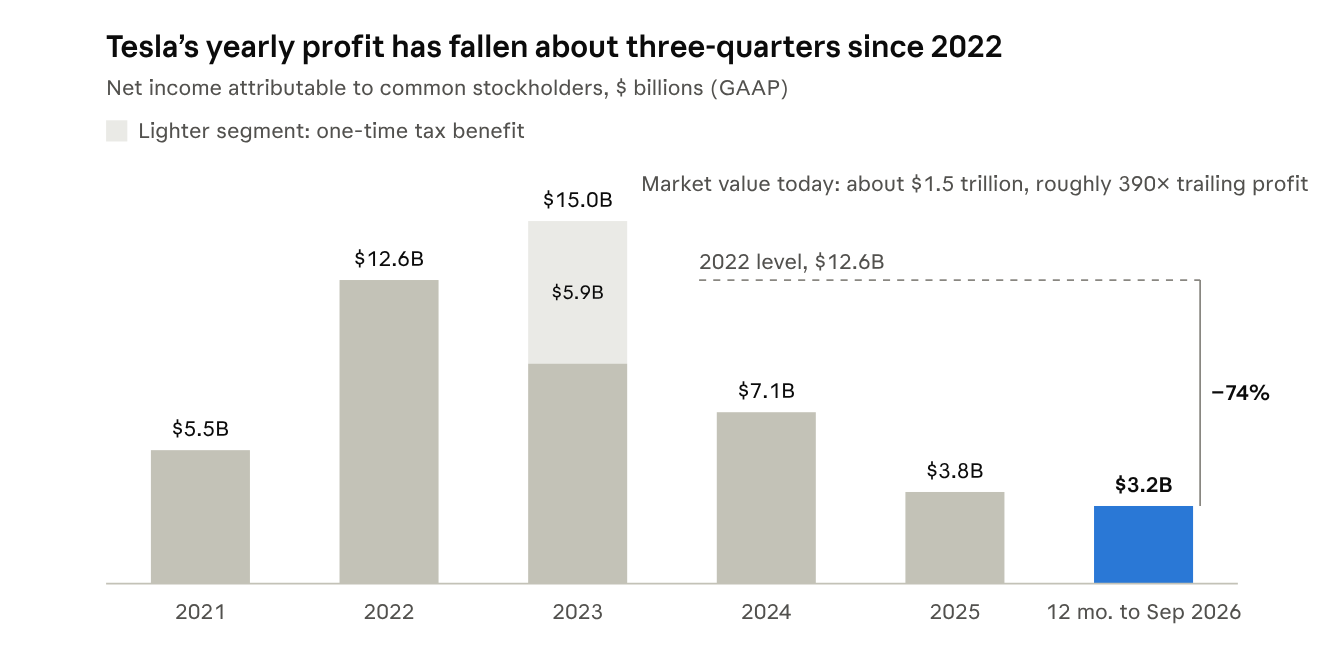
Strip out 2023's one-time tax benefit and the peak was 2022; the past twelve months earned about a quarter of it.
C. Three Valuations Compared
| Company | Market value | Revenue | Net income | Price to Sales Ratio | What the price pays for |
|---|---|---|---|---|---|
| Tesla | ~$1.5T | $103.6B (12 mo.) | ~$3.2B (12 mo.) | 14x | Robotaxis, Optimus robots |
| SpaceX | ~$1.9T | $14.6B (Q3) | $4.4B (Q3); –$0.4B (9 mo.) | 33x (Q3 annualized) | AI compute, Starlink, Starship |
| Trump Media | ~$1.1B | $4.5M (12 mo.) | –$1.3B (12 mo.) | 245x | The Trump brand, bitcoin, a fusion merger |
Tesla: market value on November 11 and results for the 12 months to September 2026. SpaceX: November 10 close of $143.09 on 13.58 billion shares, and third-quarter results. Trump Media: trailing twelve months; its third-quarter profit came from crypto gains.
Comments