
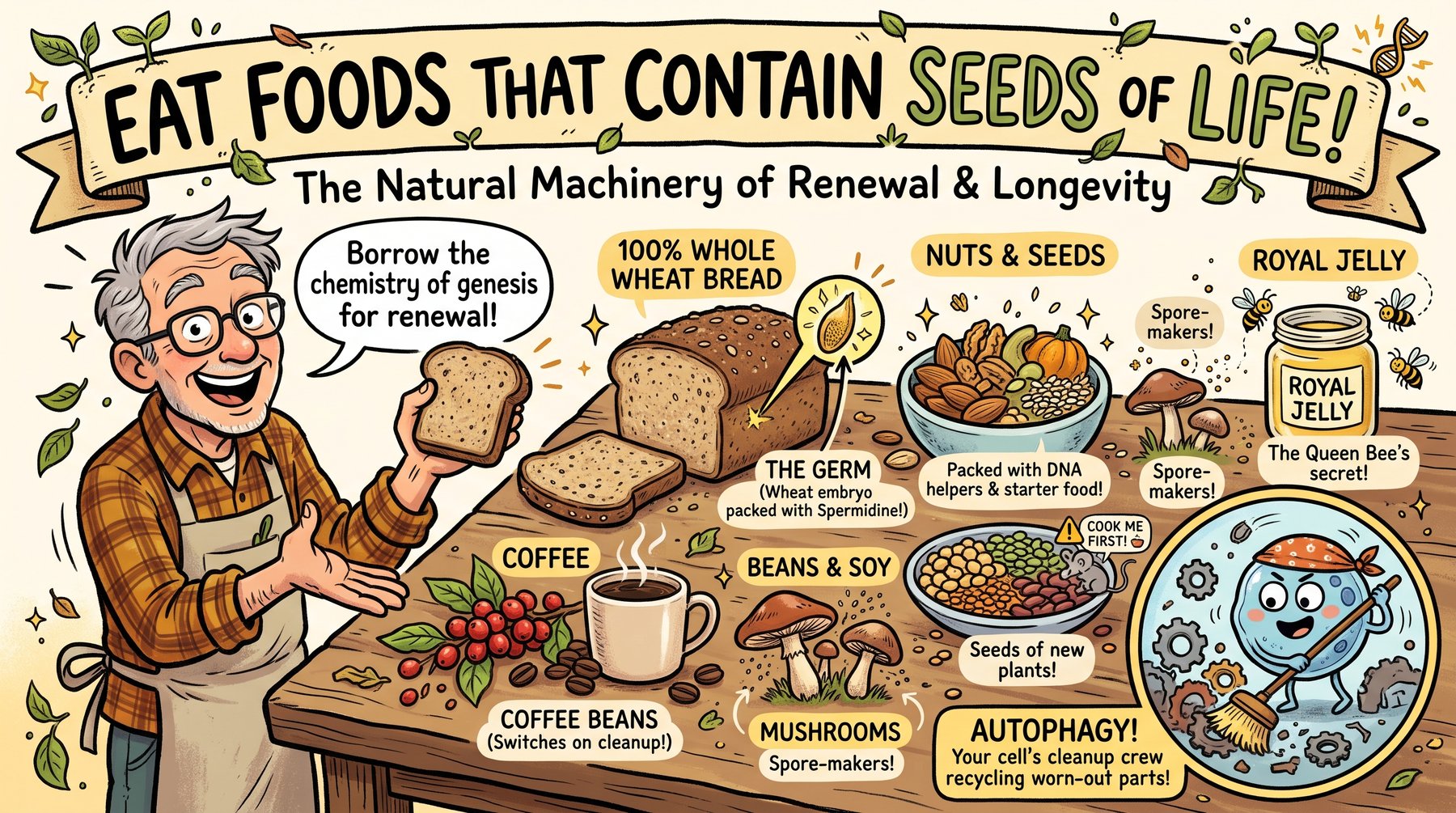
The longevity molecule in your bread
Whole wheat bread contains one of the most promising molecules in aging research. It is called spermidine.
Does that word remind you of anything? It should. It is what you think it is. In 1678, Antonie van Leeuwenhoek saw crystals. They were spermine, spermidine's sibling. Spermidine itself was found and named later.
In wheat, spermidine sits in exactly the parts refining throws away. The richest is the germ, the embryo that would sprout into a new wheat plant. The germ is only about 2.5% of the kernel, yet it is the richest source of these molecules among cereals. The bran, the seed's protective coat, carries plenty too.
White flour is the starchy endosperm alone, with germ and bran sifted away, and milling studies find less spermidine in white flour than in bran or whole flour. If you eat bread, eat it whole.
Autophagy: the cell's cleanup crew
Spermidine's main trick is switching on autophagy, the process by which cells digest and recycle their own worn-out parts. As we age, autophagy slows, spermidine levels fall, and cellular junk piles up.
In 2009, Austrian researchers showed that spermidine markedly extended the lifespan of yeast, worms and flies, and that the benefit vanished when autophagy genes were disabled. In 2016, the same group found that oral spermidine extended mouse lifespan and kept aging hearts younger, even when started late in life.
In humans, the evidence is promising but softer. The Bruneck study followed 829 Italians for 20 years: those in the top third of spermidine intake had a death risk comparable to being 5.7 years younger than those in the bottom third. That is an association, not proof. And a 12-month randomized trial of a wheat germ supplement found no memory benefit in older adults, though it raised daily spermidine intake by only about 10%. For now, the better bet is food, not pills.
The whole wheat bread paradox
Here is a puzzle. A slice of whole wheat bread and a slice of white bread spike your blood sugar almost equally: the international glycemic index tables put them at 74 and 75.
Yet their health records diverge. Among nearly 120,000 Harvard nurses and health professionals, each daily serving of whole grains was linked to 5% lower total mortality and 9% lower cardiovascular mortality. In the Adventist Health Study, people who mostly ate whole wheat bread had 44% fewer nonfatal heart attacks than white bread eaters. And across 21 countries, the heaviest eaters of refined grains had 27% higher mortality.
Something in whole wheat must offset the sugar spike. Fiber is the leading suspect, and in the Harvard data the bran, not the germ, carried the heart benefit. But bran is more than fiber. It also carries spermidine, along with magnesium and polyphenols. Spermidine is likely one of several protectors, not the whole story.
A pattern: the parts that make new life
Step back and a pattern appears. The foods rich in renewal molecules tend to be the parts of living things that create new life.
- Nuts and seeds are plant embryos packed with a starter food supply.
- Whole wheat keeps the germ, the wheat embryo.
- Beans are seeds too. Soybeans are rich in spermidine, and fermenting them into natto raises it by about 40%.
- Coffee beans are seeds as well. Coffee, even decaf, switches on autophagy in mice within hours, and among 400,000 older Americans, coffee drinkers had lower death rates.
- Mushrooms are the fruiting bodies of fungi, the parts that make and release spores. In one survey of 227 foods, dried mushrooms ranked just behind wheat germ for polyamines.
- Royal jelly, fed to a larva for life, turns it into a queen bee. Queens share their genome with workers yet live years instead of weeks, and royal jelly has extended lifespan in worms, flies and mice.
Nuts and seeds deserve special mention. Beyond polyamines, they carry vitamin E (almonds, hazelnuts, sunflower seeds), omega-3 fat (walnuts) and lignans (flax, sesame). Their outcome data are striking. In two Harvard cohorts, people who ate a handful of nuts daily had a 20% lower death rate than those who ate none. Among California Adventists, eating nuts five or six times a week was one of five habits that each added one to nearly three years of life expectancy.
Why evolution would put them there
This is not a coincidence. A seed is a bet on the future. When it wakes, its embryo must divide fast, copy its DNA and build new tissue. Polyamines like spermidine bind and protect DNA and drive cell growth, so the plant stocks its embryo with them, along with antioxidants like vitamin E to survive months of dormancy. Mothers do the same through milk; hives do it through royal jelly.
An aging body is losing exactly this machinery.
But treat this as a heuristic, not a law. Seeds also defend themselves. Apricot kernels carry amygdalin, which turns into cyanide, castor beans carry ricin, and as few as four or five raw kidney beans can cause severe food poisoning. Eggs, reproductive by definition, show no such benefit: across 55 studies, each extra daily egg was linked to 7% higher total and 13% higher cancer mortality. And growth chemistry cuts both ways. Cancer cells hoard polyamines too, though dietary intake has not been tied to cancer in healthy people.
Nature packs its embryos with nourishment and poison alike. Let evidence, not the pattern alone, pick your foods. And cook your beans.
How to eat for renewal
- Buy bread labeled 100% whole wheat or whole grain. "Wheat bread" is often mostly white flour.
- Sprinkle a tablespoon or two of wheat germ on yogurt or oatmeal. Keep it in the fridge; its oils turn rancid.
- Eat a handful of nuts most days.
- Put beans, lentils, soy and mushrooms on the menu several times a week.
- Don't count on spermidine pills yet. The food comes with fiber and decades of data; the pills don't.
The heuristic is simple: foods that support the creation of new life may also support the renewal of existing life. Nuts, seeds, wheat germ, beans, coffee, mushrooms, royal jelly: these are not random health foods. They are nature's most concentrated stores of the molecular machinery of youth. To eat them is to borrow the chemistry of genesis for the purpose of regeneration.
Comments