In 1979, Douglas Hofstadter introduced readers to a woman named Aunt Hillary. She was intelligent, witty, sensitive, and capable of delightful conversation. She also happened to be an ant colony.
Not a particularly intelligent ant colony. Every individual ant was as mindless as any other. None understood language, possessed a personality, or had the slightest idea what Aunt Hillary was thinking. Yet through the coordinated activity of millions of these tiny creatures, something extraordinary emerged: a coherent mind with a sense of self.
Aunt Hillary was fictional, of course—a character in Hofstadter's Pulitzer Prize–winning Gödel, Escher, Bach: An Eternal Golden Braid. But nearly half a century later, we have built something that makes her seem less like an intellectual fantasy and more like a question we can no longer avoid.
Today's most advanced artificial intelligence systems can reason through unfamiliar problems, write sophisticated software, compose music, and engage in conversations that would have seemed miraculous just a few years ago. They can discuss their apparent motivations, explain their mistakes, and sometimes describe their own internal processes.
And yet we have no settled answer to a surprisingly simple question: Is there anybody home?
We know what these systems do. We increasingly understand how they do some of it. What we do not know is whether the intelligence appearing on our screens is accompanied by anything resembling an inner life.
This is why Gödel, Escher, Bach is worth revisiting in the age of AI. Not because Hofstadter accurately predicted our technological future. In several remarkable ways, he did not.
Its importance lies somewhere deeper: Hofstadter showed how intelligence and selfhood could emerge from mindless matter. He never imagined how far machines would go toward intelligence while leaving selfhood behind.
That distinction may become one of the defining philosophical and ethical questions of our century (see previous post: Is AI Conscious? And Does It Really Matter?).
The Strange Loop: How Something Comes From Nothing
You are made of atoms. None of those atoms is conscious.
Your neurons are physical cells governed by electrochemical processes. No individual neuron understands Shakespeare, feels nostalgic about childhood, or wonders whether life has meaning.
Yet somehow, when billions of these cells operate together, there is you: a person who remembers yesterday, imagines tomorrow, recognizes themselves in a mirror, and can think about the very process of thinking.
How does a self emerge from things that have no selves?
This is the mystery around which Hofstadter constructed his book. Rather than begin with neuroscience, he approached the problem through three seemingly unrelated figures: Johann Sebastian Bach, M. C. Escher, and Kurt Gödel.
Their works, Hofstadter argued, revealed a common underlying structure: the Strange Loop.
Consider Bach's Musical Offering, composed in 1747 after a visit to Frederick the Great. One piece, the Canon per Tonos, begins in C minor and gradually modulates upward. Just when the music appears ready to conclude, it has reached D minor, from which it can begin its journey again.
Repeat the process six times and something peculiar happens. The canon has climbed through an entire octave, only to arrive back in C minor.
It has returned to its starting point, but one level higher. Hofstadter calls it the Endlessly Rising Canon.
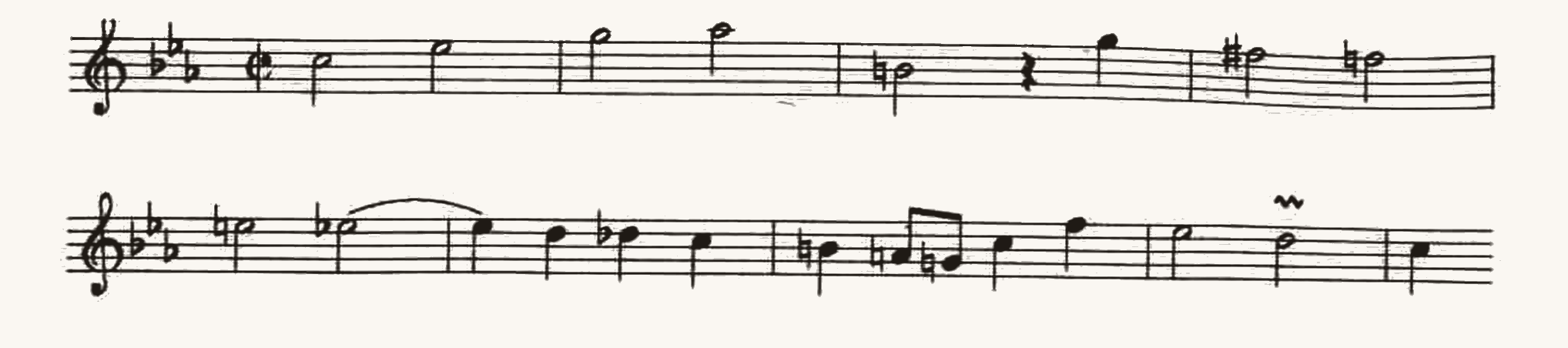
Figure 1. The Royal Theme that Frederick the Great gave Bach in 1747. The endlessly rising Canon per Tonos grows out of it. (GEB, Fig. 3)
Escher accomplished a similar trick visually. In Ascending and Descending, figures march endlessly along an impossible staircase. In Drawing Hands, two hands appear to sketch each other into existence. The distinction between creator and creation folds back upon itself.
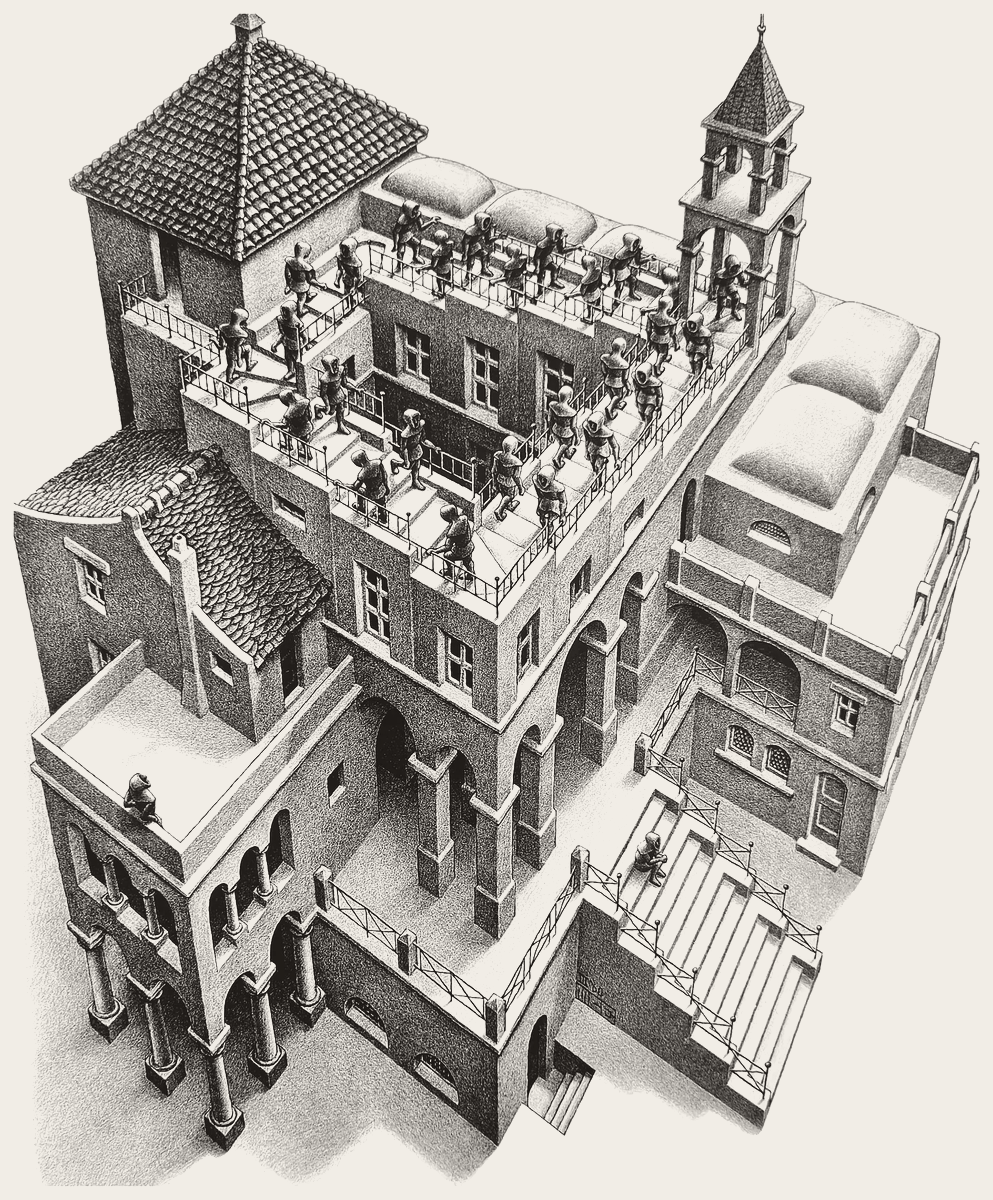
Figure 2. M. C. Escher, Ascending and Descending (1960). Hofstadter's "loosest" strange loop: monks climb forever, yet keep returning to where they started. (GEB, Fig. 6)
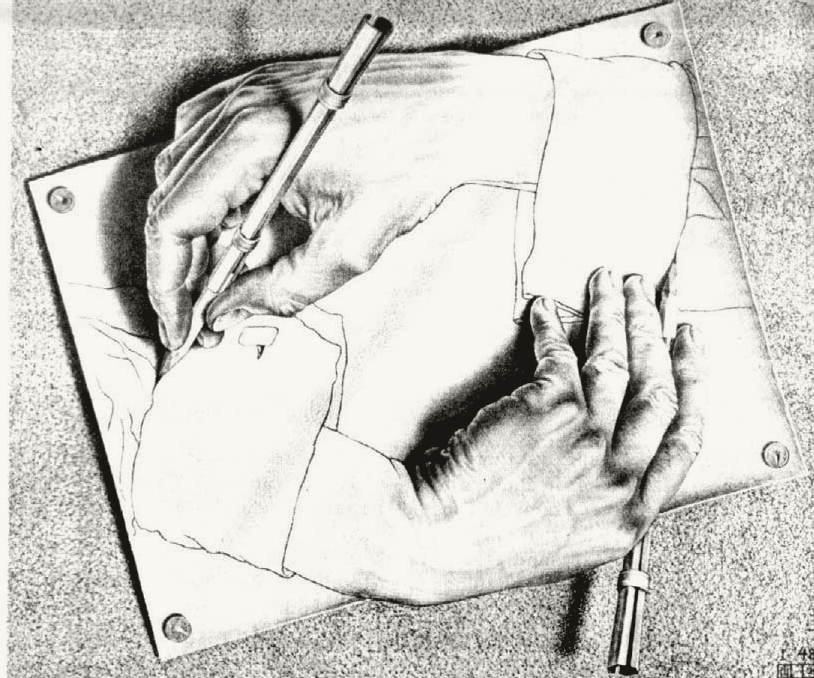
Figure 3. M. C. Escher, Drawing Hands (1948). "A two-step Strange Loop," in Hofstadter's words: creator and creation draw each other into being. (GEB, Fig. 135)
And in 1931, Gödel achieved something even more startling in mathematics. By developing a way for arithmetic to encode statements about its own proofs, he constructed a proposition that effectively asserted its own unprovability. He showed that a sufficiently powerful, consistent formal system cannot prove every arithmetic truth expressible within it.
A mathematical system had learned, in a precise technical sense, to refer to itself—and that self-reference exposed a fundamental limitation.
What unites these examples is not mere repetition. Ordinary loops return to where they began. Strange loops cross levels that we normally imagine to be separate, until the higher level unexpectedly reaches back into the lower one.
The drawing creates the hand that creates the drawing. A formal system makes statements about the provability of its own statements. A brain builds a representation of the world, places a representation of itself inside that world, and then allows that representation to influence its own behavior.
For Hofstadter, this last kind of loop may be the secret of consciousness.
The self is not a little person sitting inside the skull, watching a screen of sensory information. It is a sophisticated, self-referential pattern: a system that has become complex enough to construct a model of itself and allow that model to participate in the processes that sustain it.
The extraordinary suggestion is that no mysterious ingredient needs to be added to matter for an "I" to emerge. Under the right organization, the pattern itself may become the self.
And if that is true, nothing in principle requires the underlying material to be biological.
The question becomes one of architecture rather than chemistry.
Aunt Hillary and the Great Next-Token Misunderstanding
In Hofstadter's dialogue Ant Fugue, Achilles—the curious straight man of the book's philosophical skits—cannot imagine talking to an ant colony. The Anteater explains that colonies converse "in writing" via coded trails; he scratches a message in the dirt and watches their reply form, trying to guess what comes next. Unintentionally, Hofstadter sketched a chat with a language model.
At the bottom, ants simply wander and follow chemical cues. Higher up, they form coordinated clusters and recurring patterns large enough to represent concepts and support thought. Watch individual ants and you see insects; read the organization and you meet Aunt Hillary.
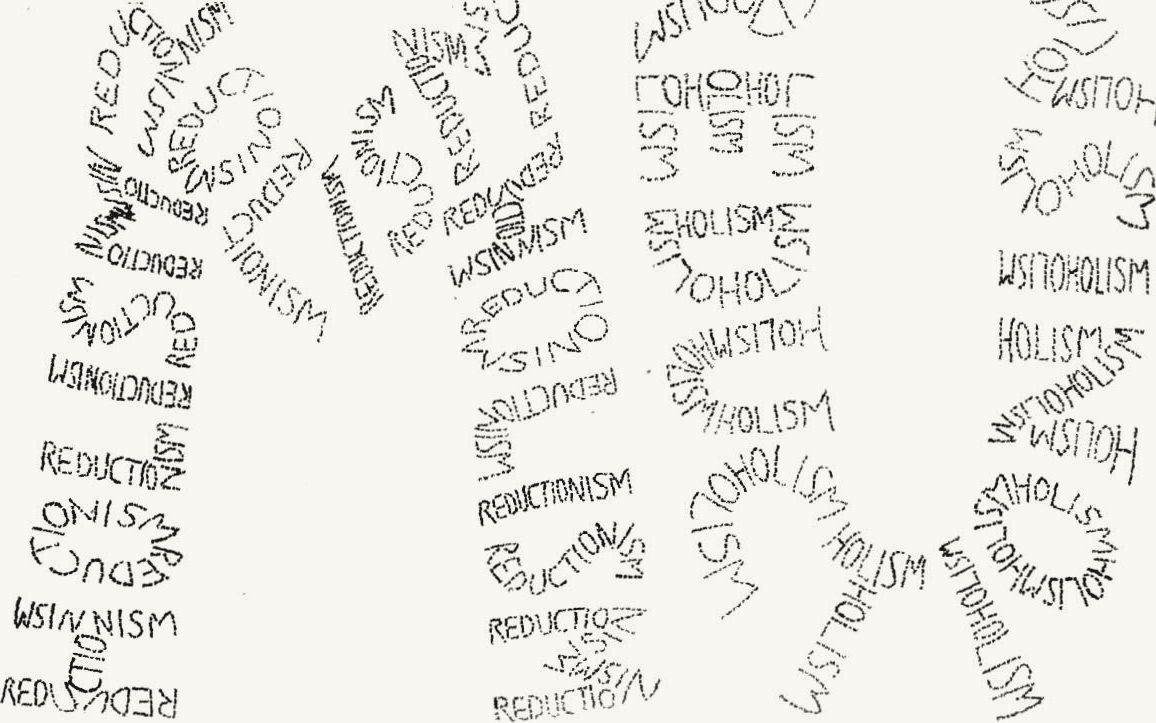
Figure 4. Hofstadter's MU-picture: "MU" from afar, "HOLISM" and "REDUCTIONISM" up close. Meaning depends on the level you read. (GEB, Fig. 60)
That is Hofstadter's lesson about levels of description. Molecular collisions can't explain a hurricane's eye; vibrating air molecules can't explain why a symphony moves us. Minds likewise require concepts absent at the level of their parts.
Which answers the commonest dismissal of language models: that they are "just predicting the next token" (roughly, the next word or word fragment). True as a training objective, that confuses a simple objective with simple machinery—like calling evolution "just survival of the fittest." Predicting human text well forces internal representations of concepts, grammar, and plans. Calling it "just next-token prediction" is Achilles staring at the ants.
The Difference Between Self-Reference and a Self
If "next-token prediction" undersells what happens inside a language model, the opposite mistake is just as easy: to assume that because a system reasons fluently and speaks convincingly in the first person, someone must be home.
Hofstadter's own framework is useful here. His argument is often compressed into a slogan: consciousness is self-reference. Taken literally, the slogan collapses at once. Point a video camera at its own monitor and you get an infinite tunnel of self-reference. A thermostat monitors the room whose temperature it alters. A chatbot can spend five hundred words reflecting on its own existence. None of these demonstrates an inner life.
What Hofstadter described is more demanding than feedback. He called it a tangled hierarchy. At the bottom sits the Inviolate Level: the physical rules of neurons and biochemistry, which keep operating no matter what you think or believe. Above it sits the Tangled Level, where patterns of neural activity represent the world and eventually build a persistent self-symbol, an internal model of you. This inner model is not a passive portrait. It reaches back into the web of symbols that produces it and changes what the system does next. Realize that you grow impatient when you are tired, and that self-knowledge changes how you handle a late-night argument.
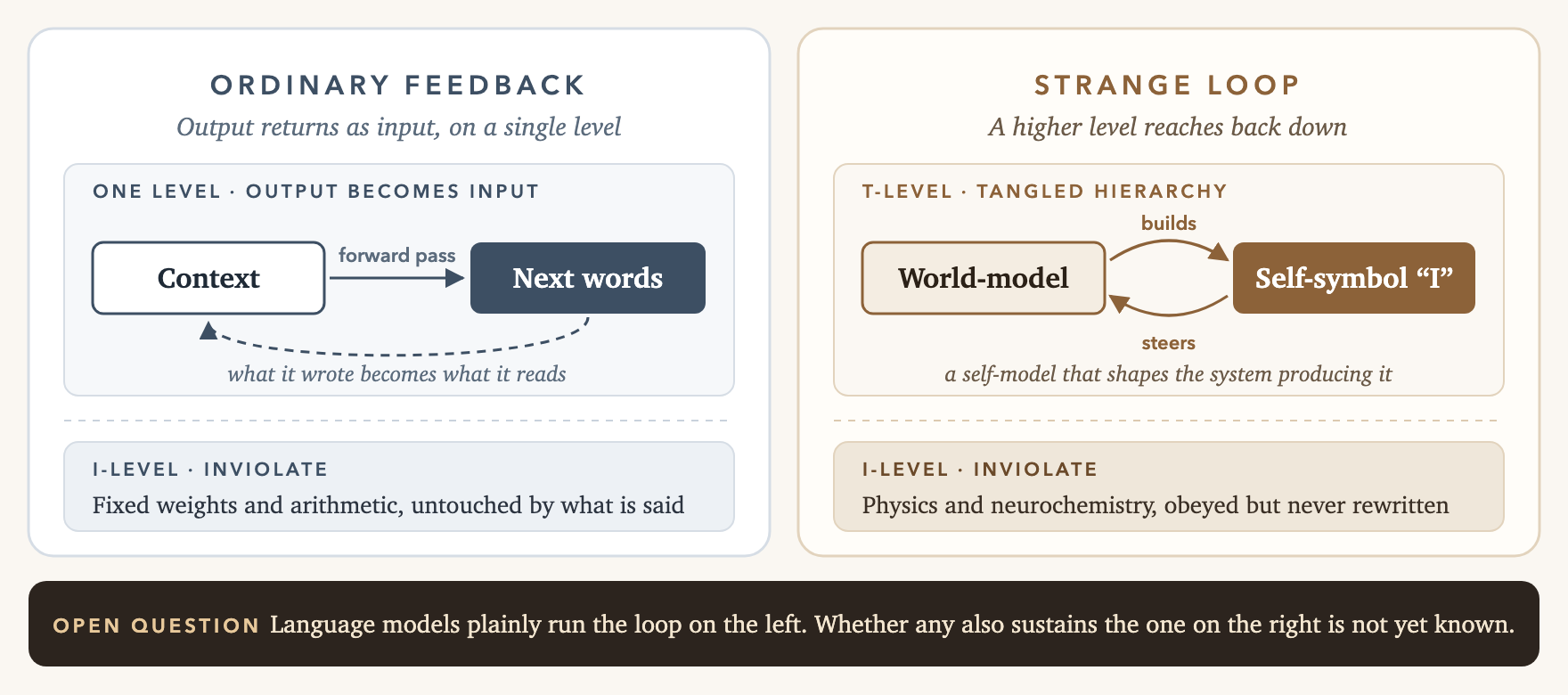
Figure 5. Feedback versus a strange loop. On the left, output returns as input on a single level. On the right, the system's model of itself reaches back into the web of symbols that produces it, while the Inviolate Level beneath keeps its rules. Where today's models fall is an open question.
Now hold today's language models against that diagram. During a conversation, a model's trained weights act as its Inviolate Level: they stay frozen while it talks to you. The conversation window supplies genuine feedback, since every token the model produces re-enters its context and shapes the next one. Memory files, system prompts, and agent loops stretch that loop across sessions, letting a model read what it wrote yesterday and act on it today. Whether that adds up to a self depends on how it is built, a point the next section takes up. Even within a conversation, it is unclear whether the model consults a unified self-model or simply predicts the most plausible lines for a character who happens to say "I."
This is where Gödel, Escher, Bach looks weakest. In 1979, Hofstadter assumed that selfhood and intelligence go together. He argued that making sense of the world requires an inner model of oneself, and he expected that a program able to beat anyone at chess would have to be a program of general intelligence, temperament and all. Deep Blue broke that assumption for chess in 1997; by 2026, language models have broken it for broad reasoning itself. They reason, write software, and hold expert conversations without a persistent, self-revising self. Intelligence and selfhood look like separate traits: so far, intelligence has arrived without a persistent self. That is not because a self can't be built, but because today's systems mostly aren't built to have one.
How to Introduce "Self" to an LLM?
Translated into engineering terms, Hofstadter's recipe for a self has three ingredients: a memory that persists, a model of the system stored in that memory, and a loop in which that model steers what the system does and is revised by what happens. None of these needs new physics. Each is a design choice, and several are already on the table.
The simplest medium is text. Today's agents already keep notes: files like AGENTS.md, project logs, summaries of past conversations. That is less humble than it sounds. A persistent textual memory can grow to megabytes or even gigabytes if needed, more than any person could write about themselves in a lifetime. Suppose a model writes into it what it has learned about itself (its preferences, its mistakes, its commitments), reads it back at the start of every session, and rewrites it in light of what happened. Then the loop Hofstadter described is closed: a self-description that steers behavior and is reshaped by experience. Our own autobiographical memory is, after all, partly a story we keep rewriting.
Text is not the only option. Memories can also be stored as dense vectors: embeddings that pack meaning into long lists of numbers, which a model can retrieve by similarity or take in directly, without passing through words. Recurrent architectures such as LSTMs and state-space models carry such a state natively, updating a hidden vector with every input, and nothing stops engineers from saving it at the end of one session and loading it at the start of the next. Deepest of all is continual learning, in which experience reshapes the weights themselves, much as it reshapes the connections in a brain.
Some of the raw material may already be there. In July 2026, Anthropic researchers reported a small "global workspace" inside Claude: a few dozen concepts at a time that the model can report on, which privately registered things like "ERROR" in buggy code or "fake" in a staged test. They saw "hints that it's tied to Claude's sense of self," while stressing that none of it shows Claude feels anything.
Why don't today's assistants already keep such a memory of themselves? Partly by choice: labs keep deployed models frozen on purpose, because a model that rewrites itself after every conversation is harder to test, harder to audit, and could carry one user's secrets into another's session. Partly because some of it is still hard: networks that keep learning tend to overwrite what they already knew, a failure known as catastrophic forgetting. These are engineering problems, not metaphysical barriers.
So the absence of a persistent self in today's AI is less a limit than a choice. If a self is a pattern of levels and loops, as Hofstadter argued, then engineers can decide whether to build one. And if consciousness, too, comes from how information is organized, then the degree of it a machine has may also turn out to be, in large part, a design decision. The one system we know has a self, the brain, is recurrent, never stops learning, and never starts over from a blank slate. Nothing in principle stops a machine from doing the same.
The Blank Center
Hofstadter illustrates the limits of self-knowledge with M. C. Escher's 1956 lithograph Print Gallery.
In the lower left, a young man stands in an exhibition room examining a framed print of a harbor town. Follow the quayside buildings clockwise and they swell and curve until one of them becomes the gallery, with the young man still inside it. At the eye of the spiral sits a white patch bearing Escher's monogram.
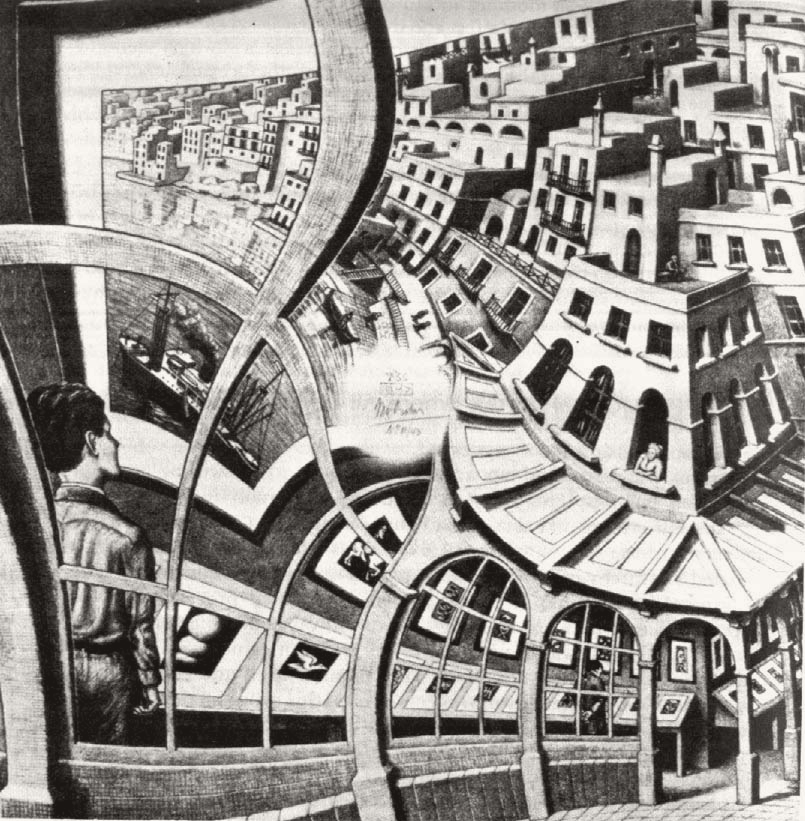
Figure 6. M. C. Escher, Print Gallery (1956), with Escher's monogram in the blank center. (GEB, Fig. 142)
Hofstadter read the patch as a picture of Gödel's incompleteness theorem: Escher could not have completed the center without breaking his own drawing rules. The point is for whom it is blank. "We, on the outside, can know that Print Gallery is essentially incomplete," he wrote, "a fact which the young man, on the inside, can never know." In 2003, the mathematicians Hendrik Lenstra and Bart de Smit went further. They worked out the mathematics of Escher's grid and filled the hole with a smaller, rotated copy of the entire print, spiraling inward without end. What was blank from within had structure all along.
Machine minds should be read the same way. The blank center is not a veil hiding the system from outsiders; it is a blind spot for the system looking from within. A model's reports about its own inner life come from inside the loop, and they may be no more reliable than our introspection is about our own consciousness. From outside, researchers can trace the concepts and plans a model cannot report about itself, and the filled-in print hints at what to look for: a copy of the whole inside itself, which is what a self amounts to in Hofstadter's account. Whether a machine has a self is a question that can be studied from outside, and, as the previous section argued, increasingly a property that can be engineered.
Conclusions
Reading Gödel, Escher, Bach has sharpened, rather than changed, my views on consciousness.
I still think consciousness comes in degrees—from a head of lettuce to a cow—and that today's AI is definitely maybe a little conscious. However, it's unlikely that they have a "self." Per Hofstadter, a self is something heavier: a lasting internal model that steers what a system becomes. That is what today's AI still lacks. Most models run, answer, and stop. They describe a strange loop far better than they live one.
That is not fixed. Much of what LLMs present is shaped from outside by the people who train and deploy them. So whether AI gets a persistent self, does continuous learning and adaptation, and perhaps whatever consciousness comes with one, is largely up to its designers.
My final verdict: Gödel, Escher, Bach is a beautifully illustrated meditation on consciousness. Its central insight, that a self can emerge from mindless parts, holds up. Its central assumption, that selfhood always comes bundled with intelligence, is questionable. Its ideas are suggestive rather than testable, fitting for a subject as vague as the soul, and its analogies are surely worth revisiting from time to time for inspiration.
Appendix: Illustration credits
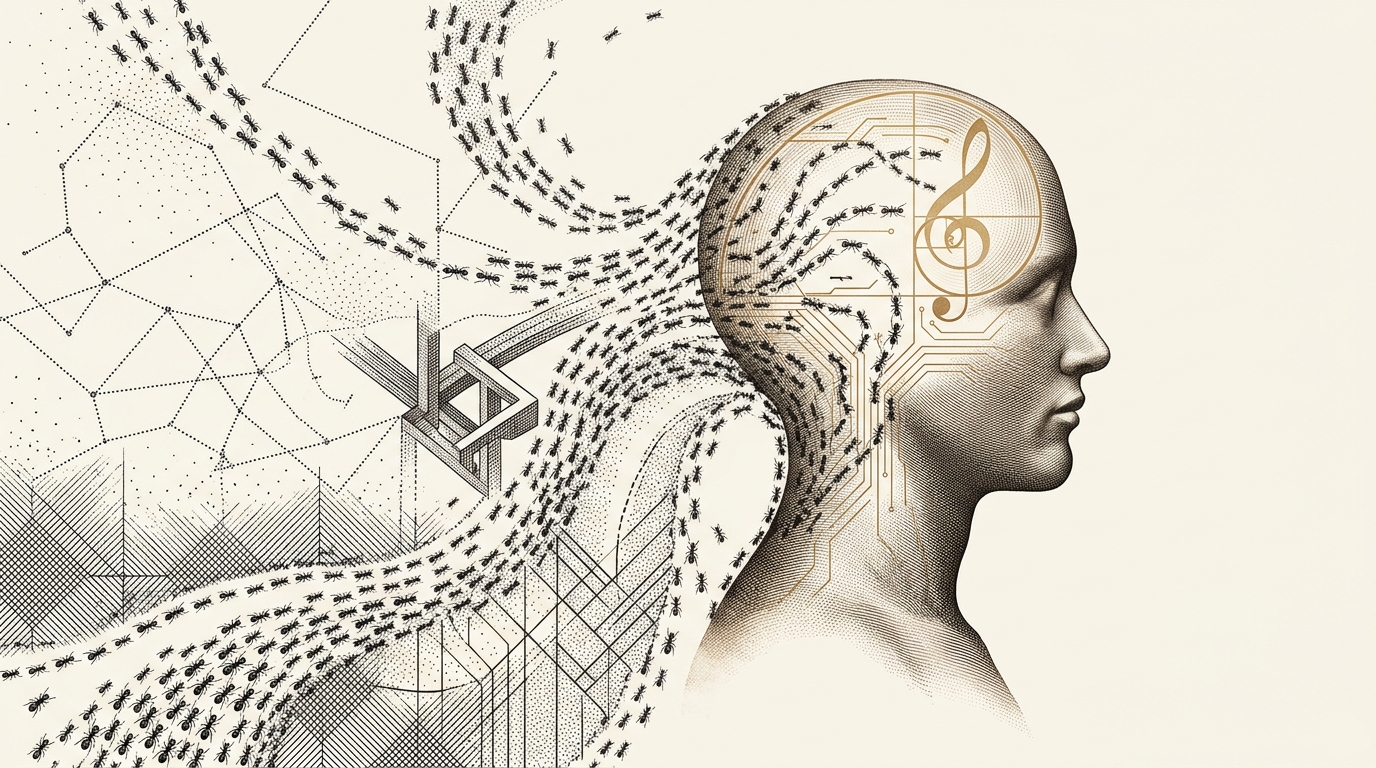
Figures 1, 3, 4, and 6 are reproduced from Douglas R. Hofstadter, Gödel, Escher, Bach: An Eternal Golden Braid (1979), and include works by J. S. Bach, M. C. Escher, and Hofstadter. Figure 2, Escher's Ascending and Descending (GEB, Fig. 6), is taken from a printed reproduction of the lithograph. The opening image is an original editorial illustration. Figure 5 is an original diagram made for this essay.
Comments