
Imagine arriving at work on a Monday morning in 2028 (or 2026?). You don't open your email. You don't launch Salesforce, Excel, Slack, or your project management dashboard. Instead, you ask a simple question: "Good morning. What needs my attention today?"
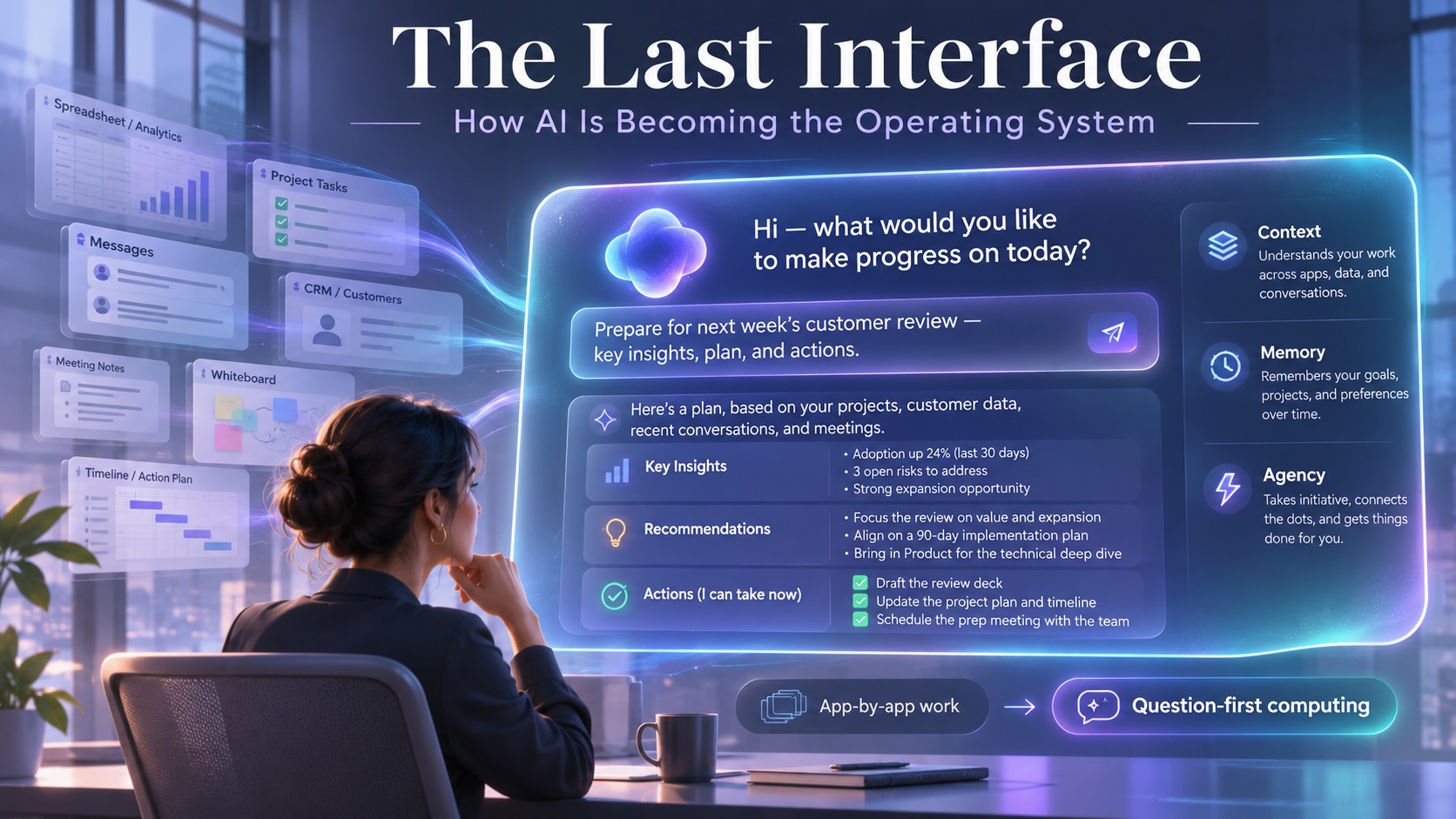
Your AI already has a briefing waiting. Three customer accounts are showing early signs of churn. Last week's sales figures have diverged from the forecast. An engineering decision made six months ago is creating a risk for next quarter's launch. The AI has already assembled the evidence, modeled possible responses, and prepared an action plan. You challenge an assumption, adjust the priorities, and approve. In seconds, it updates the records, drafts the communications, assigns follow-up tasks, and revises the timeline—without you opening a single application.
This is not merely a more sophisticated chatbot. It represents a fundamental inversion of the relationship between humans and computers. For decades, humans have adapted themselves to the rigid logic of software. Now, software is beginning to adapt itself to human intent. And the companies that control this new relationship may become some of the most powerful businesses in the digital economy.
The Human Was Always the Connector
From command lines to smartphones, one dynamic of personal computing has remained unchanged: the human was still the central coordinator of the computer.
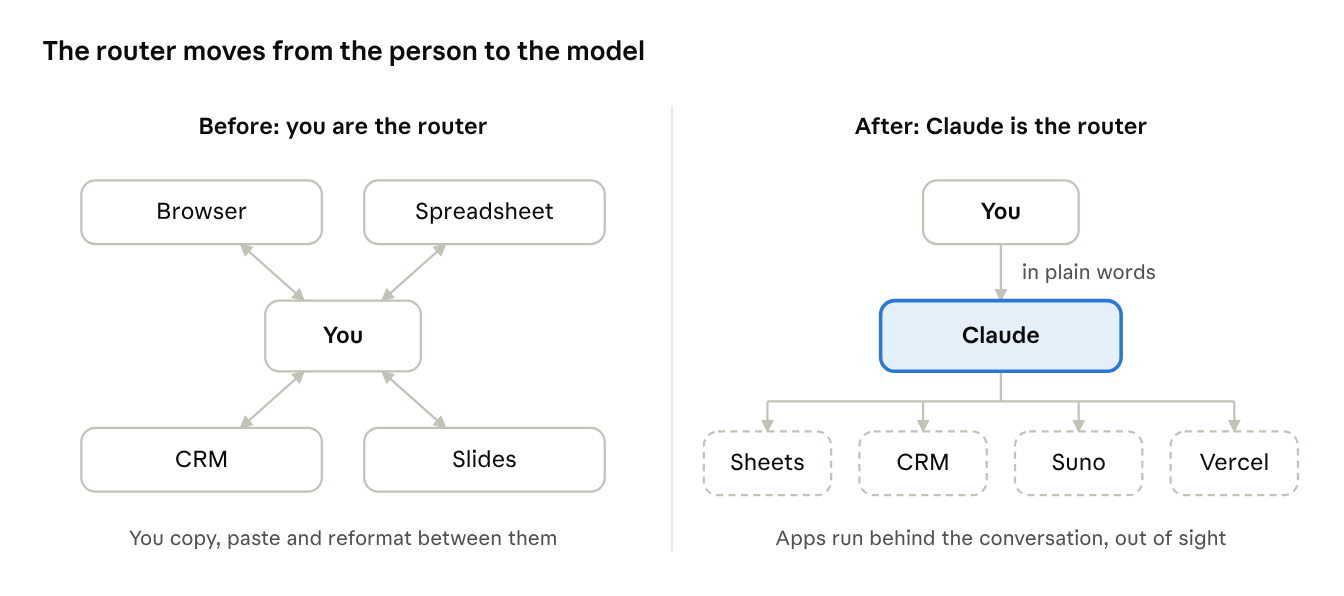
To understand a market trend, you open a browser. To estimate the financial implications, you switch to a spreadsheet. To discuss the findings, you jump into a messaging app; to organize execution, a project tracker; to communicate the strategy, a slide deck. You spend your day ferrying information between specialized systems—copying, pasting, reformatting, reconciling. In effect, the human has been the biological API connecting the modern enterprise.
Artificial intelligence challenges that arrangement at its root. A person can increasingly describe the outcome they want and let an intelligent system decide which tools to use, what information to retrieve, and how to assemble the results. The fundamental unit of computing is shifting from the application to the objective.
That is why the competition among Anthropic, OpenAI, Google, Microsoft, and other AI labs is much larger than a race to build the smartest chatbot. The real prize is the coordination layer through which people interact with the digital world. It won't replace Windows or macOS, but from the user's perspective it becomes the operating system: the place where work begins, context accumulates, and actions are executed. It is the operating system of human intent.
From Tool-First to Question-First Computing
One of the clearest illustrations arrived with Anthropic's November 10, 2026 introduction of Claude Sheets, Claude Whiteboards, and Claude Data. The vital development is not another spreadsheet or whiteboard; it is the changing relationship between the user and the work itself.
Traditional software is organized around the process of producing an outcome: a spreadsheet helps you manipulate cells, a presentation app helps you arrange slides. Each assumes that a human will translate a business question into a sequence of mechanical operations. AI reverses that flow. Imagine a CEO asking: "Why did our margins decline last quarter, and which three decisions would have the greatest impact on improving them?" Instead of setting off weeks of data collection, reconciliation, and slide-making, the AI retrieves the data, tests possible explanations, and builds an editable model. When the CEO asks what happens if customer acquisition spending falls 15 percent and enterprise pricing rises 8 percent, the numbers update instantly. The spreadsheet still exists, but it becomes the inspectable record of an analysis rather than the workshop where a human performs every calculation.
This is Question-First computing: not eliminating spreadsheets or professional expertise, but collapsing the mechanical distance between a meaningful question and a defensible answer. And with interactive connectors that open applications like Adobe, Atlassian, Notion, and HubSpot directly inside Claude, an AI platform doesn't need to replace every specialized application; it can absorb them into a common intelligence layer. The interface becomes contextual, fluid, and secondary to the outcome.
The spreadsheet is no longer where the work begins. The question is.
The Meeting That Remembers Why
Perhaps the most consequential shift is happening in meetings. On November 12, 2026, Anthropic introduced Claude Meetings in beta, allowing Claude to join video calls as a visible participant, answer questions, capture notes, and build documents in real time. It hints at something transformative: AI as a persistent memory of organizational reasoning.
Six months ago, an engineering team debated a new product's architecture and settled on Architecture B. The specification records what was decided, but the why—the rejected alternatives, the constraints, the objections that seemed minor at the time—evaporates into scattered notes and the memories of employees who eventually leave. Now imagine a new engineering leader proposing Architecture A, and the AI responding: "That approach was evaluated in March. The team rejected it because of three constraints. Two remain relevant, but the third appears to have changed. Would you like to revisit the decision?"
Institutional reasoning can become a durable asset, and when an AI tracks commitments and flags cross-team conflicts before they become crises, managers spend less time chasing status updates and more time making decisions. The enterprise can finally develop a memory of why it believes what it believes—not just a database of what it knows.
The Great SaaS Unbundling
For two decades, Software-as-a-Service companies followed a proven formula: own a valuable workflow, keep a direct relationship with the user through a proprietary interface, and build switching costs. The more hours employees spent inside a platform's UI, the more pricing power it enjoyed.
But what happens when users stop visiting the application? A marketing director asks an AI to build a six-week launch campaign, produce three versions of the promotional video, and track the budget. Behind the scenes, the AI coordinates an image generator, a video editing suite, a CMS, an ad network, and an analytics platform, and the director never lays eyes on them. Wes Roth showcased such pipelines in his November 15 analysis of Claude's expanding capabilities. Every vendor now faces an existential question: If customers use your product every day but never interact with your application, whose customers are they really?
The Model Context Protocol (MCP), the open standard Anthropic introduced in 2024, makes this possible by giving AI systems a common language for external tools and data. Its thousands of connectors turn isolated software islands into a single, composable workflow. Meanwhile, AI is collapsing the cost of bespoke software: why buy a subscription for a minor internal workflow when an AI can generate the exact tool, wire it to approved data, and dissolve it once the project is over?
Applications that merely wrap a pleasant interface around basic workflows will be hard to defend. But companies with proprietary data, trusted systems of record, regulatory compliance, and complex domain logic may become more valuable, as AI agents query them at a volume humans never could. Software is separating into three layers:
- The Experience Layer, which captures user intent and presents results.
- The Intelligence Layer, which reasons, plans, and orchestrates actions across systems.
- The Capability Layer, which provides the specialized engines, systems of record, data, and infrastructure required to execute the work.
Traditional SaaS vendors will either push upward to become orchestrators, specialize downward into indispensable capability engines, or get squeezed in the middle.
Context Is the New Competitive Moat
Picture two AI models with identical reasoning benchmarks. The first knows nothing about your company. The second, with proper authorization, understands your projects, customers, finances, and past debates. Asked to evaluate a product launch plan, the first produces a polished, textbook strategy. The second flags that the timeline collides with a key client renewal, that the margin projections rely on a pricing model abandoned two months ago, and that engineering already vetoed a core technical dependency. The difference isn't raw model intelligence; it is the continuity and depth of context.
Models will commoditize and features will be copied within weeks, but an organization's accumulated history is extraordinarily difficult to replicate. That is why AI labs are racing to embed themselves into documents, spreadsheets, meetings, browsers, and codebases. And while open standards like MCP make tools interoperable, they don't make an AI's accumulated memory portable. The more an AI understands your work, the more indispensable it becomes—and the harder it is to leave behind.
This is the next platform war. OpenAI's ChatGPT Work is pushing into multi-step project execution, Google is leveraging Workspace and Android, and Microsoft is fusing its operating system, enterprise software, and cloud into a ubiquitous copilot layer. Anthropic's October 2026 IPO filing underscores the staggering capital fueling the race. The goal is identical: become the default place where humans express what they want to accomplish. Whoever mediates human intention influences which services get called and where economic value accrues. Whether that produces an open web of interoperable agents or a consolidated gatekeeper economy is being decided right now.
Invisible Software Demands Visible Accountability
An AI that hallucinates a fact in a chat window is a minor annoyance. An AI that acts on a hallucination across your enterprise systems is a liability: it can send fabricated commitments to clients, corrupt financial ledgers, or take down production infrastructure. Memory carries the same peril. Faithfully recalling a strategy session is an asset; enshrining an offhand remark as company policy, or drifting into ambient workplace surveillance, is a hazard.
For the AI operating layer to succeed, it must be governable: verified identity, granular permissions, audit trails, cited evidence, human approval gates, rollback, and a clear line between verified facts, inferences, and speculation. The more invisible the software becomes, the more visible accountability must become. The winning platforms will know precisely when to execute, when to ask for permission, and when to stop.
From Knowledge Workers to Directors of Intelligence
For decades, white-collar competence meant mastery of complex tools: analysts were judged by their prowess in Excel, designers by their capability in creative suites. As AI absorbs routine execution, professionals will spend less time building models and formatting decks, and more time stress-testing assumptions, sharpening the narrative, and deciding which questions are worth asking. They will direct ensembles of specialized agents, as part editor, part systems architect, and part strategist.
This creates an apprenticeship paradox: if junior professionals no longer do the grunt work, how do they develop the intuition to catch an AI's mistakes? Organizations will have to redesign how they cultivate expertise. But the grand opportunity is to elevate human attention toward taste, curiosity, ethical reasoning, empathy, and leadership. Human value is shifting from operating the machinery to directing the intelligence.
The Last Interface
Every major milestone in computing—the command line, the graphical user interface, the web, the smartphone—has reduced the friction between human intention and computational power. Agentic AI closes the remaining translation gap. What makes that Monday morning in 2028 remarkable isn't that the computer is faster; it's that the human no longer has to think about the computer at all. The starting question of work shifts from "Which application do I need to open?" to "What am I trying to achieve?"
We will look back on today's maze of browser tabs, dashboards, CSV exports, and manual copy-pasting the way we now look at punch cards: a vital stepping stone, but a decidedly primitive way to get work done.
The last interface isn't the disappearance of software. It's the disappearance of the need to think about software before we can get something done.
Comments