
On February 20, 2025, at the Conservative Political Action Conference in Maryland, Argentina’s president handed the richest man in the world a roaring steel chainsaw. Hoisting the blade overhead as the driving force behind the new Department of Government Efficiency, Elon Musk declared it "the chainsaw for bureaucracy" while the crowd cheered for the demolition of the administrative state. Fourteen months later, on April 14, 2026, New York City’s newly elected democratic-socialist mayor, Zohran Mamdani, stood inside East Harlem’s historic La Marqueta to announce the first of five city-owned grocery stores backed by $70 million in public capital, declaring, "A public option allows us to intervene where the market has failed." His supporters cheered just as loudly.
One crowd demanded less government. The other demanded more. Beneath the slogans, each was acting out an old caricature: ask a hardline socialist what government is for, and they will describe an all-providing parent; ask a radical anarcho-capitalist, and they will describe a cartel of thieves with a flag.
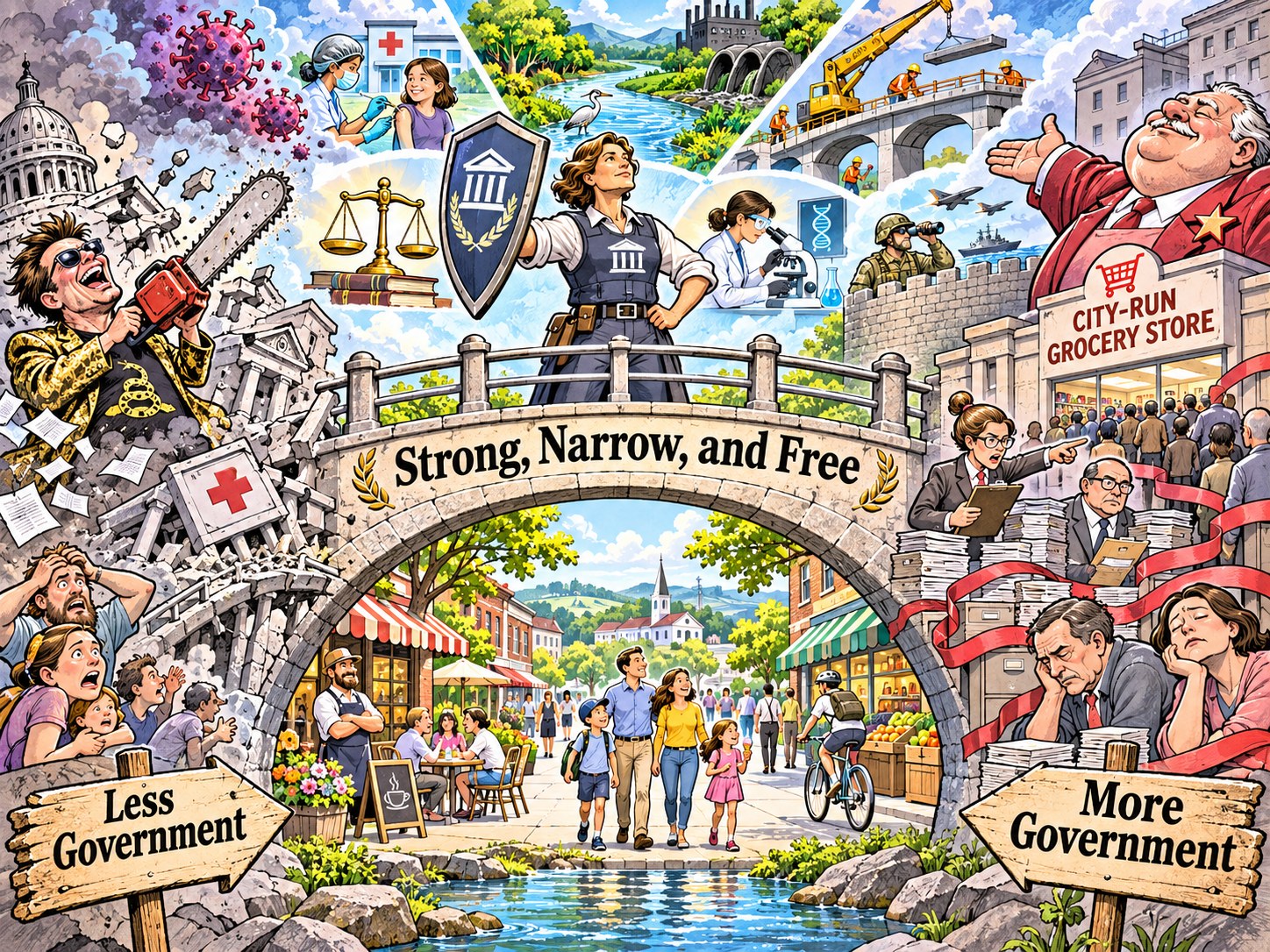
Both caricatures are wrong, even though both crowds were responding to real institutional failures—a federal leviathan that spends trillions while failing at basic execution, and a cost-of-living squeeze that drove New York-area grocery prices up 34 percent in a decade and, by the state comptroller’s count, pushed household grocery spending up 66 percent. Yet neither the chainsaw nor the municipal supermarket answers the single question upon which modern civilization depends: not how much government we should have, but what government should actually do—and whether it possesses the competence to do it.
Because neither political extreme has an honest answer, American politics has degenerated into a violent pendulum of panic. In November 2024, furious over prices after a 9.1 percent inflation peak in June 2022 and disorder at the southern border, 49.8 percent of voters returned Donald Trump to the White House—looking past 34 felony convictions, a civil liability verdict for sexual abuse, and an attempt to overturn a presidential election. Barely a year later, battered by chaotic tariff decrees, rebounding inflation, and administrative whiplash, voters in Virginia and New Jersey elected moderate Democratic governors by double digits, New York City handed the keys of the nation’s financial capital to a democratic socialist, and on November 3, 2026, voters took both the House and the Senate away from the party they had empowered two years earlier.
Voters are not fools for swinging; the pain is real, and the ballot is the only button they have. But a pendulum is not a governing philosophy. When citizens are unhappy with the economy, they mistake the opposite ditch for the road—installing leaders whose first job is to erase the last four years by executive decree, while the debt, the shortages, and the broken agencies remain untouched.
There is a way off the pendulum. It begins with a candid observation about institutional competence: government is uniquely capable of doing a small handful of extraordinarily important things, mediocre at doing many others, and reliably catastrophic at doing most.
If you are economically center-right and socially liberal—if you believe in personal liberty, radical social tolerance, empirical science, and the unmatched power of competitive markets to lift humanity out of poverty—you do not want a state that tries to run your life or micromanage the economy. Yet you also recognize that a modern society cannot function like the Wild West. What we need is a government that is strong, but narrow: a state that fiercely guards the perimeter of civilization and sets fair, neutral rules for the game, but stays off the field and lets free people play it.
Every argument that follows rests on a single moral premise:
A free society is not one in which the right people control everyone else. It is one in which nobody is permitted to control everyone else.
Part I: Fourteen Principles for Getting Government Right
To stop swinging blindly between the central planner and the strongman, a free republic must organize the state around a Competence Ladder. At the top rung are the indispensable sovereign duties that only a state can perform. In the middle are vital human investments that the state should help finance without operating directly. At the bottom are the commercial and moral arenas where state intervention reliably produces corruption, scarcity, and tyranny.
Here are fourteen principles for what government is actually good for—and where it must get out of the way.
1. Respect Capitalism as Human Freedom, Not a Grudging Concession
Every philosophy of government requires a default—a baseline presumption that the other side carries the burden of overcoming. In a free society, the default is liberty. Absent a compelling, demonstrable justification, consenting adults decide for themselves what to build, where to work, what to buy, how to invest, and what risks to take.
We usually defend capitalism on utilitarian grounds, and the empirical case is overwhelming: two centuries ago, more than four in five human beings lived in extreme poverty; today, fewer than one in ten do. No five-year plan accomplished that miracle. Decentralized trade, property rights, and the compounding accumulation of scientific and commercial knowledge did.
Yet the deeper case for free enterprise is moral: capitalism is economic freedom. Economic liberty is not a separate species from personal liberty; it is personal liberty applied to our daily work and creativity. A market is simply the voluntary cooperation of millions of individuals exchanging value without coercion. Prices transmit real-time, dispersed local information that no committee of experts could ever gather. Profit rewards ideas that serve others; loss liquidates waste that politics would subsidize for decades.
Markets fail, sometimes badly. But the relevant comparison is never between an imperfect market and an imaginary government staffed by omniscient, incorruptible saints. It is between actual markets and actual governments run by fallible politicians responding to electoral and lobbying incentives. Being pro-capitalism does not mean being pro-cronyism: the goal of policy is never to shield incumbent corporations from failure, but to protect the open freedom to compete.
2. Guard Society Against Catastrophic "Tail Risks" and Invisible Harms
Free markets are miraculous engines for optimizing the expected case, but they are structurally blind to the tails—low-probability, high-devastation catastrophes. No private firm earns a quarterly return by maintaining massive idle reserve capacity for a once-in-a-century disaster, and when catastrophe strikes, the losses cascade across the entire society.
Managing systemic tail risks is the foremost justification for having a state:
- Pandemics and Biosecurity: Viruses do not care about market incentives. Early pathogen surveillance, rapid genomic sequencing, biosecurity guardrails, and fast countermeasure capacity—like Operation Warp Speed’s public-private push that delivered randomized-trial-validated vaccines in under a year—are non-negotiable sovereign functions.
- Systemic Financial Stability: Bank runs are contagious panics that can vaporize a nation’s productive capacity overnight. Markets require a credible lender of last resort and sturdy capital requirements—a lesson forgotten when a 2018 regulatory rollback raised the threshold for strict bank supervision from $50 billion to $250 billion, setting the stage for the $209 billion collapse of Silicon Valley Bank in 2023. Crucially, the state’s job is to save the financial system, never reckless executives, shareholders, or bondholders, who must be wiped out when their bets fail.
- Frontier Technological Risks: Emerging capabilities with catastrophic potential—including autonomous biological design and frontier artificial intelligence—warrant targeted monitoring for existential safety, not blanket bureaucratic vetoes over every software startup or sweeping federal preemption of narrow frontier-safety laws.
- The Food, Water, and Chemical Supply (The Precaution Rule): A shopper in a grocery aisle cannot test a tomato for neurotoxins, check baby formula for heavy metals, or screen tap water for PFAS "forever chemicals." Human beings are not guinea pigs. When a risk is invisible and involuntarily imposed, the burden of proof flips: whoever introduces a synthetic chemical into our food, water, air, or personal-care products must demonstrate safety through rigorous testing before the public is exposed—the standard that the bipartisan 2016 Lautenberg Chemical Safety Act, the 2022 cosmetics reform, and efforts to close the FDA’s self-certified food-additive loophole rightly advance. Once a product passes rigorous testing with clear deadlines, the evidence decides.
Judge a government not by the thousands of pages of petty rules it writes, but by the catastrophes it prevents.
3. Solve the Tragedy of the Commons and Price Externalities
Freedom is not the absence of law. Your freedom to swing your fist ends precisely where my nose begins. In a complex industrial society, "fists" take the form of negative externalities—uncompensated costs that one actor dumps onto everyone else without their consent.
A factory pouring toxic sludge into a river is not exercising economic liberty; it is confiscating clean water from everyone downstream. When anyone can overfish an ocean, pump unbounded greenhouse gases into the atmosphere, or send an unimmunized child into a classroom during a lethal outbreak, individually rational selfishness produces collective ruin.
Enforceable rules against poisoning the commons expand net human freedom. Two disciplines keep this power honest. First, prefer prices to bureaucratic prohibitions: a transparent carbon price or tradable emissions permit—like the 1990 acid-rain program that slashed sulfur dioxide emissions at a fraction of projected costs—harnesses market ingenuity far better than bureaucrats dictating every factory’s machinery. Second, insist on strict proportionality: public-health interventions, including school vaccination requirements where transmission directly endangers others, must rest on hard causal evidence and never stretch beyond the actual threat. Protecting citizens from one another is the state’s job; protecting competent adults from themselves mostly is not.
4. Be the Neutral Referee: Rule of Law, Property Rights, and Fair Competition
Before government attempts anything ambitious, it must master its foundational daily job: maintaining an incorruptible legal system and safe streets. No entrepreneur can build a business if criminals can loot it with impunity, if politicians can arbitrarily seize assets, or if suppliers can break contracts without consequence.
A functioning legal order—independent courts, secure physical and intellectual property, enforced contracts, due process, and constitutional policing—is not an alternative to free markets; it is what makes markets possible. And a good referee protects the integrity of the game itself. Antitrust enforcement should target genuine anticompetitive conduct that locks out upstarts without punishing companies merely for succeeding at scale. A referee enforces the rules; a referee never decides the score.
5. Fund What Markets Won’t: Foundational Science and True Public Goods
Private venture capital is brilliant at commercializing discoveries and scaling products for consumers. What private investors rarely fund is basic, curiosity-driven scientific research whose commercial payoff may lie thirty years in the future and whose insights cannot be monopolized by any single firm.
This is where government shines. The internet grew out of DARPA’s defense network. GPS was built for the military and opened to civilian commerce. The Human Genome Project mapped our biological code and seeded modern biotechnology. Decades of federally funded basic research laid the scientific foundation for the mRNA vaccines that private pharmaceutical firms later manufactured at historic speed.
The lesson is the division of labor: government funds the foundational knowledge, basic infrastructure, and non-excludable public goods (like national defense and weather forecasting), and then immediately hands the keys to competitive private enterprise to commercialize, scale, and innovate.
6. Don’t Run Businesses: Government Is a Monopoly ("Pay, Don’t Run")
Whenever someone proposes that the state should take over an industry—whether grocery stores, airlines, or healthcare delivery—ask a simple question: Have you tried renewing a passport in a hurry lately? Have you spent a Tuesday afternoon at the DMV?
When a private business treats you badly, you walk across the street to its competitor, and the bad business shrinks or goes bankrupt. When a government agency treats you badly, you have nowhere else to go—and the following year, politicians increase its budget because its failure is cited as proof that it is "underfunded."
This is not because public employees are bad people; it is because monopoly incentives are terrible. An organization sheltered from bankruptcy and competition faces zero existential pressure to innovate, control costs, or respect your time. While a few state monopolies are unavoidable (we cannot have competing private armies or rival court systems), the middle rung of the Competence Ladder follows an iron rule: pay, don’t run.
Government can finance access to a vital good without operating the supply chain. We do not feed low-income families through state-owned collective farms and municipal grocery stores; we provide SNAP electronic benefits that families spend at competing private supermarkets, which must keep their shelves stocked and prices low to earn that business. The same principle of public funding paired with competitive delivery—and strict empirical accountability for results—should govern education choices, housing assistance, and universal catastrophic health insurance. When rigorous studies of urban charter schools show substantial learning gains for low-income children while a lottery study of Louisiana’s voucher program finds math losses, the lesson is clear: fund the family, measure the outcomes, expand what works, and close what fails.
7. Keep the State Narrow Because Power Always Corrupts
We must retire the childish fantasy that if we just elect "virtuous people," concentrated political power will become benevolent. Government is a massive reservoir of coercive force and other people’s money—and concentrated power attracts the ambitious, the venal, and the rent-seeking the way a porch light attracts moths.
Modern corruption rarely looks like a cartoon villain handing over a briefcase of cash. Most of it is entirely legal: regulatory agencies captured by the incumbent giants they were meant to police, tax codes riddled with donor carve-outs, and subsidy troughs engineered for lobbyists. Limited government is the ultimate anti-corruption strategy. The fewer discretionary favors politicians are allowed to auction off, the fewer favors corporations and oligarchs will waste billions buying.
Above all, we must subject every grant of state authority to The Switch Test: Before you applaud a power in the hands of a leader you admire, imagine that identical power wielded by your worst political enemy. Every weapon you forge for your champion will eventually be inherited by your rival.
8. Radical Social Tolerance and Personal Autonomy
Just as the government does not belong in the boardroom, it does not belong in the bedroom, the pulpit, the library, or the doctor’s exam room. On cultural and personal questions, the baseline rule of a free society is straightforward: harm, not moral disapproval, is the only legitimate license for state force.
Government has no business dictating religious belief, adult relationships, personal identity, or private morality. It must fiercely defend freedom of speech, freedom of conscience, and bodily autonomy against both flanks. Conservatives must not use the state to impose religious doctrine or police private medical emergencies. Progressives must not use institutional or state power to police speech, enforce ideological loyalty oaths, or punish dissent. The proper ambition of government is not to force everyone to live according to an official script; it is to allow people who profoundly disagree to live peacefully side by side.
9. Choose Dynamism Over Stasis
The most underrated failure of modern government is not what it spends; it is what it blocks.
Across the political spectrum, entrenched interests beg the state to freeze the world in amber. Incumbent manufacturers demand tariffs to shield them from foreign competition. Occupational licensing boards require government permission to arrange flowers or braid hair.
The costs of this vetocracy are invisible because they are measured in things that never exist: the starter home never built, the clean power plant never connected, the medical breakthrough strangled in red tape. A healthy government protects society against catastrophic tail risks, prices real externalities, and then steps aside so creative destruction and human ingenuity can build the future. The future should not need permission from the past.
10. Fair Starts, Never Equal Outcomes
Human beings are not identical. We differ in our talents, ambitions, appetites for risk, work ethics, and life priorities. In any free society, individual outcomes will vary substantially.
Attempting to force equal outcomes—whether through old-school Marxist wealth confiscation or modern demographic quotas—requires massive coercion, destroys meritocracy, and breeds tribal resentment by treating individuals as interchangeable avatars of racial or gender categories.
What a decent society owes every citizen is a fair starting line. No child should have their destiny sealed by the zip code of their birth. Investing in rigorous early education grounded in phonics, empowering low-income parents with school choice, ensuring child nutrition and safe neighborhoods, and tearing down exclusionary zoning and licensing barriers gives every child shoes at the starting line. Remove actual discrimination against individuals, equip every kid to compete, and then let character and merit decide the race.
11. Design the Safety Net as a Trampoline, Never a Hammock
A prosperous society can and should build a sturdy floor of dignity beneath which no citizen is allowed to fall. Done right, a safety net strengthens capitalism: people are far more willing to start a business, switch careers, or weather technological disruption when a single setback does not mean destitution for their children.
Yet redistribution is never costless. High marginal taxes blunt the incentive to work and invest, and badly designed welfare programs create cruel benefit cliffs—where a low-income worker who earns an extra dollar loses nearly a dollar in food, housing, or healthcare aid, facing an effective marginal tax rate approaching 100 percent that no billionaire ever pays.
A smart safety net is transparent, simple, and work-aligned—favoring direct cash transfers, gradual phase-outs, and wage supplements like the Earned Income Tax Credit or Milton Friedman’s negative income tax over sprawling paternalistic bureaucracies. As artificial intelligence and automation drive economic output toward unprecedented abundance while potentially compressing labor’s share of income, a broader floor may become both affordable and necessary. But abundance never repeals arithmetic: create prosperity first, share a portion of its gains wisely, and never sabotage the engine that makes both possible.
12. Treat Social Security and Medicare as Earned Insurance—and Fund Them Honestly
Debates over government spending routinely fail to distinguish between discretionary welfare and mandatory social insurance. Social Security and Medicare’s hospital insurance are not arbitrary political handouts; workers pay dedicated payroll taxes into these programs across their entire working lives—supplying roughly 91 percent of Social Security’s retirement trust-fund income—and plan their retirement around those statutory commitments.
Yet "earned" is not the same as "actuarially solvent." Today’s workers pay for today’s retirees, Medicare’s physician and drug coverage draws roughly three-quarters of its funding from general tax revenues, and demographic math is unforgiving. According to the 2026 Social Security and Medicare Trustees Reports, Social Security’s retirement trust fund will be depleted in late 2032, triggering an automatic statutory cut that reduces payments to 78 percent of scheduled benefits—a sudden 22 percent slash for every retiree. Medicare’s hospital insurance fund follows in 2033, able to pay only 89 percent.
Pretending that promised benefits can be paid indefinitely without reform is not compassion; it is fiscal fraud. Keeping a solemn promise requires fixing the math gradually today—through a balanced mix of revenue adjustments, slower benefit growth for affluent retirees, and gradual longevity indexing, just as a bipartisan commission did in 1983—before the cliff arrives.
13. Practice Fiscal Discipline and Sound Money
Political incentives are structurally myopic: the applause for spending borrowed money happens today, while the bill is sent to children who cannot yet vote.
Borrowing to fight an existential war or survive a once-in-a-century pandemic is justifiable. Running massive deficits during peacetime employment to finance ordinary political promises is generational theft. It crowds out productive investment, consumes the budget in compounding interest, and tempts politicians to pressure the central bank into printing money. And inflation is the cruelest, most regressive tax of all: it silently confiscates the purchasing power of savers, pensioners, and working families without a single member of Congress ever having to cast a vote.
A responsible republic balances its budget over the business cycle, fiercely guards the independence of its central bank, and subjects every spending bill or tax cut to The Out-Loud Test: Would we still vote for this if we had to state, out loud and in the same bill, the exact taxes or spending cuts that will pay for it?
14. Fight Only for Enlightenment and Constitutional Principles—Not for "The Man at the Top"
Sometimes a free nation must fight wars—on physical battlefields and in the global contest of ideas. When it does, our loyalty must never belong to a bloodline, a party, or "the man at the top." A free civilization is not a piece of geography or a clan; it is an operating system built on Enlightenment and constitutional principles: the radical proposition that individuals possess inalienable rights, that political power is on revocable loan from citizens, that laws bind rulers and ruled alike, and that claims about reality must answer to evidence rather than force.
Western democracies have often fallen short of their stated ideals, from the crime of slavery to foreign policy blunders. But as Frederick Douglass argued in his 1852 Fourth of July address, the proper response to hypocrisy is to hold a free society accountable to its constitutional creed—never to burn the creed down. Whether it is a foreign dictator invading a neighbor or a domestic demagogue trying to subvert an election, both fail the same test of civilization. A free people never march to glorify a strongman; we fight only so that no human being is forced to surrender their freedom, their reason, or their conscience to a ruler.
Part II: The Nine Crises Driving America Toward the Precipice
Measure contemporary American politics against those fourteen principles, and the diagnosis is grim. Across the past decade, behaviors, policies, and institutional pathologies that would once have ended political careers have been normalized. Ranked from the most urgent daily damage to the deepest cultural rot, nine interlocking crises now threaten to turn the world’s oldest constitutional republic into a stagnant banana republic.
1. Economic Self-Harm: How Both Flanks Manufacture Scarcity and Inflation
The most immediate pain in American life is economic, and headline GDP numbers do not capture it. On paper, the economy is still expanding: real GDP grew at a 3.4 percent annual rate in the third quarter of 2026, and October’s jobs report showed 165,000 new jobs with unemployment at 4.1 percent. But families do not shop in GDP. Over the past year, payroll growth has averaged a sluggish 48,000 jobs a month; inflation climbed back to 3.7 percent in September (2.6 percent core) as an unauthorized war in the Middle East sent gasoline prices surging 34 percent; the Federal Reserve was forced to raise interest rates instead of cutting them; and the average 30-year mortgage stands above 7 percent. In the AP’s survey of November 2026 midterm voters, roughly six in ten said they were deeply concerned about the cost of groceries. Yet instead of unleashing supply, both political flanks have embraced economic illiteracy that actively makes life more expensive.
On the populist right, the signature economic policy has been the resurrection of 1930s-style protectionism and state capitalism. By the time the Supreme Court struck down the administration’s emergency tariffs in February 2026, the effective U.S. tariff rate had reached roughly 16 percent, the highest since the 1930s. Unfazed, the White House rebuilt the duties under other statutes: Yale’s Budget Lab put the average rate at 11.1 percent in July, rising to 11.8 percent by year’s end, costing the average household about $1,100 a year. Foreign governments do not pay tariffs: the New York Fed found that nearly 90 percent of the burden of the 2025 tariffs fell on American firms and consumers—a finding that prompted the White House’s National Economic Council director to suggest the Fed economists who wrote the study "should presumably be disciplined." Earlier studies of the 2018–19 duties showed the same pass-through, with washing-machine tariffs costing consumers $815,000 a year for every domestic job created.
Worse, the nationalist right has embraced state capitalism wrapped in a flag. Since January 2025, Washington has announced 15 deals taking federal equity stakes in private corporations worth $20.9 billion—including a 10 percent stake in Intel and a presidential "golden share" in U.S. Steel. A government that owns corporate equity regulates its own portfolio and teaches CEOs that profit comes from flattering the White House rather than serving customers. Compounding the supply shock, the administration has choked off talent and labor. A $100,000 fee on new H-1B petitions targets the engineers and researchers America competes for, while a collapse in legal and border arrivals pushed net migration below zero in 2025 by Brookings’ estimate for the first time in at least half a century (and down to roughly 400,000 even by the Congressional Budget Office’s higher count). That contraction explains why unemployment remains low despite anemic hiring: Brookings estimates that as few as 20,000 to 50,000 new jobs a month now keep unemployment steady because the workforce itself has stopped growing. In a nation where immigrants founded or co-founded 59 percent of billion-dollar startups—and where the 2026 Social Security Trustees explicitly cited lower immigration for worsening the retirement system’s deficit—closing the door is economic self-sabotage.
Yet when voters look to the far left for relief, they are offered remedies that wear a different costume and make the exact same mistake:
- Price Controls: Renters’ anger over housing costs is justified. But in June 2026, New York City’s rent board fulfilled Mayor Mamdani’s campaign pledge and froze rents on roughly one million stabilized apartments even as the board’s own index showed building operating costs up 5.3 percent. A freeze helps today’s tenant at the expense of tomorrow’s, because price ceilings do not abolish scarcity; they shrink supply. When San Francisco expanded rent control in 1994, affected landlords reduced the rental housing they offered by 15 percent, pushing citywide rents up an estimated 5.1 percent. When St. Paul, Minnesota, capped rents on new construction in 2021, multifamily building permits plunged 80 percent until the city scrambled to exempt new buildings.
- State-Owned Retail: Pouring $70 million into five tax-exempt municipal grocery stores in a city of eight million people cannot lower food prices in an industry operating on 2 percent profit margins; it merely shifts overhead onto taxpayers while undercutting the neighborhood bodegas and independent grocers serving the same blocks. When the goal is helping low-income families afford food, expanding direct purchasing power that can be spent at any store beats running a municipal monopoly every time.
Meanwhile, suburban conservatives and urban progressives share the destructive habit of blocking physical supply—vetoing new apartments, power lines, and transit projects, then lamenting that nobody can afford to live anywhere. Austin proved the alternative: it loosened zoning, added 120,000 homes in a decade—growing its housing stock 30 percent against 9 percent nationally—and watched asking rents fall about 22 percent from their 2023 peak, including an 11 percent drop in older buildings serving low-income tenants. The centrist answer to scarcity is supply, competition, and statutory rules: legalize building by right across states and cities (building on the modest bipartisan step Congress took in July 2026 with the 21st Century ROAD to Housing Act), return tariff authority to Congress, divest federal corporate shares (or simply put them in an arm’s-length fund that presidents have no control over), and welcome high-skill talent.
2. The Pendulum of Panic: Voter Flip-Flopping and Rule by Decree
Because bad economic policies keep failing working families, voters keep punishing whichever party holds power. Every federal election since 2014 has flipped the White House, the Senate, or the House of Representatives—just as, across the developed world in 2024, every governing party lost vote share for the first time on record. In the November 2026 midterms, roughly four in ten Americans named the economy as the nation’s top issue, and about two-thirds said President Trump’s policies had made it worse. Nobody should mistake the resulting Democratic sweep of Congress for an ideological conversion: fewer than half of voters hold a favorable view of the party they just put in charge. Citizens are asking for a government that works, and they keep being handed a change of management.
The cycle turns destructive because each party treats a narrow protest vote as a mandate for total revolution—and bypasses Congress to impose it. In 2021, Democrats took a 50–50 Senate, pursued trillions in partisan spending, and attempted a $430 billion student-loan cancellation by executive decree by stretching a post-9/11 military relief law. In 2024, Donald Trump won 49.8 percent of the popular vote—a 1.5-point plurality—proclaimed an "unprecedented and powerful mandate," and governed through sweeping emergency decrees on tariffs, immigration, and agency purges.
When presidents rule by pen and phone, American law has the lifespan of a carton of milk. The United States joined the Paris climate accord in 2016, left in 2020, rejoined in 2021, and left again in January 2026. Businesses cannot plan decade-long factory or grid investments when tax, trade, and regulatory rules invert every forty-eight months. The cure is to restore Article I of the Constitution through an ironclad statutory rule: every presidential emergency declaration and executive tariff must automatically expire after sixty days unless Congress affirmatively votes to extend it. And Democrats taking the gavels in January 2027 should heed the same lesson: pass durable laws with enough bipartisan support to survive the next swing of the pendulum.
3. Banana-Republic Fiscal Recklessness: The "One Big Beautiful Bill" and the Debt Spiral
A superpower that cannot pay its bills without borrowing trillions in peacetime is on the road to third-world fiscal instability.
In fiscal year 2026, outside any recession or world war, the federal government ran a roughly $2.0 trillion deficit. According to the Congressional Budget Office, federal debt held by the public reached about 100 percent of GDP in 2026 and is on track to hit 120 percent by 2036—surpassing the all-time 1946 peak recorded just after World War II. Net interest payments alone have exploded to $1.1 trillion a year—more than triple the annual interest bill of 2018 to 2021, larger than the entire national defense budget, and consuming roughly one of every five tax dollars the government collects.
Both parties built this bonfire. Republicans passed a 2017 tax cut that CBO estimated would add about $1.9 trillion to deficits even after accounting for economic growth. Democrats passed the $1.9 trillion American Rescue Plan in March 2021 when the post-COVID recovery was already accelerating, pouring fuel on inflation while their left flank preached the magical thinking of Modern Monetary Theory and promised "free" universal programs paid for by someone else.
Then the populist right took office promising fiscal discipline and enacted the 2025 One Big Beautiful Bill Act (OBBBA)—a fiscal abomination that the CBO estimates will add $3.4 trillion to primary deficits over a decade, and roughly $4.7 trillion once debt service and economic effects are included. Worse than its sheer size is its inverted morality: the law finances trillions in unpaid-for tax cuts on our children’s credit card while slashing healthcare support to leave roughly 7.5 to 10 million more low-income Americans uninsured by 2034, even as the expiration of temporary ACA subsidies drove another 2.6 million enrollees out of the individual marketplace.
Issuing the world’s reserve currency buys the United States extraordinary forgiveness, but that privilege is not immortal. In April 2025, as The Economist observed, America "briefly began to trade like a crisis-prone emerging market" when investors dumped stocks, Treasury bonds, and the dollar simultaneously; a month later, Moody’s stripped away the nation’s last triple-A credit rating. Stopping the debt spiral requires naming specific trade-offs: stabilizing debt as a share of GDP within five years, restoring statutory pay-as-you-go rules with teeth, equalizing Medicare payments across sites of care to save roughly $153 billion over a decade, modernizing entitlement formulas before the 2032 cliff, and broadening the tax base—by capping the tax exclusion for gold-plated employer health plans, ending the carried-interest loophole, and taxing unrealized capital gains at death above $5 million rather than chasing destructive wealth taxes.
4. The Retreat from Science into Mythology and Dogma
The Enlightenment rests on a simple compact: beliefs about the physical world must answer to empirical testing, not political power or ideological dogma. Today, that compact is disintegrating.
On the populist right, epidemiology and climate physics are being replaced by folklore, conspiracy theories, and political purges. In June 2025, the Health and Human Services Secretary summarily fired all 17 sitting members of the CDC’s vaccine advisory committee, two months later canceled 22 mRNA vaccine projects worth nearly $500 million, and that November had the CDC’s website rewritten to declare that "vaccines do not cause autism" is not an evidence-based claim. In September 2025, the president publicly linked Tylenol use during pregnancy to autism, ignoring a Swedish study of 2.48 million children whose sibling comparisons found no causal link. Viruses do not negotiate with political appointees: as kindergarten immunization rates slipped from 95.2 percent to 92.5 percent, U.S. measles cases surged past 2,200 in 2025 and topped 4,500 by late October 2026—the highest toll since 1991, prompting an international commission to review America’s measles-elimination status.
Across the federal government, inconvenient data are treated as insubordination. When the August 1, 2025 employment report showed weak hiring, the president fired the Commissioner of Labor Statistics that same day, claiming without evidence that the numbers were "rigged." In February 2026, the EPA repealed its 2009 greenhouse-gas endangerment finding despite overwhelming physical evidence of human-caused warming. Meanwhile, the administration waged open war on America’s scientific engine, freezing over $2 billion in research grants at Harvard and attempting to slash NIH research overhead reimbursements to 15 percent—actions blocked by federal courts, but not before disrupting laboratories while China aggressively expands R&D.
Yet the far left has damaged public trust in science from the opposite direction: by turning contested empirical questions into moral loyalty tests. During the pandemic, teachers’ unions in cities like Chicago fought reopening classrooms well into 2021 long after evidence showed schools were safe and low-income children were suffering severe learning losses. On youth gender medicine, American progressive institutions too often treated calls for clinical trials as bigotry—even after England’s independent Cass Review found the evidence base for pediatric puberty blockers remarkably weak in 2024, prompting European health systems to restrict them. On energy, environmental groups helped push New York’s carbon-free Indian Point nuclear plant and Germany’s last nuclear reactors into closure even as fossil-fuel plants kept burning. And across social policy, progressives routinely peddle bare statistical correlations as causal proof—spending millions on implicit-bias trainings that a meta-analysis of 492 studies found do not change behavior, or blaming "food deserts" for nutritional gaps when economic research shows store access explains only 9 percent of diet differences.
The toll on institutional credibility is measurable: public confidence in scientists has fallen from 87 percent in April 2020 to 77 percent, with a 25-point partisan gap. As the physicist Richard Feynman warned in his classic address on cargo cult science: "The first principle is that you must not fool yourself—and you are the easiest person to fool." Science is neither a priesthood to be obeyed ("Trust the Science") nor a deep-state plot to be purged. It is an Evidence Ladder where replicated randomized trials and natural experiments—like the Tennessee pre-K lottery study that honestly published disappointing sixth-grade results—rule over anecdotes, correlations, and tribal slogans.
5. Oligarchy and a Government for Sale
Why do so many of America’s wealthiest titans continue to bankroll and applaud political leaders whose tariffs, deficits, and institutional vandalism threaten the very rule-of-law foundation that made their fortunes possible?
Because when government expands its discretionary power to hand out exemptions, contracts, and regulatory punishment, the state goes up for sale—and the richest players calculate that buying a seat at the table beats defending neutral rules.
Consider the transactional oligarchy of the past two years:
- Buying Access and Regulatory Power: In the 2026 midterm cycle, the 50 largest donors poured roughly $2.77 billion into national politics, led by Elon Musk at $446 million. That followed the 2024 campaign, when Musk spent roughly $290 million and was subsequently installed at the center of DOGE as a special government employee—wielding influence over agencies (Defense, NASA, the FAA, the NLRB) that held billions in contracts with his companies or were conducting active regulatory investigations into them.
- Regulatory Tolls and Retaliation: In July 2025, Paramount paid $16 million to settle the president’s lawsuit over a 60 Minutes broadcast; three weeks later, the FCC approved Paramount’s corporate merger with Skydance on a 2–1 party-line vote. Targeted by punitive executive orders for having employed or represented the president’s legal adversaries, nine major corporate law firms pledged $940 million in free legal work for administration-favored causes to buy peace—while the four courageous law firms that sued won in federal district court.
- Open Self-Enrichment and Paralyzed Watchdogs: Meanwhile, the presidential family’s business ventures generated an estimated $802 million in cryptocurrency income in the first half of 2025 alone. The president pardoned the founder of Binance months after an Abu Dhabi state-backed fund used the family’s stablecoin for a $2 billion investment in the exchange. The administration accepted a luxury Boeing 747 from Qatar for presidential use, and the Federal Election Commission lost its quorum in May 2025, leaving it unable to enforce campaign-finance law for most of the 2026 cycle.
No prosecutor needs to prove an explicit quid pro quo for this pattern to corrode the republic—and voters noticed, with more than half of midterm voters calling government corruption crucial to their vote. Oligarchs who think they can purchase safe passage under arbitrary personal rule are misreading history: once the neutral rule of law is replaced by royal favor, no property right is secure, because a favor bought today can be confiscated tomorrow. The disease is political privilege, not private wealth, and the cure is structural: strip away the discretionary favors politicians can sell, bind the president to the same conflict-of-interest and blind-trust rules that govern civil servants, mandate full disclosure of political money, and maintain an election watchdog with a working quorum.
6. Information Warfare, Foreign Propaganda, and Filter Bubbles
A constitutional democracy cannot function when its citizens no longer inhabit the same factual universe. Over the past decade, shared reality has been shattered by a lethal combination of commercial outrage machines, foreign intelligence operations, and partisan filter bubbles.
The asymmetry is documented. A landmark study in Science, drawing on 208 million American Facebook users around the 2020 election, found that 97 percent of the political news links rated false by fact-checkers were seen and engaged with by more conservatives than liberals. When Donald Trump claimed the 2020 election was rigged by voting machines, Fox News broadcast the fabrication for months despite internal texts showing its hosts and executives knew the claims were false—ultimately paying Dominion Voting Systems $787.5 million in April 2023 rather than face a jury, even as 57 percent of Republicans still name the network as a regular news source, more than double any other outlet. Foreign adversaries eagerly work these seams: in September 2024, the Justice Department indicted operatives of Russia’s state broadcaster RT for covertly funneling nearly $10 million through a Tennessee company to pay prominent right-wing online influencers, and researchers tracked Russian operation Storm-1516 staging fabricated videos during the 2026 campaign—yet on her first day in office in 2025, the Attorney General disbanded the FBI’s Foreign Influence Task Force.
Democrats spread their attention across a wider range of outlets, making the left-leaning filter bubble far less monolithic than a single propaganda network—yet it remains a bubble that damages institutional credibility. When progressive newsrooms waved away a sitting president’s visible physical decline until a televised debate in June 2024 made denial impossible, or brushed off working-class anger over inflation and border disorder as mere partisan talking points, they squandered the credibility needed to counter real disinformation. By 2025, Americans’ confidence in the mass media had plunged to a record low of 28 percent in Gallup polling.
The answer to misinformation is never a government Ministry of Truth. Apply the Switch Test: imagine such censorship power in the hands of the FCC chairman who publicly threatened ABC before it suspended Jimmy Kimmel, or of a president who sues news organizations for billions. Existing defamation law already does its vital, narrow job—forcing Fox to pay a massive price for provable lies about an identifiable company without lowering First Amendment protections. The state’s proper duties are to publish honest, independent statistics, protect the civil servants who produce them, and expose and prosecute covert foreign funding. The rest belongs to a journalistic culture that checks evidence regardless of which tribe it embarrasses, and to citizens who demand proof from their own side first.
7. Wrecking Democratic Alliances and Inviting Global War
For eighty years, the American-led alliance system—anchored by NATO and Pacific treaty partners—prevented a third world war. Alliances are the cheapest national security insurance ever devised: a predator rarely attacks when doing so triggers the combined industrial and military might of thirty-two nations.
Today, that deterrent perimeter is being dismantled from within. The nationalist right treats democratic allies as freeloaders while flattering autocrats in Moscow. In February 2025, the administration berated Ukraine’s president in the Oval Office and days later paused vital military aid to a democracy fighting for its survival against Russian conquest, followed in November 2025 by a 28-point plan drafted with a Kremlin envoy pressing Kyiv to surrender sovereign territory. In January 2026, the president threatened tariffs on eight European allies to press his territorial claim on Greenland—Danish territory—backing off only after emergency talks with NATO’s chief.
The strategic consequences are perilous. American pressure did help push NATO allies to pledge 5 percent of GDP toward defense and security at The Hague in June 2025, and that burden-sharing was long overdue. But when Washington pairs demands for burden-sharing with threats against allies and deference to Moscow, it shatters confidence in collective deterrence. For eight decades, European peace rested on the assurance that historic rivals had no need to fear one another because the United States stood behind them all. Now, doubt about America’s word is driving a fragmented rearmament: Germany has exempted defense from its constitutional debt brake to build Europe’s strongest conventional army as its defense chief warns that Russia could be capable of attacking NATO territory by 2029. A continent of nervous, separately armed powers facing an emboldened imperial predator from the east is more prone to great-power war, not less.
Meanwhile, the same administration that preaches isolationism toward democratic allies launched unauthorized military strikes against Iran in February 2026 without a vote of Congress. Within days, oil-tanker traffic through the Strait of Hormuz plunged roughly 90 percent, setting off the global energy shock Americans are still paying for at the gas pump. When both chambers of Congress passed a historic bipartisan War Powers resolution in June 2026 directing the president to remove U.S. forces from hostilities, his dismissive reply was, "I will get it done, one way or the other."
At the same time, the far left fails the test of civilization through moral equivalence abroad: blaming "NATO expansionism" for Vladimir Putin’s imperial invasion of Ukraine, apologizing for socialist dictatorships, and watching thirty-four Harvard student organizations hold Israel "entirely responsible" on the very day Hamas terrorists massacred roughly 1,200 people, most of them civilians, on October 7, 2023. Criticizing any government’s wartime conduct, including Israel’s in Gaza, is entirely legitimate; excusing anti-Western terror and conquest is not. A free republic’s foreign policy rests on clear rules: Congress alone declares war, democratic allies pay their fair share and are fiercely defended, territorial conquest is never rewarded, and one moral standard applies to every border and every civilian.
8. The Imperial Presidency, a Compromised Court, and the Erosion of Checks and Balances
What separates a constitutional republic from a third-world strongman state is not the beauty of its parchment constitution; it is whether independent referees can enforce the rules against the person in power.
Over the past six years, those guardrails have been battered as never before:
- Impunity for Subverting Elections and Political Violence: After a sitting president pressured Georgia’s Secretary of State to "find 11,780 votes" and summoned a mob that assaulted the Capitol on January 6, 2021, the Senate fell ten votes short of the two-thirds required to convict him. On January 20, 2025, upon returning to office, he issued sweeping pardons and commutations for roughly 1,500 January 6 defendants—including individuals convicted of seditious conspiracy and roughly 174 charged with assaulting officers with a dangerous weapon or seriously injuring them. Forgiving violent attacks on law enforcement when committed in service of the leader is the hallmark of a banana republic.
- A Supreme Court Compromised by Immunity and Ethics Blindness: Instead of fortifying the constitutional perimeter, the Supreme Court in Trump v. United States (2024) invented sweeping presidential criminal immunity for official acts, placing the chief executive largely above the criminal law. Earlier that year, in Trump v. Anderson, the Court rendered Section 3 of the Fourteenth Amendment (the insurrectionist disqualification clause) practically unenforceable without new congressional legislation, and in June 2026 it overruled Humphrey’s Executor to let presidents fire independent FTC commissioners at will. All of this unfolded while the justices policed their own ethics under a code with no enforcement mechanism: Fix the Court tallies 130 gifts to Justice Clarence Thomas since 2004 worth an estimated $3.06 million, with only 14 of the 120 reportable gifts disclosed—a stark decay from 1969, when Justice Abe Fortas resigned over a $20,000 retainer even without proof of a purchased vote.
- Purging the Watchdogs and Weaponizing Justice: On January 24, 2025, the administration fired seventeen independent inspectors general in a single night without the thirty days’ notice required by statute. In autumn 2025, the Justice Department indicted two prominent critics of the president, former FBI Director James Comey and New York Attorney General Letitia James, in cases a federal judge dismissed that November because the special prosecutor had been unlawfully appointed; when prosecutors tried again, two grand juries refused to re-indict James. In January 2026, prosecutors even subpoenaed the Federal Reserve over Chair Jerome Powell’s testimony before dropping the inquiry that spring.
- Rigging the Electoral Map: In August 2025, Texas Republicans convened a mid-decade redistricting session to carve out five extra GOP seats; California Democrats immediately retaliated with Proposition 50 to gerrymander five seats of their own. Only rare profiles in constitutional courage—like the twenty-one Indiana Republican state senators who helped kill, 31–19, a mid-decade gerrymander demanded by their own president in December 2025, or the four Republican U.S. senators who voted in June 2026 to halt the unauthorized Iran war—showed what the constitutional oath still looks like.
To be fair, the Supreme Court has not completely surrendered its whistle: it struck down the emergency tariffs 6–3 (with Justices Gorsuch and Barrett joining Chief Justice Roberts), blocked the firing of Fed Governor Lisa Cook 5–4, and refused to allow the federalization of the National Guard in Chicago over its governor’s objection, just as it rightly stopped Biden’s student-loan decree. And the far left’s reflex whenever the Court rules against it—proposing legislation to pack the Supreme Court to thirteen justices or abolish the Senate—is the exact same authoritarian impulse: breaking the referee whenever you lose a call.
The textbook checklist of democratic erosion is familiar: a chief executive leans on the central bank, fires the statistician, sends prosecutors after political opponents, pardons street fighters who attacked police, enriches his family in office, and governs by emergency decree. Every item now has an American entry. Those judicial checks, grand juries, and the seven in ten voters who said in November 2026 that Congress was not doing enough to check the president are why the republic still stands—but guardrails that depend on individual heroism are dangerously thin. Both parties should sign a constitutional disarmament treaty before they know whom it will bind next: eighteen-year staggered terms and an enforceable ethics code for Supreme Court justices; statutory protection for the Fed, statistical agencies, and inspectors general; the sixty-day automatic sunset on emergency powers; a nationwide ban on mid-decade redistricting; and a bar on pardoning political violence.
9. The Twin Illiberalisms: Blood-and-Soil Bigotry on the Right, Woke Tribalism on the Left
Finally, at the cultural extremes, two mirror-image movements are waging war on the core Enlightenment principle of judging every human being as an individual rather than a racial or ideological avatar.
On the far right, blood-and-soil ethnonationalism and overt bigotry are climbing back out of the sewer. In October 2025, leaked chats among Young Republican leaders praised Hitler and joked about gas chambers while the vice president said he would "refuse to join the pearl clutching"; that same month, Tucker Carlson hosted Holocaust denier Nick Fuentes for a friendly interview and the president of the Heritage Foundation defended him. A president who campaigned claiming immigrants are "poisoning the blood of our country" shared a video in February 2026 portraying Barack and Michelle Obama as primates, removing it only after Republican senators objected. Meanwhile, the administration moved to return a Confederate memorial to Arlington National Cemetery, issued an executive order attempting to strip birthright citizenship (struck down 6–3 by the Supreme Court in June 2026), and slashed the refugee ceiling to a record low while reserving slots almost exclusively for white South Africans.
Securing the border is an indispensable sovereign duty—years of visible disorder fueled this backlash, and "abolish ICE" politics blinded Democrats to the reality that a country that cannot control who enters loses public consent for legal immigration altogether. Yet the administration’s enforcement has trampled constitutional due process and the rule of law: in March 2025, federal agents deported Maryland resident Kilmar Abrego Garcia to a Salvadoran mega-prison in defiance of an active court order protecting him; in January 2026, federal agents in Minneapolis shot and killed two American citizens, Renée Good and Alex Pretti, whose conduct senior officials branded "domestic terrorism" before any investigation had run its course; and at sea, the military carried out 70 strikes on suspected drug boats by early October 2026, killing at least 235 people without charge or trial. In the states, Christian nationalists simultaneously used government power to police private conscience and medical care—mandating the Ten Commandments in every Texas and Louisiana public classroom, driving more than 10,000 school book removals, and writing abortion bans so punitive that Alabama IVF clinics briefly shut down and doctors hesitated over life-threatening ectopic pregnancies until Texas passed the bipartisan Life of the Mother Act in 2025.
Yet voters disgusted by right-wing bigotry and moral authoritarianism have repeatedly been driven away from the left by an equally toxic orthodoxy: woke identity essentialism and socialist coercion.
Socialism’s twentieth-century record was written in poverty and repression, and while its democratic-socialist heirs are gentler, their rent freezes and municipal grocery stores repeat the same economic error. Their cultural counterpart swaps class warfare for racial essentialism. Instead of defending Martin Luther King Jr.’s dream of judging individuals by the content of their character, the woke left sorts citizens into permanent categories of group privilege and collective guilt:
- Quotas and Group Essentialism: In 2020, the Smithsonian’s National Museum of African American History and Culture published a chart listing "hard work," "objectivity," and "rational linear thinking" as traits of "whiteness," while California enacted statutes forcing private corporate boards to meet racial and gender quotas—laws struck down by courts in 2022 as unconstitutional.
- Lowering Standards in the Name of "Equity": Progressive educators suspended basic graduation proficiency standards in reading, writing, and math in Oregon through at least 2029 and eliminated eighth-grade algebra in San Francisco until outraged parents voted to restore it in 2024—the exact opposite of Mississippi’s phonics and standards reform, which lifted its fourth-grade reading rank from 49th to ninth, or Dartmouth’s 2024 restoration of mandatory SAT scores after internal data proved test-optional policies hurt low-income strivers.
- Campus Loyalty Oaths and Intolerance: Mandatory DEI statements policed university faculty hiring until institutions like MIT and the University of California dropped them in 2024–25. Even so, FIRE’s 2026 survey of nearly 63,000 students found that a quarter self-censor in class multiple times a week and 35 percent consider shouting down a speaker acceptable; after October 7, 26 percent of Jewish respondents to Harvard’s task-force survey reported feeling physically unsafe on campus.
- Abandoning Public Order: On city streets, "defund the police" pledges and hard-drug decriminalization abandoned poor neighborhoods as murders jumped nearly 30 percent in 2020 and open-air fentanyl markets spread—until Minneapolis voters rejected abolishing their police department and Oregon recriminalized drug possession in 2024.
Blood-and-soil nationalism and woke identity politics are not opposites; they are twin rejections of individual liberty and equal citizenship under law. Yet honesty requires stating plainly that they do not hold equal power simultaneously: the populist right commands the presidency, federal prosecutors, the military, and a conservative Supreme Court majority, while the identity left dominates universities, human-resources bureaucracies, philanthropic foundations, and progressive city halls. A president wielding state coercion can inflict far more immediate constitutional damage than a campus dean—and a principled center holds both to the same unyielding standard of individual rights.
The Bottom Line: Three Tests for Every Law
Read the failures of the far right and the far left side by side, and the family resemblance is unmistakable. Both extremes despise competitive markets: one reaches for tariffs and state equity stakes, the other for rent freezes and municipal grocery stores. Both demand a coercive state aimed at their cultural enemies, and both try to break the constitutional referees the moment a court or an election blocks their way. Both treat empirical science as a tribal loyalty test. And both buy votes today by piling trillions in debt onto our children tomorrow.
A principled political center does not mechanically split the difference between these two insanities. When an arsonist wants to burn your house down and a firefighter wants to put the blaze out, the answer is not to let the kitchen burn.
Nor does a serious center sneer at the voters drawn to the flanks or make excuses for the old establishment status quo. Voters on both flanks are responding to real institutional betrayals: borders that went unenforced for years, industrial towns that lost an estimated two million jobs to the China trade shock while Washington shrugged, elites who treated working families with condescension, housing that young people cannot afford, and medical bills that bankrupt households. And establishment moderates too often defended broken bureaucracies as they were—even when the CDC shipped flawed test kits at the dawn of a pandemic. A political class that refuses to reform anything eventually invites a demagogue who promises to wreck everything.
Instead, a principled center applies one consistent standard to every party, every leader, and every proposed law. Before the state passes any statute, creates any agency, or spends a single taxpayer dollar, it must pass three diagnostic tests:
- The Necessity Test: Is there a genuine collective problem—a catastrophic tail risk, an invisible contaminant, or an unpriced negative externality—that free individuals and competitive markets cannot solve on their own?
- The Competence Test: Is a government agency actually capable of solving it better than private cooperation, without creating worse distortions, regulatory capture, or bureaucratic monopolies?
- The Proportionality Test: Do the measurable benefits clearly outweigh the costs in taxes, debt, and lost human liberty—and does the power pass The Switch Test if handed to your worst political enemy tomorrow?
When the answer to all three questions is an emphatic yes—as with pathogen surveillance, a transparent carbon price, or public funding for basic science and vaccine development—government must act with decisive competence. When the answer is no—as with across-the-board tariffs that fail Necessity, or municipal grocery stores that fail Competence when an electronic benefit card reaches the same family through competing private grocers—the state must have the humility to step back. And those same three tests bind the chainsaw as well: abolishing a vital safeguard or scientific agency requires the same empirical proof as creating one.
We do not need a ruler to command us or a bureaucratic parent to manage us. We need a republic that is strong, narrow, and free—one that guards the perimeter of civilization, keeps its fiscal promises, bows to empirical truth, and remembers that the ultimate purpose of government is not to build utopia from the top down, but to protect the arena in which free human beings can build a better world for themselves.
Build every rule for the day your side loses, because that is the only day a rule is ever tested.
Comments