
It started with a YouTube video.
I shared a documentary with my wife. It was one of those stories that stays with you long after you finish watching—not necessarily because of anything extraordinary, but because it forces you to confront something we spend most of our lives trying to ignore: our own mortality.
A little later, my wife replied:
"I'm glad they had a child."
I immediately understood what she meant.
The woman in the story was facing the possibility of leaving this world much earlier than anyone would have wanted. But she had brought a new life into it. Something of her would continue, even after she was gone.
And that got me thinking.
What exactly do we leave behind when we die?
The Illusion of Permanence
We live as though we have unlimited time.
We make five-year plans, save for retirement, accumulate possessions, worry about careers, argue over trivial things, and postpone experiences until some more convenient future.
Of course, planning is necessary. We couldn't function otherwise.
But underneath all that planning lies an assumption that we rarely examine: that tomorrow is somehow guaranteed.
It isn't.
Our lives are temporary arrangements. The body we inhabit, the relationships we build, the things we own, even the identity we spend decades constructing—all of them exist within a finite window of time.
We know this intellectually.
But knowing something and truly accepting it are two very different things.
When Death Becomes Part of Your Daily Feed
Over the past few years, I've followed several YouTube creators whose lives have taken unexpected turns.
Two developed late-stage cancer. Another was diagnosed with multiple sclerosis.
These are very different illnesses, with different trajectories and prognoses. But watching people confront serious health challenges in public has made something very clear to me: life can change dramatically, without warning.
There's something particularly powerful about following someone online for years.
You watch them build careers, move into new homes, get married, have children, travel, and pursue their passions. Their lives unfold alongside yours, even though you've never met them.
Then one day comes a video with a title like "I Have Some Difficult News."
And suddenly, the familiar narrative changes.
The person who was discussing cameras, travel, or everyday projects a few months earlier is now talking about chemotherapy, medical uncertainty, or learning to live with a chronic illness.
For a moment, the distance between their life and yours disappears.
Because you realize that the same thing could happen to you.
Or to someone you love.
"You Should Stop Watching These Things"
When I mentioned these stories to my wife, she had an understandable reaction:
"Following all these people is going to make you depressed. Watch something else!"
I laughed.
Because I genuinely don't find these stories depressing.
Sad? Sometimes.
Emotionally difficult? Certainly.
But depressing? Not really.
I see them as part of the natural cycle of life.
People are born. They grow. They love. They create. They struggle. They get sick. They grow old—or sometimes they don't get the opportunity to grow old.
And eventually, they die.
This isn't a pessimistic worldview.
It's simply reality.
What seems strange to me is how much energy we devote to pretending otherwise.
We celebrate birth, youth, success, and growth, but treat aging, illness, and death almost as embarrassing interruptions to the story.
Yet they are part of the same story.
You cannot fully embrace life while insisting that death has no place in it.
What Do We Actually Leave Behind?
My wife's observation about the child brought me back to a question I've thought about many times.
When we're gone, what's left?
For some people, it's children and grandchildren.
For others, it's books, music, inventions, businesses, artwork, scientific discoveries, or ideas.
For most of us, it's something quieter.
The people we helped. The conversations someone remembers. The values we passed along. The knowledge we shared. The small changes we made in other people's lives.
Perhaps someone remembers a joke we told thirty years earlier.
Perhaps a child carries forward a habit learned from a parent.
Perhaps something we created continues to be useful to people we've never met.
Children aren't simply extensions of their parents, of course. They are independent human beings, with their own futures and purposes. Nor is having children the only meaningful way to leave something behind.
But there is something beautiful about the continuity of life.
We inherit a world shaped by people who came before us, contribute whatever we can during our brief time here, and eventually hand it to those who follow.
None of us owns the story.
We're all temporary participants in something much larger.
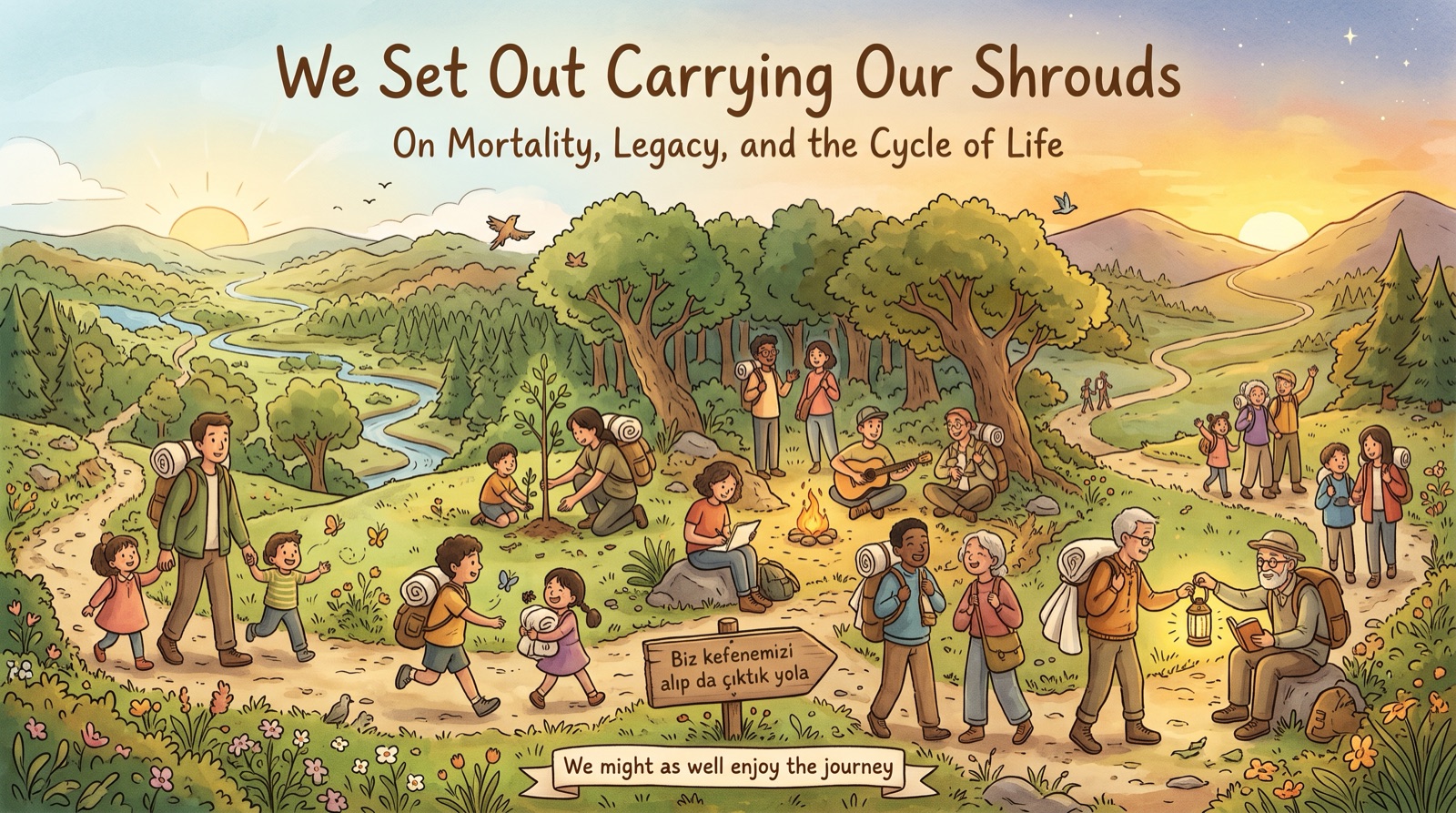
We Set Out Carrying Our Shrouds
At the end of our conversation, I wrote something in Turkish:
"Biz kefenemizi alıp da çıktık yola."
Roughly translated:
"We set out on this journey already carrying our burial shrouds."
I meant it partly as a joke. I even added a few smiley faces.
But the more I think about it, the more I like the philosophy behind that sentence.
From the moment we're born, death is part of the deal.
There is no separate moment when mortality suddenly becomes relevant. It was always there.
Accepting this doesn't mean living in fear or obsessing over the end.
Quite the opposite.
Once you stop treating mortality as some extraordinary catastrophe that should never happen, you can begin to see life with greater clarity.
You might become less concerned about winning meaningless arguments.
Less obsessed with accumulating things you won't ultimately need.
Less willing to postpone everything that matters.
More interested in spending time with people you love.
More motivated to create something worthwhile.
More appreciative of an ordinary afternoon when absolutely nothing remarkable happens.
In a strange way, the awareness of death can make everyday life feel more valuable.
The Difference Between Being Depressed and Being Aware
I think there's an important distinction between dwelling on mortality and understanding it.
Dwelling on death can become unhealthy when it consumes your attention, produces constant anxiety, or prevents you from participating in life.
But acknowledging mortality is something else entirely.
It's a form of perspective.
The Stoic philosophers understood this. So did many Buddhist traditions. Across cultures and centuries, people have repeatedly arrived at the same insight: recognizing the impermanence of life can help us live more deliberately.
The goal isn't to think about death every minute.
It's to remember, occasionally, that our time is limited—and allow that knowledge to influence how we spend it.
Not through fear.
Through appreciation.
A Good Life Doesn't Require Permanence
Perhaps the biggest mistake we make is assuming that something must last forever to have meaning.
A beautiful sunset lasts minutes.
A wonderful conversation might last an hour.
A childhood lasts only a few years.
A human life, even a long one, is remarkably short compared with the history of the world.
And yet none of these things becomes meaningless because it ends.
Their temporary nature is part of what makes them precious.
Maybe we don't need to leave behind a permanent monument.
Maybe living well, loving well, contributing something, and making the journey a little better for the people around us is enough.
And maybe the question isn't merely, "What will remain after I'm gone?"
Maybe a better question is:
"While I'm still here, what am I doing with the time I have?"
That, to me, is the real lesson.
Not sadness.
Not resignation.
Just a little more awareness of the extraordinary privilege of being alive.
After all, we set out carrying our shrouds.
We might as well enjoy the journey.
Inspired by a conversation about a YouTube video, the lives of people we follow online.
Comments