HD-OPM Archive
Topics › Mediterranean, DASH, MIND & plant-forward diets

3 of 18 men on Ancel Keys' Mediterranean diet reached 100, odds near 1 in 10 billion

Louis Nervegna · Oct 31, 2025 · ♥ 13 reactions · 13 comments · original Facebook post
Mediterranean, DASH, MIND & plant-forward dietsAging & longevity
↻ This is a repost. The main version (highest ranked) is Three of Ancel Keys' 18 researchers reached 100 on a traditional Mediterranean diet · Mar 14, 2025.
AI summary & key facts

Louis recounts that 3 genetically unrelated men among 18 on Ancel Keys' research team who ate a traditional Mediterranean diet reached 100, which he puts at about 1 in 10 billion odds. He also cites four randomized trials showing 46% lower CVD death with such a diet.

Studies of centenarians have shown that genes seem to play the major role in reaching age 100. The odds in the USA of reaching that age are about 1 in 10,000.

When you do the math, the odds of 3 genetically unrelated males out of a group of 18 American men all reaching age 100 are about 1 in 10 billion. Yet, that is exactly what happened to Ancel Key’s research team where everyone ate a strict traditional Mediterranean for most of their lives.

facebook.com/share/v/1AWJDBs7mD

(See the comments for an explanation of the math behind those 1 in 10 billion odds.)

So if you are one of the 9,999 people out of 10,000 who don’t naturally have the genes to reach 100yo, then your best chance may be to listen to Keys and follow his traditional Mediterranean diet as closely as possible. This is what people in Sardinia and Ikaria used to do, and 5-10x more reached age 100 than in the USA. Keys patterned the diet that he personally ate (and recommended) on these groups of long-lived people.

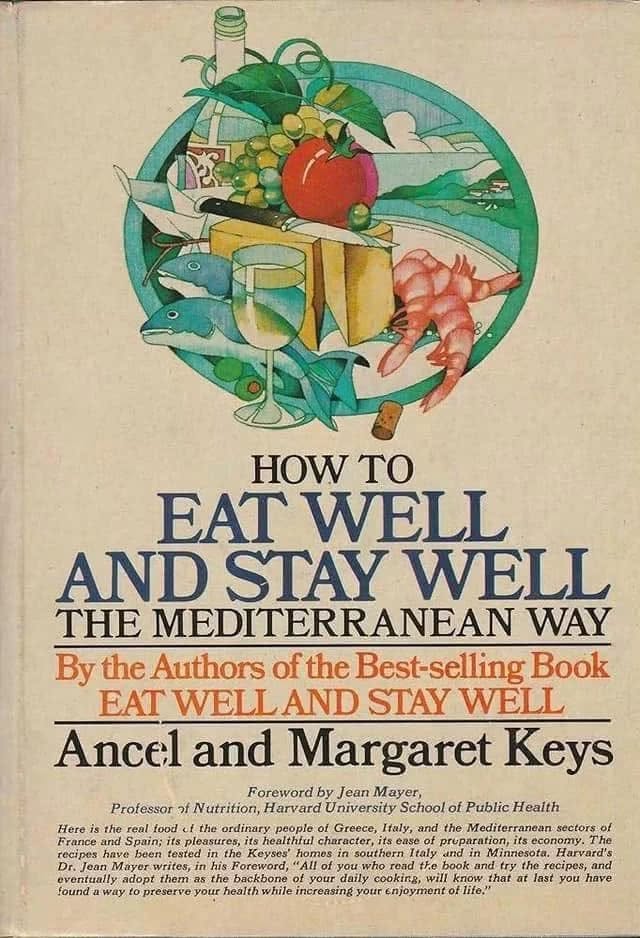
The details of the traditional Mediterranean diet that Keys and his research team ate can be found here: ↪ Ancel Keys' 1975 Mediterranean diet book: plants, olive oil, fish, little red meat

Four large long-running randomized controlled trials have shown in aggregate that a traditional Mediterranean diet reduces the risk of dying from CVD by 46%:

↪ Meta-analysis of 4 Mediterranean diet RCTs: MACE down 48%, CVD death down 46%

↪ Four long-term RCTs show the Mediterranean diet cuts CVD death by 46% in aggregate

↪ Video on what the Lyon, PREDIMED and CORDIOPREV Mediterranean diet trials showed

Keep in mind that the version of the diet in these randomized trials was a lot more liberal than the strict version that Keys, his wife, and his research team all ate. Yet it still had major benefits. The benefits of the strict version are probably even larger.
Research cited

This is the most remarkable case of extreme longevity that I have ever heard of.

The math on this is astonishing (see comments).

——

The traditional Mediterranean diet was originally popularized in the USA during the 1970’s.

This was a result of the famous “7 countries study” which first discovered that groups of people following this diet were living considerably longer with much lower rates of heart disease than in the United States.

Once learning this, the scientists working on the 7 countries study all personally switched to a traditional Mediterranean diet themselves. They were highly motivated and followed the diet religiously for the rest of their lives.

As a result, 3 out of the total 18 scientists in this research group lived to the age of 100. The most famous of these 18 was Ancel Keys who made it to a few days short of 101. His wife also followed the diet religiously and lived to 98.

The odds of 3 out of 18 people (all men born in the early 1900’s) living to 100 by pure chance is about 1 in 10 billion.

Historically, only about 1 in 10,000 people living in the USA have ever made it to age 100.

The details of exactly the diet that they were eating can be found in this post:

↪ Ancel Keys' 1975 Mediterranean diet book: plants, olive oil, fish, little red meat

See the comments for my explanation of the math that shows odds of 1 in 10 billion.

#ancelkeysHD #mediterraneanHD #agingHD #longevityHD #centenariansHD

← newer: Mendelian randomization finds no causal link of VO2max with older: Opinion: longevity clinics charging $125,000-$250,000 a year →