(no text — see the shared post below)
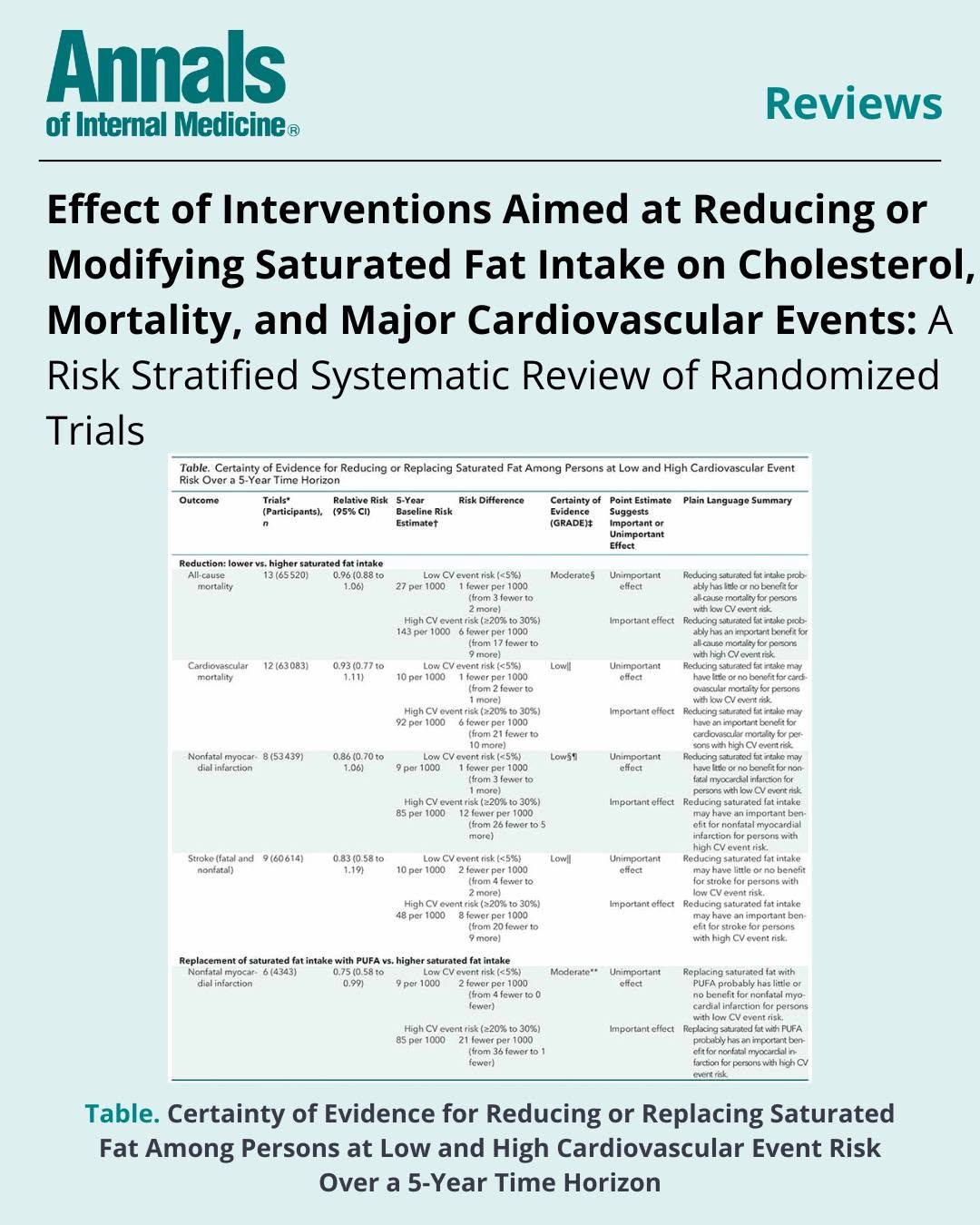
Reducing saturated fat intake lowers risk for heart attacks by 25% in people at high baseline risk, when it is replaced by polyunsaturated fat.
This systematic review and meta-analysis of 17 randomized controlled trials was just published:
Paper · Ann Intern Med · 2026Effect of Interventions Aimed at Reducing or Modifying Saturated Fat Intake on Cholesterol, Mortality, and Major Cardiovascular Eventsacpjournals.org
What it shows:
Randomized controlled trials demonstrate as a whole that replacing saturated fat by polyunsaturated fat reduces risk of (non-fatal) heart attacks by 25% in people at higher baseline risk, over a period of 5 years.
These 17 randomized trials looked at HARD ENDPOINTS like deaths, heart attacks, strokes, etc. Not just soft biomarkers, like cholesterol.
A 25% risk reduction in 5 years is a big deal. It is similar to the benefit that someone with higher baseline risk gets by taking a lower-dose statin.
When reducing saturated fat, there were also trends towards lower all-cause mortality, lower cardiovascular mortality, lower strokes, and lower (non-fatal) heart attacks, in people at higher baseline risk over this 5 year period— when using the background diet as a whole as the replacement. (In other words, when saturated fat was replaced by a basket of foods representing the rest of the overall diet.) But these results did not reach full statistical significance. On the other hand, the results where polyunsaturated fat replaced saturated fat did reach full statistical significance.
Polyunsaturated fats are the fats found naturally in high amounts in nuts, seeds, seafood, eggs, and poultry. And yes, this includes “seed oils”.
Note that both the omega 6 fats and the omega 3 fats are polyunsaturated. But the majority of the polyunsaturated fat in these 17 randomized trials came from the omega 6 family, as this was the predominant source of polyunsaturated fat in most people’s diets. A lot of this omega 6 fat came from “seed oils”. Not only did this higher omega 6 intake not show any evidence of harm in these 17 trials, but it showed a clear benefit in higher risk individuals when polyunsaturated fat replaced saturated fat one-for-one.
This is what the highest-quality evidence from randomized trials actually demonstrates in aggregate.
This is why the AHA and virtually all major cardiology organizations around the world recommend replacing saturated fat by unsaturated fat, including BOTH omega 6 and omega 3 polyunsaturated fat. Not just because it lowers cholesterol— but because it lowers hard endpoints like heart attacks, in people at higher risk.
Quoted:
“For persons at low cardiovascular risk, reducing or modifying saturated fat intake has little or no benefit over a period of 5 years. Among persons at high cardiovascular risk, low- to moderate-certainty evidence was found for important reductions in mortality and major cardiovascular events, particularly for MI [heart attacks], with respect to replacing saturated fat with polyunsaturated fat.”
“There were 17 eligible trials (66,337 participants). Risk stratified evidence provides low to moderate certainty that reducing saturated fat intake may result in a reduction in all-cause mortality (risk ratio [RR], 0.96 [95% CI, 0.88 to 1.06]), cardiovascular mortality (RR, 0.93 [CI, 0.77 to 1.11]), nonfatal myocardial infarction (MI) (RR, 0.86 [CI, 0.70 to 1.06]), and fatal and nonfatal stroke (RR, 0.83 [CI, 0.58 to 1.19]). For persons at low baseline cardiovascular risk, absolute reductions were below our thresholds of importance (5 and 10 per 1000 persons followed over 5 years for fatal and nonfatal outcomes, respectively); for those at high risk, the benefits were above our thresholds, suggesting there may be important absolute reductions. The effects were more pronounced when replacing saturated fat with polyunsaturated fat for nonfatal MI (RR, 0.75 [CI, 0.58 to 0.99]; P for interaction = 0.05; moderate credibility of subgroup effect based on Instrument to assess the Credibility of Effect Modification Analyses assessments).”
#saturatedfatHD #unsaturatedfatHD #polyunsaturatedfatHD #seedoilsHD #omega6HD #nutsHD #omega6cvdHD