HD-OPM Archive
Topics › Supplements & vitamins

High-dose methylfolate shortens lifespan in animals; stick to the RDA of folate

Louis Nervegna · Sep 08, 2025 · ♥ 11 reactions · 8 comments · original Facebook post
Supplements & vitaminsAging & longevity
AI summary & key facts

Louis warns that too much folate, especially the methylated form (5-MTHF), shortened lifespan and promoted cancer growth in mice and worms. He recommends about the RDA from food-grade folate or folic acid and suggests safer ways to lower homocysteine.

Methylfolate shortens lifespan in animal models.

This is the methylated form of folate, sometimes called 5MTHF.

Too much folate shortens lifespan in mice and worms and promotes cancer growth, particularly the methylated form:

digitalcommons.wayne.eduLink to digitalcommons.wayne.edudigitalcommons.wayne.edu Paper · Nat Commun · 2021Regulation of the one carbon folate cycle as a shared metabolic signature of longevityThe metabolome represents a complex network of biological events that reflects the physiologic state of the organism in health and disease. Additionally, specific metabolites and metabolic signaling pathways have been shown to modulate animal ageing, but whether there are convergent mechanisms uniting these processes remains elusive. Here, we used high resolution mass spectrometry to obtain the metabolomic profiles…nature.com

↪ Harvard Nutrition Source review of folate: a little is good, too much may be bad

Taking high doses of folate is probably a bad idea, especially the methylated form.

The RDA of folate (or a little bit more) is likely plenty for most people. Food grade folate or folic acid are probably the best choices, not methylated folate. Many studies have shown that food grade folate and folic acid are both safe and potentially beneficial at the level of the RDA:

↪ Harvard Nutrition Source review of folate: a little is good, too much may be bad

There are much safer ways to lower homocysteine than taking high doses of methylfolate.
#folateHD #folicacidHD #homocysteineHD #methylfolateHD

Research cited

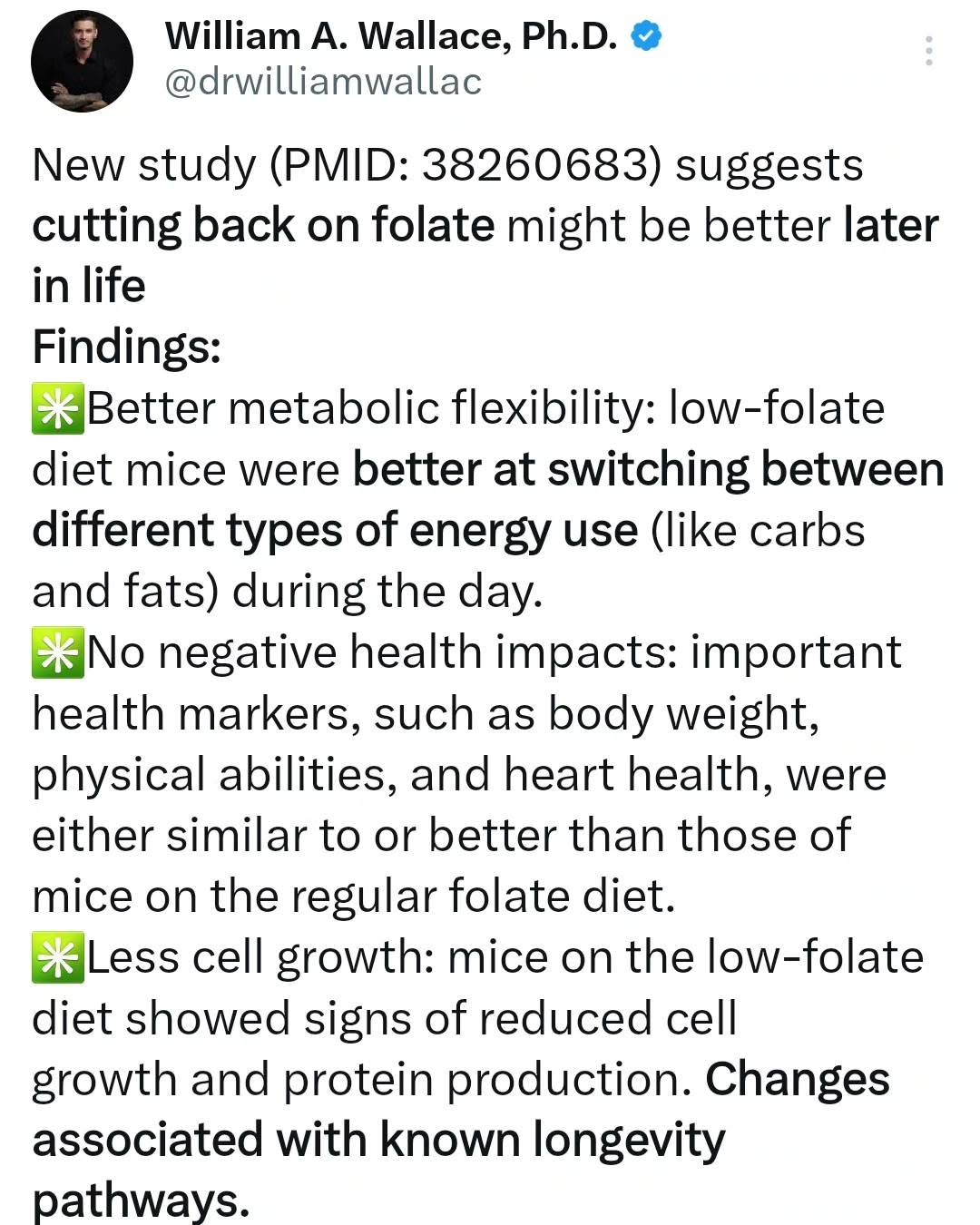
New study [in rodents] suggests cutting back on folate might be better later in life

A theoretical framework known as antagonistic pleiotropy suggests that early-life advantages (and things that support those advantages) in fitness and reproduction come at a cost later in life. This theory was introduced in 1957 and proposed that “an individual cannot be exceptionally gifted with both youthful vigor and long life”

Folate (vitamin B9) is necessary for cell division and growth, and DNA repair. It’s role in these processes has been evident owing to its realized importance in maternal health for fetal outcomes. It has been suggested that folate may have differential effects at different life stages. For instance, lower methyl-folate levels are a common signature of several “pro-longevity” pathways (PMID: 34108489). Additionally, past research in French centenarians with a family history of longevity showed higher levels of a gene variant responsible for lower active folate levels in the body compared to a younger control group (suggesting people with lower serum folate levels can indeed live longer lives)

A recent study published in Life Science Alliance investigated how/if reducing folate intake later in life could benefit overall health and aging.

mice were split into two groups: 1 group had a diet rich in folate. The other group received a diet low in folate and choline (both sources of methyl groups).

Findings:
✳️Better metabolic flexibility: low-folate diet mice were better at switching between different types of energy use (like carbs and fats) during their daily activities
✳️No negative health impacts: study found that mice with lower folate intake did not experience negative health effects. Important health markers, such as body weight, physical abilities, and heart health, were either similar to or better than those of mice on the regular folate diet​
✳️Less cell growth: mice on the low-folate diet showed signs of reduced cell growth and protein production. These changes are associated with known longevity pathways, suggesting that slowing down these processes might help with healthy aging​

Continued in comments ⬇️

No photo description available.
← newer: Harvard review of folate: a little is good, too much might bolder: Tufts: B vitamins can help older people with high homocystei →