Does a basic multivitamin do anything useful? For years many clinicians said no, and one large cohort study even reported slightly higher mortality in daily users. The group's admins argue that the best randomized evidence now points the other way for older adults: in the Harvard-led COSMOS trials, a plain once-a-day multivitamin at roughly recommended-dietary-allowance (RDA) doses was associated with slower cognitive decline and slower biological aging.123
The multivitamin is not a heart-disease drug, and the posts are careful on this point. The measured benefits are for memory, thinking skills, biological-aging markers and cancer, and the effects are modest. Louis Nervegna's suggestion that a multivitamin might help people with heart disease, because heart disease and cognitive decline travel together, is explicitly a hypothesis rather than a trial result.4
Vitamin B12 and folate come up because the COSMOS multivitamin contained B12 at about ten times the RDA, and because both vitamins help the body clear homocysteine, an amino acid linked to clots, heart disease and stroke. This article walks through the multivitamin trials, what is and is not known about B12 and folate, and what the admins suggest discussing with your doctor.
What the COSMOS and Physicians' Health Study trials are
COSMOS stands for the COcoa Supplement and Multivitamin Outcomes Study, a randomized, placebo-controlled trial run by Brigham and Women's Hospital with Harvard and Wake Forest medical schools. Its 2x2 design randomized more than 21,000 older adults (21,442 in the main report) to a cocoa flavanol extract, a multivitamin, both, or neither.2511 Louis calls it arguably the highest-quality randomized trial on multivitamins ever done, with a standard of rigor comparable to good drug trials.12
The multivitamin was ordinary: Centrum Silver, with nearly every ingredient near the RDA. The one standout is vitamin B12, at about 10 times the RDA. The supplementary material of the COSMOS publication lists the exact ingredients, and Louis placed it next to the Physicians' Health Study II multivitamin, which had the same B12 pattern.78 The multivitamin tablets were donated by the manufacturer, and cocoa extract by Mars Edge.56
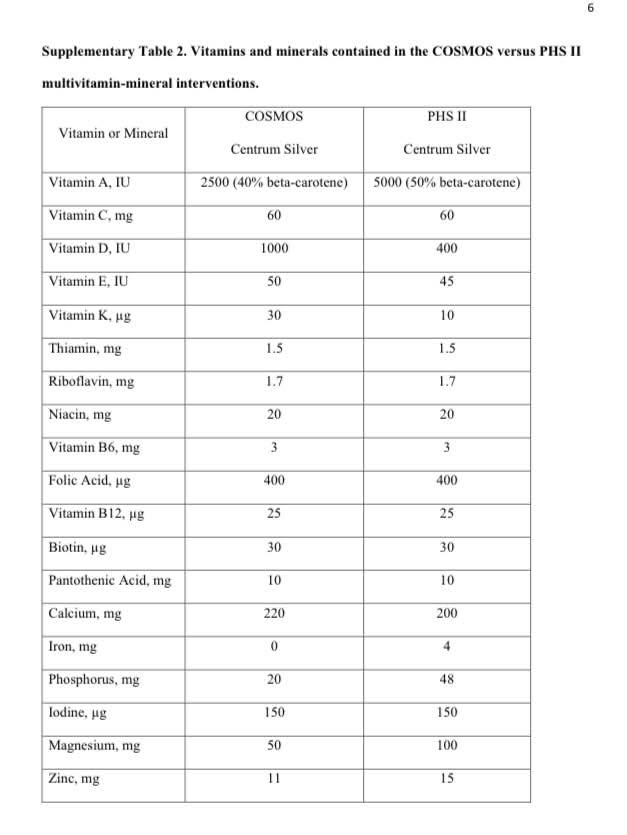
The Physicians' Health Study II (PHS II) was a separate, earlier trial. It followed 14,641 male US physicians for about 14 years. Louis stresses that the participants were well-off, well-nourished doctors, so it is notable that any effect appeared.8 The paper is Multivitamins in the Prevention of Cancer in Men: The Physicians' Health Study II.8
What the evidence shows
Memory and cognitive decline
COSMOS has produced three separate placebo-controlled cognition studies. The group's posts describe them as consistently favoring the multivitamin.131415
- Three-year result. A summary quoted by Louis said that three years of Centrum Silver in healthy adults over 65 slowed cognitive decline by an estimated 60%, about 1.8 years, with larger benefits in people with significant cardiovascular disease.2
- Third study and pooled analysis (2024). A Mass General Brigham release reported that the third COSMOS cognition study, which used in-person assessments, plus a combined analysis, confirmed consistent and statistically significant benefits for memory and global cognition. The meta-analysis covered about 5,000 participants, including more than 500 with in-person testing over two years.15 The paper is Effect of multivitamin-mineral supplementation versus placebo on cognitive function (American Journal of Clinical Nutrition, 2024).7
- Details of the in-person study. Among 573 adults aged 60 and older, a daily multivitamin modestly improved overall cognition and episodic memory (memory for events and experiences) over two years, with no clear benefit for attention and planning. Pooled with the two earlier studies (one tested by phone, one online), the researchers estimated the multivitamin slowed cognitive aging by about two years.6
Several posts repeat larger or different figures from podcast clips by Rhonda Patrick: "about 2 years" or "2.1 years" less global brain aging and "almost 5 years" (4.9) for episodic memory, "up to 3 years", and even "up to 5 years". The clips disagree on the timeframe, describing one year in one post and 3.6 years in another. They are secondary summaries rather than the papers, so the safest reading is the primary-source figure of roughly two years for global cognition.1161718192021
The same summary that gave the two-year figure also listed the caveats: effects were modest, the "two years" is an estimate and not a guarantee, it is unclear which nutrient matters, and the studies did not test dementia prevention.6 Louis also notes COSMOS's cocoa arm did not slow cognitive decline overall, although other studies suggest cognitive benefit from cocoa.22 A separate summary adds that cocoa flavanols helped memory only in people whose diets were low in flavanols to start with.23
Biological aging
A 2026 Nature Medicine paper from COSMOS used DNA methylation "epigenetic clocks", which estimate biological age from chemical marks on DNA. Blood samples from about 950 (958, per the Harvard Gazette) randomly selected participants, average age 70, were measured at baseline and after one and two years.313
- All five clocks showed a signal for slower aging in the multivitamin group.1213
- The two second-generation clocks, PCGrimAge and PCPhenoAge, showed statistically significant slowing of about 10% to 20% over two years, roughly four months of aging averted.1213
- Participants who were biologically older than their chronological age at baseline benefited more.313
- Rhonda Patrick cites a range of 2.7 to 5.1 months. She argues that a small effect could compound over decades, which is her speculation and not something the trial measured.17
The editorial caveats matter. Belsky and Ryan wrote that epigenetic clocks such as GrimAge and DunedinPACE predict healthspan and lifespan in observational studies, and that the COSMOS data bring the field "one step closer" to evidence that a simple multivitamin can slow aging, but "uncertainties remain".24 JoAnn Manson, a co-investigator, herself says the findings need replication and that supplements are never a substitute for a healthy diet and lifestyle.13
Cancer, cataracts and mortality
In PHS II the multivitamin reduced total cancer by 8% compared with placebo over about 14 years.825 Manson's quoted summary adds that the 2022 US Preventive Services Task Force review also found total invasive cancer reduced, and that PHS II saw fewer cataracts.13 Louis uses this to argue that claims of low-dose multivitamins raising cancer risk are unsupported.8
A counterpoint: a study of more than 390,000 adults in three US cohorts, followed for up to 27 years, found 4% higher mortality in daily multivitamin users. Peter Attia's commentary, shared by Gokhan Can, calls the result uninformative: it was inconsistent across follow-up periods, showed no dose response, and is open to healthy-user and sick-user bias (people who start vitamins may already be unwell). He concludes it neither proves benefit nor shows harm, and notes multivitamins are valuable for correcting deficiencies.26
A broader review quoted in the group, a JACC systematic review of 884 randomized trials (883,627 participants, 27 micronutrients), found no effect of vitamins C, D, E or selenium on cardiovascular disease or type 2 diabetes. Beta-carotene supplements increased all-cause mortality (RR 1.10), CVD mortality (RR 1.12) and stroke (RR 1.09).27 VITAL, another trial led by Manson, found little effect of vitamin D on heart disease, while omega-3 was associated with 28% fewer heart attacks.14
Heart outcomes: the cocoa arm of COSMOS
The heart-disease result from COSMOS belongs to the cocoa flavanol arm, not the multivitamin arm. Over a median of 3.6 years, 500 mg/day of cocoa flavanols (including 80 mg of epicatechin) reduced total cardiovascular events by 10%, which was not statistically significant. Cardiovascular death fell a significant 27% (hazard ratio about 0.73), a secondary outcome. In adherent participants the reductions were 15% for total events and 39% for cardiovascular death. The authors urged cautious interpretation.5112829
Supporting findings cited by Louis include lower hsCRP (an inflammation marker) by 8.4% per year in 598 participants30, a small UCSF crossover study in men with heart disease where high-flavanol cocoa improved flow-mediated dilation by 47%31, and a meta-analysis of 25 trials (1,167 people) showing blood pressure drops of about 2.7/1.8 mmHg.11 Gokhan says he does not take cocoa supplements but eats it often.32 Louis leans toward eating a wide variety of polyphenol-rich foods.33
Vitamin B12
Why B12 might matter
Louis noticed that the COSMOS multivitamin was close to the RDA except for B12 at 10 times the RDA, and given B12's known neurological roles, finds it hard not to suspect that dose played an outsized role in the cognitive results.7 This is an inference. COSMOS did not test B12 on its own, and the trial reports do not isolate which nutrient is responsible.6
Other evidence is consistent with a brain role. A UCSF study in Annals of Neurology (2025) of 231 healthy older adults without dementia found that lower levels of active B12, the form the body can use, went with slower processing speed and more white matter lesions on MRI, even though average total B12 was above the current deficiency cutoff. The authors ask whether current cutoffs are too low for older brains.34 The study is observational, so it cannot prove cause and effect.
Louis also points to a Cornell study in the Journal of Nutrition, which reported that B12 deficiency impairs muscle mitochondrial energy production, that B12 supplements improved this in aged mice, and that early biomarkers may detect B12 stress before classic deficiency.35
Who is at risk of low B12
- Older adults. Louis notes many older people stop producing intrinsic factor, the stomach protein needed to absorb B12, so they can become insufficient even with adequate intake. B12 absorption also needs stomach acid.3536
- People on metformin. A study summarized in a shared post found metformin lowered B12 without affecting other vitamins, supporting checking B12 in metformin users.37
B12, homocysteine and the heart
Homocysteine is an amino acid that vitamins B12, B6 and folate help break down; high levels can signal a deficiency and, untreated, are linked to clots, heart disease and stroke.38 Peter Attia takes methylfolate and methyl B12 to keep his homocysteine below 9, which the post describes as a personal regimen and not evidence.39
A 2026 review of B12 and cardiovascular health, shared by Louis, found B12 supplements reliably lower homocysteine, but large randomized trials did not consistently reduce heart attacks or cardiovascular deaths. The strongest benefit was for stroke, more clearly in countries without folic acid fortification, but most trials combined B12 with folic acid and B6, so the benefit cannot be credited to B12 alone. The summary states current evidence does not support routinely taking extra B12 purely for cardiovascular prevention (it remains essential if you are deficient).9 A Tufts article that Louis recommends similarly says B vitamins can help certain groups, such as older people with high homocysteine at risk for dementia.40
The Oxford VITACOG trial in people with mild cognitive impairment found folate, B6 and B12 slowed brain shrinkage by about 30% over two years (up to 53% in those with high baseline homocysteine). Later analyses suggested the benefit appeared mainly in participants with high blood omega-3 (EPA and DHA).41
Is high-dose B12 safe?
Louis considers harm from high B12 unlikely. PHS II used a multivitamin with 10 times the RDA of B12 for 14 years and found no increase in any major disease. In Harvard's Nurses' Health Study and Health Professionals Follow-up Study, B12 intake was not associated with disease; a signal for combined B12 and B6 and hip fracture disappeared for B12 alone.25 Observational links between high blood B12 and disease may reflect reverse causality, because some diseases themselves raise blood B12.42
On B6, a new randomized trial found 100 mg daily reduced depression symptoms over a month while B12 did not; Louis warns prolonged high doses can cause peripheral neuropathy.43 Attia's reported B6 dose was cut back for similar concerns.39
Folate: a little is good, a lot is debated
Folate (vitamin B9) is in food; folic acid is the supplement form; methylfolate (5-MTHF) is the active form in the body. Louis explains that food folate is bound to chains that must be cleaved before absorption, so food folate is less bioavailable than folic acid, which is less bioavailable than methylfolate.10
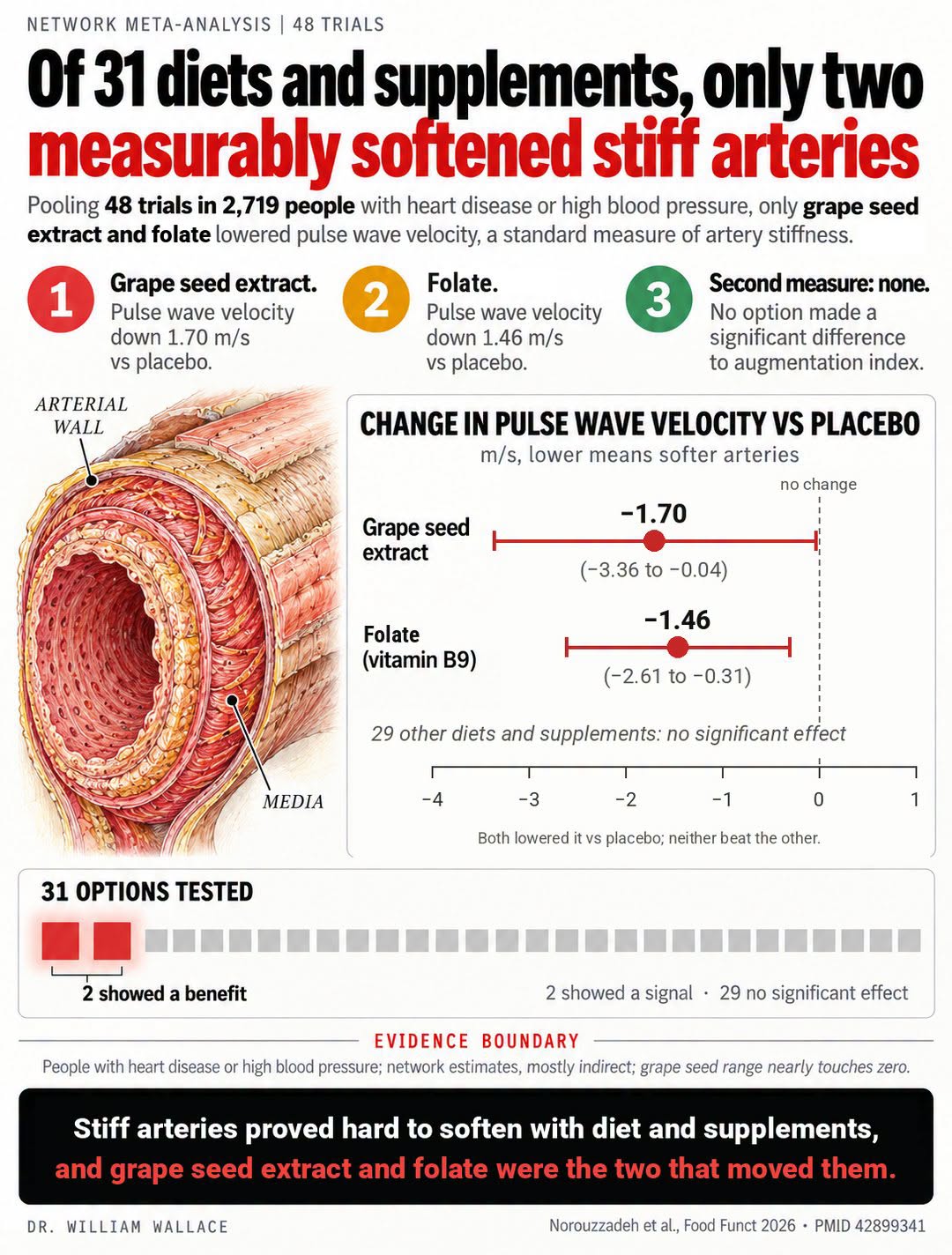
- Benefits at ordinary doses. A 2025 meta-analysis of 45 randomized trials (96,962 people) found folic acid reduced stroke by 15% (RR 0.85) and overall CVD by 5%, with no effect on mortality, CHD or peripheral artery disease. Louis suspects other folates would behave similarly but notes this is unproven.44 The JACC review reported a stroke RR of 0.84.27 A network meta-analysis found folate lowered arterial stiffness (pulse wave velocity) by 1.46 m/s.45
- Caution at high doses. Louis argues that adequate folate prevents cancer initiation, but that people with existing precancerous lesions may be fueled by high doses of any folate form.1046 He cites worm and mouse data linking high methylfolate to shorter lifespan, and calls megadosing a bad idea.1047 A mouse study found late-life folate restriction did not cause anemia, though Gokhan stresses it was not done in humans.48
- Nuance. Harvard's Nutrition Source review, shared by Louis, concludes a little is good and too much may be bad. A trial of 1,000 mcg of folic acid in people with prior polyps showed no protection and more advanced polyps, but the dose was more than double a standard multivitamin and participants were high-risk. The review says the overall human evidence points to lower colon and breast cancer risk with higher folate.49
Show data
| Relative risk (log scale) | 95% CI | |
|---|---|---|
| Stroke | 0.85 | 0.76–0.96 |
| Overall cardiovascular disease | 0.95 | 0.90–0.99 |
| Peripheral artery disease | 0.94 | 0.75–1.17 |
| Coronary heart disease | 0.98 | 0.91–1.06 |
| Death from any cause | 0.98 | 0.93–1.02 |
Louis takes 400 mcg of folic acid daily (the RDA) and says methylfolate at the same dose would raise his methylfolate more than he would be comfortable with. He lists alternatives: food-grade folate, lower methylfolate doses, or just eating folate-rich foods.1047
Nuances and misconceptions
- Multivitamins are not megadoses. Louis repeatedly stresses these were RDA-level products, not megavitamins, apart from the B12 content.36
- Who benefits. The participants were older adults, and PHS II volunteers were well-nourished physicians. Younger people were not the studied group.813
- Opinion versus data. Louis argues clinicians should not give public health advice, and that Harvard epidemiologists have recommended a basic multivitamin for more than 25 years. That is an admin view in a debate.1
- Hype in the clips. Phrases like "reverse cognitive aging by 5 years" come from podcast summaries and exceed what the primary papers support.119
- Not a replacement for diet. Manson says supplements are not a substitute for a healthy diet and lifestyle, and a quoted AARP article similarly advises improving diet first.1350
- Iodine. Louis points out iodine deficiency is rising as people drop iodized salt, and suggests a basic multivitamin with iodine as insurance.51
What this means for you
- Older adults may want to ask their doctor about a basic RDA-level multivitamin; Louis's view is that the COSMOS trials support it and risks are low.116
- Prefer standard doses to megadoses.347
- If you take metformin or are an older adult, consider asking about checking B12.3537
- Do not expect extra B12 to prevent heart attacks; it is essential if deficient, and the stroke signal comes from combined B vitamins.9
- Stay near the RDA for folate (400 mcg), and be wary of high-dose methylfolate.1047
- Keep the heart basics first: the cardiovascular death signal in COSMOS came from cocoa flavanols, not from the multivitamin.529
Frequently asked questions
Does a multivitamin prevent dementia?
Not shown. COSMOS found slower cognitive decline on memory and global cognition tests over two to three years; dementia prevention was not tested.615
Is it the B12 doing the work?
Possibly, but it is unproven. Louis suspects the 10x RDA B12 dose, and observational data link low active B12 to white matter lesions, but COSMOS did not test B12 on its own.734
Do multivitamins increase cancer risk?
PHS II found 8% less cancer over 14 years, and Louis calls claims of increased risk unsupported. A 390,000-person cohort found 4% higher mortality but, per Attia, is hard to interpret because of bias.826
Is methylfolate better than folic acid?
It is more bioavailable and potent, which Louis sees as the problem at high doses. He prefers RDA-level folic acid or food folate. Attia's regimen includes methylfolate.1039
Does lowering homocysteine prevent heart attacks?
B12 reliably lowers homocysteine, but trials have not consistently reduced heart attacks; the best signal is for stroke.944
Did the multivitamin lower cardiovascular events in COSMOS?
The posts do not report a multivitamin heart result. The cardiovascular death reduction (27%) belongs to cocoa flavanols.529