The Q-SYMBIO Randomized Trial
Testing CoQ10 as a treatment for heart failure
Link to full study:
Paper · JACC Heart Fail · 2014The effect of coenzyme Q10 on morbidity and mortality in chronic heart failure: results from Q-SYMBIO: a randomized double-blind trial.Conclusion: Long-term CoQ10 treatment of patients with chronic HF is safe, improves symptoms, and reduces major adverse cardiovascular events. (Coenzyme Q10 as adjunctive treatment of chronic heart failure: a randomised, double-blind, multicentre trial with focus on SYMptoms, BIomarker status [Brain-Natriuretic Peptide (BNP)], and long-term Outcome [hospitalisations/mortality]; ISRCTN94506234).jacc.orgQuoted:
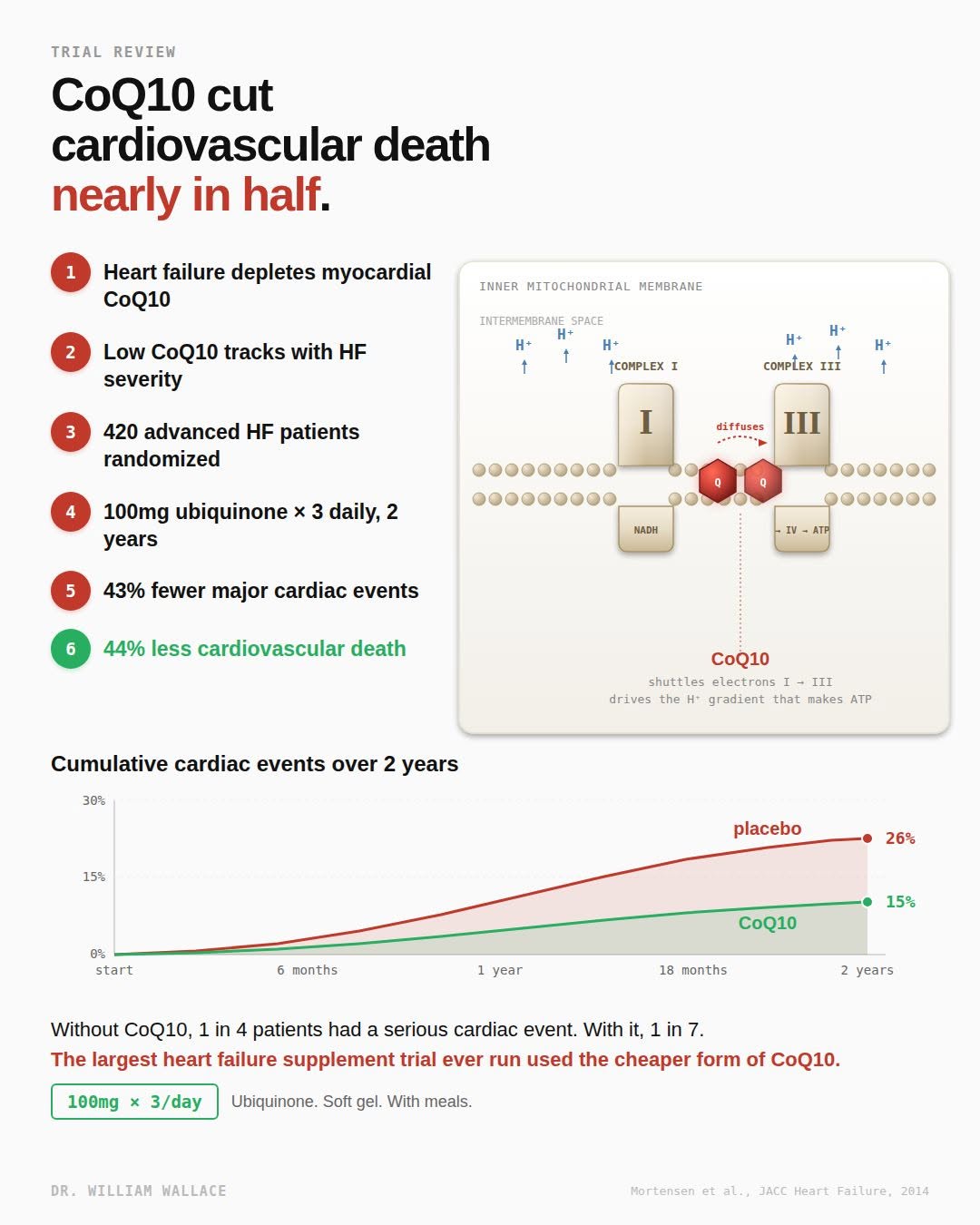
“Patients with moderate to severe HF [heart failure] were randomly assigned in a 2-year prospective trial to either CoQ10 100 mg 3 times daily or placebo, in addition to standard therapy. The primary short-term endpoints at 16 weeks were changes in New York Heart Association (NYHA) functional classification, 6-min walk test, and levels of N-terminal pro–B type natriuretic peptide. The primary long-term endpoint at 2 years was composite major adverse cardiovascular events as determined by a time to first event analysis.”
“A total of 420 patients were enrolled. There were no significant changes in short-term endpoints. The primary long-term endpoint was reached by 15% of the patients in the CoQ10 group versus 26% in the placebo group (hazard ratio: 0.50; 95% confidence interval: 0.32 to 0.80; p = 0.003) by intention-to-treat analysis. The following secondary endpoints were significantly lower in the CoQ10 group compared with the placebo group: cardiovascular mortality (9% vs. 16%, p = 0.026), all-cause mortality (10% vs. 18%, p = 0.018), and incidence of hospital stays for HF (p = 0.033).”
“The following secondary endpoints were significantly lower in the CoQ10 group compared with the placebo group: cardiovascular mortality (9% vs. 16%, p = 0.026), all-cause mortality (10% vs. 18%, p = 0.018), and incidence of hospital stays for HF (p = 0.033).”
“Conclusions- Long-term CoQ10 treatment of patients with chronic HF is safe, improves symptoms, and reduces major adverse cardiovascular events.”