Coq10 cut cardiovascular death in HALF in heart failure patients, and improved most other outcomes.
These results are from the Q-SYMBIO randomized trial.
CoQ10 has the strongest evidence base of any dietary intervention for reducing cardiovascular death in heart failure patients.
#coq10HD #heartfailureHD #qsymbioHD #kisel10HD #ubiquinoneHD #bioquinoneHD #ubiquinolHD
The Q-SYMBIO trial, published in JACC: Heart Failure in 2014, is the most important study ever conducted on CoQ10 supplementation and cardiovascular outcomes. It is also a trial that most people promoting CoQ10 supplements seem to have selectively forgotten the details of.
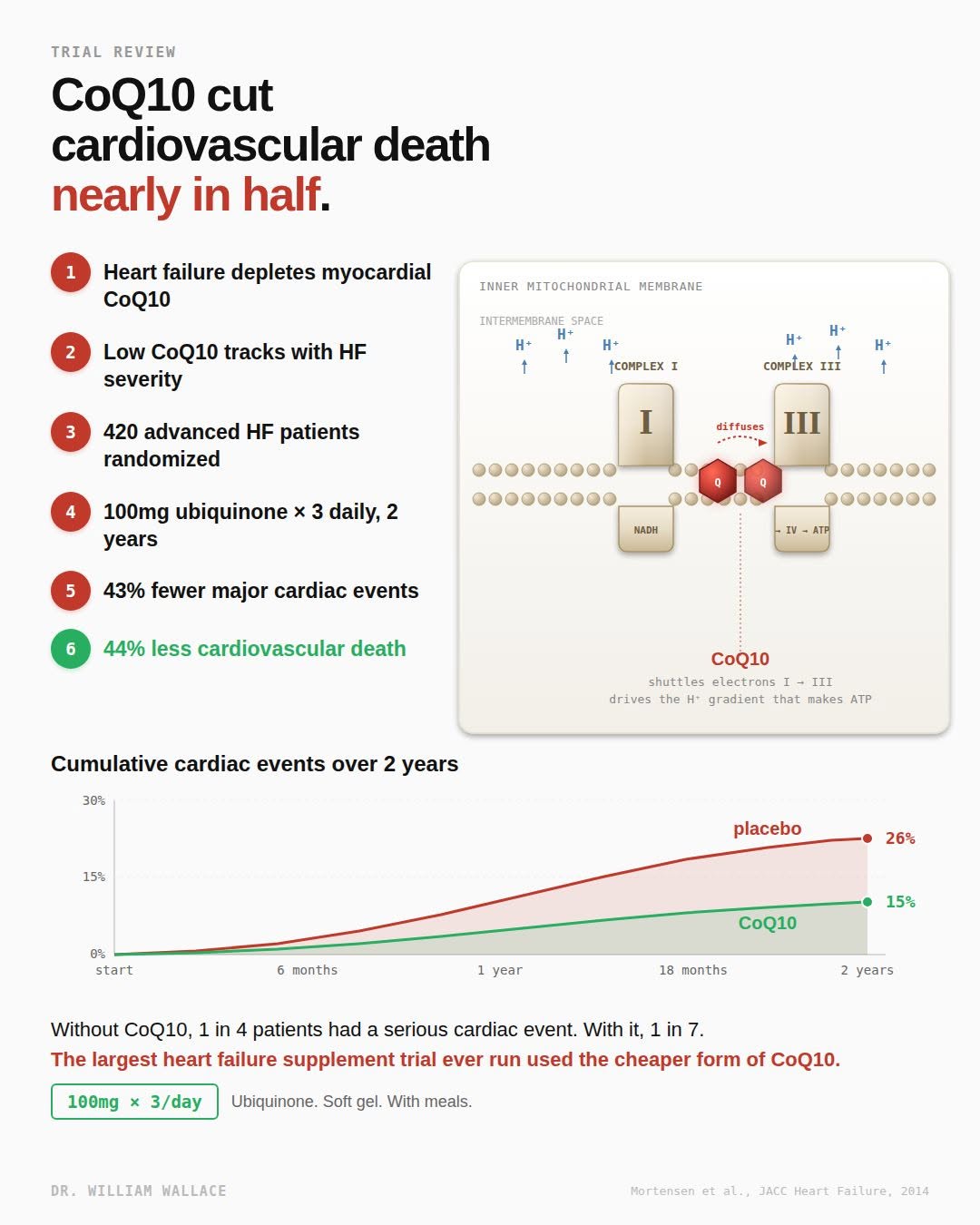
Mortensen and colleagues enrolled 420 patients with moderate to severe chronic heart failure across 17 cardiology centers in nine countries. Half received 100mg of ubiquinone three times daily for two years as adjunct to standard heart failure therapy. The other half received matching placebo. The primary endpoint was a composite of unplanned heart failure hospitalization, cardiovascular death, urgent transplant, or need for mechanical support. Patients entered this trial already on guideline-directed medical therapy. The intervention was added on top of optimal care, not instead of it.
The results at two years: 15% of patients in the CoQ10 group hit the primary endpoint versus 26% in the placebo group. A 43% relative reduction in serious cardiac events. Cardiovascular mortality was 9% in the CoQ10 arm versus 16% in placebo, a 44% relative reduction. All-cause mortality was 10% versus 18%. Heart failure hospitalizations were 8% versus 14%. Every clinically meaningful endpoint moved in the same direction by similar magnitudes. This is the kind of effect size that earns a drug a breakthrough designation. It was achieved with a molecule that has been sold as a dietary supplement for decades.
The mechanism is not a mystery. CoQ10 is the electron shuttle that moves electrons from Complex I and Complex II to Complex III in the mitochondrial respiratory chain. That electron flow drives the proton gradient across the inner mitochondrial membrane, which powers ATP synthesis. No other molecule in human biology can perform this function. When myocardial CoQ10 is depleted, which occurs in heart failure and is worsened by statin use via the mevalonate pathway, cardiac mitochondrial efficiency drops. Myocardial CoQ10 levels correlate with heart failure severity. The CoQ10 deficit tracks with how sick the heart is.
The Q-SYMBIO finding was independently replicated by KiSel-10 (Alehagen et al., 2013), a Swedish trial in 443 elderly community-dwelling subjects given 200mg CoQ10 (ubiquinone) plus 200μg selenium daily for four years. Cardiovascular mortality dropped from 12.6% in the placebo arm to 5.9% in the treatment arm. The twelve-year follow-up published in 2018 showed the mortality benefit was sustained long after the intervention ended, which is an unusual and striking finding. Two independent trials. Two different patient populations. Both using ubiquinone. Both showing large reductions in cardiovascular death.
Here is the part the marketing departments would rather you not notice. Both trials used ubiquinone, the oxidized form of CoQ10, specifically the Bio-Quinone product sold under the Myoqinon brand name. Not ubiquinol. Every major clinical trial demonstrating hard cardiovascular outcomes from CoQ10 supplementation used the form that retails for a fraction of the price of "premium" ubiquinol products. Fladerer and Grollitsch published a systematic review in Current Cardiology Reports in 2023 that reviewed 28 clinical trials and found no ubiquinol trial has replicated these cardiovascular mortality findings. They explicitly recommend ubiquinone over ubiquinol for the prevention and treatment of cardiovascular disease in heart failure patients.
Why did it work? The formulation was not accidental. Bio-Quinone is crystal-dispersed ubiquinone delivered in a soft gel with a carrier oil. Crystal dispersion is the manufacturing step that breaks CoQ10 out of its native crystalline lattice so it can actually dissolve in gastrointestinal fluid. Without it, oral bioavailability drops by roughly 75% (Mantle and Dybring, Antioxidants, 2020). The soft gel with oil carrier ensures lipid-phase absorption. Three times daily dosing maintains serum levels above the approximately 3 μg/mL therapeutic threshold commonly cited in the CoQ10 cardiovascular literature. The trial worked because the formulation worked. Not because the form on the label was special.
The practical takeaways: if you or someone you care about has heart failure, CoQ10 has the strongest evidence base of any dietary intervention for reducing cardiovascular death. The dose is 100mg three times daily, ideally with meals, as ubiquinone in a crystal-dispersed soft gel. Cheaper forms without crystal dispersion do not produce the same bioavailability. Neither does ubiquinol at standard doses, despite the marketing. Talk to a cardiologist before starting. If you are on warfarin, CoQ10 can alter INR and requires monitoring. This is adjunct therapy, not a replacement for guideline-directed medical care.
The broader point for the dietary supplement industry is this. When the best-designed trial on a supplement outperforms most pharmaceutical interventions in its target population, the industry should probably be shouting about it from the rooftops. Instead, the field pivoted to selling a more expensive form that has not replicated the outcome data, while the cheaper form that generated the evidence base sits in the background. Formulation science beat redox chemistry. The market has the story backwards.
Mortensen, JACC HF, 2014
Alehagen, Int J Cardiol, 2013
Fladerer & Grollitsch, Curr Cardiol Rep, 2023
Mantle & Dybring, Antioxidants, 2020