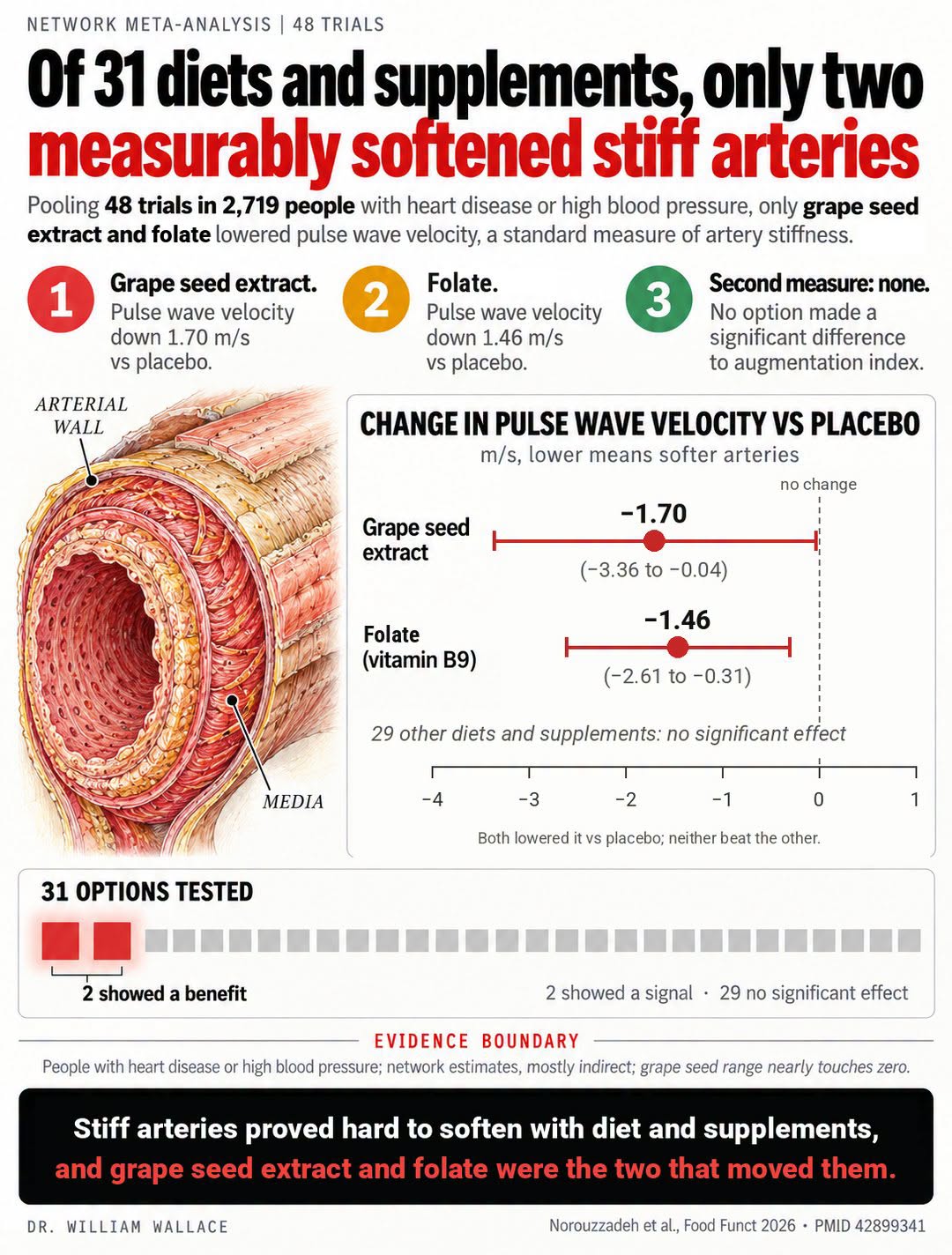
Grape seed extract and folate reduce arterial stiffness.
My note:
Grape seed extract is likely safer than high doses of folate. There are major issues with megadosing folate: ↪ Too much folate may shorten lifespan in animals and promote cancer in humans.
#grapeseedextractHD #folateHD #arterialstiffnessHD #pwvHD
Only two of 31 diet and supplement options made stiff arteries measurably more flexible, and both have a longer track record than most people realize.
Grape seed extract has been studied for blood pressure for more than a decade. A 2016 meta-analysis of 16 randomized trials in 810 people found it lowered systolic pressure by about 6 mmHg and diastolic pressure by about 2.8 mmHg. A 2022 analysis of 19 trials found a 2.2 mmHg drop in diastolic pressure, but no significant change in systolic pressure or in flow-mediated dilation, a test of how well blood vessels relax.
Folate has a similarly mixed history. In a 2005 crossover trial, 41 men with normal to high-normal blood pressure took 5 mg a day for three weeks, and pulse pressure fell by 4.7 mmHg while their large arteries became more compliant. Yet a 2023 meta-analysis found that folate improved flow-mediated dilation but showed no significant effect on pulse wave velocity, the standard measure of artery stiffness.
The newest analysis takes a wider view. Researchers pooled 48 randomized trials covering 2,719 people with heart disease or high blood pressure and ran a network meta-analysis, a method that compares 31 diets and supplements against placebo even when trials never tested them side by side.
Three findings stand out.
- Grape seed extract lowered pulse wave velocity by 1.70 m/s versus placebo (range -3.36 to -0.04), with moderate certainty.
- Folate lowered pulse wave velocity by 1.46 m/s versus placebo (range -2.61 to -0.31), with moderate certainty.
- None of the 31 options made a significant difference to augmentation index, a second measure of how stiff arteries behave.
Stiff arteries push blood pressure up and add strain on the heart, so a shift in pulse wave velocity is worth paying attention to. Among dozens of popular nutritional approaches, only these two showed a measurable signal on this marker, and that signal now sits alongside earlier blood pressure and vessel function data pointing in the same direction.
The boundaries matter. These results apply to people who already have heart disease or high blood pressure. Most of the comparisons are indirect network estimates rather than head-to-head trials. The grape seed range comes within 0.04 of zero, so its estimate is the less precise of the two, and the analysis does not show that either option beat the other. The authors call for dose-tested trials as the next step.
References
Norouzzadeh M et al., Food & Function, 2026
Zhang H et al., Medicine, 2016
Foshati S et al., Pharmacological Research, 2022
Williams C et al., American Journal of Clinical Nutrition, 2005
Bokayeva K et al., Healthcare, 2023