Which supplements have meaningful evidence for heart health, and which are hype? From the group's posts, the honest answer is that only a few have randomized-trial evidence on heart outcomes. Omega-3 fats have the broadest support, CoQ10 has support in heart failure specifically, and folic acid has support for stroke. Most of the rest have effects on blood pressure, lipids or glucose, early signals in small studies, or animal data only. A few appear to carry real risks.
The two admins, Louis Nervegna and Gokhan Can, take supplements themselves and say so. Gokhan notes that he takes multiple supplements, each with limited evidence, and that the aim is to stay grounded about what to expect.1 Louis stresses that an unstudied intervention is "indeterminate", not proven useless, and that it is unwise to bet your life on indeterminate items; each person has to assign their own subjective probability.2 Nothing here is individual medical advice, and the admins recommend discussing supplements with your doctor.
A note on terms. An RCT is a randomized controlled trial, the strongest design for testing a treatment. A hard endpoint is an event such as a heart attack, stroke or death, as opposed to a risk factor or surrogate such as cholesterol, blood pressure or a calcium score. Many supplements improve surrogates without proof that events fall.
What the large reviews show
The 884-trial review
A systematic review in the Journal of the American College of Cardiology, shared by Louis, pooled 884 randomized trials of 27 micronutrients in 883,627 participants. Its main findings were:
- Omega-3 supplementation lowered cardiovascular mortality (RR 0.93), heart attack (RR 0.85) and coronary events (RR 0.86).
- Folic acid lowered stroke risk (RR 0.84), and CoQ10 lowered all-cause mortality (RR 0.68; 95% CI 0.49-0.94).
- Vitamin C, vitamin D, vitamin E and selenium showed no effect on cardiovascular disease or type 2 diabetes risk.
- Beta-carotene increased all-cause mortality (RR 1.10), cardiovascular mortality (RR 1.12) and stroke (RR 1.09).
- A long list (omega-3 and omega-6, L-arginine, L-citrulline, folic acid, vitamin D, magnesium, zinc, alpha-lipoic acid, CoQ10, melatonin, catechin, curcumin, flavanol, genistein and quercetin) showed moderate- to high-quality evidence for improving cardiovascular risk factors.3
The distinction matters: improving a risk factor is not the same as preventing events. Vitamin D, for instance, appears on the risk-factor list but showed no effect on cardiovascular disease risk itself.
Show data
| Relative risk (log scale) | 95% CI | |
|---|---|---|
| Omega-3: cardiovascular death | 0.93 | 0.88–0.97 |
| Omega-3: heart attack | 0.85 | 0.78–0.92 |
| Omega-3: coronary heart disease events | 0.86 | 0.80–0.93 |
| Folic acid: stroke | 0.84 | 0.72–0.97 |
| CoQ10: death from any cause | 0.68 | 0.49–0.94 |
| Beta-carotene: death from any cause | 1.10 | 1.05–1.15 |
| Beta-carotene: cardiovascular death | 1.12 | 1.06–1.18 |
| Beta-carotene: stroke | 1.09 | 1.01–1.17 |
Guidance from Verdin's tiers
Louis also shared a five-tier framework from geroscientist Eric Verdin, ranking longevity supplements from Tier 1 (solid human data) to Tier 5 (the science says no). The content is in images only, so the placements are not recorded here.9
Supplements with the best support
Omega-3 fish oil (EPA and DHA)
A 2021 meta-analysis in Mayo Clinic Proceedings pooled 40 randomized trials with 135,267 participants. EPA/DHA supplementation was associated with a 13% lower risk of heart attack (RR 0.87; high-certainty evidence, number needed to treat 272), 10% lower coronary heart disease events, 35% lower fatal heart attack (moderate certainty) and 9% lower coronary mortality (low certainty), but not a lower rate of the broad cardiovascular-events composite. The effect looked dose dependent: each extra gram per day was linked to about 9% lower risk of coronary events and heart attack. The authors suggest 1,000-2,000 mg/day of EPA plus DHA.4
The post adds a warning: several RCTs showed a small increased risk of atrial fibrillation (an irregular heart rhythm) at high doses, so people at risk should talk to a cardiologist before taking high-dose fish oil.4
Show data
| Relative risk (log scale) | 95% CI | |
|---|---|---|
| Heart attack | 0.87 | 0.80–0.96 |
| Coronary heart disease events | 0.90 | 0.84–0.97 |
| Fatal heart attack | 0.65 | 0.46–0.91 |
| Coronary heart disease death | 0.91 | 0.85–0.98 |
| Broad cardiovascular events composite | 0.95 | 0.90–1.00 |
Other points from the group:
- Plaque. Louis lists high-dose EPA among six strategies with randomized evidence for plaque regression.10 In the EVAPORATE trial, icosapent ethyl 4 g/day cut vulnerable plaque by 17%; the plaque did not shrink much, but its type changed.11
- Dose and testing. Rhonda Patrick, as summarized by Gokhan, describes the Omega-3 Index (EPA plus DHA in red blood cells) with under 4% as undesirable and over 8% as optimal, and says reaching 8% generally takes about 2 g/day.12 Peter Attia takes about 2 g EPA and 1.5 g DHA aiming for roughly 12% in red cells.13 These are personal regimens.
- Not for everything. A review of 33 systematic studies found little evidence that omega-3 supplements build muscle or strength in healthy adults.14 A meta-analysis shared in the group found reduced aggressive behavior, which is unrelated to the heart.15
- Quality and form. One review of nutraceuticals and small dense LDL found inconclusive results for 4 g/day of fish oil on LDL particle size.16
CoQ10 in heart failure
The Q-SYMBIO trial (JACC: Heart Failure, 2014) enrolled 420 patients with moderate to severe chronic heart failure at 17 centers in 9 countries. Half took 100 mg of ubiquinone three times daily for two years on top of standard care. The shared summary reports the primary composite endpoint in 15% versus 26% (a 43% relative reduction), cardiovascular mortality 9% versus 16%, and all-cause mortality 10% versus 18%.5 Louis calls CoQ10 the best-supported dietary intervention for cardiovascular death in heart failure, and the same summary stresses that CoQ10 was added to optimal therapy, not used instead of it.5 This is specific to heart failure, and the pooled review also found a lower all-cause mortality signal.3
Show data
| CoQ10 | Placebo | |
|---|---|---|
| Primary composite (heart failure hospitalization, cardiovascular death, urgent transplant or mechanical support) | 15% | 26% |
| Cardiovascular death | 9% | 16% |
| Death from any cause | 10% | 18% |
Folic acid and B vitamins
Beyond the pooled stroke result (RR 0.84), Louis cites a meta-analysis of 45 randomized trials in 96,962 people in which folic acid lowered stroke risk by 15%, and says RDA-level folic acid is associated with lower risk of stroke and colon cancer in the Harvard Nurses Study.317 A Tufts article he shared reports that certain groups, such as older people with high homocysteine at risk of dementia, benefit substantially from B vitamins.18
Louis argues against assuming methylfolate is superior. He says food folate is less bioavailable than folic acid, which is less bioavailable than methylfolate (5-MTHF), and that high folate levels may feed existing precancerous lesions, with worm and mouse data linking high methylfolate to shorter lifespan. These are his interpretations, and he suggests lower methylfolate doses or folate-rich foods instead.17 Attia nevertheless uses methylfolate and methyl B12 to keep homocysteine below 9.13 Here the group's sources differ.
Cocoa flavanols and multivitamins (the COSMOS trial)
COSMOS randomized more than 21,000 adults to 500 mg/day of cocoa flavanols, a multivitamin, both or neither for about 3.6 years. Total cardiovascular events fell 10%, which was not statistically significant. Cardiovascular death fell a significant 27%, and among people who took the pills regularly, total events fell 15% and cardiovascular death 39%. The authors urge cautious interpretation.1920 Louis calls it one of the highest-quality long-term supplement trials. A follow-up analysis reported that cocoa extract lowered hsCRP (an inflammation marker). Gokhan says he eats cocoa rather than supplementing.21 One member suggested a cheaper bulk cacao extract, estimating 1.5 g gives 500 mg flavanols; the supplier does not test flavanol content, so this is an unverified consumer tip.22
The multivitamin arm is best supported for cognition, not the heart:
- A three-year analysis in adults over 65 estimated about 60% slower cognitive decline (about 1.8 years), with larger benefit in people with significant cardiovascular disease.23
- A later pooled analysis put the benefit at about two years of slower cognitive aging, called modest; effects were unclear for attention and planning, dementia prevention was not tested, and the manufacturer donated tablets.24
- An epigenetic-clock analysis in 958 participants (average age 70) found slowing equivalent to about four months of aging over two years, with editorialists saying "uncertainties remain."2526
- The multivitamin contained B12 at about ten times the RDA, and Louis suspects B12 may drive the cognitive effect; a UCSF study of 231 older adults tied lower active B12 to slower processing speed and more white matter lesions.2728 He speculates the cognitive benefit may matter for people with heart disease, a hypothesis.29
- In the Physicians' Health Study II (over 14,600 participants, 14 years) a multivitamin with 10x RDA of B12 showed an 8% lower cancer risk and no increase in any major disease.30
Mixed or early evidence
Vitamin D and magnesium
The pooled review found no effect of vitamin D on cardiovascular disease or type 2 diabetes.3 Advocates see it differently: Patrick says about 70% of people are at or below 30 ng/mL, suggests 4,000 IU/day with testing to reach 40-60 ng/mL, and cites magnesium needs of about 400 mg/day for men and 300-350 for women.12 Attia takes 5,000 IU daily but acknowledges the need for more rigorous vitamin D studies.13
Practical points from Louis: vitamin D2 may lower 25(OH)D by about 18 nmol/L, and D3 raises levels more, with 2,000-4,000 IU/day suggested for most adults.31 Supplements lack the sun's built-in feedback, so 20,000 IU/day for months risks hypercalcemia, which can cause cardiac arrest and arterial calcification.7 A UK coroner warned after an 89-year-old died of vitamin D toxicity.32
Vitamin K2
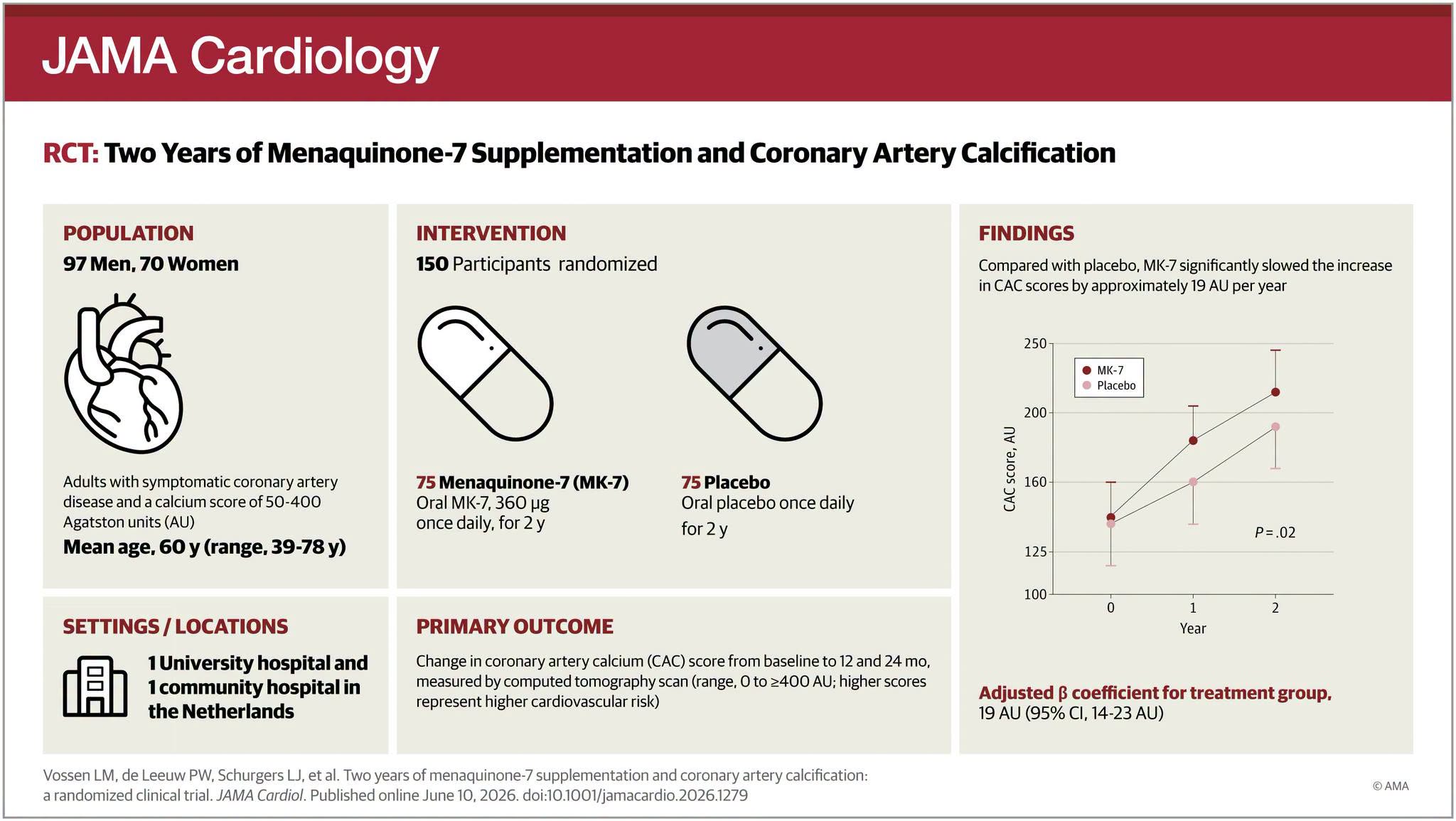
Evidence on K2 is the most debated topic in the group. A JAMA Cardiology randomized trial (2026) found two years of MK-7 reduced coronary calcium progression versus placebo in symptomatic coronary disease, mainly by limiting new calcification in noncalcified plaque. It did not change stenosis severity or total plaque volume, showed no relevant adverse effects, and its effect on events is unknown. Gokhan advises against K2 on warfarin without checking with a doctor.33
Dr. Gil Carvalho, as summarized by Gokhan, is skeptical. Calcium is a marker of long-standing plaque, not the cause of risk, and no large powered trials show K2 reduces heart attacks or strokes; slowing calcification without reducing plaque could even be unhelpful, since calcium may stabilize plaque. The main danger is false reassurance.134 Louis takes K2 mainly for insulin sensitivity, citing three RCTs of MK-7 (90-360 mcg/day) that lowered fasting glucose and HbA1c in type 2 diabetes, though the source is a supplement-industry magazine.35
Taurine
A 2026 meta-analysis in Nutrition Reviews pooled 34 randomized trials in 1,394 people and found that oral taurine improved several cardiometabolic markers versus placebo or control; the post does not list which markers or the effect sizes.36 The broader taurine case, as Gokhan summarizes it, relies largely on animal and observational data.37 Gokhan has said he may have overdosed taurine and beta-alanine in the past.38
Berberine, curcumin and red yeast rice
- Berberine lowered TMAO (a gut-derived compound linked to atherosclerosis) and plaque in a small human trial mentioned by Gokhan.39
- 1,000 mg/day curcuminoids with 5 mg piperine reduced small dense LDL in one trial.16
- Red yeast rice still lowers cholesterol through related monacolins even though US products are supposed to contain no lovastatin. Louis says it may suit people who cannot tolerate statins, but it is unregulated and variable, with no large trials showing fewer heart attacks, so it is a gamble for high-risk people.40
Supplements for plaque: promising but unproven
Louis notes that the supplements said to stop plaque rest on small, lower-quality studies that look promising but are uncertain; he considers gotu kola the most plausible mechanistically.1041 A Life Extension summary describes 60 mg of Centella asiatica extract three times daily hardening carotid plaque by 30% and femoral plaque by 63% over 12 months, with 41% fewer events in a randomized phase. Louis calls for larger trials.42
Aged garlic extract (about 1.2 g/day) slowed calcium progression in three small RCTs (for example 6.8% versus 26.5% in 65 patients), although two used co-supplements.43 Charles Grashow's calcium score fell from 102 to 32 while he took high-dose nattokinase, but also rosuvastatin, ezetimibe, telmisartan and other supplements, so it is a single case, not a trial.4445
For context, trials in the group show plaque regression with major weight loss, Mediterranean or DASH diets, LDL-lowering drugs, colchicine, exercise and high-dose EPA.1011
Possible harms and hype
- L-arginine. In a Johns Hopkins trial of 153 heart attack survivors (3 g three times daily), the trial was stopped at six months with 6 deaths on arginine and none on placebo. Louis speculates citrulline may carry similar concern.6 Gokhan uses a lower 700 mg dose personally.38
- L-carnitine. A 6-month trial in metabolic syndrome found worsening carotid plaque stenosis versus placebo, though plaque volume did not change; TMAO is the suspected mechanism.46
- Glutathione. Louis argues oral glutathione barely enters cells and may disturb signaling outside them, favoring foods that raise production inside cells. This is mechanistic opinion.4748
- NAD precursors. A Nature Metabolism study found whole-blood NAD stays stable with age, which makes commercial NAD blood tests of little use, and there is no convincing evidence NR or NMN slow human aging.49
- Animal or tiny-sample findings. Alpha-ketoglutarate extended lifespan in worms and mice (Gokhan takes it).50 Vanadyl sulfate extended male mouse lifespan 7.4%, but vanadium is toxic.51 Tricaprin reversed lesions in just two patients with a rare condition.52 A ketone ester improved cardiac function only acutely.53
- Turmeric and creatine. Louis argues that a turmeric liver-injury case report involved a normal dose and untested capsules.54 Creatine showed more cancer spread in animals, but human data are reassuring.55
- Collagen and whey. Collagen improved skin and osteoarthritis symptoms but is a poor muscle protein.56 Louis says processed whey has no long-term data, unlike yogurt.57
- Medicine interactions. Louis notes some supplements compound the anticoagulant effect of Eliquis, which is metabolized by CYP3A4.8
What this means for you
Where the main supplements stand in the group's posts34561719334243:
| Supplement | Strongest evidence shared | Effect on heart events |
|---|---|---|
| Omega-3 (EPA plus DHA) | Meta-analyses of 40 and 884 randomized trials | Fewer heart attacks (RR 0.85-0.87); possible atrial fibrillation risk at high doses |
| CoQ10 | Q-SYMBIO trial in heart failure | Cardiovascular death 9% vs 16% in heart failure |
| Folic acid | Meta-analysis of 45 trials | About 15% fewer strokes |
| Cocoa flavanols | COSMOS trial | 27% fewer cardiovascular deaths (secondary outcome); main endpoint not significant |
| Vitamins C, D, E, selenium | 884-trial review | No effect on cardiovascular disease |
| Vitamin K2 | 2026 JAMA Cardiology trial | Slower calcium progression; effect on events unknown |
| Gotu kola, aged garlic, nattokinase | Small studies or a single case | Not shown in large trials |
| Beta-carotene | 884-trial review | Higher death rate (RR 1.10) |
| L-arginine after a heart attack | Trial stopped early | 6 deaths vs 0 on placebo |
- Treat omega-3 (1,000-2,000 mg/day EPA plus DHA), CoQ10 in heart failure and folic acid for stroke as the best-supported options, and discuss them with your doctor.345
- If you take fish oil at high doses, ask about atrial fibrillation risk.4
- Avoid assuming a supplement proven to move a surrogate (calcium score, glucose, LDL) will prevent events.133
- Be cautious with L-arginine after a heart attack and with carnitine.646
- Test vitamin D levels before using high doses.712
- Tell your doctor about all supplements, especially if you take blood thinners.833
- Never use supplements instead of proven treatments.1 Gokhan and Hasselbalch published a review of heart drugs, supplements and lifestyle in polycythemia vera.58
Frequently asked questions
Does a multivitamin protect the heart?
The pooled review did not show benefit for vitamins C, D, E or selenium on cardiovascular disease.3 COSMOS supports modest cognitive and aging-marker benefits from a standard multivitamin, not proven heart protection.2425
Is fish oil worth taking?
Pooled trials suggest fewer heart attacks, with 1,000-2,000 mg/day suggested and some atrial fibrillation risk at high doses.4
Can supplements reverse plaque?
Not proven. Small studies and individual stories exist, but better-established routes are weight loss, diet, LDL-lowering drugs and exercise.1041
Is vitamin K2 worth it?
Debated: it slows calcium progression in a recent RCT but has no proven effect on events.3334