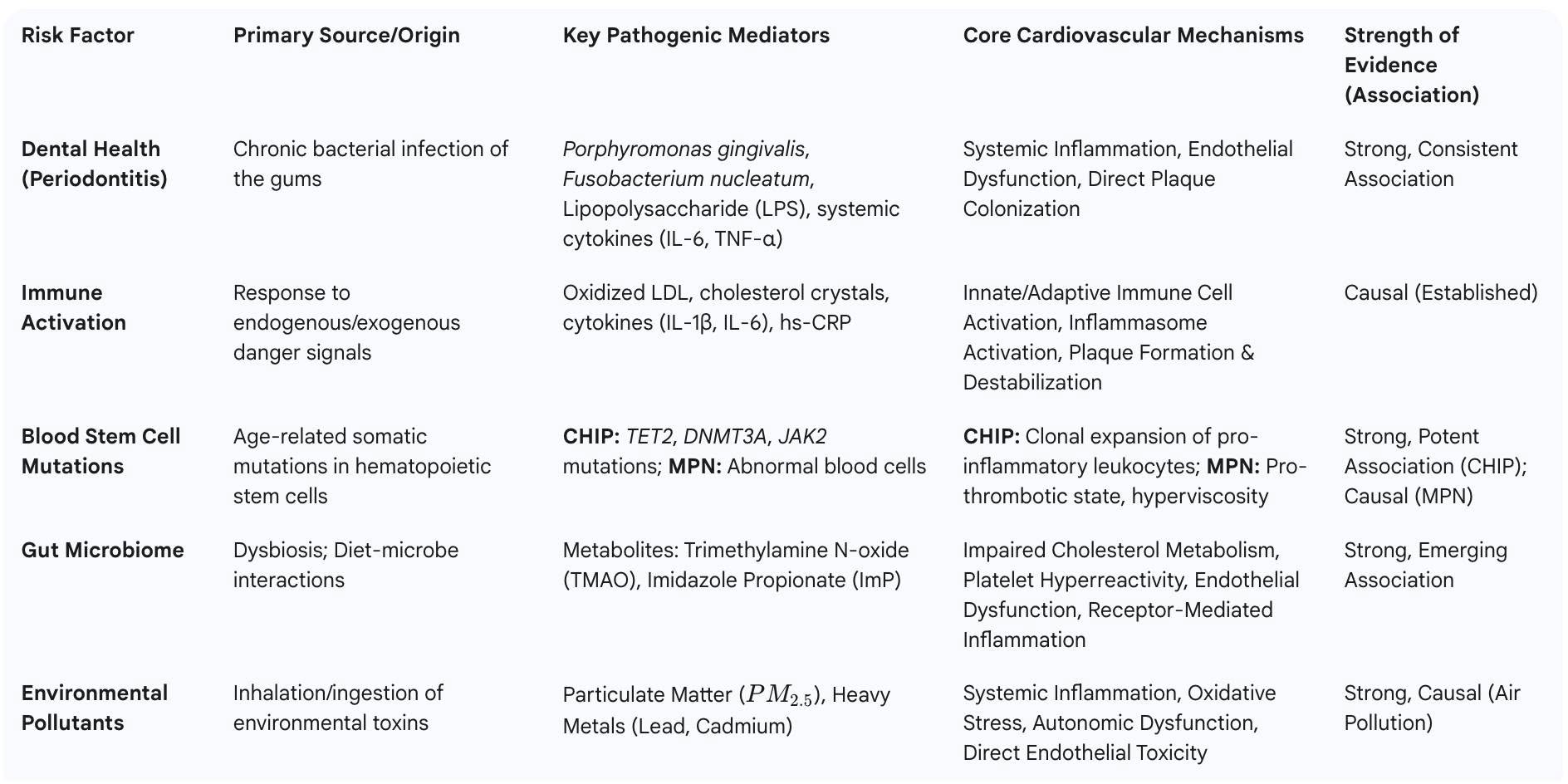
This article does an excellent job of explaining why inflammation is an independent risk factor for heart disease. Inflammation is largely independent of classical risk factors like LDL, blood pressure, diabetes, smoking, etc.
Even if all your classical risk factors are well managed, inflammation might still be driving the progression of your disease.
Quoted:
“This deadly puzzle has haunted cardiologist Paul Ridker for years. “I remember saying to myself that there must be some other fundamental determinant of heart disease,” says Ridker, who is director of the Center for Cardiovascular Disease Prevention at Brigham and Women’s Hospital in Boston.
Dozens of studies and clinical trials later, Ridker thinks he has found the missing piece. His work, along with that of other researchers, now suggests that chronic inflammation—a prolonged and body-damaging state of immune system activation—may be the hidden factor that accelerates cardiovascular problems to a dangerous and deadly state. When cholesterol builds up in the arteries, it shape-shifts into a sharp and jagged form the body no longer recognizes, provoking the immune system to wage war against it and blood vessels. It is a battle with no winners, and the wreckage it leaves behind ends in heart attacks and strokes.”
“Inflammation is a complicated process. It’s the body’s built-in alarm system, activated when the immune system senses that something untoward is happening. The body recruits immune cell soldiers to the scene, which launch an attack against any unwelcome intruders and cells they’ve infected. That’s why your throat gets red and swollen when you have the flu. Sometimes this alarm system becomes overzealous—fighting too hard or too long—and ends up harming the body’s healthy tissues in the process.”
“Surprisingly, Ridker’s work started to suggest that statin drugs didn’t just reduce cholesterol—they damped inflammation, too. In a 2001 study, he and his colleagues showed that pravastatin, sold under the brand name Pravachol, reduced levels of CRP by 17 percent after 24 weeks. And in a 2005 study published in the New England Journal of Medicine, Ridker and his co-workers reported that regardless of their LDL cholesterol levels, people who took statins and had low CRP levels were less likely to have heart attacks or die from heart-related causes than people who took statins but had high CRP levels.”
“That discovery raised a radical question: Could people with healthy cholesterol levels—who typically would not be prescribed statins—still benefit from the drugs if their degree of inflammation was high?
Ridker decided to find out. He and his team designed a clinical trial to see whether people with low LDL but high CRP would benefit from statin therapy. They did—and markedly so. Published in 2008 and known as JUPITER, this trial enrolled nearly 18,000 participants with low LDL and high CRP to receive either a statin or a placebo. The trial was stopped early, after following people for an average of about two years, because the statins proved so effective. Those who took them were 54 percent less likely to have a heart attack and 48 percent less likely to have a stroke. A follow-up analysis of JUPITER patients showed that people most strongly protected from heart trouble were those who had lowered both their cholesterol and their CRP levels on the drug.”
“At first glance the JUPITER findings suggest that cholesterol’s true role in heart disease might be a small one. But the opposite is true: cholesterol, it turns out, is the match that lights the fire of vascular inflammation. A match in the shape of a crystal.”
“These discoveries and theories of action suggest that cholesterol is not the only bad guy in the story. The immune system’s overreaction to cholesterol crystals—the chronic inflammation it causes—is potentially far more dangerous.”
“In 2023, based in part on these findings, the FDA approved the use of colchicine to reduce the risk of heart attack, stroke, coronary revascularization, and cardiovascular death in patients with atherosclerotic disease or multiple risk factors for heart disease. That was followed two years later by the American College of Cardiology’s recommendation that health-care providers routinely screen patients’ CRP levels—a striking sign of how far the field has come.”
“Ultimately the hope is not merely to prevent heart attacks and strokes but to stop atherosclerosis and heart disease before they start. To that end, Tardif recently started a clinical trial involving 10,000 patients with type 2 diabetes to see whether colchicine can prevent heart disease in such people. Diabetes is a prime risk factor for cardiac trouble. “We’re trying to show that reducing inflammation very early in the process is going to help,” he says. At N.Y.U., Moore’s lab is trying to answer a related question: Is it possible to find drugs that can not only help to stop the immune fire but also repair the damage it’s already done?
Ridker thinks much of that is possible. After decades of skepticism, he is enjoying seeing his once radical idea go mainstream. The change ‘is very exciting,’ he says. ‘Twenty years ago people thought we were just nuts.’ “