The GLP-1 cancer story keeps getting more interesting.
These drugs started as diabetes medications. Then they transformed obesity treatment. Now researchers are asking a bigger question:
Could GLP-1 medications also reduce cancer risk, slow cancer progression, or even improve the effectiveness of cancer treatments?
A new Washington Post article highlights several studies presented at ASCO looking at GLP-1 drugs such as Ozempic, Wegovy, and Mounjaro in cancer prevention, progression, and survival. Science around glp drugs cancer is suddenly getting lot more interesting (washingtonpost.com)
The numbers are worth paying attention to:
- More than 40 ASCO studies, abstracts, oral presentations, and posters examined GLP-1 drugs and cancer.
- Obesity is associated with 13 different cancers.
- A University of Pennsylvania study of more than 100,000 women found GLP-1 users were about 30% less likely to develop breast cancer.
- A breast cancer analysis of more than 137,000 patients found 5-year survival of nearly 96% in GLP-1 users, compared with about 90% in similar nonusers.
- A study of 10,225 patients across seven solid tumors found GLP-1 use was associated with lower progression to stage IV disease.
- The strongest metastatic-progression signals were seen in lung, breast, colorectal, and liver cancers, with risk reductions in the range of about 31% to 50%.
- In chronic pancreatitis, GLP-1 use was associated with a more than 50% lower risk of pancreatic cancer.
- One acute myeloid leukemia analysis found a 63% lower risk among GLP-1 users.
- In metastatic colorectal cancer patients receiving immunotherapy, GLP-1 use was associated with lower mortality at 3 years, 5 years, and beyond.
- In more than 25,000 patients with metastatic non-small cell lung cancer treated with targeted therapies called TKIs, GLP-1 users had 5-year survival of 63%, compared with 40% among nonusers.
- In one lung cancer subgroup treated with ALK inhibitors, survival was reported as 85% in GLP-1 users versus 48% in nonusers.
That is a lot of signal.
But it is not proof.
Most of these studies are observational. That means they can show associations, but they cannot prove that GLP-1 drugs prevent cancer or improve cancer survival.
There is also an important caution: randomized trial data so far have not clearly proven that GLP-1 drugs reduce cancer risk. Many of those trials were not designed to study cancer outcomes and had limited follow-up, but the distinction matters.
Another nuance: some studies compare GLP-1 drugs against insulin. Since insulin itself may have cancer-promoting biology in some settings, that comparison could make GLP-1s look more favorable. When GLP-1s are compared with metformin or SGLT2 inhibitors, the advantage may be smaller or may disappear.
So no, I would not call GLP-1s cancer-prevention drugs today.
And I would not recommend them specifically to treat cancer.
But I also would not ignore this signal.
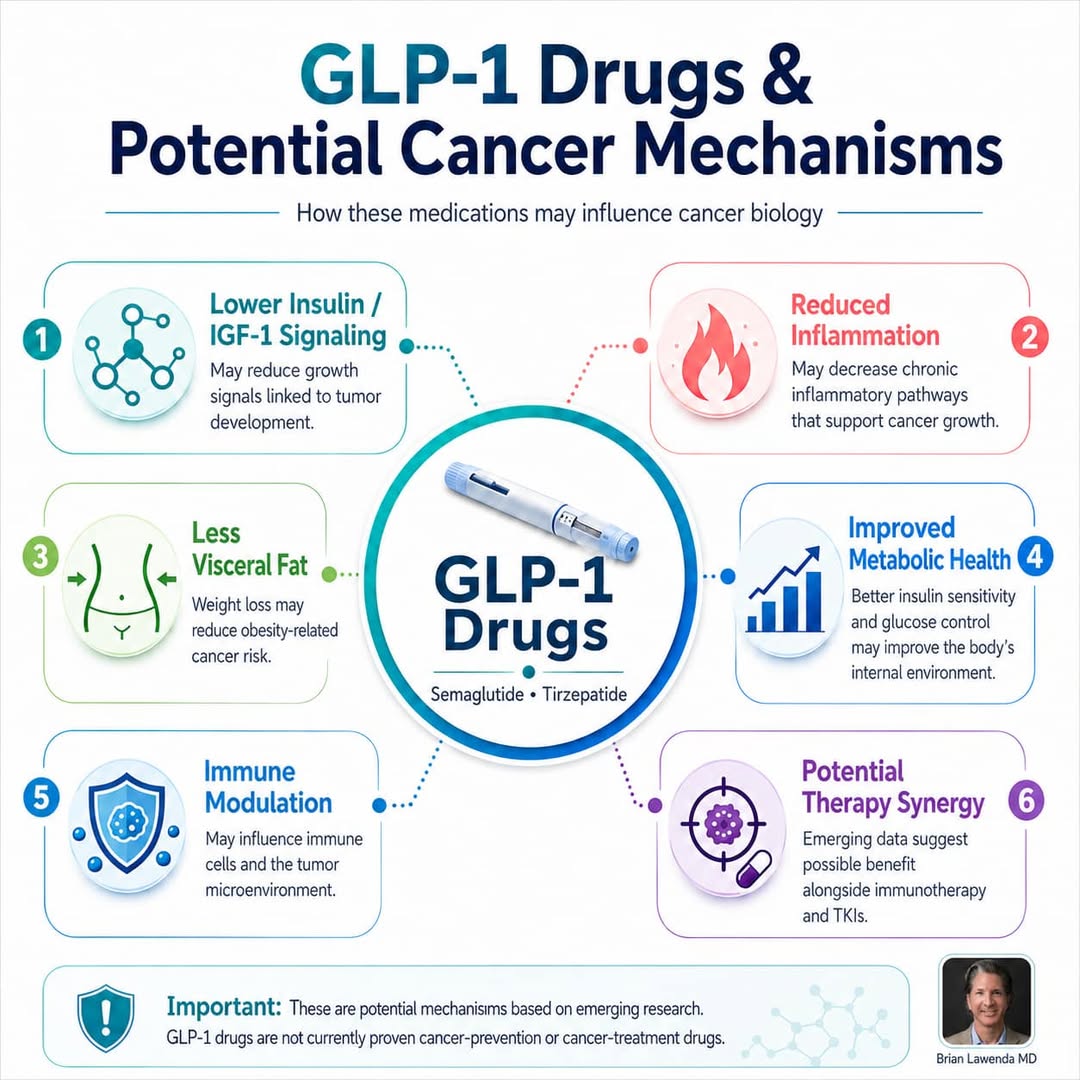
The most interesting question is whether the benefits are simply from weight loss, or whether GLP-1 drugs are doing something deeper: improving insulin resistance, lowering inflammation, altering immune signaling, changing the tumor microenvironment, or possibly making immunotherapy and targeted therapy work better.
Cancer is not only a genetic disease.
It is also influenced by metabolism, inflammation, hormones, immune function, insulin resistance, visceral fat, and the environment around the tumor.
That may be the real lesson here.
GLP-1 drugs may end up being one of the most important metabolic therapies of our time.
Not proven cancer drugs.
But absolutely worth studying.