A nice summary of some of the research on Urolithin A (mostly preclinical in animals), with practical recommendations.
As I’ve posted about before, Urolithin A might have some value in treating heart failure, among other things.
A shared summary of research on urolithin A, a compound gut bacteria make from ellagitannins in pomegranate, walnuts and berries. The poster notes most of the evidence is preclinical in animals and says it may have value in heart failure. The summary also mentions human trials published in Nature Medicine.
A nice summary of some of the research on Urolithin A (mostly preclinical in animals), with practical recommendations.
As I’ve posted about before, Urolithin A might have some value in treating heart failure, among other things.
Urolithin A did not exist as a named compound in most people's awareness five years ago.
It is now one of the most actively researched longevity molecules in existence — the subject of human clinical trials at the Swiss Federal Institute of Technology, published in Nature Medicine, funded by serious academic institutions and biotech companies investing hundreds of millions of dollars in its potential.
Not because it is exotic. Not because it was synthesised in a laboratory.
Because it is produced in your gut from pomegranate — and it does something that almost nothing else can do naturally.
It activates mitophagy — the selective removal of damaged mitochondria — with a specificity and potency that researchers have struggled to replicate pharmaceutically.
And in doing so it addresses one of the most fundamental mechanisms of ageing, muscle decline, neurodegeneration, and metabolic dysfunction simultaneously. 🌱
🔬 𝐖𝐇𝐀𝐓 𝐔𝐑𝐎𝐋𝐈𝐓𝐇𝐈𝐍 𝐀 𝐈𝐒
Urolithin A is a urolithin — a class of compounds produced by gut bacteria when they metabolise ellagitannins and ellagic acid from specific plant foods.
The primary dietary sources of ellagitannins:
→ Pomegranate — the richest source; pomegranate juice, seeds, and extract
→ Walnuts
→ Raspberries
→ Strawberries
→ Blackberries
→ Muscadine grapes
→ Oak-aged red winesThe process: ellagitannins from these foods reach the large intestine — where specific gut bacteria (primarily Gordonibacter urolithinfaciens and Ellagibacter isourolithinifaciens) metabolise them through a multi-step fermentation process into urolithins — primarily urolithin A, urolithin B, and urolithin M5. Urolithin A is the most bioactive and most studied form.
The critical problem: only approximately 30–40% of people have the specific gut bacteria required to efficiently produce urolithin A from dietary ellagitannins.
This means that for 60–70% of people — eating pomegranate produces little or no urolithin A. The food is consumed. The ellagitannins are present. But without the right gut bacteria — the conversion does not happen.
This is one of the clearest demonstrations of why microbiome health determines nutritional outcomes — and why urolithin A supplementation is genuinely distinct from simply eating more pomegranate for a significant proportion of the population.
⚙️ 𝐖𝐇𝐀𝐓 𝐔𝐑𝐎𝐋𝐈𝐓𝐇𝐈𝐍 𝐀 𝐃𝐎𝐄𝐒 — 𝐓𝐇𝐄 𝐌𝐄𝐂𝐇𝐀𝐍𝐈𝐒𝐌𝐒
🔵 𝐌𝐢𝐭𝐨𝐩𝐡𝐚𝐠𝐲 𝐚𝐜𝐭𝐢𝐯𝐚𝐭𝐢𝐨𝐧 — 𝐭𝐡𝐞 𝐩𝐫𝐢𝐦𝐚𝐫𝐲 𝐚𝐧𝐝 𝐦𝐨𝐬𝐭 𝐞𝐱𝐭𝐫𝐚𝐨𝐫𝐝𝐢𝐧𝐚𝐫𝐲 𝐦𝐞𝐜𝐡𝐚𝐧𝐢𝐬𝐦:
Mitophagy is the selective autophagy of mitochondria — the targeted removal of damaged, dysfunctional mitochondria through the cellular self-cleaning machinery. Think of it as the body's quality-control system for its own power generators: damaged units are identified, dismantled, and replaced with new ones.
Healthy mitochondrial quality control requires a continuous cycle:
→ Damaged mitochondria are tagged for removal — through the PINK1/Parkin pathway
→ The autophagosome (a cellular disposal vehicle) engulfs the damaged mitochondrion
→ The lysosome degrades and recycles its components
→ New healthy mitochondria replace the cleared ones through biogenesisWith ageing — mitophagy becomes progressively impaired. Damaged mitochondria accumulate instead of being cleared. The cell fills with dysfunctional power generators producing more reactive oxygen species and less ATP — driving the energy failure, oxidative stress, and inflammatory signalling that characterise aged tissue.
Impaired mitophagy is now understood as one of the primary mechanisms of biological ageing — in muscle, neurons, cardiac tissue, and immune cells.
Urolithin A directly activates mitophagy — through multiple complementary pathways:
→ Activates the PINK1/Parkin mitophagy pathway — the primary selective mitophagy mechanism
→ Activates AMPK — the cellular energy sensor that drives autophagy broadly
→ Inhibits mTOR — releasing the brake on autophagy
→ Upregulates autophagy gene expression — LC3, BECN1, and ATG genes
→ Improves lysosomal function — the cellular recycling machinery that completes autophagyThe result: damaged mitochondria are cleared more efficiently; the mitochondrial pool is renewed; cellular energy production improves; oxidative stress falls; inflammatory signalling from dysfunctional mitochondria decreases.
This is not simply an antioxidant effect. This is quality control at the level of the organelle — and it is a mechanism that most supplements cannot touch.
🔵 𝐌𝐮𝐬𝐜𝐥𝐞 𝐡𝐞𝐚𝐥𝐭𝐡 𝐚𝐧𝐝 𝐩𝐡𝐲𝐬𝐢𝐜𝐚𝐥 𝐩𝐞𝐫𝐟𝐨𝐫𝐦𝐚𝐧𝐜𝐞 — 𝐭𝐡𝐞 𝐦𝐨𝐬𝐭 𝐜𝐥𝐢𝐧𝐢𝐜𝐚𝐥𝐥𝐲 𝐯𝐚𝐥𝐢𝐝𝐚𝐭𝐞𝐝 𝐚𝐩𝐩𝐥𝐢𝐜𝐚𝐭𝐢𝐨𝐧:
The landmark 2022 human clinical trial published in Nature Aging — from Amazentis/EPFL — demonstrated that urolithin A supplementation (1,000mg daily for 4 months) in middle-aged and older adults produced:
→ Significantly improved muscle endurance — hand grip strength, walking endurance, and aerobic capacity
→ Increased mitochondrial gene expression in muscle tissue
→ Reduced inflammatory markers — C-reactive protein and several inflammatory cytokines
→ Improved mitochondrial health biomarkersThis was a double-blind, randomised, placebo-controlled trial — the gold standard of clinical evidence. The improvements in physical performance through a mitophagy mechanism represented a genuinely novel clinical finding.
Sarcopenia — age-related muscle loss — is driven in large part by mitochondrial dysfunction in muscle cells. Impaired mitophagy allows damaged mitochondria to accumulate in muscle fibres — reducing their energy production capacity and contractile force. Urolithin A addresses this at the root — not by providing more fuel to failing mitochondria but by clearing the damaged ones and creating the conditions for functional renewal.
🔵 𝐍𝐞𝐮𝐫𝐨𝐥𝐨𝐠𝐢𝐜𝐚𝐥 𝐩𝐫𝐨𝐭𝐞𝐜𝐭𝐢𝐨𝐧:
Neurons are among the most mitochondria-dependent cells in the body — and among the most vulnerable to mitochondrial dysfunction.
Urolithin A in the brain:
→ Activates neuronal mitophagy — clearing damaged mitochondria from neurons before they can drive oxidative stress and neuroinflammation
→ Reduces amyloid-beta accumulation — through improved mitochondrial function and reduced oxidative stress in neurons
→ Reduces neuroinflammation — through microglial mitophagy improvement and reduced inflammatory signalling from damaged mitochondria
→ Protects against Parkinson's-like dopaminergic neuron loss in animal models — through PINK1/Parkin pathway activation in the substantia nigra
→ Improves cognitive function in ageing animal modelsThe neurological applications of urolithin A are earlier in development than the muscle applications — but mechanistically compelling and supported by consistent animal model data.
🔵 𝐈𝐦𝐦𝐮𝐧𝐞 𝐬𝐲𝐬𝐭𝐞𝐦 𝐫𝐞𝐣𝐮𝐯𝐞𝐧𝐚𝐭𝐢𝐨𝐧:
Immune cells — particularly T cells and NK cells — are extraordinarily mitochondria-dependent. Aged immune cells with accumulating mitochondrial dysfunction become less responsive, less precise, and less capable of anti-tumour and anti-viral activity.
Urolithin A improves immune cell mitochondrial function through mitophagy — with documented improvements in:
→ NK cell killing activity
→ T cell proliferative capacity
→ Reduction of inflammaging — the chronic low-grade inflammatory state of ageing driven partly by dysfunctional immune cell mitochondriaThis immune rejuvenation effect may be one of the most clinically significant but least discussed applications of urolithin A — particularly relevant to cancer immunosurveillance and anti-viral immunity in ageing populations.
🔵 𝐆𝐮𝐭 𝐡𝐞𝐚𝐥𝐭𝐡:
Urolithin A — produced in and acting within the gut before systemic absorption — has documented gut-specific effects:
→ Strengthens intestinal tight junctions — reducing intestinal permeability
→ Reduces intestinal inflammation — through NF-kB inhibition in gut epithelial and immune cells
→ Promotes beneficial microbiome shifts — including Akkermansia enrichment
→ Reduces colonic oxidative stressThe bidirectional relationship: a healthy microbiome produces more urolithin A; urolithin A improves the microbiome. A damaged microbiome produces less urolithin A; reduced urolithin A allows gut inflammation to worsen microbiome composition — a self-perpetuating cycle in both directions.
🔵 𝐂𝐚𝐫𝐝𝐢𝐨𝐯𝐚𝐬𝐜𝐮𝐥𝐚𝐫 𝐩𝐫𝐨𝐭𝐞𝐜𝐭𝐢𝐨𝐧:
→ Reduces cardiac mitochondrial dysfunction — through mitophagy activation in heart muscle cells
→ Reduces atherosclerotic plaque formation in animal models
→ Improves endothelial function
→ Reduces cardiac inflammatory markers
→ Protects against ischaemia-reperfusion injury in animal models🔵 𝐀𝐧𝐭𝐢-𝐢𝐧𝐟𝐥𝐚𝐦𝐦𝐚𝐭𝐨𝐫𝐲:
Beyond mitophagy-mediated inflammation reduction — urolithin A directly inhibits NF-kB and reduces pro-inflammatory cytokine production through multiple mechanisms. The reduction in damaged mitochondria — the primary source of damage-associated molecular patterns (DAMPs) that chronically activate innate immune inflammatory signalling — may be the most important anti-inflammatory mechanism.
🌿 𝐂𝐎𝐍𝐃𝐈𝐓𝐈𝐎𝐍𝐒 𝐖𝐇𝐄𝐑𝐄 𝐔𝐑𝐎𝐋𝐈𝐓𝐇𝐈𝐍 𝐀 𝐈𝐒 𝐌𝐎𝐒𝐓 𝐑𝐄𝐋𝐄𝐕𝐀𝐍𝐓
🔵 𝐒𝐚𝐫𝐜𝐨𝐩𝐞𝐧𝐢𝐚 𝐚𝐧𝐝 𝐦𝐮𝐬𝐜𝐥𝐞 𝐚𝐠𝐞𝐢𝐧𝐠:
The most clinically validated application. For anyone over 40 experiencing reduced muscle strength, endurance, or recovery — urolithin A addresses the mitochondrial root of muscle ageing more directly than almost any other natural compound.
Combined with:
→ Resistance training — the most potent stimulus for muscle mitochondrial biogenesis
→ Adequate protein — particularly leucine-rich animal protein
→ Creatine — the most evidence-supported ergogenic aid for muscle energy
→ Vitamin D — muscle fibre function and testosterone supportThis combination addresses muscle ageing from every relevant angle simultaneously.
🔵 𝐌𝐢𝐭𝐨𝐜𝐡𝐨𝐧𝐝𝐫𝐢𝐚𝐥 𝐝𝐢𝐬𝐞𝐚𝐬𝐞 𝐚𝐧𝐝 𝐝𝐲𝐬𝐟𝐮𝐧𝐜𝐭𝐢𝐨𝐧:
For any condition involving significant mitochondrial impairment — ME/CFS, Long COVID fatigue, fibromyalgia, post-chemotherapy fatigue — urolithin A addresses the organelle-level quality control that underlies mitochondrial functional decline.
🔵 𝐍𝐞𝐮𝐫𝐨𝐝𝐞𝐠𝐞𝐧𝐞𝐫𝐚𝐭𝐢𝐨𝐧 𝐩𝐫𝐞𝐯𝐞𝐧𝐭𝐢𝐨𝐧:
Particularly for Parkinson's — where the PINK1/Parkin pathway that urolithin A activates is the same pathway mutated in familial Parkinson's; urolithin A functionally compensates for reduced PINK1/Parkin activity — making it one of the most mechanistically rational natural interventions for Parkinson's prevention and early support.
For Alzheimer's prevention — combined with fisetin, lion's mane, omega-3s, and dietary polyphenols — urolithin A addresses the mitochondrial dimension of neurodegeneration that other compounds do not specifically target.
🔵 𝐈𝐦𝐦𝐮𝐧𝐞 𝐚𝐠𝐞𝐢𝐧𝐠 (𝐢𝐦𝐦𝐮𝐧𝐨𝐬𝐞𝐧𝐞𝐬𝐜𝐞𝐧𝐜𝐞):
For older adults with declining immune function — particularly relevant to cancer immunosurveillance and response to infection — urolithin A's immune cell mitochondrial rejuvenation effect is directly relevant.
🔵 𝐀𝐭𝐡𝐥𝐞𝐭𝐢𝐜 𝐩𝐞𝐫𝐟𝐨𝐫𝐦𝐚𝐧𝐜𝐞 𝐚𝐧𝐝 𝐫𝐞𝐜𝐨𝐯𝐞𝐫𝐲:
Beyond ageing populations — urolithin A improves mitochondrial quality in younger athletic populations — potentially improving endurance performance, reducing recovery time, and enhancing the mitochondrial adaptation to training.
🔵 𝐋𝐨𝐧𝐠 𝐂𝐎𝐕𝐈𝐃:
Mitochondrial dysfunction is one of the most consistently documented biological findings in Long COVID — particularly driving the post-exertional malaise and profound fatigue. Urolithin A's mitophagy activation directly addresses this mechanism.
💊 𝐒𝐔𝐏𝐏𝐋𝐄𝐌𝐄𝐍𝐓𝐀𝐓𝐈𝐎𝐍 — 𝐓𝐇𝐄 𝐏𝐑𝐀𝐂𝐓𝐈𝐂𝐀𝐋 𝐆𝐔𝐈𝐃𝐄
🔵 𝐖𝐡𝐨 𝐧𝐞𝐞𝐝𝐬 𝐭𝐨 𝐬𝐮𝐩𝐩𝐥𝐞𝐦𝐞𝐧𝐭:
Given that 60–70% of people cannot efficiently produce urolithin A from food — supplementation is not simply a convenience. For the majority of people — it is the only way to access meaningful urolithin A levels regardless of dietary intake.
A simple test: eat 200ml of pomegranate juice daily for 4 weeks and measure urolithin A in urine (through specialised testing). If levels are low — you are likely a non-converter and supplementation is indicated.
🔵 𝐂𝐨𝐦𝐦𝐞𝐫𝐜𝐢𝐚𝐥 𝐬𝐮𝐩𝐩𝐥𝐞𝐦𝐞𝐧𝐭𝐬:
Mitopure (Amazentis/Timeline):
→ The most studied commercial urolithin A supplement
→ The formulation used in the Nature Aging clinical trial
→ Pharmaceutical-grade purity and standardised urolithin A content
→ Available as powder sachets and capsules
→ The benchmark against which other products should be measuredGeneric urolithin A supplements:
→ Increasingly available from multiple manufacturers; significantly less expensive than Mitopure
→ Purity and bioavailability vary — look for third-party tested products with standardised urolithin A content
→ The compound itself is relatively straightforward to produce — quality control is the primary variable🔵 𝐃𝐨𝐬𝐢𝐧𝐠:
→ Research-backed dose: 500mg–1,000mg daily
→ The Nature Aging trial used 1,000mg daily — the most evidence-supported dose
→ 500mg daily may be sufficient for maintenance and prevention in younger populations
→ 1,000mg daily for active mitochondrial rehabilitation — post-illness, sarcopenia, significant fatigue🔵 𝐓𝐢𝐦𝐢𝐧𝐠 𝐚𝐧𝐝 𝐛𝐢𝐨𝐚𝐯𝐚𝐢𝐥𝐚𝐛𝐢𝐥𝐢𝐭𝐲:
→ Take with food — fat improves absorption
→ Morning dosing is practical — no specific timing advantage over evening
→ Effects on mitochondrial gene expression visible within weeks in research
→ Physical performance improvements documented at 4 months in the clinical trial
→ Long-term continuous use appears safe and progressively beneficial — no documented tolerance or diminishing returns
→ Urolithin A has reasonable oral bioavailability — better than many polyphenols; liposomal forms show promise but are not yet the standard🔗 𝐓𝐇𝐄 𝐌𝐈𝐓𝐎𝐏𝐇𝐀𝐆𝐘 𝐒𝐓𝐀𝐂𝐊 — 𝐔𝐑𝐎𝐋𝐈𝐓𝐇𝐈𝐍 𝐀 𝐈𝐍 𝐂𝐎𝐌𝐁𝐈𝐍𝐀𝐓𝐈𝐎𝐍
Urolithin A works synergistically with compounds that support mitophagy through complementary mechanisms.
The core mitophagy stack:
→ Urolithin A 500–1,000mg — PINK1/Parkin pathway activation; primary mitophagy driver
→ Spermidine 1–3mg — complementary mitophagy activation through different autophagy pathways
→ Fisetin 100–200mg — AMPK activation and mTOR inhibition supporting autophagy
→ NAD+ precursor (NMN/NR) 250–500mg — energy substrate for mitophagy machinery
→ CoQ10 (ubiquinol) 100–300mg — mitochondrial electron transport supportThe broader longevity stack incorporating urolithin A:
→ Urolithin A — mitophagy
→ Fisetin — senolytic (clearing senescent cells)
→ Apigenin — CD38 inhibition, NAD+ protection
→ Quercetin — complementary senolytic, anti-inflammatory
→ Spermidine — autophagy, epigenetic regulation
→ Resveratrol/pterostilbene — SIRT1 activation
→ NMN or NR — NAD+ restorationThese compounds address the primary hallmarks of ageing through non-overlapping and complementary mechanisms — representing the most comprehensive evidence-based natural longevity protocol currently available.
🌿 𝐅𝐎𝐎𝐃 𝐀𝐏𝐏𝐑𝐎𝐀𝐂𝐇 — 𝐌𝐀𝐗𝐈𝐌𝐈𝐒𝐈𝐍𝐆 𝐄𝐋𝐋𝐀𝐆𝐈𝐓𝐀𝐍𝐍𝐈𝐍 𝐈𝐍𝐓𝐀𝐊𝐄 𝐀𝐍𝐃 𝐂𝐎𝐍𝐕𝐄𝐑𝐒𝐈𝐎𝐍
For the 30–40% who are efficient converters — dietary ellagitannins are a meaningful source.
Daily ellagitannin-rich foods:
→ Pomegranate seeds or 100–200ml unsweetened pomegranate juice — the foundation
→ Walnuts — 30g daily; also provide omega-3s and gut-supportive polyphenols
→ Raspberries and blackberries — high ellagitannin content; also anthocyanins
→ Strawberries — alongside fisetin contentSupporting the converting bacteria:
→ Diverse prebiotic fibre — feeds the bacterial ecosystem that includes urolithin-producing species
→ Polyphenol diversity broadly — the gut bacteria producing urolithins are enriched by a polyphenol-rich diet generally
→ Akkermansia enrichment — Akkermansia and urolithin-producing bacteria are positively correlated; supporting Akkermansia through cranberry, pomegranate, and fasting supports the broader ecosystemThe honest reality: even for efficient converters — the urolithin A levels achievable through diet are lower than the 500–1,000mg supplemental dose used in clinical trials. Food is the foundation; supplementation extends therapeutic effect beyond what diet alone provides.
⚠️ 𝐂𝐀𝐔𝐓𝐈𝐎𝐍𝐒 𝐀𝐍𝐃 𝐋𝐈𝐌𝐈𝐓𝐀𝐓𝐈𝐎𝐍𝐒
→ Human clinical evidence, while growing, is limited — the Nature Aging trial is landmark but represents early human evidence; long-term safety and efficacy data continue to accumulate
→ Not all supplements are equal — purity, standardisation, and bioavailability vary significantly between products; Mitopure remains the most validated formulation
→ Pregnancy and breastfeeding — insufficient safety data; avoid supplemental doses
→ Drug interactions — urolithin A inhibits some CYP450 liver enzymes at high doses; discuss with physician if on medications with narrow therapeutic windows
→ Immunosuppressant interaction — theoretical concern given immune-activating effects; discuss with transplant physicians
→ Cost — quality urolithin A supplements are significantly more expensive than standard antioxidants; Mitopure in particular is a premium product
→ Generally very well tolerated — the clinical trials to date show an excellent safety profile with no significant adverse events💚 𝐓𝐇𝐄 𝐃𝐄𝐄𝐏𝐄𝐑 𝐓𝐑𝐔𝐓𝐇
The biology of ageing converges on a simple but profound problem.
Mitochondria accumulate damage. The machinery to clear them fails. Damaged mitochondria pile up — generating reactive oxygen species, triggering inflammatory signalling, impairing cellular energy production, and driving the progressive dysfunction of every tissue and organ in the ageing body.
This is not inevitable. It is a maintenance failure.
And urolithin A — produced by gut bacteria from pomegranate — activates the primary maintenance system that clears the damage.
The fact that 60–70% of people cannot produce it efficiently from food is one of the most significant — and most actionable — examples of how gut microbiome depletion directly impairs the biological processes governing ageing.
The pomegranate knew. The gut bacteria that evolved alongside humans to process it knew. The ancient connection between this fruit and human longevity — consumed across the Mediterranean and Middle East for millennia — was not coincidence.
It was mitophagy.
Restore your microbiome. Eat the pomegranate. And if you cannot convert it — take the supplement.
Your mitochondria have been waiting for the maintenance crew to arrive.
Urolithin A is the signal that sends them in. 🌱🌿
⸻
📌 This guide is for educational purposes only and is not medical advice. Please work with a knowledgeable healthcare practitioner for your individual situation.
Louis says urolithin A is a compound to watch for heart failure based on animal evidence, but it has not been properly tested in humans with the condition. Small human trials in healthy people suggest improved muscle function and exercise capacity; the shared post mentions 500-1,000 mg daily and mitophagy effects.
A video from a medical-education channel on how urolithin A, made by gut bacteria from pomegranate and walnut ellagitannins, may help the stiff heart of HFpEF through mitochondrial quality control. The post describes the work as pre-clinical.
A Men's Journal article reports that a compound made from pomegranate, urolithin A, produced up to an 80% improvement in heart-function measures, but only in animal models rather than patients.
A newly published mouse study strengthens the preclinical case that urolithin A, a compound made from pomegranates, walnuts and some berries, helps stiff heart tissue relax in a hard-to-treat form of heart failure. It improved heart function measures by up to 80% in animal models; human data are lacking.
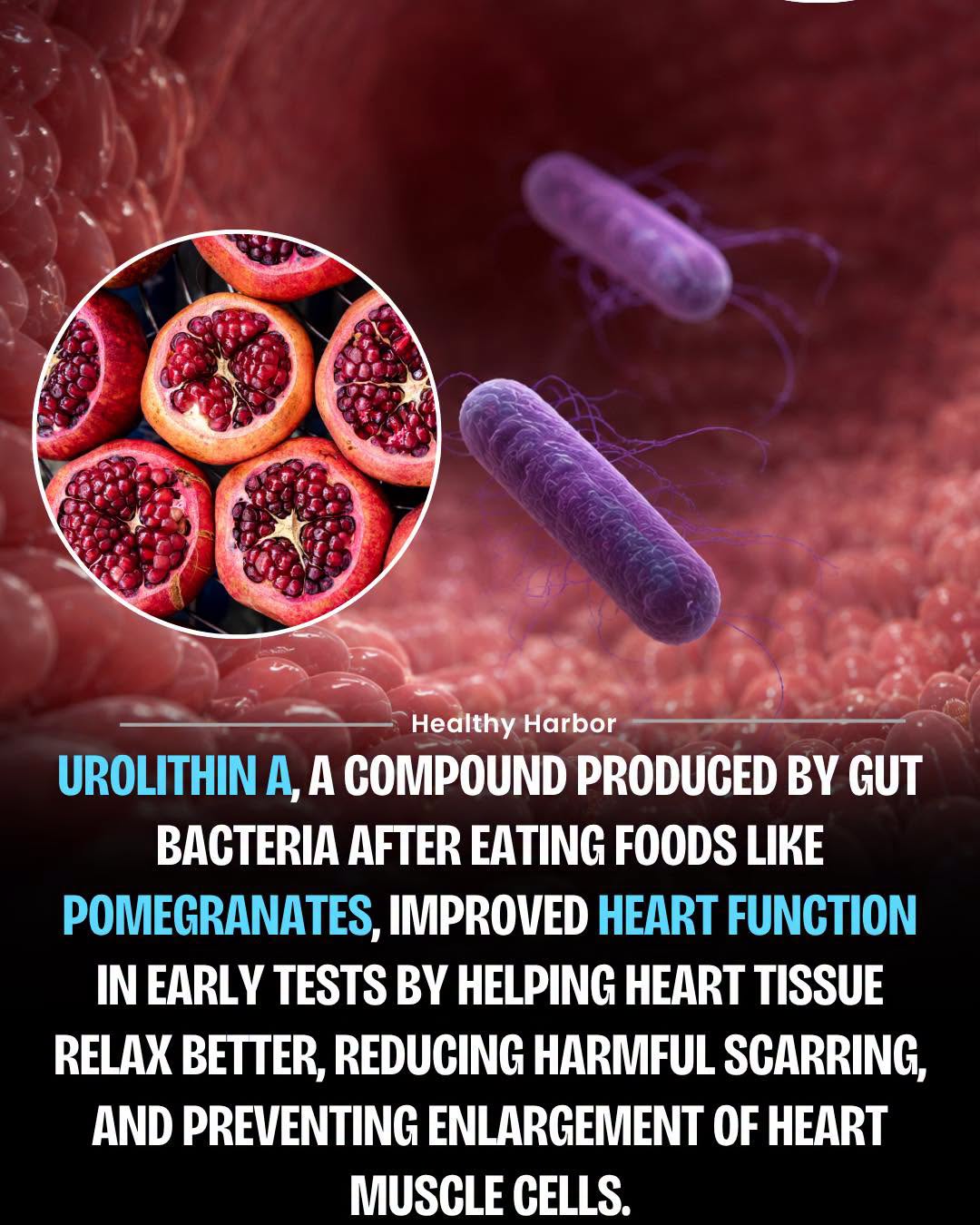
A Science Advances study from King's College London found that urolithin A activates the heart-protective protein PKGIα at cysteine 42, improving heart relaxation, fibrosis and exercise activity in mice with HFpEF and relaxing engineered human heart tissue. About half of people produce urolithin A from pomegranate; human trials are lacking, so benefit for patients is unproven.
Louis shares a Bredesen post on urolithin A de-aging immune T cells and adds that it is a mild mitochondrial toxin like statins and metformin, creating hormetic stress that activates defense pathways. It is brief and largely a mechanistic opinion with a news link.