Most "longevity supplements" have far more evidence in worms and mice than in people. In the group's posts, taurine comes closest to having a human evidence base, with several meta-analyses of randomized trials showing small improvements in blood pressure, triglycerides and insulin resistance.11314 The central claim behind its fame, that low taurine drives aging and topping it up slows aging, is disputed.24
For NAD boosters (NR and NMN), spermidine, urolithin A, glycine and similar products, the group's admins mostly describe the evidence as promising but preclinical, or as changing a biomarker without proof of clinical benefit.51015 Creatine has a small human signal in Alzheimer's disease and a mixed preclinical picture in cancer.716
This summary organizes the group's posts by how strong the evidence behind each supplement is. It is educational, not medical advice; Louis Nervegna repeatedly stresses words like "might" and the admins recommend discussing any supplement with your doctor.417
How to read longevity-supplement claims
Four kinds of evidence appear in the posts, and they carry very different weight.
- Randomized human trials and meta-analyses (for example taurine and glycine in diabetes). They can show an effect on a measured marker, but most last weeks to months and track blood tests, not heart attacks or lifespan.1918
- Observational human data (for example dietary spermidine and mortality). These show associations, not proof that a supplement would do the same.8
- Mouse and cell studies (urolithin A, vanadyl sulfate, NAD boosting). Louis flags these as mouse data, "not evidence for humans."1119
- Biomarker changes. A shared commentary on NAD puts it bluntly: "Changing a biomarker is not the same as improving health."5
A large systematic review quoted by Louis shows how different the landscape looks when trials are pooled. In 884 randomized trials of 27 micronutrients (883,627 participants), omega-3 reduced cardiovascular mortality (RR 0.93), heart attack (RR 0.85) and coronary events (RR 0.86); folic acid reduced stroke (RR 0.84); and coenzyme Q10 reduced all-cause mortality (RR 0.68, 95% CI 0.49-0.94). Vitamins C, D, E and selenium showed no effect on cardiovascular disease or type 2 diabetes, and beta-carotene increased all-cause mortality (RR 1.10), cardiovascular mortality (RR 1.12) and stroke (RR 1.09).12 The quoted text does not mention taurine, creatine, NMN or the other products below, which fits the point that the trendiest supplements are not necessarily the best studied.
Show data
| Relative risk (log scale) | 95% CI | |
|---|---|---|
| Omega-3: cardiovascular death | 0.93 | 0.88–0.97 |
| Omega-3: heart attack | 0.85 | 0.78–0.92 |
| Omega-3: coronary heart disease events | 0.86 | 0.80–0.93 |
| Folic acid: stroke | 0.84 | 0.72–0.97 |
| Coenzyme Q10: death from any cause | 0.68 | 0.49–0.94 |
| Beta-carotene: death from any cause | 1.10 | 1.05–1.15 |
| Beta-carotene: cardiovascular death | 1.12 | 1.06–1.18 |
| Beta-carotene: stroke | 1.09 | 1.01–1.17 |
Taurine
What it is
Taurine is a sulfur-containing amino-acid-like molecule that the body makes from cysteine and that is found in food. It is concentrated in the heart, brain, retina and skeletal muscle, and is described as conditionally essential because the body's production does not always meet demand.11720
The aging debate
In 2023, Columbia University researchers reported that taurine deficiency drives aging in animals, with work spanning worms, mice, monkeys and humans. Louis highlighted it with the caveat that taurine "might" be an aging intervention and appears reasonably safe.17 The Columbia mouse work gave a lifespan extension of 10-12% in mice, according to Gokhan Can's summary of the research.21
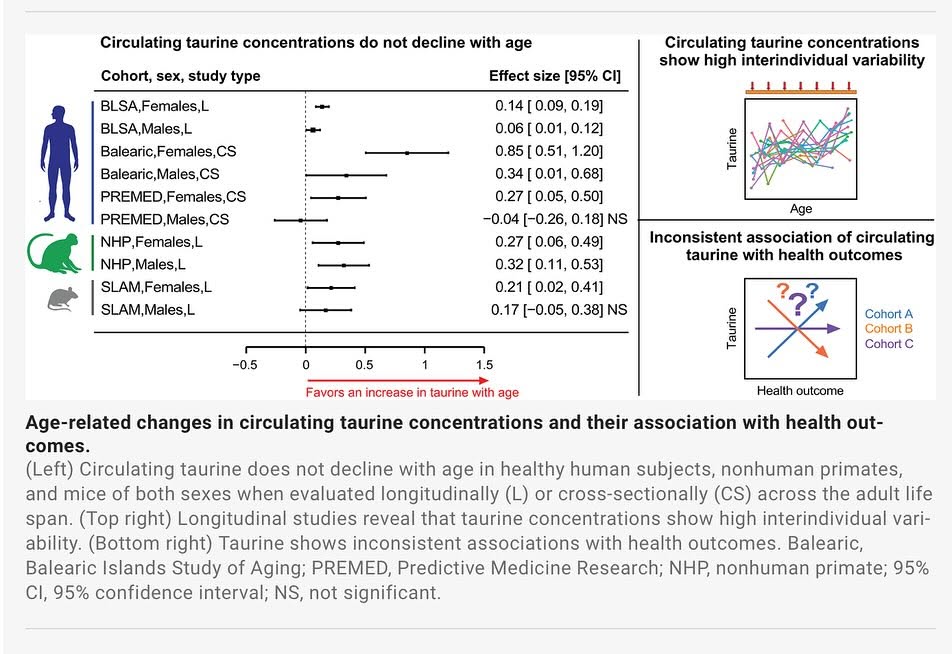
Then came a challenge. A large longitudinal study from Rafael de Cabo's group at the NIA, described by Louis as published in Nature, found that taurine levels do not decline with age in humans, monkeys or mice. Louis noted that most of its data were collected longitudinally, whereas much of the Columbia data were cross-sectional. He also pointed out that unchanged levels do not mean supplementation has no value, because the Columbia paper included interventions in animals, and he predicted a fight "like what happened with resveratrol."2 Another shared summary described the same finding as taurine often rising with age, especially in women, with individual differences outweighing age trends, and concluded taurine is not a reliable biomarker of aging in healthy people.3
A 2026 study from Yale in Cell offers a possible reconciliation. Serum from people aged 20-40 and 60-99 showed that taurine actually increased with age, which led the researchers to suspect this is a failed attempt to damp inflammation.4 In macrophages (immune cells), inflammatory triggers made the cells release up to 80% of their taurine, which helped switch on the NLRP3 inflammasome (a protein complex that drives inflammation). Restoring taurine suppressed that activation, and in older mice raising taurine improved grip strength, coordination, some glucose measures and inflammatory markers.2223 Louis's reading is that taurine may rise with age as a defense against "inflammaging," but he labels this unproven and preclinical.4
Dose: what mice imply
Louis worked through the dose question for the Columbia mouse study, which used 500-1000 mg/kg. Applying FDA allometric scaling (dividing by 12.3 to account for mouse metabolism) gives about 40.7-81.3 mg/kg, or roughly 2.8-5.7 g for a 70 kg person. He calls this a crude starting point for human trials, on the high end of doses used in prior human studies, and emphasizes "might."24 Gokhan, who took taurine personally, wrote that he suspects he overdosed it in the past.21
Human trials
The most useful evidence is on cardiometabolic markers.
- Meta-analysis (Tzang 2024, Nutrition & Diabetes). Randomized trials using 0.5-6 g/day showed, against placebo, systolic blood pressure down 4 mmHg, diastolic down 1.5 mmHg, triglycerides down 18.3 mg/dL, total cholesterol down 8.3 mg/dL, LDL down 6.5 mg/dL, fasting glucose down 5.9 mg/dL, HOMA-IR (an insulin-resistance index) down 0.69, fasting insulin down 1.5 mU/L, and an HbA1c trend of -0.34%. Louis summarized that taurine "modestly improves multiple major risk factors."1
- Meta-analysis of 34 trials (Nutrition Reviews, 2026). In 1,394 participants taurine improved several cardiometabolic markers versus placebo or control, though the post does not list the specific markers.13
- Meta-analysis in overweight and obesity (Nutrients, 2024; 9 trials). Fasting insulin, triglycerides and total cholesterol fell. BMI dropped 1.14 kg/m2 in overweight adults, HbA1c and HOMA-IR improved only in people with obesity, and 3 g/day was linked to HbA1c down 0.37 points and fasting glucose down 7.14 mg/dL. The summary cautions that results do not show everyone with overweight or obesity should take 3 g daily.14
- Type 2 diabetes RCT (2022). In 120 people on a low-calorie diet, 3 g/day for 8 weeks lowered insulin, HOMA-IR, inflammation markers (TNF, hs-CRP), an oxidative-stress marker (MDA) and endothelial-dysfunction markers, but did not improve lipids, HbA1c or fasting glucose.18
- Type 1 diabetes crossover trial (2010). 1.5 g/day for 2 weeks returned arterial stiffness and brachial artery flow-mediated dilation (FMD) to control levels in young men with type 1 diabetes. It was tiny (9 diabetics, 10 controls).25
Results are not uniform. A prediabetic trial listed in Gokhan's long evidence summary found that 8 weeks of taurine did not improve insulin sensitivity or lipids. Most of the other support in that summary is animal or observational, such as higher taurine intake correlating with lower coronary disease and reduced atherosclerosis in rabbits.26 A promotional post shared in the group claims blood pressure and insulin benefits but cites no specific study, so it is better treated as marketing than evidence.27
Taurine and cancer headlines
A shared explainer pushes back on headlines that "taurine fuels cancer." The underlying Nature paper used genetically engineered mouse models of leukemia, where leukemia cells upregulated a taurine transporter and used locally made taurine; blocking taurine transport slowed the disease. The explainer stresses that this did not test dietary taurine, supplements or energy drinks.20
NAD, NR, NMN and niacin
NAD+ is a cellular molecule that sirtuin proteins (SIRT1, SIRT6) depend on, and vitamin B3 forms (niacin, nicotinamide, NR and NMN) all raise it.28
Blood NAD tests are not meaningful
A Nature Metabolism study quantified NAD+ in seven independent human cohorts by mass spectrometry. Whole-blood NAD+ stayed stable with age and with lifestyle interventions, and only changed with nicotinamide riboside supplementation.615 Louis says the blood level mainly reflects recent vitamin B3 intake, calls it a useless biomarker, and argues that Charles Brenner has been vindicated; tissue NAD is what may matter, but no commercial test measures it.56 Louis adds that he takes his vitamin B3 anyway, "just like Brenner."6
Do NR and NMN work?
NR and NMN do raise circulating NAD+, but a shared reality check says there is still no convincing clinical evidence they slow human aging, extend lifespan or broadly improve healthspan, and calls for rigorous human trials.515 There are narrower human signals. In a 6-month trial in peripheral artery disease, NR improved six-minute walking distance, while placebo and NR plus resveratrol groups declined, per a FoundMyFitness summary Louis shared.29
Heart and arteries: conflicting animal signals
Animal data point in both directions. A 2025 mouse study found niacin reduced vascular calcification through SIRT1/SIRT6 activation, and Louis speculated that other B3 forms might act similarly, while cautioning it is an artificially engineered mouse model with unclear human relevance.28 Gokhan, by contrast, shared a 2025 Atherosclerosis paper in which NAD+ boosting increased plaque and inflammation in Apoe knockout mice, again with the note that nobody knows what happens in humans.30
Louis also reminds readers that niacin (nicotinic acid) failed to improve outcomes in two very large randomized trials when combined with maximum-dose statins, with more side effects than statins alone, and states that nicotinic acid should not be combined with high-dose statins.28
Non-heart uses of vitamin B3
Louis has posted several times on glaucoma. A 2020 randomized trial in 57 people with glaucoma gave nicotinamide at 1,500 mg daily for six weeks then 3,000 mg daily and reported improved inner retinal function; a phase 2 trial in 32 people combined nicotinamide with pyruvate and showed more improving visual-field locations than placebo.3132 An observational study found people with high eye pressure taking nicotinamide were about two-thirds less likely to be diagnosed with open-angle glaucoma, and a larger trial is underway.33 The summary says the doses were far higher than ordinary supplements and should not be attempted without an ophthalmologist, and that it does not replace pressure-lowering treatment.32 A small glioblastoma pilot using niacin reported 82% of 24 patients free of progression at six months, but used historical controls.34 None of this is about heart disease directly.
Creatine
The group's posts on creatine are few and mostly about the brain and cancer, not the heart.
- Alzheimer's pilot. In an open-label study of 20 older adults (mean age 73) with probable Alzheimer's, 20 g/day of creatine monohydrate for 8 weeks raised brain creatine by 11% (measured by MR spectroscopy) and serum creatine by about 35%, with 90% compliance and no serious adverse events. It was a feasibility study, not an efficacy trial.7 A separate FoundMyFitness-sourced post reported nearly 5% improved cognition at the same dose and duration, and Louis framed it as "something to consider" for a loved one with Alzheimer's.35 The cognition claim comes from an interview summary rather than a cited paper, and the post does not say whether it comes from the same pilot.
- Cancer. The evidence is mixed. A summary notes that animal and cell models showed creatine increasing metastatic behavior and worsening survival, but higher dietary creatine has been linked to lower cancer risk in a limited study, and a randomized trial giving creatine to people with malignant cancer found no meaningful survival difference, although it was not designed to test that. The poster advises people with cancer to talk with their oncology team.16 A newer UCLA mouse study suggested creatine may boost cancer-fighting immune cells and slow tumor growth. Louis notes earlier preclinical work pointed the other way.36
- Fatty liver. One animal study suggested creatine may help diet-related fatty liver but not alcohol-related fatty liver. Louis says it needs human replication.37
Spermidine
Spermidine is an autophagy-inducing polyamine (autophagy is the cell's recycling process) found in foods such as wheat germ, mushrooms, soy, aged cheese and natto. Gokhan's summary lists several mouse and rat studies, including a 2016 report that oral spermidine extended median lifespan and protected the heart in aged mice, a lifespan increase of about 25% in mice in a 2017 study, and a 2020 rat study that found no lifespan extension but other health benefits.838
The human data are observational. In a prospective study of 829 people aged 45-84 followed for 20 years, all-cause mortality across rising spermidine-intake tertiles was 40.5, 23.7 and 15.1 deaths per 1000 person-years, with each 1-SD higher intake linked to 24-26% lower mortality and about 70% lower risk of cognitive impairment.8 Spermidine supplementation is described as safe and well tolerated in older adults.8
Gokhan estimates a 50 g serving of natto has 5-13 mg of spermidine, and cites an association between natto consumption and 18% lower all-cause mortality.38 He and Louis also point to whole wheat (the germ) as a source, with Louis offering the "reproductive parts of plants" idea as biologically plausible but acknowledging that it sounds pseudoscientific and that the life-extension evidence is in rodents and lower animals.3940
Urolithin A
Urolithin A is a compound gut bacteria make from ellagitannins in pomegranate, walnuts and berries. About half of people produce it after eating pomegranate.101941 Louis calls it a mild mitochondrial stressor that triggers protective "mitohormesis," like statins and metformin, which is his opinion rather than a trial result.42
Heart-related findings are preclinical. A 2026 Science Advances study found urolithin A activated the heart-protective protein PKGIα, improved relaxation and reduced fibrosis in mice with heart failure with preserved ejection fraction (HFpEF), and also improved relaxation in engineered human heart tissue. Louis stresses human studies are lacking.10 Another newly published mouse study reported improvements of up to 80% in heart-function measures.19 One shared overview mentions human trials published in Nature Medicine, but the group's posts do not give their results, and Louis says most of the evidence is preclinical.41
Glycine, glutathione and other amino acids
- Glycine. A 2008 randomized trial of 74 people with type 2 diabetes gave 5 g three times daily for 3 months. A1C fell, in the quoted example from 8.3 to 6.9, compared with placebo, with lower proinflammatory markers.9 A narrative review says glycine may be geroprotective and may help in acute heart attack, endothelial dysfunction and insulin resistance, and that it modestly extends lifespan in rodents; it is a review, not a trial.43 Gokhan reports that glycine "never helped me."21
- Glutathione. Louis argues oral glutathione is probably a bad idea long term, because it is mostly broken down and can raise levels outside cells, interfering with redox signaling. He prefers Nrf2 activators (broccoli sprouts, turmeric) and enough cysteine and glycine. This is his reasoning, supported by skin-lightening anecdotes rather than trials.44
- Gokhan's "metabolite cocktail." Gokhan describes taking AKG, L-arginine, beta-alanine, taurine and L-carnitine, mostly on animal data, and calls it a personal experiment rather than evidence of cardiovascular benefit.21
Other products that appear in the group
- Vanadyl sulfate. A 2026 Nature Aging mouse study found it acts as a senolytic (kills senescent cells) and extended male mouse median lifespan by 7.4% when started late in life. The cohort was small (about 20 mice per group), the effect barely reached significance, and vanadium is toxic. Louis calls it mouse data, not human evidence.11
- Nattokinase. In a 1,062-person clinical study, 10,800 FU/day improved carotid intima-media thickness, plaque size and lipids, while 3,600 FU/day was ineffective.45 Gokhan notes that nattokinase appears to act by inhibiting PAI-1, a marker linking clotting, inflammation, metabolic disorder and aging, and suggests high-dose nattokinase might be the safest option for that today; this is his view, and the PAI-1 findings he lists include preclinical work.46 His natto summary adds that doses above 8,000 FU/day may reverse coronary plaque progression, which is a hypothesis drawn from the same study.38
- Aged garlic extract, gotu kola and pine bark. Small trials of garlic extract slowed coronary calcium progression, but two of the three used co-supplements.47 Louis says gotu kola plaque findings need larger, higher-quality studies.4849
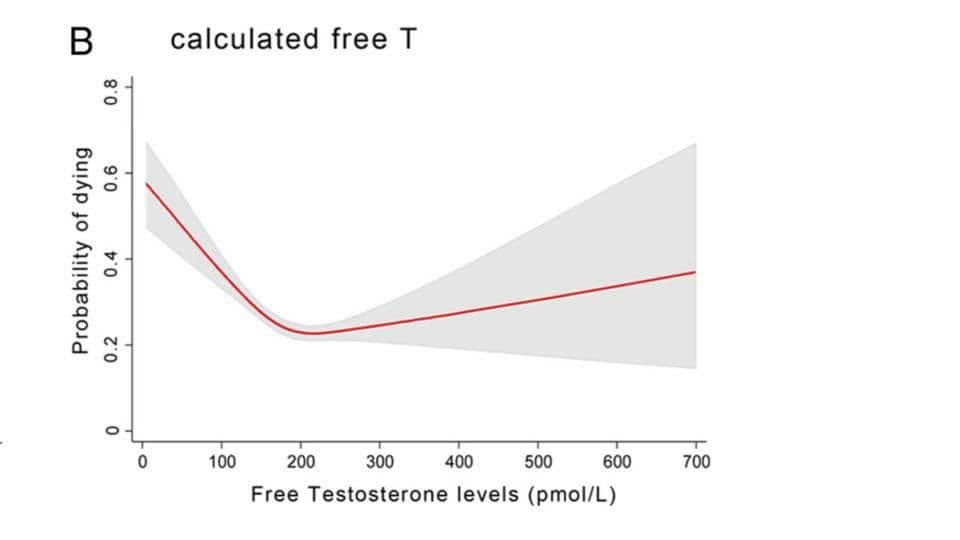
- Testosterone for "anti-aging." Louis warns there is no credible evidence of longevity benefit beyond treating diagnosed hypogonadism, citing an inverse-U relationship with mortality in 3,690 older men.5051
- Magnesium and other basics. Louis argues magnesium form-specific claims are hype, with all forms absorbed, and a Rhonda Patrick summary describes widespread inadequate intake of magnesium and vitamin D.525354
What this means for you
This is a summary of the group's discussion, not personal medical advice.
- Treat "longevity" claims as hypotheses unless there is a randomized trial in humans measuring something that matters.515
- Taurine has the most human trial data, but the proven effects are modest changes in blood pressure, triglycerides and insulin resistance. Whether it slows aging is unresolved.12
- The mouse-to-human dose conversion for taurine (about 2.8-5.7 g) is described by Louis as a crude starting point for trials, not a recommendation.24
- Do not buy NAD blood tests; the group's admins say blood NAD does not track age or tissue levels.56
- Avoid combining nicotinic acid (niacin) with high-dose statins, per Louis.28
- With creatine, people with cancer should discuss it with their oncology team, per the post that summarized the evidence.16
- Evidence from small animal studies such as urolithin A and vanadyl sulfate is hypothesis-generating only.1011
- Supplements with outcome-level randomized evidence (such as omega-3 and coenzyme Q10 in the 884-trial review) are a different category from the products above.12
Frequently asked questions
Does taurine slow aging in humans?
Not shown. Columbia's 2023 work suggested taurine deficiency drives aging in animals, but later studies found taurine does not consistently fall with age, and a Yale study found it rises. No human trial has tested lifespan effects.2417
What does taurine reliably do in trials?
Modest improvements in blood pressure, triglycerides, LDL, glucose and insulin resistance in pooled randomized trials. A diabetes trial using 3 g/day found improved insulin resistance and inflammation but no change in HbA1c, glucose or lipids.118
Are NMN and NR worth taking?
They raise NAD+ in blood, but the group's summaries say there is no convincing clinical evidence of slower aging. The best human signal in the pack is an NR trial in peripheral artery disease that improved walking distance over 6 months.529
Is creatine safe regarding cancer?
Animal data are mixed, and human data are reassuring but not definitive. A randomized trial in people with malignant cancer showed no survival difference, though it was not designed for that purpose.1636
Does urolithin A help the heart?
Mouse and engineered-tissue data suggest it might help heart failure with preserved ejection fraction, but human studies of that use are lacking.1019
Is spermidine proven to extend life?
In mice, yes in several studies; in people only observational associations exist.8