Can you calculate ApoB from a standard lipid panel that shows TC, HDL, TG, LDL ?
Technically, you can’t.
But you can get a good feeling for it by calculating your non-HDL cholesterol. Just subtract HDL from your total cholesterol, by the formula TC-HDL. This is your non-HDL cholesterol, which accounts for most of your ApoB tagged particles. It is mostly just LDL, plus some VLDL, with a little IDL as well.
Note that ApoB is a measure of the number of particles, whereas non-HDL cholesterol is a measure of the total amount of cholesterol inside most of those particles. So you cannot directly compare them. But they are basically measuring the same thing.
Measuring the total number of particles is a more accurate indicator of risk than measuring the total cholesterol inside those particles, which is why the ApoB blood test is preferred to just calculating non-HDL cholesterol. Also the ApoB blood test includes additional ApoB tagged particles that are not included when calculating non-HDL cholesterol. Overall, the ApoB blood test is more accurate.
——
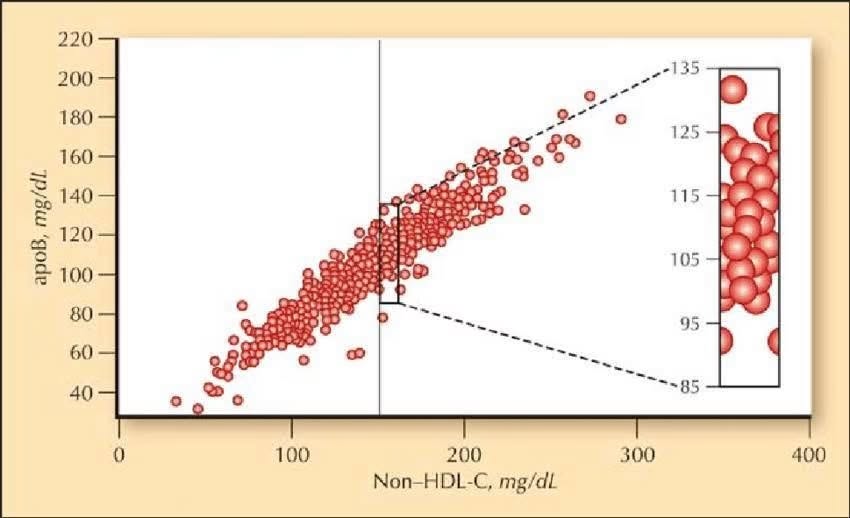
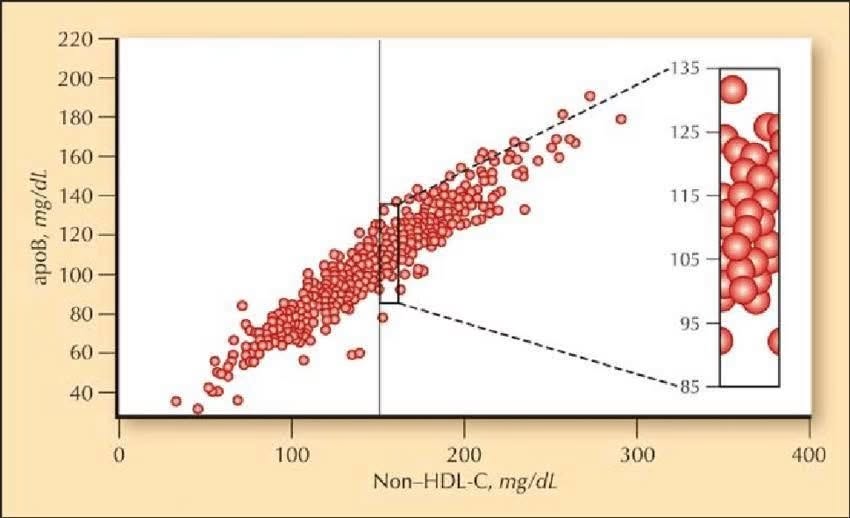
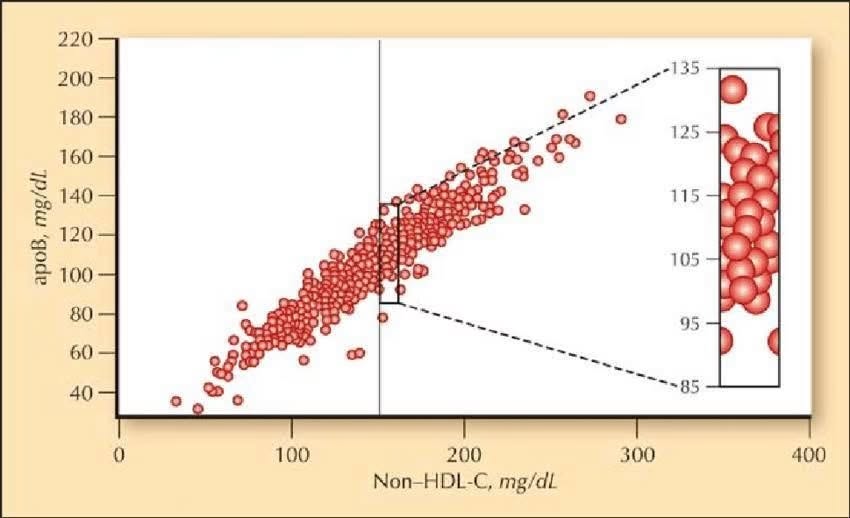
Edit: Below is a graph that you can use to do a crude estimate of what your ApoB might be, based on your non-HDL cholesterol. The graph was pointed-out to me by Nick Thomas.
From the graph, ApoB can be crudely approximated as 0.7 * non-HDL-C.
So in summary:
ApoB is roughly 0.7 * (TC - HDL)
Or equivalently:
ApoB is roughly 0.7 * (LDL + TG/5)
This second formula is calculated from the standard equation: TC = LDL + HDL + TG/5, which implies TC - HDL = LDL + TG/5.
Reference for graph:
PaperApoB versus non HDL C What to do when they disagreeresearchgate.net#apobHD #apobestimateHD #ldlHD #vldlHD #nonhdlHD #triglyceridesHD #idlHD #hdlHD