HD-OPM Archive
Hashtags

#oxpl

6 posts

Atorvastatin may 'disarm' Lp(a) by blocking oxidation, a theory for HORIZON's failure

Nov 10, 2026 · Louis Nervegna ♥ 9 · 💬 12 ↩ 1 Lp(a)

Louis proposes that Lp(a)HORIZON failed because aggressive statin treatment (78% on high-intensity statins) may have already neutralized oxidized phospholipids carried by Lp(a). A shared abstract (Sherratt et al., Eur Heart J) found atorvastatin's active metabolite scavenges free radicals and inhibits oxidation of Lp(a) and small dense LDL better than other statins. This is a lab-based hypothesis.
Why some people with very high Lp(a) have clean arteries: oxidized phospholipids

Dec 04, 2025 · Louis Nervegna ♥ 19 · 💬 7 Lp(a)

Louis shares an article proposing that Lp(a) harms arteries largely through oxidized phospholipids (OxPL), and that people with high Lp(a) but low OxPL content may avoid plaque. OxPL may predict risk better than Lp(a) itself, so measuring both could improve risk assessment; the piece is a blog explainer, not new data.

Tsimikas: Lp(a) risk can be managed with LDL under 65 and tight risk-factor control

Nov 10, 2026 · Louis Nervegna ♥ 13 · 💬 1 ↩ 1 Lp(a)

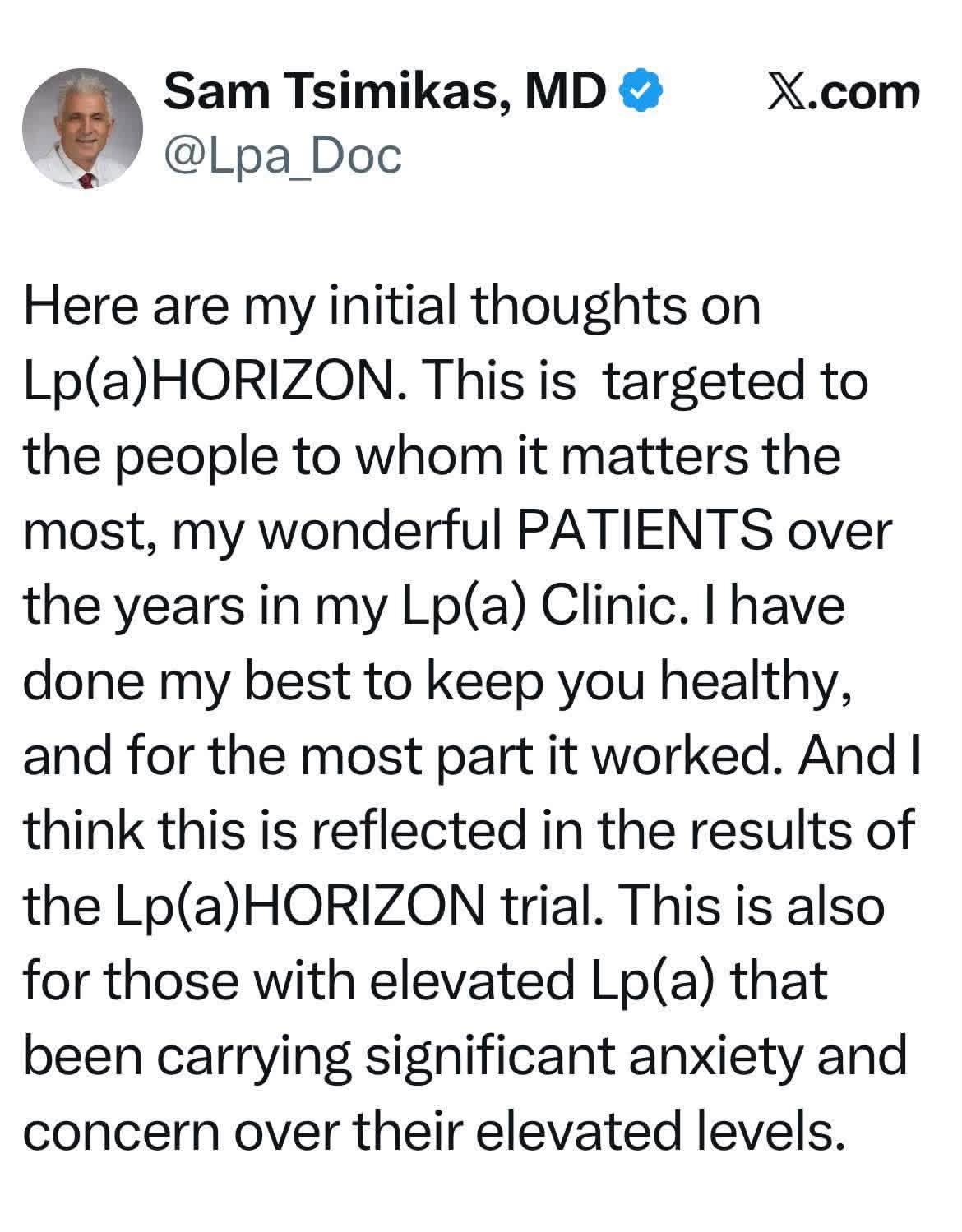
Louis quotes Sam Tsimikas, who calls Lp(a)HORIZON a success because it suggests Lp(a) risk can be reduced by keeping LDL-C at or below 65, blood pressure at 120 or lower, controlling other risk factors and taking proven medicines. In his Lp(a) clinic about 75% take a statin, 50% ezetimibe, 50% a PCSK9 inhibitor, plus aspirin.

Lp(a) has no known essential role in modern humans and may even have minor upsides

Sep 16, 2026 · Louis Nervegna ♥ 6 · 💬 2 Lp(a)

Louis explains that people with very low or undetectable Lp(a) show no significant ill effects, so it does not appear essential today. It may have conferred an evolutionary advantage to hunter-gatherer ancestors, and high Lp(a) might lower the risk of some conditions such as diabetes and hemorrhagic stroke, even though it strongly raises CVD risk. He supports this with an AI-generated explanation.

Lp(a) makes clots form more easily and resist breakdown via OxPL and apo(a)

Nov 10, 2026 · Louis Nervegna ♥ 3 Lp(a)

Louis shares a summary of an ATVB commentary by Rafael Zubiran explaining why high Lp(a) may be worse than LDL. Its oxidized phospholipids activate monocytes to make tissue factor, and apo(a) resembles plasminogen and competes with clot breakdown, producing denser, harder-to-dissolve clots. Louis notes statins, especially atorvastatin, may neutralize OxPL and aspirin lowers clotting risk.

How Lp(a) captures and carries oxidized phospholipids through its apo(a) tail

Nov 10, 2026 · Louis Nervegna ♥ 1 Lp(a)

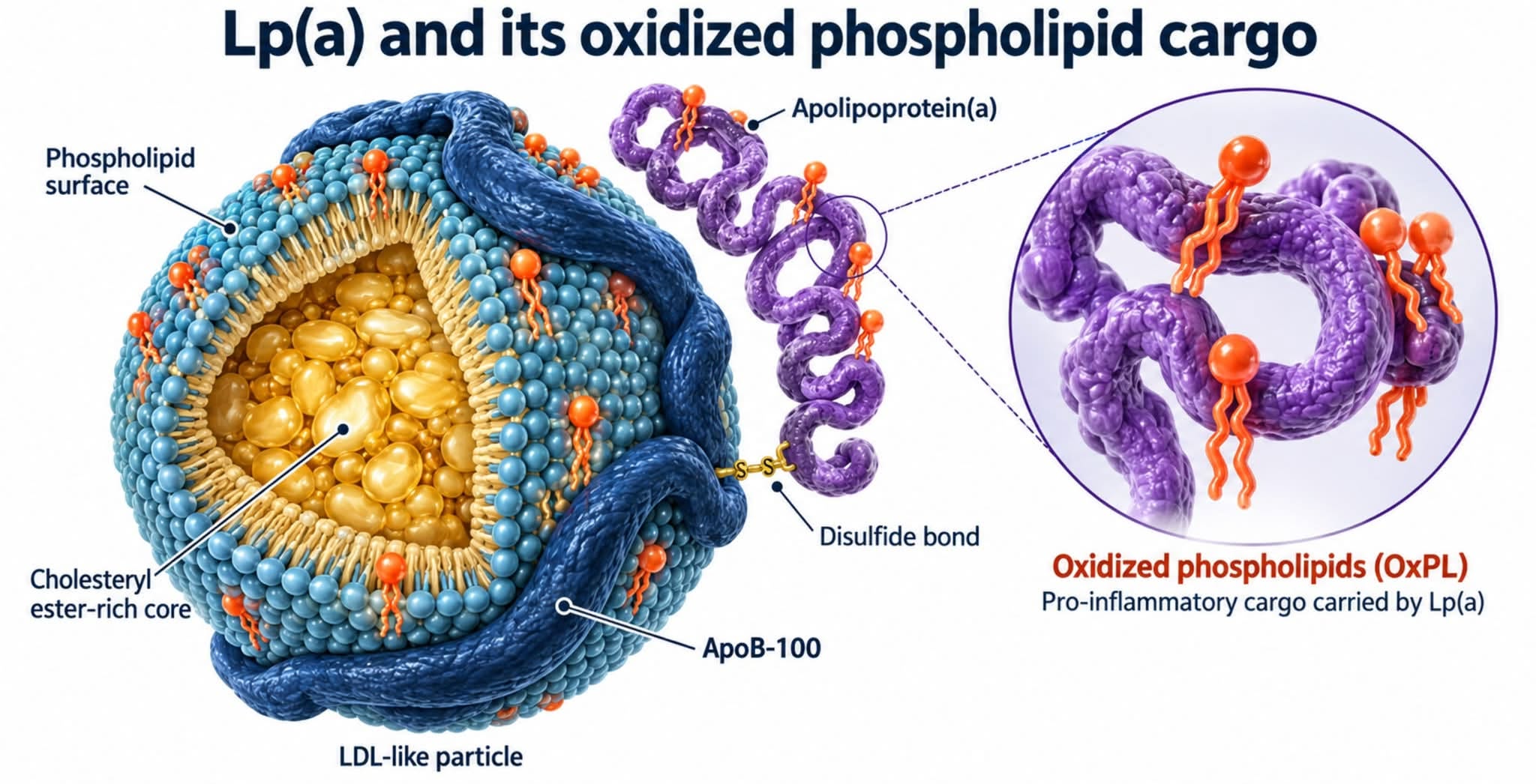
A detailed explainer on how Lp(a) is the main carrier of oxidized phospholipids (OxPL) in the blood, which may be largely responsible for the damage Lp(a) causes. Lp(a) is an LDL-like particle with apoB-100 plus an apo(a) tail made of kringle domains, and a lysine binding site in kringle IV type 10 binds OxPL.