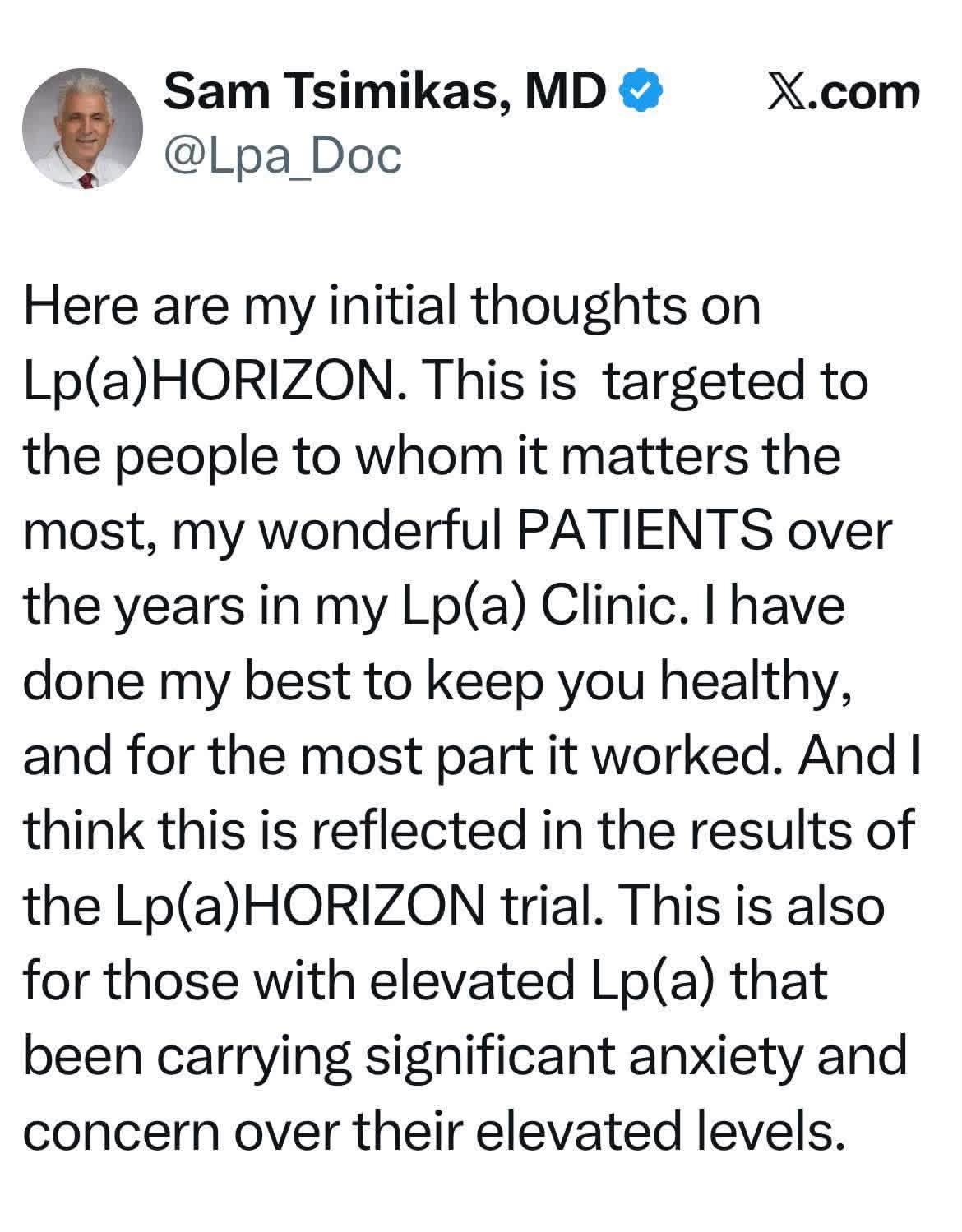
One of the theories why the Lp(a) HORIZON trial failed is because the aggressive treatment of patients with statins and other drugs might have neutralized the deleterious effects of OxPL carried by Lp(a) particles, rendering the lowering of Lp(a) unnecessary.
Lp(a)'s harmful effects may actually stem from the oxidized phospholipids (OxPL) that it carries: facebook.com/share/p/1JEgpfYVSK.
Neutralizing these oxidized phospholipids might cancel the harm of high Lp(a).
Sam Tsimikas has emphasized this in the past, and has recently brought it up again on Twitter: ↪ Tsimikas: Lp(a) risk can be managed with LDL under 65 and tight risk-factor control.
78% of the patients in HORIZON were on high-intensity statins, and most of the rest were at least taking lower doses.
Atorvastatin seems to be particularly effective at neutralizing OxPL.
Colloquially speaking, atorvastatin might "disarm" the Lp(a) particles.
Atorvastatin might make the Lp(a) particles less dangerous by preventing them from carrying the oxidized phospholipids (OxPL) that cause damage to arteries and promote clotting.
cc: Jared Bell
#atorvastatinHD #lpaHD #oxplHD #horizonHD #statinsHD #statinslpaHD