How Lp(a) Captures and Carries Toxic Fats (OxPL) in the Blood
Lp(a) acts as the primary carrier for oxidized phospholipids (OxPL) in the blood. These oxidized phospholipids are toxic, and might be largely responsible for the damage that Lp(a) causes.
- The Core Structure of Lp(a): The Cargo Ship and Its Unique Tail
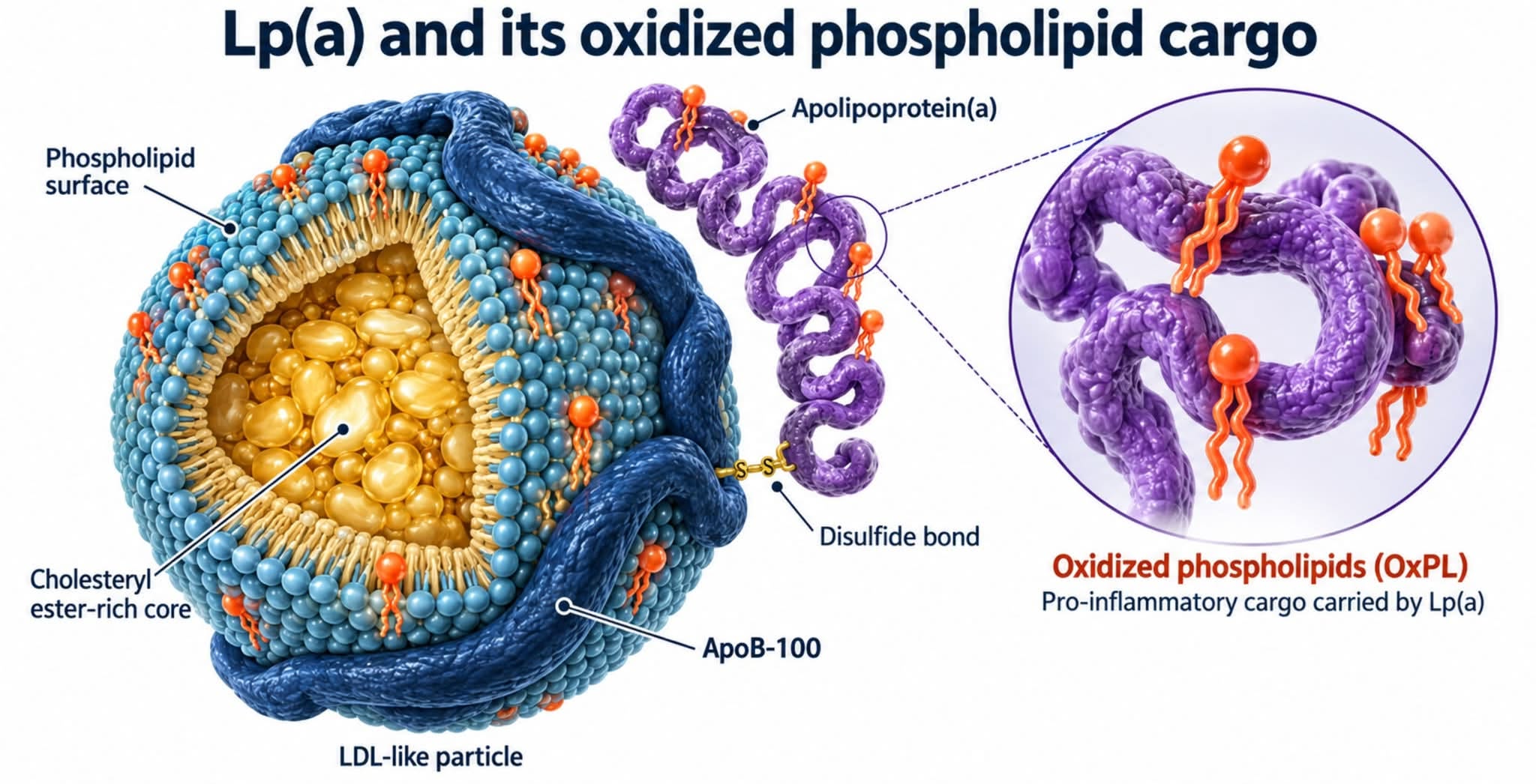
To understand how Lp(a) carries these harmful phospholipids (OxPL), it helps to picture its physical anatomy.
- The Core Particle (The Ship): Lp(a) is built like a standard LDL particle. This core is a sphere of fat wrapped in a structural scaffolding protein called apolipoprotein B-100 (apoB-100), which is measured on a standard apoB blood test.
- The Apo(a) Tail (The Crane): What makes Lp(a) unique— and highly dangerous— is a massive, extra protein tail attached to it, called apolipoprotein(a), or apo(a) for short. This tail loops out into the bloodstream like a long string of twisted knots.
- The Binding Mechanism: How It Snares Oxidized Phospholipids
Oxidized phospholipids (OxPL) are "rancid" fats. They are normal fats (phospholipids) that have been damaged by highly reactive oxygen molecules in a process called oxidation. Lp(a) acts like a sponge, or a specialized vacuum, for these damaged fats using a precise chemical lock-and-key system.
- Kringle Domains (The Knots): The long apo(a) tail is made of repeating, loop-like protein structures called kringle domains (named because their shape resembles a twisted Danish kringle pastry).
- The Lysine Binding Site (The Chemical Magnet): Inside a specific loop called KIV10 (Kringle 4, Type 10), there is a highly specialized pocket called a Lysine Binding Site (LBS). This pocket has a strong, chemical attraction to the "head" of the damaged phospholipid molecule.
- Covalent and Non-Covalent Binding: When an oxidized phospholipid (OxPL) bumps into this pocket, it locks in. Some of these fats sit loosely in the pocket (non-covalent binding). However, a vast majority are permanently, chemically welded (covalent binding) directly to the apo(a) protein. Because of this tight chemical bond, Lp(a) captures and locks away these toxic fats much better than standard LDL cholesterol can.
- The Consequences: Triggering the Immune System
Once OxPL is locked onto Lp(a), it travels through the bloodstream and acts as a major source of inflammation.
- DAMPs (The Danger Signals): In the body, these bound OxPLs act as Damage-Associated Molecular Patterns (DAMPs). Think of DAMPs as molecular "red flags" or alarm signals that tell the body a tissue is injured or rotting.
- Scavenger Receptors (The Perimeter Sensors): Immune cells, like macrophages (the body's cleanup cells), are equipped with radar-like sensors called scavenger receptors (such as CD36). When these receptors spot the red flags (OxPL) on the Lp(a) particle, they mistake it for an active infection or severe tissue damage.
- Vascular and Valve Harm: The immune cells aggressively swallow the Lp(a) particles, swelling up into "foam cells" and trapping themselves in the artery walls and heart valves. This triggers chronic inflammation, leading to atherosclerosis (clogged arteries) and calcific aortic valve stenosis (the hardening and narrowing of the heart's main valve).
- The Double Whammy: How Lp(a) Promotes Blood Clotting
Beyond causing long-term plaque buildup and inflammation, Lp(a) actively interferes with the body's hemostasis system—the delicate mechanical balance between blood clotting and clot dissolving. It does this through two main mechanisms:
- The Imposter Effect (Blocking Clot Breakdown): The unique apo(a) tail is structurally an almost perfect look-alike (homologue) to plasminogen, the body's natural clot-dissolving enzyme. Because they look so similar, Lp(a) acts like a molecular imposter. It rushes in and binds to the surface of a blood clot, physically blocking real plasminogen from landing there. Because the real "cleanup crew" cannot get to the clot, the body's ability to dissolve clots (fibrinolysis) is severely delayed, leaving the clot trapped in place.
- Hyper-Coagulation (Accelerating Clot Formation): The oxidized phospholipid (OxPL) cargo also acts as a powerful trigger for blood clotting. When OxPL interacts with blood vessels and white blood cells (monocytes), it forces them to overproduce a protein called Tissue Factor, which acts as the main master switch to activate blood clotting. Furthermore, OxPL interacts with platelets (the sticky cells that form the initial plug of a clot), making them hyper-reactive and aggressive.
By simultaneously speeding up the formation of a clot and blocking the body's ability to break it down, a ruptured plaque heavily lined with Lp(a) can rapidly trigger a catastrophic, acute blockage like a heart attack or stroke.
This post was written in collaboration with Gemini AI.