AI summary & key facts
Louis shares a summary of an ATVB commentary by Rafael Zubiran explaining why high Lp(a) may be worse than LDL. Its oxidized phospholipids activate monocytes to make tissue factor, and apo(a) resembles plasminogen and competes with clot breakdown, producing denser, harder-to-dissolve clots. Louis notes statins, especially atorvastatin, may neutralize OxPL and aspirin lowers clotting risk.
- OxPL activates monocytes to produce more tissue factor
- Apo(a) resembles plasminogen and competes with it
- Stent patients with higher Lp(a) and OxPL had stronger clots on a clotting test
- Lowering Lp(a) may be only half the story; clot behavior matters
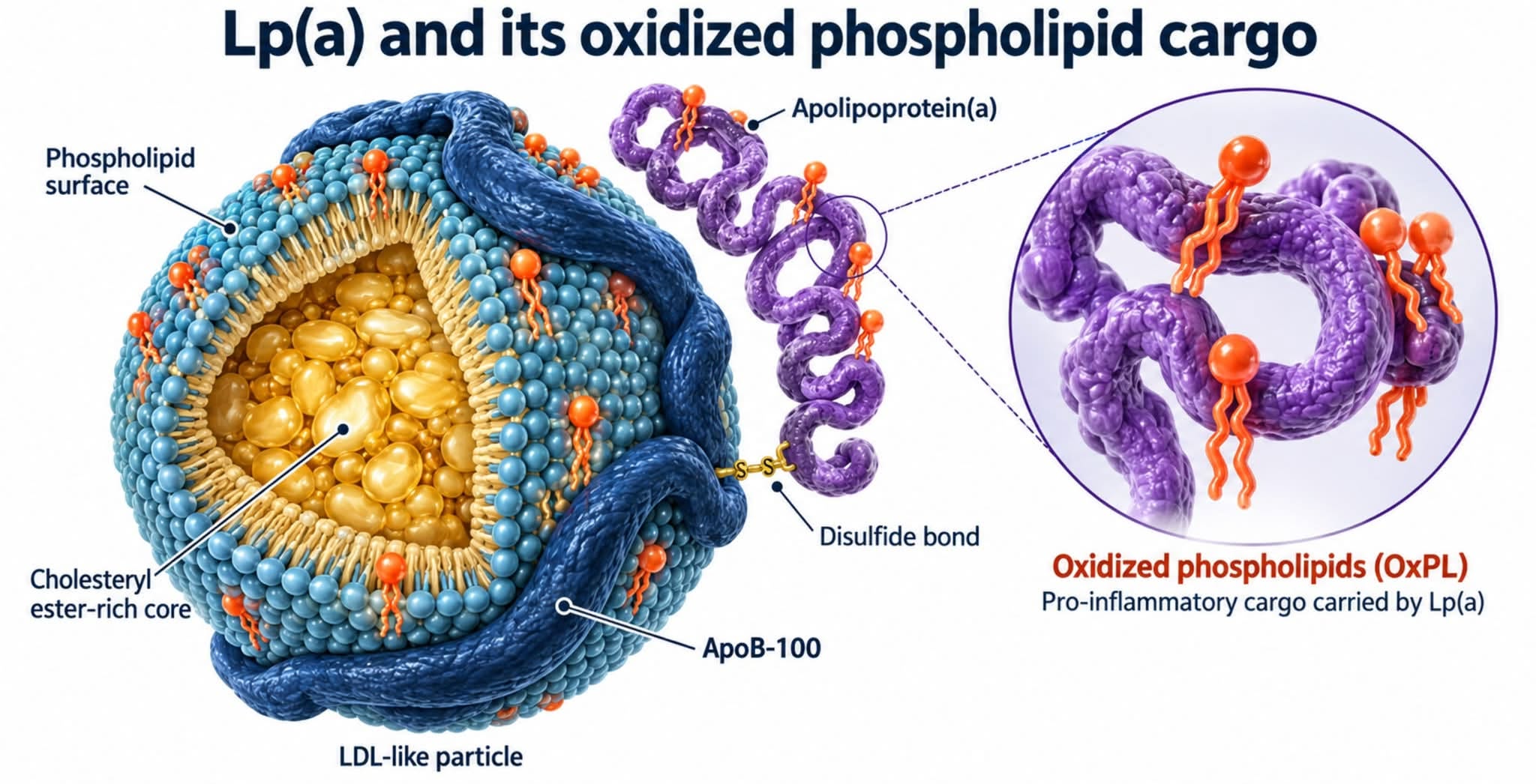
Lp(a) carries oxidized phospholipids (OxPL) that make it prone to cause clotting.
Statins might neutralize this OxPL, especially atorvastatin: ↪ Atorvastatin may 'disarm' Lp(a) by blocking oxidation, a theory for HORIZON's failure.
Aspirin reduces the risk of clotting.
#lpaHD #oxplHD #clottingHD #thrombosisHD #horizonHD #statinsHD #statinslpaHD
𝐖𝐡𝐲 𝐢𝐬 𝐡𝐢𝐠𝐡 𝐋𝐩(𝐚) 𝐬𝐨 𝐝𝐚𝐧𝐠𝐞𝐫𝐨𝐮𝐬? 𝐈𝐭'𝐬 𝐧𝐨𝐭 𝐣𝐮𝐬𝐭 𝐚𝐛𝐨𝐮𝐭 𝐜𝐡𝐨𝐥𝐞𝐬𝐭𝐞𝐫𝐨𝐥.
Many heart disease patients with high Lp(a) have heard "it's like LDL, only worse." New commentary in Arteriosclerosis, Thrombosis, and Vascular Biology (ATVB) from NIH lipidologist Dr. Rafael Zubirán explains why it may be worse, and the answer involves blood clots.
Here's the simple version:
🔹 It carries inflammatory cargo. Lp(a) carries oxidized phospholipids (OxPLs). These can switch on immune cells called monocytes, which then produce more tissue factor, one of the main signals that starts a clot.
🔹 It interferes with clot cleanup. The apo(a) part of Lp(a) looks a lot like plasminogen, the body's clot-dissolving protein, and can compete with it.
🔹 The result: Clots that form more easily, are denser, and are harder for the body to break down.
A recent study of patients who had stents placed (for multivessel disease, heart attack, or stroke) supports this. Those with higher Lp(a) and OxPL levels had measurably stronger clots on a specialized clotting test.
Why this is important now: As we wait for more results from Lp(a)HORIZON and other trials, Dr. Zubirán makes the point that lowering the number on a lab report may be only half the story. We also need to know whether new therapies improve how our blood clots, and which patients benefit most.
📖 Commentary:
Paper · ATVB_Net · 2026ATVB_net: Article Commentary: Where Lipoprotein(a) and Inflammation Meet Thrombosisahajournals.org
📊 Dr. Zubirán's post with a helpful diagram:
Post on X · Rafael ZubiránRafael Zubirán on XRelated to all Lp(a) science this year 📣 Before Lp(a)HORIZON, the biology. My commentary for @atvbahajournals on why Lp(a) is a thrombosis story: OxPL couple inflammation to tissue factor, free apo(a) blocks fibrinolysis. Lowering Lp(a) is half the question.…x.com