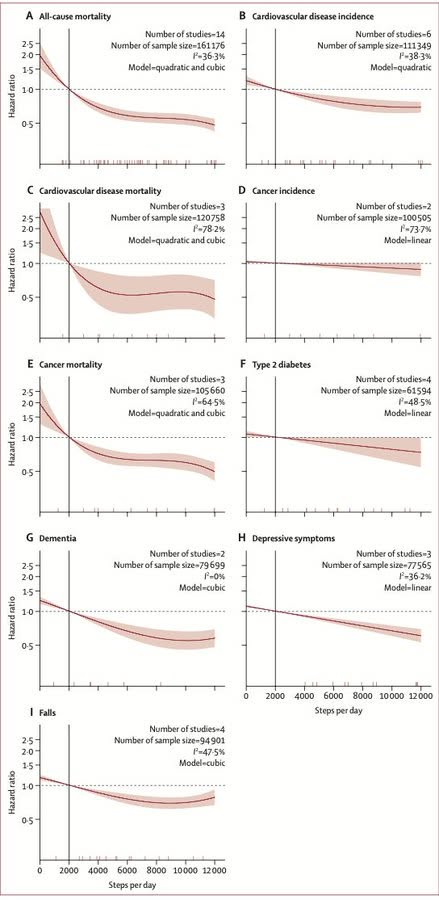
Based on a meta-analysis of 31 prospective cohort and intervention studies:
Walking 7000 steps per day (compared to only 2000 steps) is associated with lower risk for:
- All-cause mortality, by 47%
- CVD, by 25%
- CVD mortality, by 47%
- Cancer mortality, by 37%
- Diabetes, by 14%
- Dementia, by 38%
- Depression, by 22%
- Falls, by 28%
Quoted:
“This systematic review, which included meta-analyses of data from 24 cohorts across eight outcomes, is the largest and most comprehensive synthesis of the association between daily steps and major health outcomes to date. To our knowledge, it is also the first to synthesise evidence on several outcomes, including cancer and dementia. Three key findings emerge. First, even modest daily step counts were associated with health benefits. Second, 7000 steps per day was associated with sizeable risk reductions across most outcomes, compared with the reference of 2000 steps per day. Third, even though risk continued to decrease beyond 7000 steps per day, it plateaued for some outcomes.”
“57 studies from 35 cohorts were included in the systematic review and 31 studies from 24 cohorts were included in meta-analyses. For all-cause mortality, cardiovascular disease incidence, dementia, and falls, an inverse non-linear dose-response association was found, with inflection points at around 5000–7000 steps per day. An inverse linear association was found for cardiovascular disease mortality, cancer incidence, cancer mortality, type 2 diabetes incidence, and depressive symptoms.
Based on our meta-analyses, compared with 2000 steps per day, 7000 steps per day was associated with a 47% lower risk of all-cause mortality (HR 0·53 [95% CI 0·46–0·60]; I2=36·3; 14 studies), a 25% lower risk of cardiovascular disease incidence (HR 0·75 [0·67–0·85]; I2=38·3%; six studies), a 47% lower risk of cardiovascular disease mortality (HR 0·53 [0·37–0·77]; I2=78·2%; three studies), a non-significant 6% lower risk of cancer incidence (HR 0·94 [0·87–1·01]; I2=73·7%; two studies), a 37% lower risk of cancer mortality (HR 0·63 [0·55–0·72]; I2=64·5%; three studies), a 14% lower risk of type 2 diabetes (HR 0·86 [0·74–0·99]; I2=48·5%; four studies), a 38% lower risk of dementia (HR 0·62 [0·53–0·73]; I2=0%; two studies), a 22% lower risk of depressive symptoms (HR 0·78 [0·73–0·83]; I2=36·2%; three studies), and a 28% lower risk of falls (HR 0·72 [0·65–0·81]; I2=47·5%; four studies).”