Pure Alzheimer’s is rare. Most cases seem to involve a mix of Alzheimer’s and other pathologies in the brain.
#alzheimersHD #apoe4HD #dementiaHD
"Pure" Alzheimer’s is a Rare Autopsy Finding and ApoE 4 may be protective in those with no AD pathology
Paper · Alzheimer's & Dementia · 2025Subtypes of multiple‐etiology dementias and the heterogeneous impact of APOE variantsINTRODUCTION Multiple‐etiology dementias (MEDs) are frequently identified at autopsy but often missed in clinical diagnosis, limiting the efficiency of dementia research and treatment. This study aimed to characterize subtypes of MEDs, evaluate clinical underdiagnosis, and assess the heterogeneous impact of apolipoprotein E ( APOE ) variants on mortality across MED subtypes. METHODS Data from the National…alz-journals.onlinelibrary.wiley.com
"Alzheimer’s" has entered our vocabulary as shorthand to describe what is occurring with anyone living with significant cognitive and functional impairment.
Yet many people with this diagnosis actually have a more complex brain profile when autopsied. Surprisingly, this is especially true of ApoE4 carriers and may explain results suggesting limited benefit for ApoE 4/4s from anti-amyloid drugs to date.
A new study proposes that heterogeneity in dementias with multiple etiologies (MEDs) remains substantially under-recognized clinically and that effects of APOE variants vary by dementia subtype. The authors emphasize the need for refined diagnostic tools and personalized dementia treatment and care approaches.
The National Alzheimer's Coordinating Center (NACC) contains comprehensive data from more than 50,000 participants collected from more than 42 Alzheimer's Disease Research Centers (ADRCs) over more than 20 years and includes detailed postmortem neuropathological assessments for more than 7000 decedents.
Those participants provide an invaluable resource to characterize the complexity and heterogeneity of Alzheimer's disease and related dementias (ADRD) by their etiology. Doing so allows for linking ADRD pathological subtypes with ApoE subtypes, which has never been done before.
They also provide a platform for comparing the effects of APOE variants on mortality risk across neuropathological categories, especially in the context of competing risks of mortality, such as heart disease, an area where knowledge gaps remain and where competing risk analysis has been underutilized.
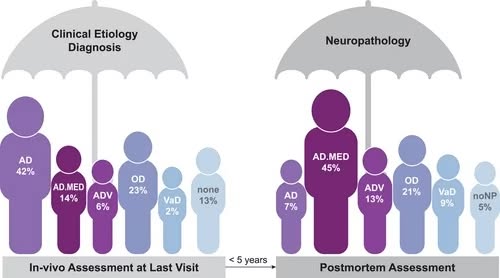
A study by researchers at NYU and Weill Cornell Medicine in New York City found that even trained Alzheimer's clinicians can be misled by overlapping symptoms among different neurological causes. Among 6842 autopsied individuals who died within 5 years of their last clinical visit, autopsy diagnoses varied in prevalence in some surprising ways:
Here's the difference between the last clinical diagnosis by a NACC clinician and the autopsy results. [Note: You can see a visual of this in the illustration above]
- Not 42% , but only 7% had "pure" AD.
- Not 6% , but 13% had AD with vascular dementia ("ADV").
- Not 14% , but almost half (45%) had a mixture of AD with other dementias such as Lewy body or FTD ("AD.MED").
- Not exactly 23% but 21% had non-AD dementias alone (OD).
- Not 2%, but 9% had vascular dementia (VaD)alone.
- Not 13% , nut only 5% had no dementia neuropathology identified.
.
The authors note "We found that apolipoprotein E (APOE) ε4 was associated with increased mortality risk in AD with co-pathologies, but not in pure AD without other neuropathologies. Conversely, APOE ε4 was associated with decreased mortality risk in decedents who did not have AD neuropathology. "
They added "APOE ε2 was protective in some AD-related subtypes but was associated with higher mortality risk in cerebral amyloid angiopathy with other vascular neuropathologies.. APOE ε2 was associated with significantly higher mortality risk in the group with mixed VaD and CAA neuropathology. This result may be related to reported associations of APOE ε2 with spontaneous intracerebral hemorrhage.About 10% to 15% of strokes are due to intracerebral hemorrhage, which is associated with a high short-term mortality rate. Thus, although APOE ε2 may appear to reduce mortality in individuals with pure AD pathology, it may confer vulnerability in contexts involving cerebrovascular disease—particularly where CAA is also present."
The distribution of APOE genotypes was examined among the 24 neuropathology subgroups in 6547 autopsied decedents who had APOE genotype data. Some notable findings:
- Among pure vascular dementia (VaD) cases, >95% carried at least one ε3 allele, and 69% were ε3/ε3.
- Among pure Alzheimer’s cases, only 7% of the total, 51% of these cases did not carry an ε4 allele, and most of those (47% ) were ε3/ε3.
- ApoE 4 was most prevalent in the AD plus cerebral amyloid angiopathy (CAA) sub-type.
- Conversely, APOE ε4 was statistically significantly associated with lower mortality risk (SHR <1 and 95% CI <1) in the competing risk groups that did not have either AD or CAA neuropathology.
- Overall, pure AD was relatively rare, and 51% of these cases did not carry an ε4 allele, whereas 47% were ε3/ε3.
In layperson's terms, genetic risk varies far more by biomarker-specific subtypes than by clinical diagnosis.
The authors emphasize the need to evaluate biomarkers and risk factors using more refined, subtype-specific biomarkers and diagnostic protocols to enable precision prevention and personalized treatment strategies for the diverse forms of the multiple etiologies of dementias.
In a welcome focus on ApoE 4, they note that ApoE4 is a risk for cardiovascular disease (CVD), and that ignoring CVD and other causes of death as major competing risks, especially in women, often results in both underestimation bias and overestimation bias on risk effects of genetic variants and other biomarkers in various competing risk groups.
They argue for more investigation into the differential effects of APOE ε4 across various ADRD or multiple-etiology dementia (MED) subtypes to provide a deeper understanding of the complexity of these diseases, refine diagnostic methods and aid in developing targeted, effective treatments.
In an important and hopeful note, they recognize that "many of these contributing conditions, including vascular disease and CAA, are influenced by many modifiable risk factors such as cholesterol levels, blood pressure, and lifestyle choices (e.g., sleep). The 2024 Lancet Commission emphasizes that targeting these modifiable risk factors can significantly reduce dementia burden.
"These findings have major implications for dementia prevention and management. Although no cure currently exists for AD, many of the most common comorbid conditions contributing to mortality in individuals with mixed AD neuropathology, particularly vascular contributors, are preventable or treatable using lifestyle modifications and specific medications. Recognizing that genetic risk interacts with lifestyle factors and the underlying mixed pathology can inform more individualized approaches to prevention and care."
The contributing authors, the NACC centers and this study are funded by multiple National Institute on Aging (NIA), NIH and CDC grants.