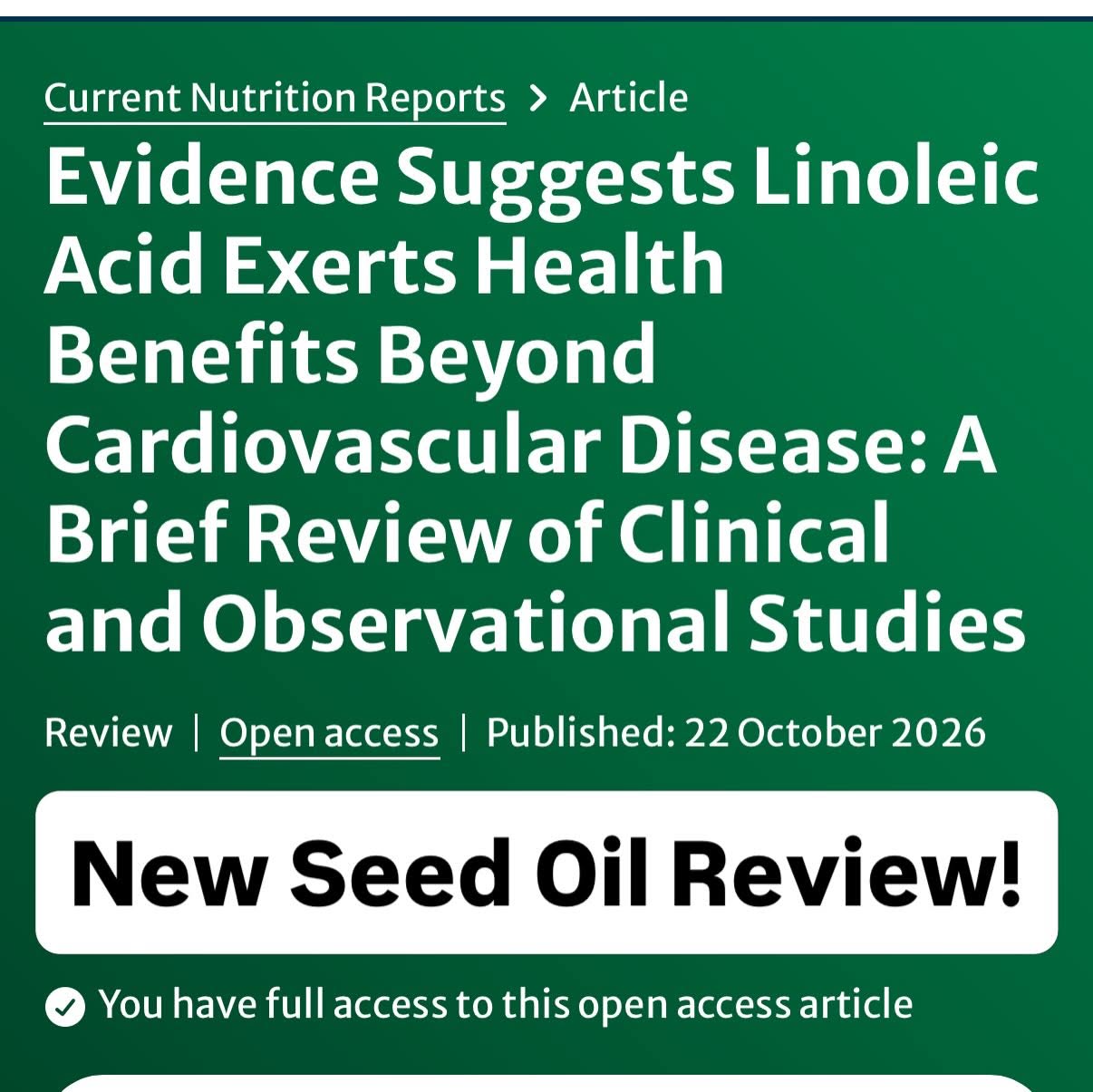
Why do studies consistently show that omega 6 fats lower risk for diabetes?
The omega 6 fatty acids are the main source of fat found in nuts and seeds.
They are essential. Your body cannot make them. Without a regular dietary source, you would die.
As explained in previous posts, over 100 randomized controlled trials in humans have shown in aggregate that omega 6 fats improve insulin sensitivity and lower blood glucose:
↪ 100+ trials: polyunsaturated fat improves glucose and insulin markers, saturated doesn't
↪ Meta-analysis of 102 feeding trials: PUFA gives the best glucose-insulin benefits
And 20 prospective cohort studies have shown in aggregate that people with the highest blood levels of omega 6 have the lowest risk of ultimately developing diabetes. In these cohort studies, people with blood levels of omega 6 in the top 20% of the range have a 43% lower risk of ultimately developing diabetes than people in the bottom 20%:
↪ Higher omega-6 (linoleic acid) biomarker levels linked to 43% lower type 2 diabetes risk
What is actually going on here? What are the mechanisms by which this is happening?
Two main references for this post are the review articles:
Paper · Lipids Health Dis · 2024Beneficial effects of linoleic acid on cardiometabolic health: an update.Linoleic acid (LA), as a part of the wider debate about saturated, omega-6 and omega-3 fatty acids (FAs) and health, continues to be at the center of controversy in the world of fatty acid research. A robust evidence base, however, demonstrates that higher intakes and blood levels of LA are associated with improved cardiometabolic health outcomes. LA lowers total and low-density lipoprotein cholesterol when compared…pmc.ncbi.nlm.nih.gov“Linoleic acid, an omega-6 fatty acid that reduces risk for cardiometabolic diseases: premise, promise and practical implications (Current Opinion in Clinical Nutrition and Metabolic Care , 2023).
↪ Omega-6 linoleic acid improves insulin sensitivity by activating PPAR-gamma
These reviews were written or edited by Bill Harris PhD, who is a distinguished fatty acid scientist best known for his work on the health benefits of omega 3. In recent years, he has become interested in the health effects of omega 6 from nuts and seeds.
(For more information on Bill Harris’s work on omega 6 fats, see these past posts: ↪ Bill Harris: omega-6/omega-3 ratio does not predict heart disease or diabetes, ↪ Harris and Patrick: omega-6 to omega-3 ratio does not predict heart disease or diabetes).
Linoleic acid (LA) is the primary omega 6 fat in the human diet. Its richest source is nuts and seeds. It is an essential fat that your body cannot make.
While the review papers cover broad cardiometabolic benefits of LA, their explanation of why LA improves insulin sensitivity and reduces risk for diabetes focuses on how LA acts as a signaling molecule through the PPAR-γ pathway.
- The Role of PPAR-γ in Diabetes Prevention
The most significant possible mechanism identified for lowering diabetes risk in these reviews is LA’s role as a natural ligand (a molecule that binds to a site) for PPAR-γ. This receptor is primarily found in adipose (fat) tissue and is the same target used by the "glitazone" (thiazolidinedione) class of diabetes medications, such as the drug pioglitazone.
(See this past post on how the drug pioglitazone may reverse the development of atherosclerotic plaque by activating PPAR-gamma: ↪ Linoleic acid activates PPAR-gamma like pioglitazone, which may reverse plaque. Like pioglitazone, nuts reversed plaque in the carotid artery in the famous PREDIMED trial: ↪ PREDIMED: nuts regressed carotid plaque and a nut-rich Mediterranean diet cut stroke 50%.)
Activation of the PPAR-gamma (PPARγ) pathway prevents diabetes and extends lifespan in animal models by acting as a master regulator of adipogenesis (creation of new fat cells from stem cells), which redirects toxic free fatty acids away from the liver and muscles into healthy adipose tissue depots. This "lipid-sink" effect reduces lipotoxicity and chronic inflammation, significantly improving insulin sensitivity and lowering systemic blood glucose levels. As mentioned, this is how diabetes drugs like pioglitazone work. It may also be how linoleic acid works.
Beyond its metabolic benefits, PPARγ activation mimics certain aspects of caloric restriction—a known longevity-enhancing intervention—by upregulating mitochondrial efficiency, enhancing antioxidant defenses, and suppressing the NF-κB inflammatory pathway. In rodents, this comprehensive stabilization of metabolic organ function and reduction in age-associated oxidative stress effectively delays the onset of degenerative diseases, thereby promoting a longer, healthier life.
How LA Influences PPAR-γ:
Adipocyte Differentiation: LA activates PPAR-γ, which promotes the creation of new, small, healthy fat cells (adipogenesis). Unlike old "sick" enlarged fat cells, these new small cells are highly sensitive to insulin and effectively "soak up" excess fatty acids from the blood. When you activate PPAR-γ, you are essentially shifting the body's storage strategy from stretching/expanding old fat cells to building new ones.
Adiponectin Boosting: PPAR-γ activation increases the expression of adiponectin. This hormone travels to the liver and muscles to enhance glucose uptake and fatty acid oxidation.
(High levels of adiponectin from exercise is the main reason why sumo wrestlers have very little insulin resistance, even though they have extremely high body fat: facebook.com/share/v/19Dqqs9nuM).
Glucose Transporter Expression: Activation of this pathway leads to the up-regulation of GLUT4, the primary "doorway" glucose uses to enter muscle and fat cells, directly lowering blood sugar levels.
- Additional Mechanisms for Insulin Sensitivity
Beyond the PPAR pathway, there are three other critical ways LA may improve metabolic health:
A. Membrane Fluidity and Insulin Binding
The cell membrane is composed of fatty acids. When you consume LA (a polyunsaturated fat) instead of saturated fats:
The cell membrane becomes more fluid and less rigid.
This physical change allows the Insulin Receptor (IR) to move more freely and change shape easily when insulin hits it, making the "signal" to the cell much stronger.
This is referred to as the cell membrane hypothesis of insulin resistance.
B. Reduction of Liver Fat (Lipid Partitioning)
One of the hallmarks of type 2 diabetes is ectopic fat— fat stored inside organs where it doesn't belong, like the liver and pancreas.
Clinical trials have shown that LA-rich diets actively reduce liver fat and visceral (belly) fat, when consumed in place of saturated fat or refined carbohydrate.
By clearing fat out of the liver, LA prevents the "clogging" of the insulin signaling pathway, a process known as reducing lipotoxicity.
C. The Pro-Inflammatory Myth vs. Reality
A common concern is that LA converts into arachidonic acid (AA), which can lead to inflammation. The paper provides an update on this:
Tight Regulation: In humans, the conversion of LA to AA is extremely low (<1%).
Anti-Inflammatory Oxylipins: In some studies, a higher LA intake is actually associated with lower levels of C-reactive protein (CRP). LA produces specific "oxylipins" that can actually help resolve inflammation in the pancreas, protecting the β-cells that produce insulin.
There have been over 30 randomized controlled trials in humans testing the hypothesis that omega 6 fat (linoleic acid) increases inflammatory markers. These trials have consistently found that this does NOT actually happen in vivo in humans: ↪ 30 RCTs show higher linoleic acid intake does not raise inflammatory markers.
#linoleicacidHD #ppargammaHD #omega6HD #nutsHD #seedsHD #seedoilsHD #pioglitazoneHD #inflammation6HD #inflammationHD #thiazolidinedionesHD #diabetesHD #insulinresistanceHD #liverfatHD #billharrisHD #omega6diabetesHD #liverfatsummaryHD #omega6liverfatHD