(no text — see the shared post below)
Omega 6 fat (linoleic acid) improves insulin sensitivity by activating PPAR-gamma
Reference:
“Linoleic acid, an omega-6 fatty acid that reduces risk for cardiometabolic diseases: premise, promise and practical implications (Current Opinion in Clinical Nutrition and Metabolic Care, 2023).
Paper · Curr Opin Clin Nutr Metab Care · 2023Linoleic acid, an omega-6 fatty acid that reduces risk for cardiometabolic diseases: premise, promise and practical implications.As heart disease and type 2 diabetes mellitus (T2DM) cases continue to rise, identifying lifestyle modifications to prevent cardiometabolic disease (CMD) is urgently needed. Clinical evidence consistently shows that higher dietary or biomarker levels of linoleic acid (LA; 18:2n6) reduce metabolic syndrome (Mets) and reduce the risk for CMD. Yet, dietary recommendations to include LA as part of a lifestyle plan with…pubmed.ncbi.nlm.nih.gov
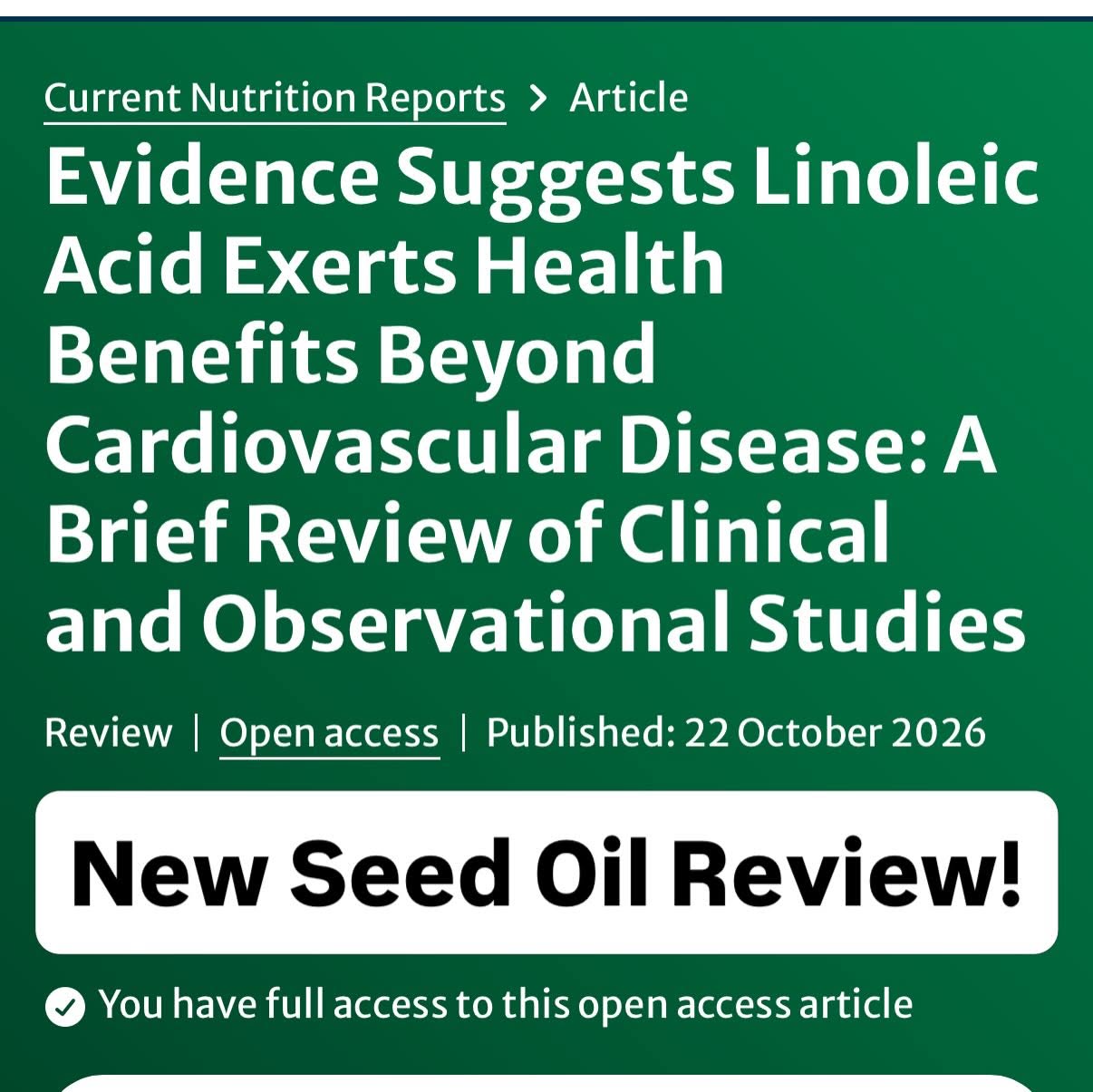
This recent review article addresses the health effects of Linoleic Acid (LA) in humans— the primary omega-6 fatty acid found in nuts, seeds, and vegetable oils. While misguided concerns in the past have suggested LA might promote inflammation, this paper explains that an overwhelming amount of scientific evidence in humans shows the opposite: LA does not increase inflammation in human randomized trials, and some studies show an anti-inflammatory effect. This paper explains how LA acts as a potent signaling molecule and a primary driver of cardiometabolic health, largely due to its interaction with the PPAR-gamma insulin sensitizing pathway. This same PPAR-gamma pathway is used by the thiazolidinedione class of diabetes drugs (e.g. pioglitazone) to treat insulin resistance, and its activation has been demonstrated to extend lifespan in animal models.
For more on this topic, including references, see this past post: ↪ Why omega-6 lowers diabetes risk: 43% lower risk in top vs bottom blood level quintile.
- The Premise: Beyond "Pro-inflammatory" Myths
The authors lead by debunking the "omega-6 is inflammatory" narrative. A common criticism is that LA converts into arachidonic acid, a precursor to inflammatory markers. However, the paper clarifies that in humans, this conversion is strictly regulated and minimal. Instead, higher blood levels of LA are consistently associated with a lower risk of Type 2 Diabetes, Coronary Heart Disease (CHD), and Ischemic Stroke.
The researchers take a firm stand on this evidence:
"In contrast to the commonly held view that LA increases inflammation, human clinical trials have shown that increasing LA intake does not increase, and may even decrease, systemic levels of inflammatory markers."
- The Role of PPAR-gamma (PPARγ)
A central mechanism for LA’s benefit is its role as a natural ligand (an activator) for PPAR-gamma (Peroxisome Proliferator-Activated Receptor gamma). This receptor acts as a "master switch" for metabolic health. Activating it improves insulin sensitivity.
Improving Insulin Sensitivity
LA and its metabolites are not passive sources of energy; they act as specific keys that unlock PPAR-gamma, which regulates genes involved in glucose and lipid metabolism. The authors state:
"LA and its oxygenated metabolites are natural ligands for PPAR-gamma, which is the molecular target for the thiazolidinedione class of insulin-sensitizing drugs."
By activating these receptors, LA performs a "pharmaceutical-like" role, helping the body clear glucose from the bloodstream and improving overall insulin sensitivity.
Adipocyte Function and Anti-inflammation
PPAR-gamma activation promotes the healthy expansion of fat cells (adipocytes) and prevents "lipotoxicity"—the dangerous accumulation of fat in the liver and muscles which causes insulin resistance. Furthermore, once activated, PPAR-gamma inhibits pro-inflammatory pathways like NF-κB. This "trans-repressive" effect means LA actually helps quiet the body's inflammatory response rather than fueling it.
- The Promise: Cardiometabolic Protection
The "promise" highlighted in the paper is the significant reduction in chronic disease risk observed when LA replaces less healthy nutrients. The authors argue that replacing saturated fats (like butter or lard) or refined carbohydrates with sources of LA like fats from nuts and seeds is one of the most effective dietary interventions available.
They summarize the clinical evidence as follows:
"The most robust evidence for a benefit of LA comes from prospective cohort studies and randomized controlled trials showing that replacing SFA with polyunsaturated fatty acids (primarily LA) reduces CHD risk."
- Practical Implications
The research suggests that the "practical implication" for the general public is to prioritize nuts, seeds, or vegetable oils as primary fat sources.
Key Takeaways
Metabolic Signaling: LA acts as a signaling molecule that improves how cells respond to insulin via PPAR-gamma— the same pathway used by the thiazolidinedione class of diabetes drugs.
Healthy Fat Storage: It encourages "healthy" fat storage, protecting vital organs like the liver and pancreas from fat buildup. This buildup of unwanted ectopic fat in the liver directly causes insulin resistance. And similarly, the buildup of ectopic fat in the pancreas causes beta cell disfunction and pancreatic insufficiency.
Eicosanoid Balance: The paper clarifies that LA does not significantly increase arachidonic acid levels, debunking the theory that it drives systemic inflammation.
#linoleicacidHD #ppargammaHD #omega6HD #nutsHD #seedsHD #seedoilsHD #pioglitazoneHD #inflammation6HD #inflammationHD #thiazolidinedionesHD #diabetesHD #insulinresistanceHD #liverfatHD #pancreasfatHD #musclefatHD #omega6diabetesHD #liverfatsummaryHD #omega6liverfatHD