Visceral fat is probably the major reason why male testosterone levels have been steadily dropping, over decades at the population level.
The obesity crisis and the testosterone crisis are likely one in the same.
“Men who stay lean, active, and free of chronic illness show stable testosterone well into their 70s and 80s in longitudinal data.”
Link to accompanying video explaining this in more detail:
 ▶Video · YouTube · Barbell MedicineIs the Testosterone Crisis Real? A Physician Review of the EvidenceA quarter of men start testosterone replacement therapy without a single pre-treatment blood test. The supplement aisle is full of boosters that do nothing, and about 1 in 8 muscle-building products is contaminated with undisclosed steroids. The lab test itself is so variable that half of low results come back normal a week later. And the headline that…m.youtube.com
The most relevant clip from this video can be found here:
facebook.com/share/v/14YQUNYVFLm
Every middle aged man considering TRT should watch this video.
The portion after minute 19:28 is most relevant to what is discussed in this post.
#testosteroneHD #visceralfatHD #trtHD #aromataseHD
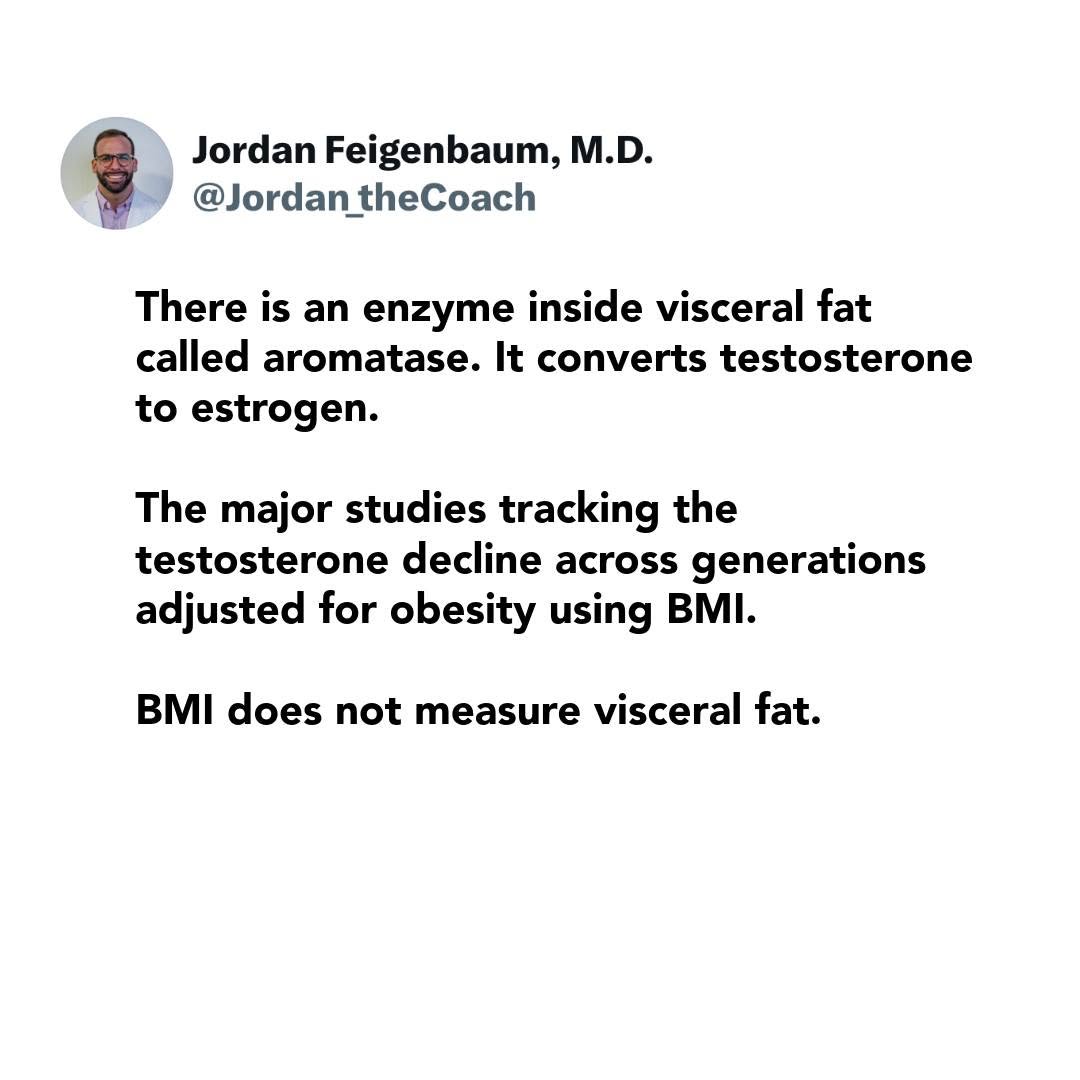
Visceral fat contains an enzyme called aromatase. Aromatase converts testosterone to estrogen. The fat stored around your organs does this continuously, at a rate that rises as the fat accumulates.
Every major study documenting the generational testosterone decline adjusted for obesity using BMI. BMI measures weight relative to height. It cannot see changes in visceral fat. Waist circumference tracks visceral fat directly in a way BMI cannot.
Men's waist circumferences have been increasing faster than BMI. The same number on the scale represented more visceral fat as the decades passed, and the obesity adjustments in these studies could not see any of it. As a result, the decline has been labeled as "unexplained".
In 2012, a team at the National Cancer Institute tested archived blood samples from 1988 through 2004 on the same mass spectrometry platform, in the same laboratory. They added waist circumference to the model alongside BMI. After adjusting for age, race, BMI, waist circumference, and lifestyle factors, there was no significant decline in total or free testosterone in the nationally representative sample.
Men who stay lean, active, and free of chronic illness show stable testosterone well into their 70s and 80s in longitudinal data.
Episode one of our four-part testosterone series is live now. Link in comments.
What aspect of testosterone do you most want us to go deeper on in the series?