Testosterone sits at the crossroads of three questions that men often mix up: whether a low level is a real medical problem, whether treatment is safe for the heart, and whether more testosterone is better. The group's posts give a fairly consistent answer. For men with clinically diagnosed hypogonadism (a true testosterone deficiency with symptoms), treatment under medical supervision appears reasonably safe over a few years. For everyone else, there is no proven benefit, some signals of harm, and a good chance that the real problem is excess body fat rather than the testes.15
Erectile dysfunction (ED) belongs in the same conversation because it is a plumbing problem as much as a hormone problem. An erection depends on blood flow controlled by the endothelium, the inner lining of blood vessels, and ED is often the first sign that the arteries are struggling.4
This summary organizes what the group's admins, mainly Louis Nervegna and Gokhan Can, and the studies they share say about testosterone, TRT, steroid use and sexual function. Much of it is the admins' interpretation and is attributed as such. Nothing here replaces a conversation with an endocrinologist or urologist.
Key terms in plain language
- Testosterone: the main male sex hormone. Total testosterone is commonly quoted as a normal range of roughly 300 to 1,000 ng/dL.48
- Hypogonadism: a clinical diagnosis of low testosterone together with symptoms. Louis describes TRT as proven only for men with this diagnosis.910
- TRT (testosterone replacement therapy): prescribed testosterone, for example as a gel or patch.11
- Aromatase: an enzyme, abundant in fat tissue, that converts testosterone into estrogen.1213
- Visceral fat: fat stored around the organs, as opposed to fat under the skin. Waist circumference tracks it better than BMI does.13
- Anabolic androgenic steroids (AAS): testosterone and related drugs taken for muscle or performance. Louis points out that exogenous testosterone taken in excess is also an anabolic steroid.3
What the evidence shows about TRT and the heart
The Budoff plaque trial
The most-discussed study in the group is a randomized, double-blind, placebo-controlled trial published in JAMA in 2017 and led by Matthew Budoff, whom Louis describes as a world-class expert in CT angiography trials. It enrolled 170 men aged 65 or older with an average of two serum testosterone levels below 275 ng/dL and symptoms suggestive of hypogonadism, and randomized them to testosterone gel (n = 82) or placebo gel (n = 88) for 12 months.1
Noncalcified plaque volume (NCPV), the softer, less calcified plaque, rose from a median of 204 mm3 to 232 mm3 in the testosterone group and from 317 mm3 to 325 mm3 with placebo. The estimated difference was 41 mm3 (95% CI 14-67; P = .003).1
Show data
| At start | After 12 months | |
|---|---|---|
| Testosterone gel (82 men) | 204 | 232 |
| Placebo gel (88 men) | 317 | 325 |
To give the number context, Louis cites an analysis suggesting that an average at-risk person on a standard American diet and sedentary lifestyle grows about 5 mm3 of soft plaque a year. By his arithmetic (41 / 5 = 8.2), one year of testosterone equalled about eight years of normal plaque growth.19 That comparison is Louis's framing, not a result of the trial itself. The trial authors quoted in the post called the increase concerning but noted that its clinical significance could depend on how testosterone affects the individual components of noncalcified plaque.1
TRAVERSE and its limits
Louis notes that several trials, especially TRAVERSE in 2023, found that treating clinically diagnosed hypogonadism did not increase heart attacks or strokes over a few years, even in men with hypogonadism who already had heart disease.1 He adds two caveats. First, no such evidence exists for men taking testosterone without that diagnosis. Second, heart disease takes decades to develop, and TRAVERSE lasted only 22 months, which may be too short to reveal long-term risk.1
So the two bodies of evidence are not necessarily in conflict. The plaque trial measured a structural change in the arteries over a year; TRAVERSE counted clinical events over about two years. The group's admins read the combination as supporting caution rather than alarm for deficient men, and real skepticism for men on testosterone for "anti-aging".9
Anecdotes from clinical practice
A cardiologist's video described middle-aged men having heart attacks while on testosterone therapy. Louis clarified that the five patients had normal testosterone levels for their age before starting TRT, so they were not clinically diagnosed with hypogonadism, and that the cardiologist himself labeled this anecdotal, the lowest level of evidence.14
Steroid-level exposure
At the far end of the dose range, a 2025 Circulation cohort followed 1,189 anabolic androgenic steroid users and 59,450 age- and sex-matched controls for 11 years. Users had roughly three times the risk of heart attack, 2.95 times the need for stent or bypass, 2.4 times the venous thromboembolism (blood clot) risk, 2.3 times the arrhythmia risk, 3.6 times the heart failure risk and 8.9 times the cardiomyopathy (heart muscle disease) risk. The summary Louis shared from Luigi Fontana notes that the risks persisted after adjusting for age, education and occupational status, and that the users were recreational gym-goers, not elite athletes.315 Louis draws the general lesson that raising androgen levels excessively high is dangerous.15
Show data
| Times the risk of controls (log scale) | 95% CI | |
|---|---|---|
| Cardiomyopathy | 8.9 | – |
| Heart failure | 3.6 | – |
| Heart attack | 3 | – |
| Stent or bypass | 2.95 | – |
| Venous thromboembolism | 2.4 | – |
| Arrhythmia | 2.3 | – |
A separate study of 247 men (50 non-users, 125 current users and 72 past users of androgens) found self-reported psychiatric diagnoses 2.5-fold higher in users and past users. Psychiatric comorbidity tracked depression and anxiety more than low testosterone did. Testosterone usually recovered within about 12 months of stopping, but mood, sexual dysfunction and fatigue were widely reported for years afterward.16
Is "more testosterone" anti-aging?
Louis is blunt on this point and the posts show where his reasoning comes from. He states that the only proven benefit of testosterone therapy is treating clinically diagnosed hypogonadism and that no credible randomized trial has shown that TRT lowers risk of any disease or extends lifespan in men without it, adding that some studies have shown harm.510
The supporting evidence he cites includes:
- An inverse U-shaped mortality curve. In a 2014 cohort of 3,690 men aged 70 to 92 published in the Journal of Clinical Endocrinology & Metabolism, an optimal plasma testosterone was associated with the lowest all-cause mortality, and the risk of death rose above a free testosterone of about 200.10
- Animal data. Androgen exposure shortened lifespan in male mice, and castration extended lifespan in rodents and primates. A 2026 preprint reported by Science found that neutering older male mice, at the human equivalent of about 30 years old, lengthened life by more than 30%, and that adult neutering beat neutering in childhood or after puberty.1017
- Cross-species analysis. A Nature analysis of zoo data from 117 vertebrate species found that sterilization and contraception increased lifespan by 10 to 20%. Louis calls the underlying idea antagonistic pleiotropy, a tradeoff between reproduction and longevity.18
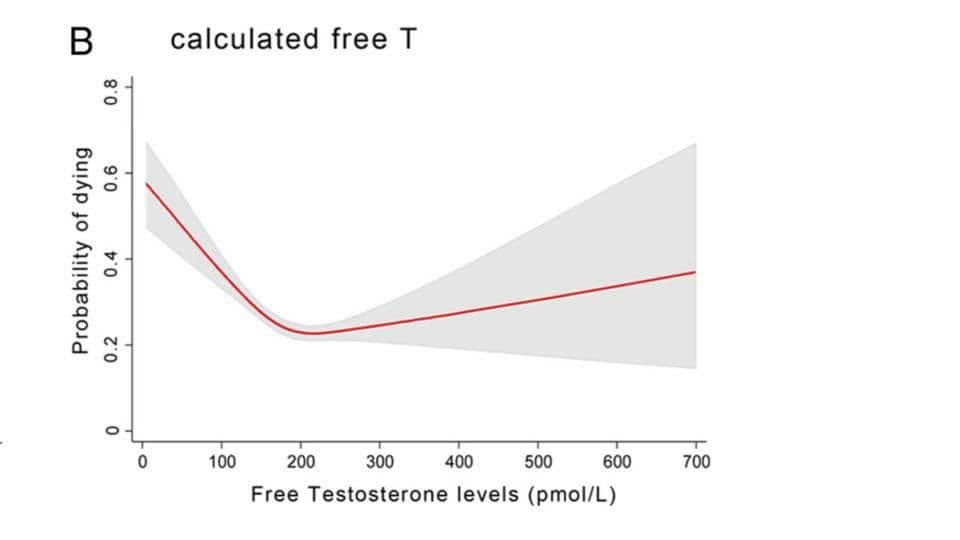
Louis uses these data to argue that anything promising to push the testosterone of older men to a 20-year-old's level as "anti-aging" deserves suspicion.1718 Note the limits. The mouse data are a preprint, castration is obviously not an option for people, and the posts themselves describe the animal evidence as suggestive rather than proof in humans. The optimal testosterone level for longevity in healthy humans is described as still unknown.1719
A related point from Louis concerns diet. A meta-analysis summary he shared suggests low dietary fat intake modestly lowers testosterone. He cautions this is not necessarily bad, since calorie restriction also lowers testosterone while extending lifespan in most animals tested.19
Why testosterone is low in many middle-aged men: visceral fat
The admins' most repeated claim is that in most middle-aged men, low testosterone is caused by excess visceral fat, with diet and a sedentary lifestyle as secondary factors, and that correcting them often normalizes levels.720 Louis cites a Harvard Health article and a 2024 Frontiers in Aging review on lifestyle and hypogonadism in sedentary older men.7
The mechanism
Posts shared from Barbell Medicine describe two reinforcing pathways. Visceral fat is rich in aromatase, which converts testosterone to estradiol. That estradiol feeds back on the hypothalamus, suppressing GnRH, which lowers LH and so reduces testosterone production by the testes. Lower testosterone in turn promotes more visceral fat storage, so the loop runs both ways. The second pathway involves leptin, which can downregulate kisspeptin neurons that drive GnRH.2 A urologist quoted in Men's Health puts it simply: "The testes are usually fine. The fat is the problem." He adds that obesity-related inflammation and lower SHBG (a protein that controls how much testosterone is active) contribute.12
A FoundMyFitness post shared by Louis says being overweight or obese can lower testosterone by as much as half a reference range. Louis calculates this as about 350 ng/dL (half of the 300 to 1,000 ng/dL range).820
How much weight loss helps
According to the Barbell Medicine material Louis shares, a 10% drop in body weight raises testosterone by about 84 ng/dL on average, and a 20 to 30% drop, typical of bariatric surgery, by about 250 ng/dL. GLP-1 drugs, at roughly 120 ng/dL on average, fall in between in proportion to the weight lost. The post's conclusion is that weight loss would make many TRT prescriptions unnecessary.2 A BoxLife article Louis shared points to a 7 to 10% weight-loss threshold, where leptin falls enough to trigger a substantial rise; it cites one study in which 11% weight loss produced a 44% drop in leptin in six months. It also recommends retesting 3 to 6 months after weight loss and monitoring TRT doses as weight changes.21
GLP-1 drugs and tirzepatide
- A controlled pilot study in 83 men with obesity (mean age about 55) compared tirzepatide (n = 28), lifestyle alone (n = 30) and transdermal testosterone (n = 25), all with lifestyle changes, for two months. Tirzepatide (2.5 mg weekly, then 5 mg) produced larger reductions in weight, waist and fat mass, and higher LH, FSH, SHBG, total and free testosterone and lower estradiol than either comparison group. It also raised the IIEF-5 erectile function score.1122 This is a small, short pilot.
- A real-world study of men with obesity on incretin-based drugs found modest weight loss, better glycemic control and higher total and free testosterone, with the biggest gains in those who lost the most weight; the share of men in the normal range rose from 67% to 86%.23
- Menno Henselmans notes that a yet-to-be-published review of 5 studies found testosterone improved in 2 studies of overweight men but not in 3 studies of healthy men, suggesting the effect comes from going from overweight to a healthier weight rather than from the drugs themselves.24 Louis agrees that there is "nothing magical" about the drug and that diet and exercise can do the same, with the drug making it easier.12
Is the population-level decline real?
Louis shares a Barbell Medicine argument that the supposed decades-long decline in US testosterone is largely an artifact. Studies adjusted for obesity using BMI, which cannot see visceral fat, while waist circumference rose faster than BMI. The video summary says a 2012 National Cancer Institute analysis of archived blood from 1988 through 2004, run in one laboratory on one mass spectrometry platform and adjusted for waist circumference, found no significant decline in total or free testosterone. Men who stay lean, active and free of chronic illness are described as keeping stable testosterone into their 70s and 80s.1325 Louis concludes that the obesity crisis and the "testosterone crisis" are probably one and the same.13
This is an interpretation from video and social-media summaries, and the group presents it as such.
Prescribing practice, screening and marketing
Several posts raise concern about how testosterone is being prescribed.
- A University of Michigan single-center study reported by Medscape found that only 12% of men prescribed testosterone had recommended diagnostic testing, and many were treated despite contraindications, including no basic PSA test to screen for prostate cancer. Prescriptions in the US have quadrupled in three decades despite stable hypogonadism diagnosis rates. The researchers pointed to social media, direct-to-consumer advertising and "low T" clinics as drivers. Louis's comment about "incompetence and greed" is his opinion.6
- Barbell Medicine, commenting on a plan to screen all active-duty service members over 30, states that about 1 in 18 men aged 30 to 79 has low testosterone plus symptoms, about a third of low readings are wrong on retest, and over half of men who genuinely qualify improve on their own. A related summary says about 70% of more than 15,000 men starting gel stopped within a year. Louis calls the plan a significant deviation from standard guidelines.26
- A magazine article Louis shared warns that TRT may raise the risk of blood clots, heart attacks, sleep apnea and infertility, especially in men who are not truly deficient. He advises seeing a board-certified endocrinologist or urologist who specializes in genuine hypogonadism, and warns against private TRT clinics.27
- Louis also shares a headline warning that Fadogia agrestis, a testosterone supplement promoted by influencers, has never been tested in humans and that animal studies indicate toxicity. The post offers no study details.28
- Gokhan Can's CHIP post says that anything strongly stimulating the bone marrow, hormone replacement with testosterone in particular, may help clonal hematopoiesis (acquired blood-cell mutations linked to over two-fold higher coronary risk) grow and progress. This is stated briefly and without trial data.29
Cholesterol, statins and sex hormones
A common fear is that lowering cholesterol starves the body of the raw material for hormones. Posts from the group address this directly.
- Gokhan's post says meta-analyses find statins lower total testosterone by an average of about 9 to 13 ng/dL, which he calls biochemical noise against a normal range of 300 to 1,000 ng/dL, rarely enough to push a healthy man into hypogonadism.4
- Louis explains that the blood holds only about 2 to 5% of the body's cholesterol (roughly 4,800 to 6,000 mg circulating), and that the net daily demand of the adrenals and gonads is only tens of milligrams. He says the FOURIER and ODYSSEY OUTCOMES trials took LDL-C below 15 to 20 mg/dL without impairing adrenal or gonadal hormone production or vitamin D.30
- One caution comes from the other direction. Louis's explanation of the lean mass hyper-responder (LMHR) pattern, in which very lean people on keto or carnivore diets show very high LDL, proposes a starvation-like response that raises LDL while lowering thyroid function and sex hormones such as testosterone. It is his reading of the literature on extreme calorie restriction.31
Erectile dysfunction and the heart
ED deserves attention because it can precede heart symptoms. High cholesterol damages the endothelium; oxidized LDL reduces nitric oxide (the molecule that relaxes blood vessels during arousal) and increases oxidative stress. That is why Gokhan describes ED as often the first sign of heart disease, an early warning that the arteries are struggling.4
His post goes on to say that statins have additional (pleiotropic) effects: they boost endothelial nitric oxide synthase and make vessels more responsive to nitric oxide. In men with high cholesterol and ED, statins improved erectile function scores by roughly one-third to one-half as much as a drug like Viagra, according to the post, and fixing lipids may help restore a response in men who did not respond to Viagra. The post also discusses the SAMSON n-of-1 study as evidence that many statin side effects, including low libido, may be nocebo effects.4 These figures are the post's own summary and are not tied to a named trial.
In the tirzepatide pilot, erectile function scores also improved with weight loss.22 Separately, a Medscape report shared by Louis says SSRI antidepressants cause sexual dysfunction in 30 to 70% of users, and that saffron may help; this is not a heart-related finding.32
What this means for you
These points reflect what the group's admins and shared sources say. Discuss any decision with your doctor.
- If you have symptoms of low testosterone, the admins recommend an honest evaluation by a board-certified endocrinologist or urologist rather than a "low T" clinic.27
- A proper diagnosis involves testing before treatment. About a third of low readings are reported to be wrong on retest, which is why a single blood draw is a weak basis for starting therapy.626
- For middle-aged men with a low reading and excess belly fat, the admins suggest treating visceral fat first, by any means, then retesting 3 to 6 months later.721
- People with heart disease should be especially cautious about testosterone unless they have a true diagnosis of hypogonadism.9
- The admins advise against testosterone for "anti-aging" in men whose levels are normal for their age.1033
- Anabolic steroid-level dosing is linked to heart attack, cardiomyopathy and heart failure in cohort data.3
- Statins are not expected to meaningfully lower testosterone, and ED is worth raising with a doctor as a possible early sign of vascular disease.4
- Louis points out that heart disease takes decades to develop, so a trial of a few years, such as the 22-month TRAVERSE, may not show the full extent of any risk.1
Frequently asked questions
Does TRT cause heart attacks?
In men with clinically diagnosed hypogonadism, TRAVERSE (2023) found no increase in heart attacks or strokes over its 22-month duration, including in men with existing heart disease. In older men on testosterone gel, however, a 12-month trial found significantly more soft plaque growth. For men without the diagnosis, the group says there is no evidence of benefit and some evidence of harm.15
I'm in my 50s and my testosterone is low. Do I need TRT?
Louis's view is that you probably need to lose visceral fat rather than take testosterone, and he argues levels often normalize when you do. This is his position, and it does not apply to every man; the endocrinologist quoted in one shared post stresses that not all low testosterone is caused by obesity and that some men do need TRT.2334
Do GLP-1 drugs raise testosterone?
Studies and shared articles report that they do, mainly in men with obesity, and most likely via weight loss. In one real-world study the share of men with normal testosterone rose from 67% to 86%.122324
Do statins hurt testosterone or erections?
According to Gokhan's post, the testosterone drop is small (about 9 to 13 ng/dL on average), and statins may improve erectile function.4
Are testosterone supplements worth it?
The only supplement discussed is Fadogia agrestis, which the headline Louis shared says was never tested in humans and showed toxicity in animal studies.28
Can low estrogen or testosterone affect bones?
Gokhan's bone-loss checklist notes that both estrogen and testosterone matter for bone, and recommends talking to an endocrinologist about hormones, along with weight-bearing exercise.35