The incremental amount that 1000IU of vitamin D supplementation raises your blood level depends on your baseline level to start.
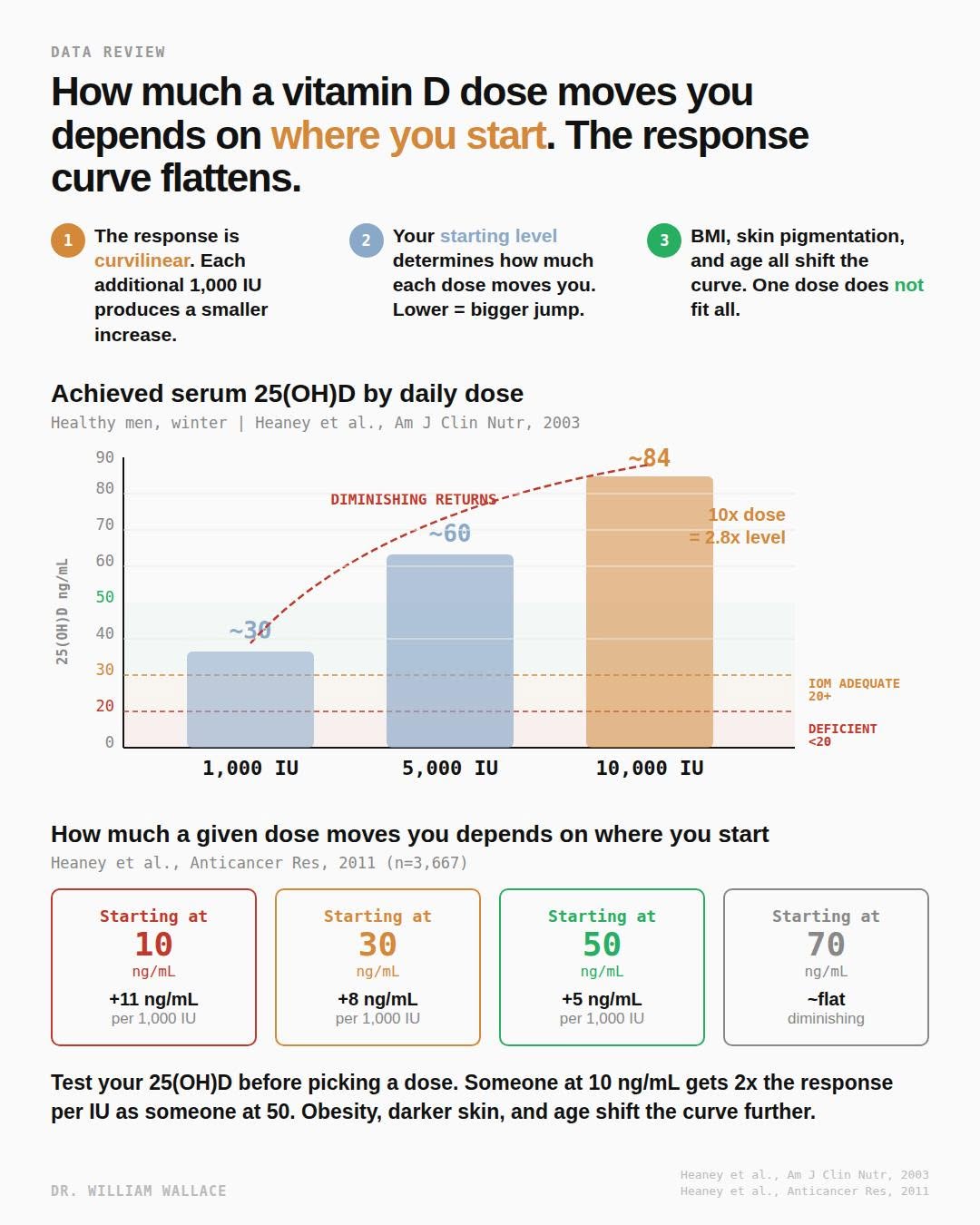
Starting at baselines of 10ng/dL, 30ng/dL, 50ng/dL, respectively, the average person will get corresponding increments of 11ng/dL, 8ng/dL, 5ng/dL for a 1000IU dose that they supplement.
Once your baseline hits 70ng/dL, the average person will no longer get much increase from a 1000IU dose. This is where the curve tends to flatten out for most people.
Other variables like body weight and age affect this, but these numbers are a good rule of thumb.
People who are significantly overweight or obese will see less of a response than these numbers predict.
#vitamindHD
Most people pick a vitamin D dose based on what is on the shelf. 1,000 IU, 2,000 IU, 5,000 IU. The assumption is that more is better, or that a single dose works the same for everyone. Neither is true. The dose-response relationship for vitamin D is curvilinear, and your starting level changes everything.
Heaney et al. (2003, Am J Clin Nutr) established this in a controlled study of healthy men during winter in Nebraska. Subjects received approximately 1,000, 5,500, or 11,000 IU of cholecalciferol daily (commonly rounded to 1,000, 5,000, and 10,000 IU in the literature), and serum 25-hydroxyvitamin D was measured until steady state. The achieved levels were approximately 30, 60, and 84 ng/mL respectively. Roughly ten times the dose did not produce ten times the level. It produced about 2.8 times the level. The curve flattens because as serum 25(OH)D rises, the rate of hepatic hydroxylation, binding protein saturation, and catabolic clearance all increase. The body is not passively accumulating vitamin D. It is actively regulating how much stays in circulation.
This has a second layer. How much each additional 1,000 IU moves your serum level depends on where you start. Heaney et al. (2011, Anticancer Res) quantified this in a community-based cohort of 3,667 adults by plotting the first derivative of the dose-response curve at various starting values. At a baseline of 10 ng/mL (deficient), each additional 1,000 IU/day raised serum 25(OH)D by approximately 11 ng/mL. At 30 ng/mL, the same 1,000 IU produced only an 8 ng/mL increase. Reading from the published derivative curve, at 50 ng/mL the increment drops to approximately 5 ng/mL, and above 70 ng/mL the response is nearly flat. The same pill produces a dramatically different result depending on your starting blood level.
The guideline landscape has shifted on what "enough" means. The IOM defines 20 ng/mL as adequate for bone and overall health and recommends 600 to 800 IU/day. The Endocrine Society's 2011 guideline set 30 ng/mL as sufficiency and recommended 1,000 to 2,000 IU/day. But their 2024 update walked that back. They no longer endorse specific 25(OH)D thresholds for deficiency, insufficiency, or sufficiency, stating that outcome-specific benefits at any given level have not been established in clinical trials. They now defer to the IOM's RDA for healthy adults under 75 and recommend against routine 25(OH)D testing. This does not mean vitamin D is unimportant. It means the evidence did not support drawing precise lines at 30 ng/mL the way the field assumed for over a decade.
Body composition shifts the curve further. Vitamin D is fat-soluble and gets sequestered in adipose tissue. Drincic et al. (2013, JCEM) showed that in obese adults, the same 1,000, 5,000, and 10,000 IU doses produced increments of only 12.4, 27.8, and 48.1 ng/mL, substantially lower than what Heaney observed in healthy-weight men. The Endocrine Society guidelines acknowledge this and suggest obese individuals may need two to three times the standard dose to achieve the same serum level.
Skin pigmentation matters because melanin competes with 7-dehydrocholesterol for UVB photons, reducing cutaneous vitamin D synthesis. This affects baseline status more than supplement response directly, but lower baselines mean a different position on the dose-response curve and therefore a different response to the same oral dose. Age also matters. MacLaughlin and Holick (1985, J Clin Invest) showed that comparing skin from subjects aged 8 to 18 years to subjects aged 77 to 82, the capacity to produce previtamin D3 decreased by more than half. Less cutaneous production means greater reliance on oral intake and a higher likelihood of starting from a lower baseline.
The practical point: if you are going to supplement, knowing your 25(OH)D level tells you where you sit on the curve and how much each IU will move you. Someone at 10 ng/mL will see a large response to a moderate dose. Someone already at 45 ng/mL taking 5,000 IU daily is spending money on a dose that barely moves the needle from where they already are. The dose that works is the one matched to your starting level, your body composition, and your individual physiology.
Heaney et al., Am J Clin Nutr, 2003
Heaney et al., Anticancer Res, 2011
Drincic et al., JCEM, 2013