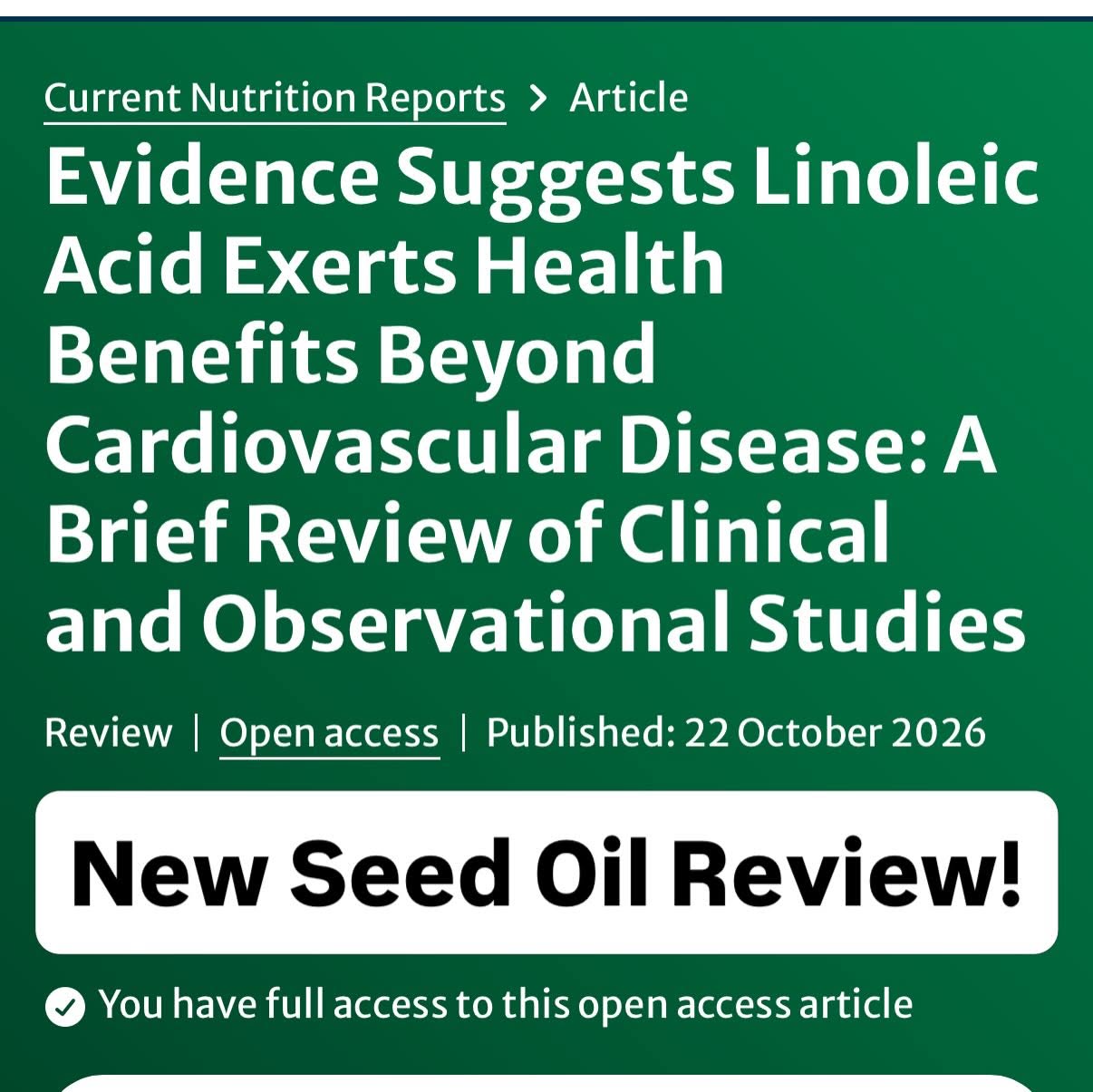
Higher blood levels of omega 6 are not associated with inflammation in the Framingham Heart Study.
In fact, they found a small anti-inflammatory effect: The higher the blood levels of omega 6, the lower the inflammatory levels like hsCRP and IL-6.
These results were published in 2025. They tested a total of 10 different markers of inflammation.
The result is not surprising, given that over 30 randomized trials in humans have shown in aggregate that omega 6 fats do not raise markers of inflammation: ↪ 30 RCTs show higher linoleic acid intake does not raise inflammatory markers.
Randomized trials tend to be short in time duration. The advantage of prospective cohort studies like Framingham is that they track people for decades.
Quoted:
“Methods: We included 2777 participants (mean age: 66 ± 9 years, 54% women, 9.8% minorities) from the Framingham Offspring and minority-enriched Omni cohorts, and calculated partial correlation coefficients. Results: After multivariable adjustment, RBC LA was inversely correlated (all p ≤ 0.05) with five markers of inflammation, receptors, or pathways: C-reactive protein (r = −0.06); soluble interleukin-6 (r = −0.15); intercellular adhesion molecule-1 (r = −0.09); monocyte chemoattractant protein-1 (r = −0.07); and P-selectin (r = −0.07). RBC AA was inversely correlated (all p ≤ 0.05) with soluble interleukin-6 (r = −0.10); intercellular adhesion molecule-1 (r = −0.14); monocyte chemoattractant protein-1, and (r = −0.06); and osteoprotegerin (r = −0.07). Lipoprotein-associated phospholipase-A2 mass and activity, urinary isoprostanes, and tumor necrosis factor receptor-2 were not significantly correlated with LA or AA. Conclusions: In our large community-based study, we observed weak but statistically significant inverse associations between several types of inflammatory biomarkers with RBC n-6 PUFAs. Our findings do not support the hypothesis that omega-6 fatty acids are pro-inflammatory.”
#omega6HD #inflammationHD #linoleicacidHD #inflammation6HD #seedoilsHD #framinghamHD