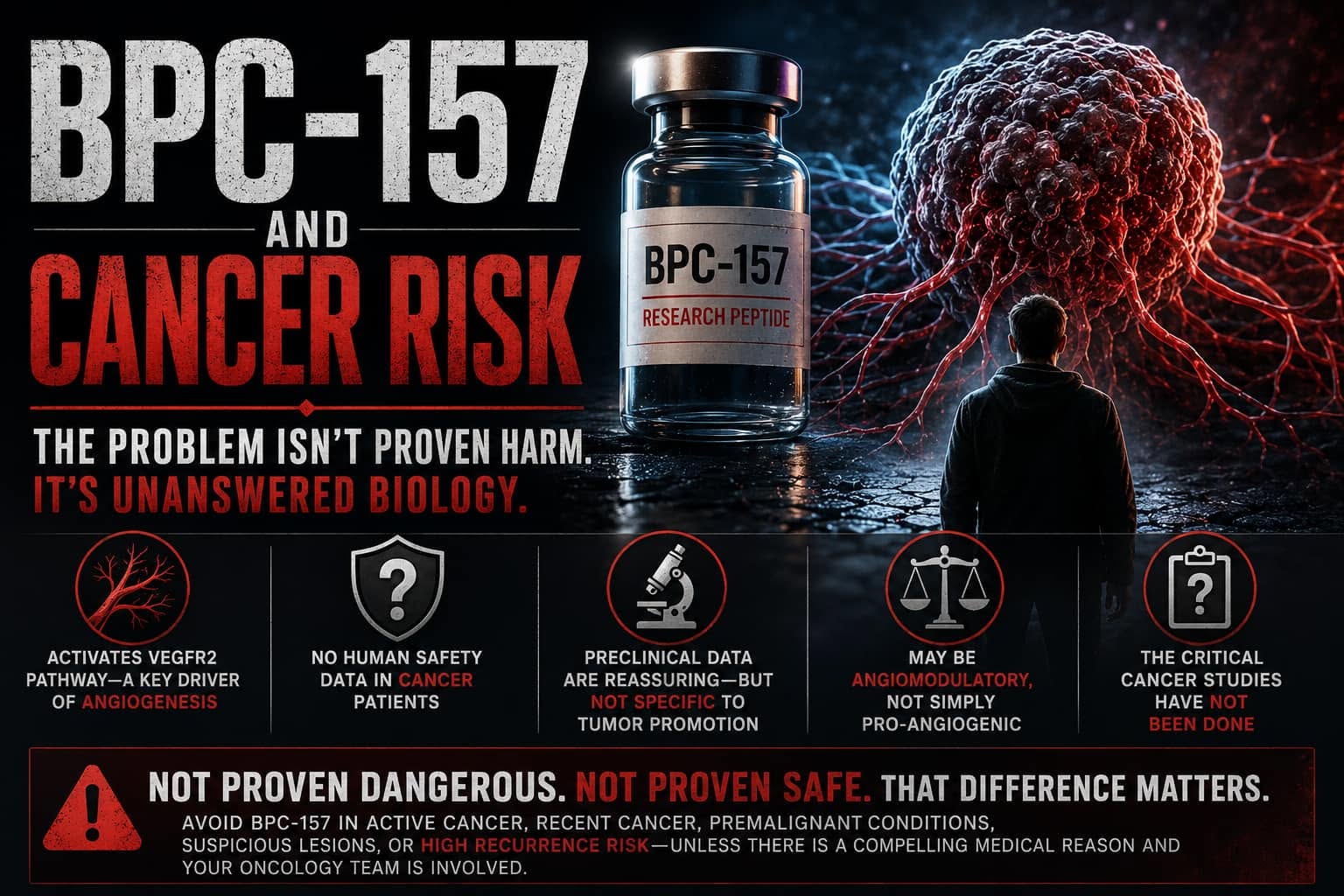
Long term use of the peptide BPC-157 might promote cancer.
The research is extremely limited and unclear.
Louis shares an oncologist's cautious summary: BPC-157 has not been shown to cause cancer, but it may stimulate tissue repair and blood-vessel growth pathways that tumours also use, so caution is advised in active, recent or high-risk cancer. Research is extremely limited.
Long term use of the peptide BPC-157 might promote cancer.
The research is extremely limited and unclear.
TLDR: BPC-157 has not been proven to cause cancer. But it has also not been proven safe in people with active cancer, recent cancer, premalignant conditions, suspicious lesions, or high recurrence risk. The concern is not that BPC-157 clearly mutates DNA. The concern is that it may stimulate tissue-repair and blood-vessel-growth pathways that cancer can also use. That is enough for me to be cautious, especially in people with active cancer, recent cancer, premalignant disease, suspicious lesions, or high recurrence risk.
BPC-157 has become one of the most talked-about “healing peptides” in the wellness and performance world. It is promoted for tendon injuries, joint pain, gut repair, inflammation, surgical recovery, athletic recovery, and tissue regeneration.
The pitch sounds appealing. Damaged tissue needs help healing, and BPC-157 may support that process.
But when someone has cancer, a recent cancer history, a suspicious lesion, a rising tumor marker, or a meaningful recurrence risk, the question changes.
It is no longer just, “Can this help tissue heal?”
It becomes, “What exactly are we stimulating?”
That is the part of the BPC-157 conversation that deserves much more caution than it usually gets.
The concern is not that BPC-157 has been proven to cause cancer. It has not. The concern is that some of the same pathways that make BPC-157 interesting as a tissue-repair peptide are also pathways cancer can exploit.
This is not a “BPC-157 definitely causes cancer” argument. That would overstate the evidence. This is a “we should not casually use pro-repair, pro-angiogenic peptides in people with cancer risk and pretend the biology is irrelevant” argument.
And that is a much more defensible position.
The Key Issue: Angiogenesis
The most important cancer-related concern with BPC-157 is angiogenesis, which means new blood vessel formation.
In normal healing, angiogenesis can be helpful. Injured tissue needs oxygen, nutrients, immune cells, and repair signals. New blood vessels can help deliver those things.
But cancer also uses angiogenesis.
A microscopic tumor can only grow so far without a blood supply. At some point, if it wants to expand, it needs oxygen and nutrients. One of the classic hallmarks of cancer is the ability to stimulate or access new blood vessels.
That is why the VEGF pathway is such a major target in oncology.
VEGF stands for vascular endothelial growth factor. VEGF and its receptors, especially VEGFR2, are central regulators of blood vessel growth. This pathway is so important in cancer that multiple cancer drugs are designed to block VEGF-driven angiogenesis, including bevacizumab and several VEGFR-targeting tyrosine kinase inhibitors.
So when a peptide is shown to activate VEGFR2-related signaling, that is not a minor mechanistic detail. It is exactly the kind of finding that should make us pause.
A key preclinical study by Hsieh and colleagues found that BPC-157 increased vessel density in experimental models, upregulated VEGFR2 expression, promoted VEGFR2 internalization, and activated the VEGFR2-Akt-eNOS signaling pathway.
In plain English, BPC-157 appeared to activate a blood-vessel-growth pathway that is highly relevant to cancer biology.
That does not prove it promotes cancer. But it does explain why the concern is biologically plausible.
The same mechanism that may be helpful in ischemic tissue, injured tendon, or damaged gut may be undesirable near microscopic residual cancer.
This Is Not About “Causing Cancer” in the Usual Sense
When people hear “cancer risk,” they often think of something that directly damages DNA: cigarette smoke, radiation exposure, certain chemicals, or some viruses.
That is cancer initiation.
BPC-157 is not mainly concerning because we know it mutates DNA. In fact, formal preclinical toxicology testing in mice, rats, rabbits, and dogs reported no genetic toxicity, no embryo-fetal toxicity, and no serious organ-system toxicity. That is reassuring as far as it goes.
But it does not answer the question I care about most.
Could BPC-157 influence the behavior of cancer that is already there?
That is a different question.
A compound does not need to be a DNA-damaging carcinogen to influence cancer biology. Estrogen does not need to mutate DNA to affect estrogen-sensitive breast cancer. Testosterone does not need to be a mutagen to influence prostate biology. Growth factors, inflammatory signals, angiogenic pathways, and stromal remodeling can all affect cancer behavior without initiating cancer from scratch.
That is the more relevant concern here.
The question is not simply whether BPC-157 causes cancer. The better question is whether it could make an existing microscopic cancer deposit, dormant micrometastasis, premalignant lesion, or tumor microenvironment more favorable for growth.
And that question has not been answered.
Cancer Is an Ecosystem
One of the biggest mistakes in wellness medicine is treating cancer as if it is only a ball of malignant cells.
It is not.
Cancer is an ecosystem. Tumors interact with blood vessels, immune cells, fibroblasts, inflammatory signals, platelets, nerves, extracellular matrix, hormones, and metabolic conditions. The surrounding environment can either restrain cancer or help it progress.
This is why “regenerative” therapies deserve caution in people with cancer risk.
When someone says, “This helps tissue heal,” my next question is: which tissue, under what conditions, in what host, and with what hidden biology present?
A pro-repair signal in a damaged tendon may be useful. A pro-repair signal in a tumor bed after surgery may be more complicated. A pro-angiogenic signal in ischemic muscle may be helpful. A pro-angiogenic signal near microscopic residual disease may be concerning.
This is the problem with applying wellness logic to cancer biology.
Cancer is not simply “inflammation bad, repair good.”
Cancer often hijacks repair programs. Tumors can behave like wounds that do not heal properly. They recruit blood vessels, remodel tissue, manipulate immune signaling, activate stromal cells, and use normal healing pathways for abnormal growth.
So the fact that BPC-157 may support tissue repair is not automatically reassuring.
It is exactly why the oncology question deserves caution.
The Nuance: BPC-157 May Not Be a Simple Angiogenesis Switch
To be fair, the biology is not as simple as “BPC-157 equals angiogenesis equals cancer.”
Some preclinical work suggests BPC-157 may be more angiomodulatory than purely pro-angiogenic. In other words, it may influence angiogenesis differently depending on tissue context, injury state, nitric oxide balance, and local physiology.
That nuance matters.
A peptide that drives angiogenesis everywhere, regardless of context, would raise a much stronger cancer concern. A peptide that mainly helps restore blood flow in injured or ischemic tissue, without independently causing pathologic neovascularization, would be a different risk profile.
Some investigators, particularly the Sikiric group, have argued that BPC-157 controls or modulates angiogenesis rather than simply promoting it. They have also argued that it may oppose certain forms of pathological angiogenesis and may have anti-tumor potential in some experimental settings.
That should not be ignored.
But it should not be overinterpreted.
There is a major difference between saying BPC-157 may have complex biology, including possible anti-tumor effects in selected experimental contexts, and saying BPC-157 is safe for people with cancer or cancer risk.
Those are not the same claim.
The anti-tumor claims appear to come largely from the same research network, and the specific tumor model data are not yet detailed enough, replicated enough, or clinically mature enough to settle the question that matters most.
What happens when BPC-157 is given to animals with established tumors, dormant micrometastases, premalignant lesions, or residual disease after cancer therapy?
Does tumor growth increase, decrease, or remain unchanged? Does tumor vascular density change? Does metastatic burden change? Does recurrence risk change? Does survival change? Does the answer differ by cancer type, dose, route, timing, or duration?
Until those studies are done rigorously, “possible anti-tumor activity” should be treated as hypothesis-generating, not reassuring.
The Human Evidence Is Thin
For all the excitement around BPC-157, the human evidence is remarkably limited.
A 2025 systematic review in orthopedic sports medicine identified hundreds of BPC-157-related articles but found only one human clinical study, a retrospective case series of 12 patients with knee pain. That is not enough to establish meaningful human safety.
A 2025 literature and patent review also noted that BPC-157 has not been approved by the FDA or other major regulatory authorities because of insufficient clinical studies. A 2026 narrative review in sports medicine similarly emphasized that rigorous human safety data remain scarce and that unapproved peptide therapies may carry potential for serious harm.
So when someone says, “There is no evidence BPC-157 causes cancer,” that is technically true.
But it is incomplete.
There is also no adequate human evidence proving it is safe in cancer survivors, people with premalignant conditions, people with occult malignancy, or people with active cancer.
The Missing Study Is the Study We Actually Need
The problem with BPC-157 is not that we have strong evidence showing it promotes cancer.
We do not.
The problem is that we do not have the right evidence showing it does not.
The studies we need are obvious. Does BPC-157 accelerate growth of established tumors? Does it increase tumor blood-vessel density? Does it increase metastatic burden? Does it stimulate dormant micrometastases? Does it change recurrence after surgery, radiation, chemotherapy, targeted therapy, or immunotherapy?
Does the effect differ in breast cancer, prostate cancer, melanoma, colon cancer, glioblastoma, lymphoma, pancreatic cancer, or sarcoma? Does dose matter? Does route matter? Does duration matter? Does timing matter? Does it behave differently during active inflammation, wound healing, post-operative recovery, radiation therapy, or immunotherapy?
Those are not academic questions. Those are the questions that determine whether this is reasonable or reckless in cancer patients.
Right now, the honest answer is that we do not know enough.
And when the mechanism overlaps with pathways cancer can use, “we do not know” is not the same as “go ahead.”
The Real-World Problem
Even if the biology were less concerning, the real-world market would still be a problem.
Many people are not getting BPC-157 as part of a carefully monitored clinical trial. They are getting it from wellness clinics, med spas, online peptide sellers, overseas suppliers, or “research chemical” vendors.
That creates practical risks that are separate from the molecule itself: purity, sterility, dose accuracy, peptide degradation, contamination, batch variability, route of administration, duration of use, stacking with other peptides, and use in people who may have undiagnosed cancer.
The FDA has specifically raised concerns about compounded BPC-157, including immunogenicity, peptide-related impurities, and inadequate safety information for proposed human routes of administration. Those concerns are not just bureaucratic. Peptides can be difficult to characterize, and small differences in sourcing, formulation, dose, and administration can matter.
Online, people often discuss BPC-157 as though everyone is using the same pharmaceutical-grade substance at the same dose, by the same route, with the same supervision.
That is not reality.
How I Would Think About It Clinically
For a healthy person with no cancer history using BPC-157 briefly for a tendon injury, the cancer risk is unknown. I would not say it is proven dangerous. I would say the claims are ahead of the human safety data, and quality-control concerns are real.
For someone with active cancer, recent cancer, suspicious imaging, rising tumor markers, known residual disease, or high recurrence risk, I would generally avoid it.
I would be especially cautious in people on active surveillance for prostate cancer, MGUS, smoldering myeloma, Barrett’s esophagus with dysplasia, high-risk colon polyps, pancreatic cysts, cirrhosis, or a suspicious lung nodule.
For someone receiving radiation therapy, chemotherapy, immunotherapy, targeted therapy, or recovering from cancer surgery, I would not add BPC-157 casually.
Not because we know it is harmful.
Because we do not know it is safe.
And the biology gives us a reason to pause.
My Bottom Line
BPC-157 has not been proven to cause cancer in humans. It has not been proven to increase recurrence risk in cancer survivors. It has not been proven to accelerate metastases.
There are preclinical toxicology data showing no obvious genotoxicity or serious organ toxicity in standard animal models. There are also research groups arguing that BPC-157 may regulate angiogenesis rather than simply stimulate it, and that it may have anti-tumor potential in certain experimental settings.
But none of that answers the most important clinical question.
Is BPC-157 safe in people with active cancer, recent cancer, premalignant conditions, suspicious lesions, dormant micrometastatic disease, or high recurrence risk?
We do not know.
The precautionary concern remains legitimate because BPC-157 interacts with angiogenesis, VEGFR2-Akt-eNOS signaling, nitric oxide biology, tissue repair, and remodeling pathways that are directly relevant to cancer behavior.
For people without cancer, the risk is unknown.
For people with active cancer, recent cancer, suspicious lesions, premalignant disease, or high recurrence concern, I would generally avoid BPC-157 unless there is a compelling medical reason and the oncology team is involved.
In medicine, “not proven dangerous” is not the same as “proven safe.”
And when the mechanism overlaps with a hallmark of cancer, that difference matters.
Louis quotes a public service announcement from a clinician stating there is little clinical evidence that peptides or growth hormone promote healing, that offshore compounded versions may be dangerous, and that growth hormone does not build muscle. No studies are cited.
Joel Kahn's post, shared by Louis, warns that injecting growth-hormone-type peptides (ipamorelin, sermorelin, CJC-1295) can chronically elevate IGF-1. High IGF-1 is associated in observational data with breast and prostate cancer and with higher cancer, cardiovascular and all-cause mortality, and excess GH signaling in acromegaly causes cardiometabolic complications.
A study found the gut-bacteria peptide corisin is elevated in diabetic patients with CKD and tracks with severity. In mice, corisin travels to the kidney on albumin and accelerates aging, scarring and cell death, and a neutralizing antibody reduced kidney damage. Gokhan notes CKD almost always accompanies heart disease.

A shared post citing a new review warns that GH boosting via peptides and supplements is marketed as anti-aging although low-GH states are associated with longer life and slower aging, while acromegaly brings many long-term harms. Louis added only hashtags; the post includes a course advertisement.
Louis compiles trials of interventions raising circulating IGF-1, such as MK-677, showing reliable gains in lean mass but almost no improvement in strength or function in older adults. He argues the extra lean mass is largely fluid and non-contractile tissue.
Shares a Gil Carvalho (Nutrition Made Simple) video criticising the podcast for guest claims such as curing cancer with keto, discouraging fibre and fear-mongering about glucose spikes. It says the producers attach research PDFs or footnotes that contradict guests yet still promote the claims.