This is a nice write-up on a study that I’ve posted about several times now.
Decline in mitochondrial function with age plays a major role in the etiology of multiple diseases, including CVD.
This study uncovered a key mechanism by which this seems to occur. The study hints that some aspects of age-related mitochondrial decline might be preventable by simply getting enough choline in your diet.
#mitochondriaHD #cholineHD #agingHD #longevityHD
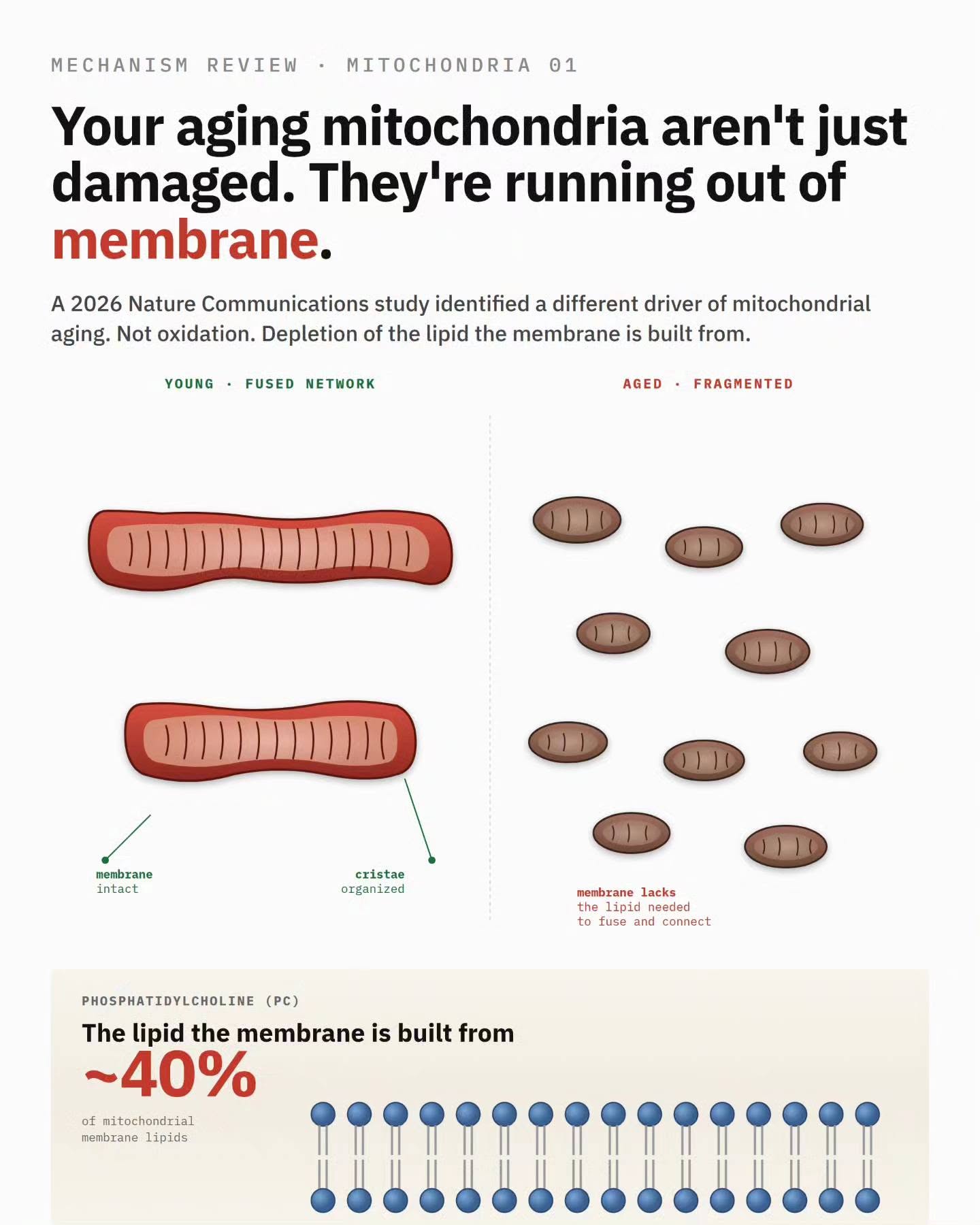
For decades, scientists who studied aging knew that mitochondria — the energy-producing organelles inside every cell — declined in function as organisms got older. What they didn't know with any precision was why that decline happened. A new study published in Nature Communications, led by Dr. Maria Ermolaeva of Germany's Leibniz Institute on Aging (Fritz Lipmann Institute) in Jena, offers a specific, previously overlooked answer: a gradual decline in the production of a membrane lipid called phosphatidylcholine.
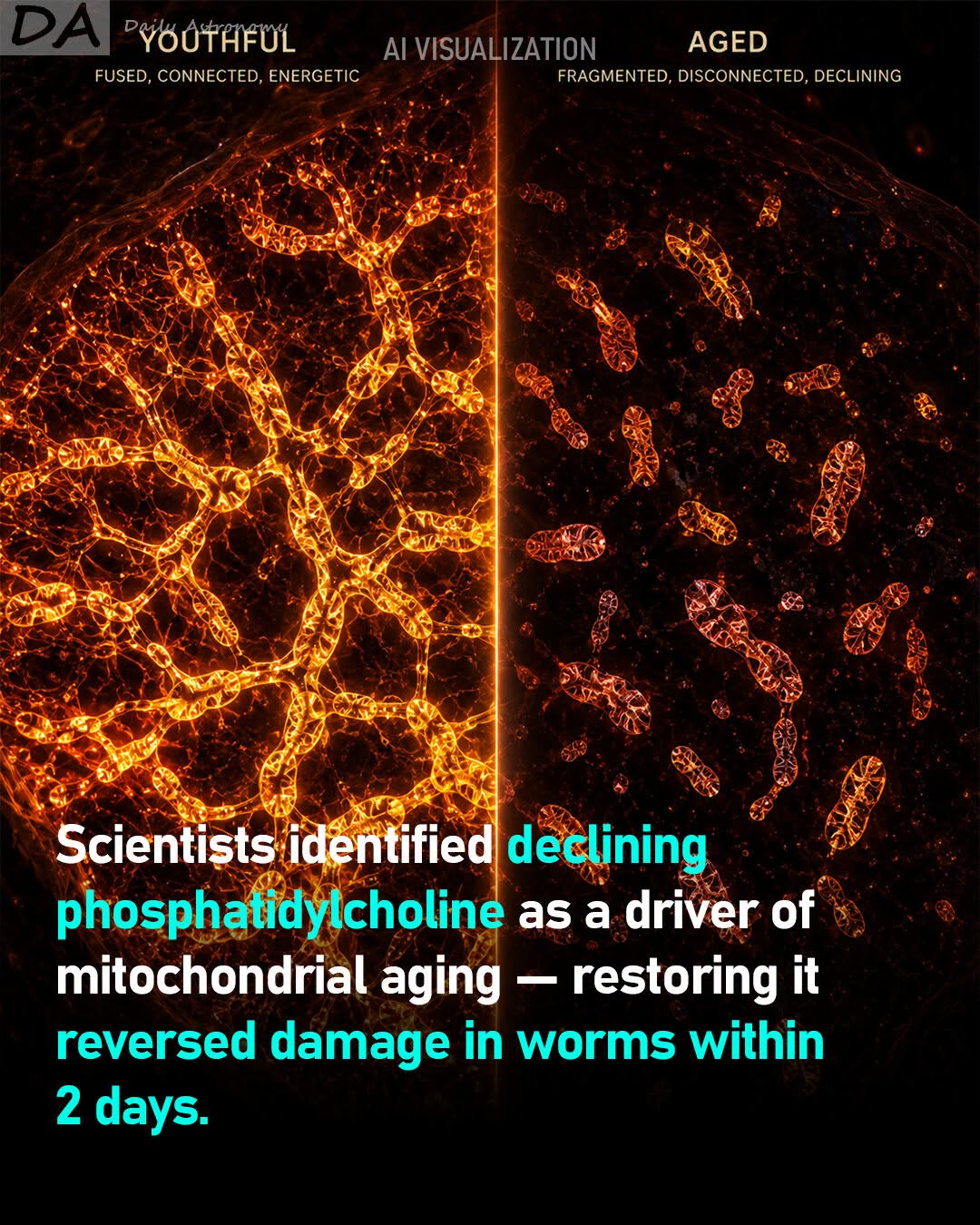
Healthy mitochondria don't function as isolated units — they form dynamic, interconnected networks inside cells, constantly fusing together, redistributing energy, and adapting to shifting metabolic demands. "You can imagine the whole system as a finely branched power grid that becomes increasingly damaged with age: connections break down and currents stall," Ermolaeva explained. "Although energy production continues, it becomes less efficient and sustainable, and energy can no longer be distributed flexibly." Phosphatidylcholine is the most abundant lipid in mitochondrial membranes, and it's specifically what keeps those membranes flexible enough to fuse together in the first place — as its production declines with age, the network loses that flexibility and begins fragmenting into disconnected, less efficient pieces.
The research team, led by first author Dr. Tetiana Poliezhaieva, traced the mechanism down to a specific molecular pathway. An enzyme called SAMS-1 converts the amino acid methionine into a compound called S-adenosylmethionine (SAM), which is required for phosphatidylcholine synthesis. When the team experimentally knocked down sams-1 in the roundworm C. elegans, it severely fragmented the mitochondrial network and triggered measurable mitochondrial stress. "We were surprised ourselves by how strongly this molecule influences the structure, connectivity, and function of mitochondria," Poliezhaieva said.
The genuinely striking part of the study is what happened when researchers reversed the deficiency. Supplementing aging worms directly with phosphatidylcholine, or with SAM itself, restored fragmented mitochondrial networks back toward a youthful, connected state — with some reports describing measurable reversal within as little as two days in the worm experiments. Parallel tests in human cell cultures, stressed to model aging conditions, showed a similar pattern: boosting phosphatidylcholine levels reinstated metabolic resilience that had been lost.
The team also analyzed large-scale human clinical datasets alongside their lab experiments and found a striking, sex-specific pattern: phosphatidylcholine levels showed a notably steeper relative decline in women during menopause specifically, compared to the more gradual decline seen elsewhere — a detail the researchers flagged as particularly noteworthy given that menopause coincides with well-documented shifts in energy metabolism and fatigue that have historically lacked a clear underlying mechanism.
It's important to be precise about what has and hasn't been shown here. The most dramatic reversal results — the two-day recovery, the restored mitochondrial networks — came from C. elegans worms and human cell cultures in a dish, not from any clinical trial in living humans. Phosphatidylcholine itself already occurs naturally in common foods, including eggs, soy, and meat, but the study does not establish that dietary supplementation would produce the same reversal effect in an actual aging human body, where absorption, distribution, and existing health conditions introduce far more variables than a controlled lab experiment. Ermolaeva herself was cautious on this point: whether and how the findings can be translated into concrete human therapies "must be clarified in further studies."
What the research does provide is something aging researchers have specifically lacked until now — a defined, "malleable" molecular target for natural (non-genetic) mitochondrial decline, distinct from the mitochondrial DNA damage that's long been studied as a separate driver of premature aging. That specificity matters, since identifying an actual mechanism gives future intervention research something concrete to test, rather than treating mitochondrial decline as an unavoidable and mechanistically vague feature of aging itself. 🧬
If you're considering phosphatidylcholine or choline supplementation based on this research, it's worth discussing with a doctor first — this remains early-stage laboratory research, not a clinically validated human intervention.
Source: Poliezhaieva, T., Ermolaeva, M.A., et al. "Aging-associated decline of phosphatidylcholine synthesis is a malleable trigger of natural mitochondrial aging." Nature Communications 17, 3589 (2026).