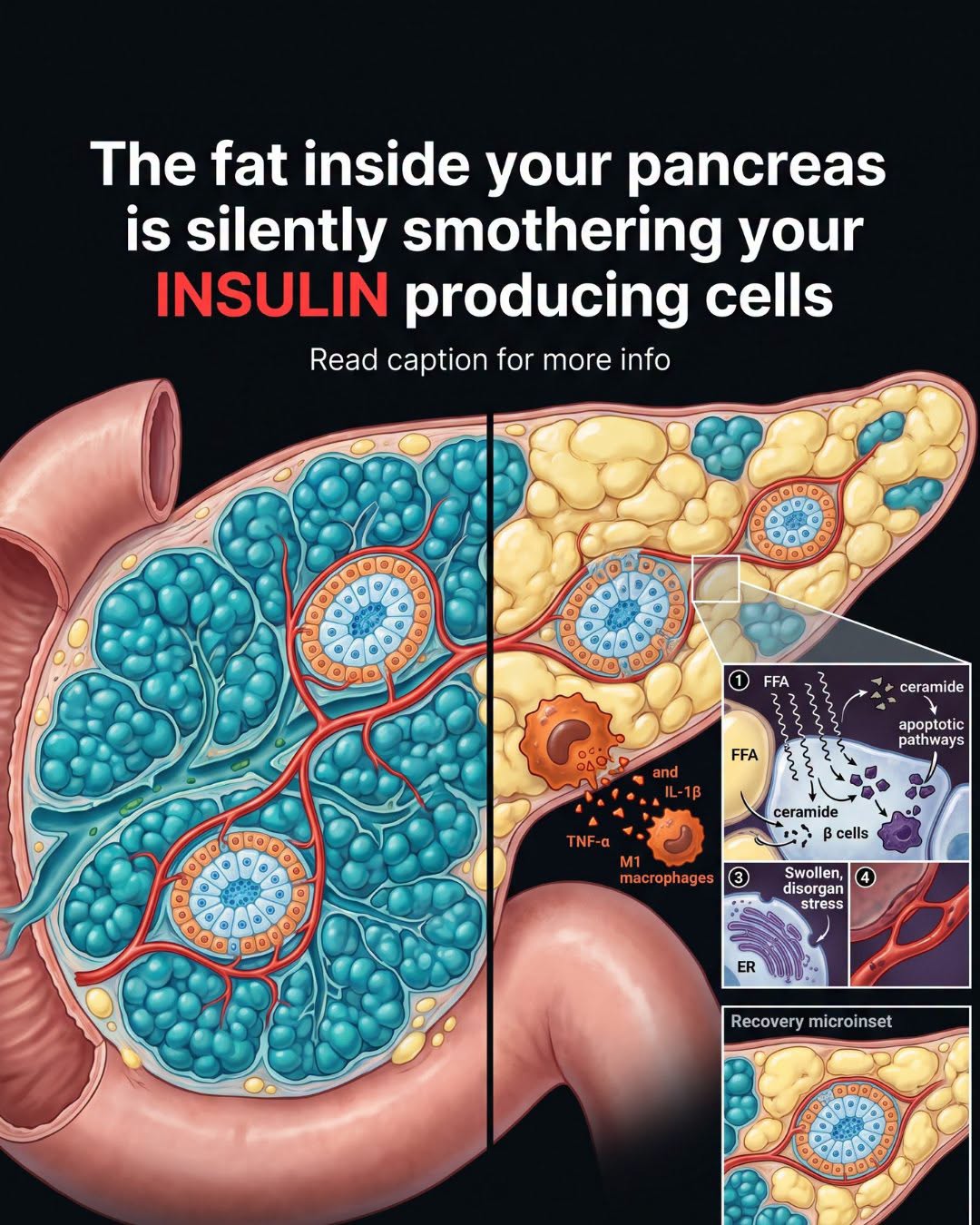
Accumulation of fat in the pancreas is the direct cause of the beta cell dysfunction that impairs insulin production in type 2 diabetes.
Lose the extra fat, and the pancreas can regenerate… with some (or even all) of the beta cell function returning to normal: ↪ Roy Taylor shows the pancreas can regenerate in type 2 diabetes, by diet alone.
“The clinical significance: research by Professor Roy Taylor at Newcastle University has confirmed that pancreatic fat reduction - achievable through dietary intervention producing liver fat clearance in the first weeks followed by pancreatic fat clearance over the subsequent months - is the specific mechanism underlying Type 2 diabetes remission. Beta cell function recovers not simply because blood glucose is lower but because the fat physically surrounding and damaging them has been removed.”
“Key takeaway: Pancreatic fat is physically surrounding and chemically attacking the cells that produce insulin through three simultaneous mechanisms. Dietary intervention that reduces liver fat first and pancreatic fat subsequently is the most direct available route to beta cell function recovery.”
#pancreasfatHD #liverfatHD #roytaylorHS #diabetesHD #regeneratepancreasHD #reversediabetesHD #pancreaticinsufficiencyHD #betacellsHD #visceralfatHD #liverfatsummaryHD
Pancreatic fat - the infiltration of lipid deposits into the pancreatic parenchyma surrounding the islets of Langerhans - is one of the most clinically significant and least discussed findings in Type 2 diabetes pathophysiology. Unlike the visceral fat surrounding abdominal organs and the hepatic fat driving liver insulin resistance, pancreatic fat attacks the problem at its most proximal point: the organ that produces insulin itself.
Pancreatic fat content is elevated in the majority of people with Type 2 diabetes - research using MRI-based pancreatic fat quantification confirms significantly higher pancreatic fat in Type 2 diabetics compared to matched non-diabetic controls at equivalent BMI, indicating that the accumulation is driven by metabolic dysfunction rather than simply body weight. It accumulates specifically within the head and body of the pancreas as interstitial lipid deposits that physically infiltrate and surround the acinar tissue and the embedded islets.
The mechanisms through which pancreatic fat destroys beta cell function are multiple and simultaneous. Adjacent infiltrating adipocytes undergo lipolysis in the fatty pancreatic environment - releasing free fatty acids directly into the immediate peri-islet environment at concentrations far higher than those delivered via portal blood. These concentrated FFAs enter beta cells through non-saturable passive diffusion, generating intracellular ceramide through the saturated fatty acid-activated serine palmitoyltransferase pathway. Ceramide in beta cells activates the intrinsic mitochondrial apoptotic cascade - producing the progressive beta cell death that is histologically visible in pancreatic tissue from Type 2 diabetic patients.
The inflammatory component amplifies the lipotoxic damage. Fatty pancreatic tissue recruits M1 pro-inflammatory macrophages - identical to those recruited to expanded visceral adipose tissue - which release IL-1beta directly into the peri-islet environment. IL-1beta is acutely toxic to beta cells at the concentrations generated by peri-islet macrophage infiltration - shown in landmark islet biology research to induce both beta cell secretory dysfunction and apoptosis through NF-kB and iNOS activation.
The vascular component adds a third mechanism. Fatty infiltrate compresses the intra-islet capillary network that delivers nutrients and oxygen to beta cells - reducing the nutrient delivery critical for maintaining the high-energy demands of insulin synthesis and granule production.
The clinical significance: research by Professor Roy Taylor at Newcastle University has confirmed that pancreatic fat reduction - achievable through dietary intervention producing liver fat clearance in the first weeks followed by pancreatic fat clearance over the subsequent months - is the specific mechanism underlying Type 2 diabetes remission. Beta cell function recovers not simply because blood glucose is lower but because the fat physically surrounding and damaging them has been removed.
Key takeaway: Pancreatic fat is physically surrounding and chemically attacking the cells that produce insulin through three simultaneous mechanisms. Dietary intervention that reduces liver fat first and pancreatic fat subsequently is the most direct available route to beta cell function recovery.
Save this post - share it with someone you love. Heart emoji
📌 RESOURCES
Pancreatic Fat and Beta Cell Dysfunction: pubmed.ncbi.nlm.nih.gov - search "pancreatic fat beta cell function MRI Type 2 diabetes"
Roy Taylor Newcastle Remission Research: ncl.ac.uk - search "Roy Taylor diabetes remission pancreatic fat"
American Diabetes Association - Beta Cell Biology: diabetesjournals.org/diabetes
#Diabetes #Type2Diabetes #BloodSugar #InsulinResistance #DiabetesAwareness