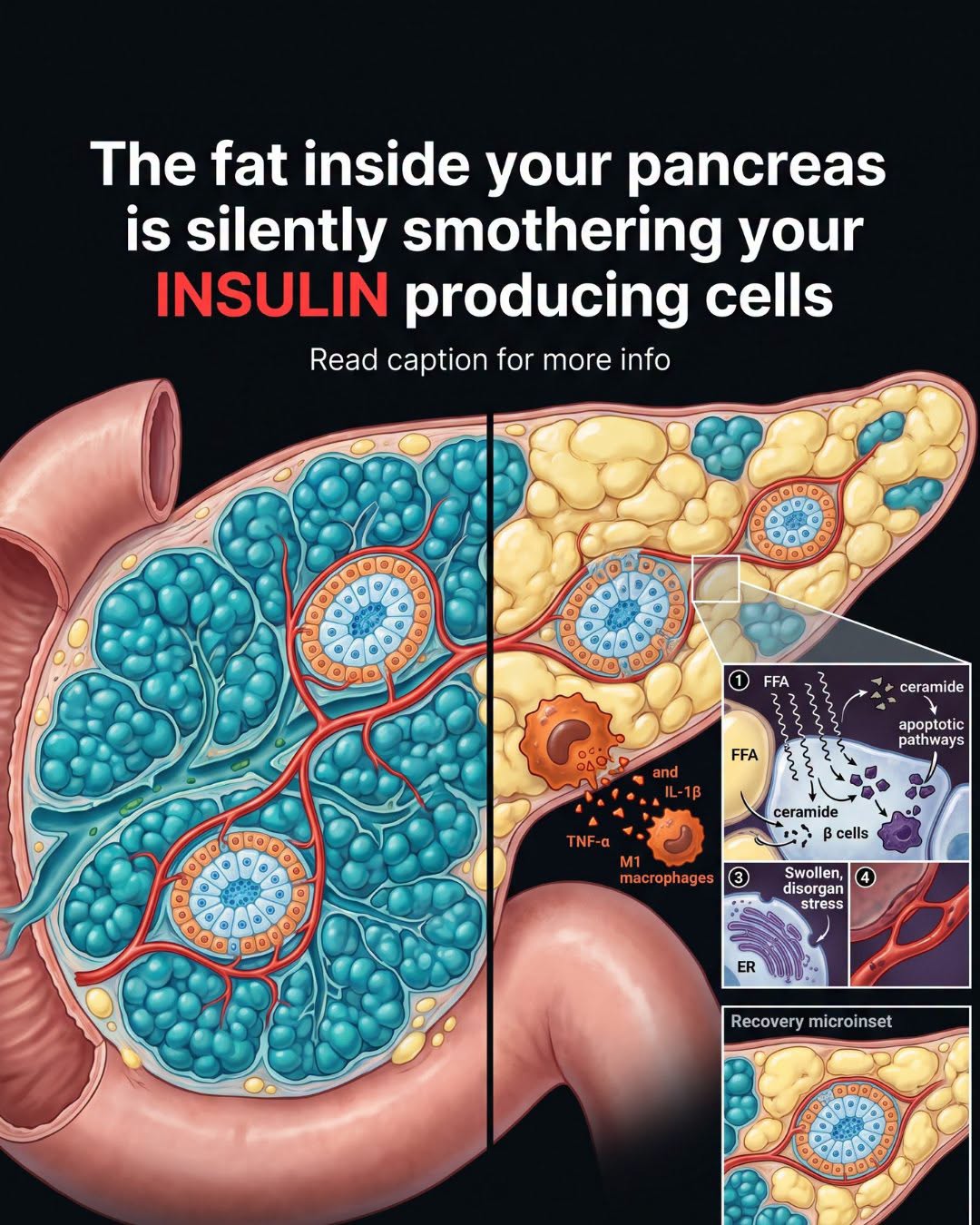
The failure of the pancreas described in this post can all be reversed by simply losing fat in the pancreas.
Professor Roy Taylor proved this in humans in an elegantly done randomized trial. See this post: facebook.com/share/v/1HcYxGa51h.
#roytaylorHD #regeneratepancreasHD #reversediabetesHD #calorierestrictionHD #diabetesHD #pancreaticinsufficiencyHD #pancreasfatHD #betacellsHD #visceralfatHD
#glp1HD
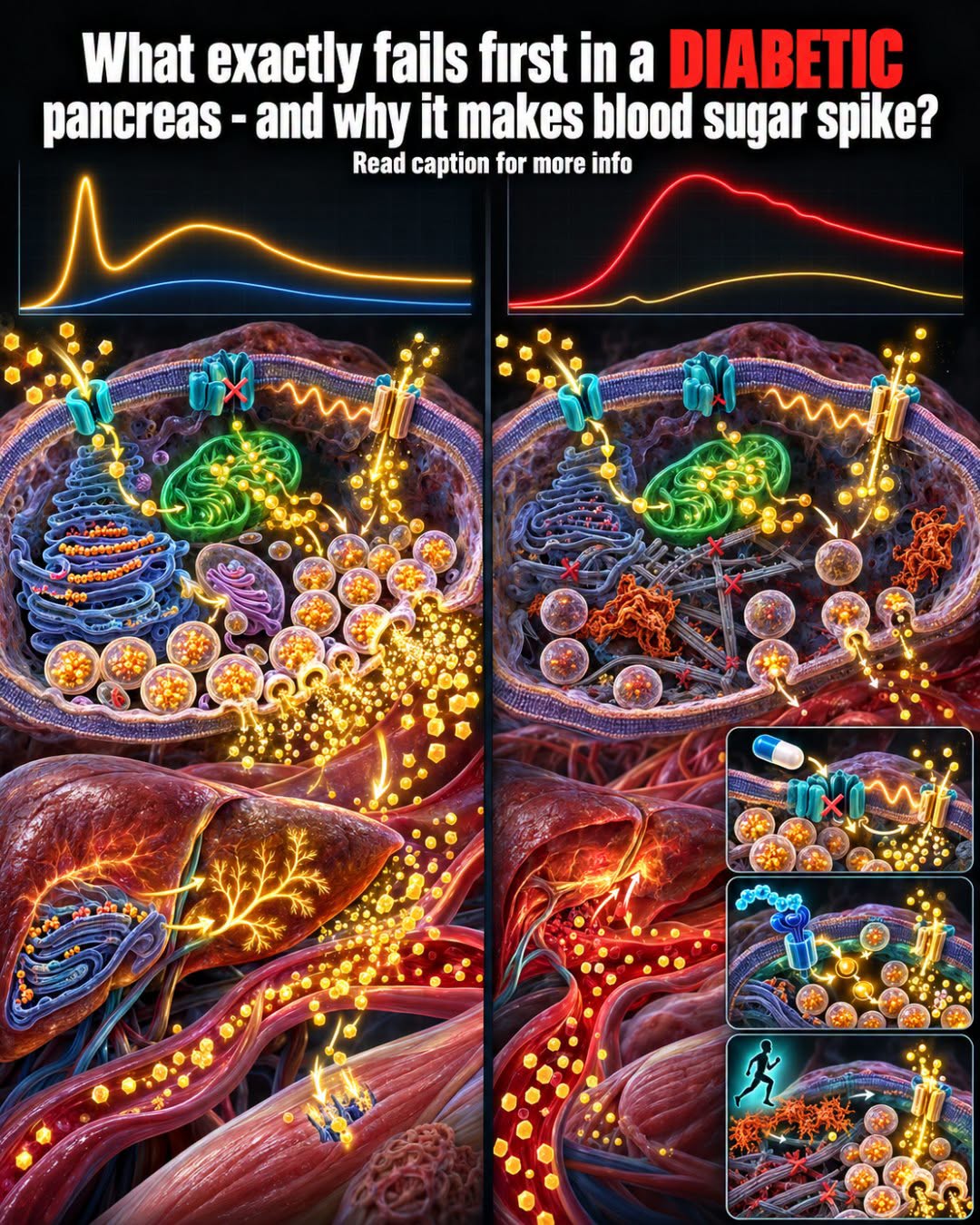
The single most consequential molecular failure in Type 2 diabetes - the one that produces the characteristic post-meal blood glucose spike, the one that precedes all other beta cell changes and is the earliest detectable functional abnormality in individuals who will eventually develop Type 2 diabetes - is the loss of first-phase insulin secretion.
Understanding what first-phase insulin secretion is, what it does, why its loss is so specifically damaging, and what produces that loss reveals the most mechanistically precise explanation of the post-meal hyperglycemia of Type 2 diabetes available from any single biological description.
Insulin secretion from pancreatic beta cells in response to a glucose meal is not a simple graded response - a steady increase in insulin proportional to the glucose concentration. It is a precisely orchestrated two-phase response. The first phase is a brief, explosive burst of pre-formed, docked insulin granules released within 1 to 3 minutes of glucose sensing - peaking at 3 to 5 minutes and subsiding by 10 minutes. The second phase is a broader, more sustained wave of newly synthesized insulin that begins at 10 to 20 minutes and continues across the meal absorption period.
The first-phase burst is the most important of the two. Not because it provides more insulin - it does not. The second phase provides more total insulin across the meal. But the first-phase burst arrives at the liver in the portal blood before the meal's glucose arrives at the liver from the intestine - and this timing is everything. The first-phase insulin bolus pre-suppresses hepatic glucose output (by dimming PEPCK and activating glycogen synthase) and pre-activates peripheral GLUT4 translocation before the post-meal glucose challenge peaks. The liver and the periphery are primed and ready when the meal glucose arrives - the spike is blunted before it begins.
In Type 2 diabetes, the first-phase burst is severely diminished or absent. The glucose sensing is intact - GLUT2, glucokinase, the glycolytic cascade, the mitochondrial ATP production, the KATP channel closure, and the calcium surge all function largely normally. What has failed is what the calcium surge is trying to trigger: the immediately releasable pool (IRP) of pre-docked, pre-primed granules at the plasma membrane is depleted. The IAPP amyloid oligomers accumulating from chronic hyperglycemia interfere with the SNARE complex proteins (SNAP-25, syntaxin-1, and VAMP2) required for granule docking and priming. The calcium surge arrives but finds almost no granules docked and ready to release. The first-phase burst is a tiny fraction of its healthy magnitude.
The consequence is direct: the liver and periphery receive no priming signal before the meal glucose arrives. PEPCK is not suppressed. GLUT4 is not pre-activated. The meal glucose enters a metabolic environment that is entirely unprepared for it - and the characteristic 30 to 45 minute post-meal spike of Type 2 diabetes is the result.
GLP-1 receptor agonists restore first-phase secretion most effectively of any pharmacological intervention - by activating PKA through the cAMP-GLP-1R signaling cascade, phosphorylating the SNARE complex proteins and restoring their granule-docking and priming function, rebuilding the IRP sufficiently to produce a meaningful first-phase burst.
Key takeaway: First-phase insulin secretion is lost in Type 2 diabetes not because the triggering signal fails but because the immediately releasable granule pool is depleted by IAPP amyloid-mediated SNARE complex disruption. Its loss removes the hepatic priming that prevents post-meal spikes. GLP-1 receptor agonists restore it most effectively. Blood glucose normalization and autophagy activation reduce IAPP oligomer accumulation over time.
Save this post - share it with someone you love.
📌 RESOURCES
First-Phase Insulin Secretion Failure Type 2 Diabetes - PubMed search: "first-phase insulin secretion loss immediately releasable pool SNARE complex IAPP Type 2 diabetes"
American Diabetes Association - Beta Cell Function - Diabetes journal two-phase insulin secretion review
GLP-1 Receptor Agonist and First-Phase Restoration - PubMed search: "GLP-1 receptor agonist first-phase insulin secretion PKA SNARE Type 2 diabetes"
#Diabetes #Type2Diabetes #BloodSugar #InsulinResistance #DiabetesAwareness