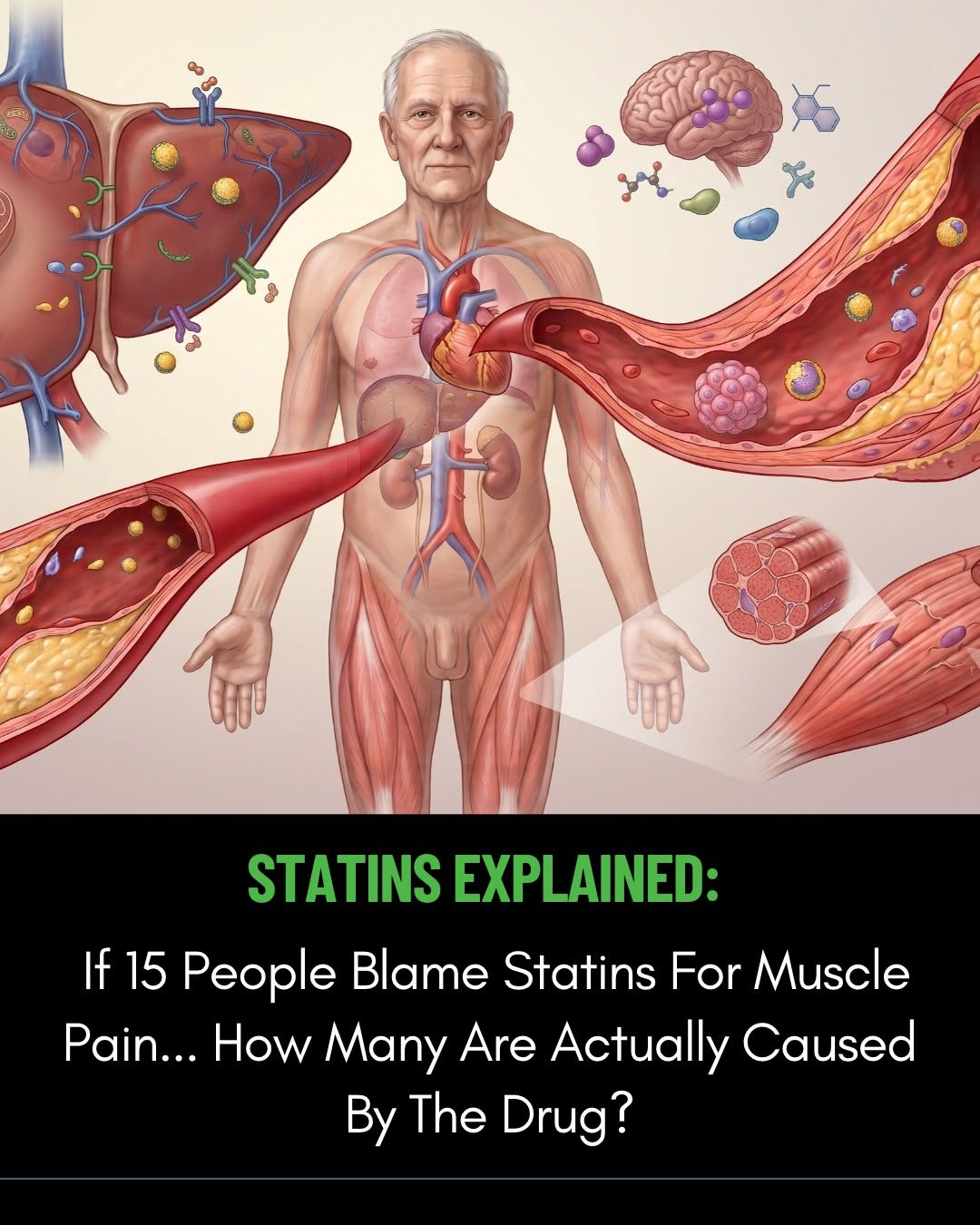
IF 15 PEOPLE ON A STATIN COMPLAIN OF ACHING MUSCLES, HOW MANY ACHES DID THE STATIN CAUSE?
Most people guess most of them. The largest analysis ever done on this question says about one.
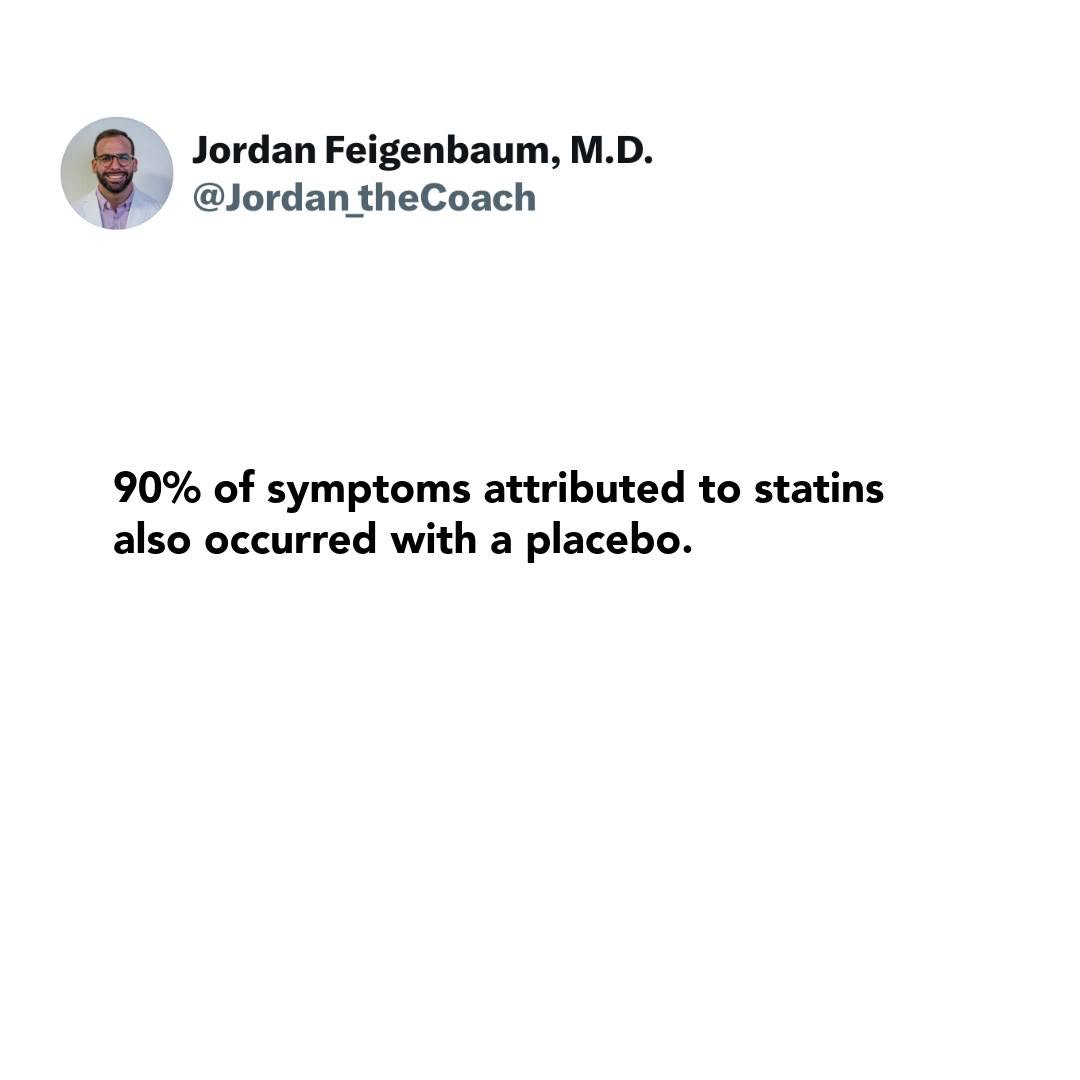
Researchers pooled 19 blinded trials with 123,940 people. None of them knew whether they were taking a statin or a dummy pill. Over about four years, 27.1 in 100 people on a statin reported muscle pain or weakness. On the dummy pill, 26.6 in 100 did.
In the first year, the researchers worked out that only about 1 in every 15 muscle complaints from people on a statin was actually caused by the statin. The rest would have happened anyway.
A London trial called SAMSON went further. People who had already quit statins because of side effects took a statin for some months, a dummy pill for others, and nothing for the rest. Their symptoms were almost as bad on the dummy pill as on the statin. Six months later, half of them were back on statins.
The aches are real. Very often the cause is expectation, not the tablet.
WHAT A STATIN ACTUALLY DOES
Your liver makes cholesterol through a long chain of steps. One enzyme sets the pace, called HMG CoA reductase. A statin slips into the pocket of that enzyme and blocks the natural molecule from getting in.
When the liver makes less cholesterol, it grabs more LDL, the cholesterol that clogs arteries, out of your blood. LDL falls. In the big trials it fell by between a quarter and a half.
The common statins are atorvastatin, rosuvastatin, simvastatin and pravastatin. They all hit the same enzyme, but they leave the body by different routes.
Atorvastatin and simvastatin are cleared by a liver enzyme that many other medicines and grapefruit juice can block.
Rosuvastatin and pravastatin depend on it much less.
That is the reason the list of dangerous combinations differs from statin to statin.
WHAT IT REALLY BUYS YOU, IN REAL NUMBERS
The answer depends almost entirely on how likely you were to have a heart attack or stroke in the first place.
People who already have heart disease. In the Scandinavian 4S trial of 4444 people with angina or a past heart attack, about 12 in 100 died within 6 years on a dummy pill, against about 9 in 100 on simvastatin. About 28 people treated for 6 years for one life saved. Heart attacks and other major coronary events fell from 28 in 100 to 19 in 100, one prevented for every 12 people treated.
People at middle risk with no heart disease. In the HOPE-3 trial of 12,705 people in 21 countries, heart attack, stroke or heart death fell from 4.8 in 100 to 3.7 in 100 over 5.6 years. About 91 people treated for one to be spared.
Healthy people with a raised inflammation marker in the blood. In the JUPITER trial, events fell from 1.36 to 0.77 in every 100 people each year. About 170 people treated for a year for one to benefit.
Same tablet. Very different value. The higher your starting risk, the more a statin can do for you.
THE 10,000 PEOPLE PICTURE
Oxford researchers who lead the pooled statin trial analyses drew up this picture. Imagine 10,000 people lowering their LDL cholesterol by 2 mmol per litre with a statin for 5 years.
If they already have artery disease, about 1000 avoid a heart attack, stroke or artery operation.
If they are at raised risk but have no disease yet, about 500 avoid one.
- On the other side, about 5 develop real muscle damage.
- Between 50 and 100 develop diabetes.
- Between 5 and 10 have a bleed in the brain.
- Up to 50 to 100 have symptoms truly caused by the drug.
These are estimates built from trial data, not results from one trial. Keep this picture somewhere you can find it before your next appointment, and share it with someone who has been told they need a statin. It shows both sides of the scale in the same units.
THE SIDE EFFECTS, STRAIGHT
- Real muscle damage is rare, about 1 in 2000 people in everyday practice, and severe muscle breakdown fewer than 1 in 10,000. The risk rises with higher doses, age over 65, kidney problems, an underactive thyroid and certain other medicines. Simvastatin 80 mg carries the highest muscle risk and is now limited to people already used to it.
- Statins nudge blood sugar up. Across 13 trials, treating 255 people for 4 years caused one extra case of diabetes, more often in older people.
- Liver injury is rare. In atorvastatin trials, liver tests stayed above three times normal in about 7 in 1000 people.
- Statins may harm an unborn baby, and the prescriber reviews treatment when a pregnancy is recognised. Breastfeeding is not recommended while taking one.
- Across all the pooled trials, statins did not increase cancer.
THE MEDICINES, HERBS AND FOODS THAT CLASH
The dangerous combinations push statin levels up and raise the risk of muscle damage.
- Clarithromycin and some antifungals with atorvastatin or simvastatin.
- Cyclosporine and gemfibrozil with most statins.
- Some heart medicines, including verapamil, diltiazem, amiodarone, amlodipine and ranolazine, with simvastatin above set doses.
- Several HIV and hepatitis C medicines.
- Grapefruit juice with simvastatin, and large amounts with atorvastatin.
- Red yeast rice can contain the same chemical as the statin lovastatin, in amounts no one can predict. Taking it with a statin is like taking two statins.
- If you take a statin with warfarin, your INR needs checking when the statin starts or changes.
Whenever a new medicine is prescribed, ask your pharmacist to check it against your statin.
COENZYME Q10, THE MIXED EVIDENCE
Two large reviews of the trials disagree. One found less muscle pain with coenzyme Q10, the other found no real effect. The evidence is mixed, so raise it with your prescriber rather than relying on it.
STOPPING AND STAYING ON
Statins do not cause a rebound when stopped. The risk is losing the protection. In France, 75 year olds who stopped their statin had a 33 percent higher chance of hospital admission for a heart or stroke event than those who kept going.
That study could not prove the stopping caused it, but it fits the trial evidence that the benefit builds the longer a statin is taken.
If muscles ache, talk to your prescriber. A different statin, a lower dose, a thyroid test or a check of your other medicines may solve it. That decision belongs to your prescriber.
DOES IT CURE ANYTHING?
No. A statin lowers your risk while you take it. It does not clear artery disease.
For people who have had a heart attack or stroke, a strong statin is first line treatment in the major guidelines. Lifestyle helps, but it does not replace it.
For everyone, food matters. In the Spanish PREDIMED trial of 7447 older adults at high risk, a Mediterranean diet with extra olive oil or nuts lowered heart attack, stroke or heart death from 4.4 in 100 to 3.8 or 3.4 in 100 over almost 5 years. Movement and a healthy weight help too, especially if your blood sugar is creeping up.
If you also take blood pressure or diabetes medicines and your diet or activity changes, tell your prescriber, because those doses may need review as your numbers improve.
GET HELP NOW IF
- You have chest pain or pressure, especially with breathlessness or sweating.
- You have sudden weakness or numbness on one side, a drooping face or trouble speaking.
- Your face, lips or throat swell, or you struggle to breathe.
Call your clinician the same day for unexplained muscle pain or weakness, especially with fever, yellow skin or eyes, a possible pregnancy, or a new antibiotic, antifungal, heart rhythm medicine or antiviral.
Book a review within the week for thigh or shoulder weakness that continues after a statin has been stopped.
Prepared by Edward Paul Mshani, BPharm
Disclaimer
This content is for educational purposes only and does not constitute medical advice, diagnosis or treatment. Do not stop, start or modify any prescribed medication or supplement regimen without consulting a qualified healthcare professional. Individual clinical decisions require personalised medical assessment.
Sources
Tier 1, human clinical trials and meta analyses
Cholesterol Treatment Trialists’ (CTT) Collaboration; Baigent C, Blackwell L, Emberson J, Holland LE, Reith C, Bhala N, Peto R, Barnes EH, Keech A, Simes J, Collins R. Efficacy and safety of more intensive lowering of LDL cholesterol: a meta-analysis of data from 170,000 participants in 26 randomised trials. Lancet. 2010 Nov 13;376(9753):1670-81. doi: 10.1016/S0140-6736(10)61350-5. Epub 2010 Nov 8. PMID: 21067804; PMCID: PMC2988224.
Cholesterol Treatment Trialists' (CTT) Collaborators; Mihaylova B, Emberson J, Blackwell L, Keech A, Simes J, Barnes EH, Voysey M, Gray A, Collins R, Baigent C. The effects of lowering LDL cholesterol with statin therapy in people at low risk of vascular disease: meta-analysis of individual data from 27 randomised trials. Lancet. 2012 Aug 11;380(9841):581-90. doi: 10.1016/S0140-6736(12)60367-5. Epub 2012 May 17. PMID: 22607822; PMCID: PMC3437972.
Cholesterol Treatment Trialists' Collaboration. Efficacy and safety of statin therapy in older people: a meta-analysis of individual participant data from 28 randomised controlled trials. Lancet. 2019 Feb 2;393(10170):407-415. doi: 10.1016/S0140-6736(18)31942-1. PMID: 30712900; PMCID: PMC6429627.
Cholesterol Treatment Trialists' Collaboration. Effect of statin therapy on muscle symptoms: an individual participant data meta-analysis of large-scale, randomised, double-blind trials. Lancet. 2022 Sep 10;400(10355):832-845. doi: 10.1016/S0140-6736(22)01545-8. Epub 2022 Aug 29. Erratum in: Lancet. 2022 Oct 8;400(10359):1194. doi: 10.1016/S0140-6736(22)01891-8. PMID: 36049498; PMCID: PMC7613583.
Randomised trial of cholesterol lowering in 4444 patients with coronary heart disease: the Scandinavian Simvastatin Survival Study (4S). Lancet. 1994 Nov 19;344(8934):1383-9. PMID: 7968073.
Ridker PM, Danielson E, Fonseca FA, Genest J, Gotto AM Jr, Kastelein JJ, Koenig W, Libby P, Lorenzatti AJ, MacFadyen JG, Nordestgaard BG, Shepherd J, Willerson JT, Glynn RJ; JUPITER Study Group. Rosuvastatin to prevent vascular events in men and women with elevated C-reactive protein. N Engl J Med. 2008 Nov 20;359(21):2195-207. doi: 10.1056/NEJMoa0807646. Epub 2008 Nov 9. PMID: 18997196.
Yusuf S, et al; HOPE-3 Investigators. Cholesterol Lowering in Intermediate-Risk Persons without Cardiovascular Disease. N Engl J Med. 2016 May 26;374(21):2021-31. doi: 10.1056/NEJMoa1600176. Epub 2016 Apr 2. PMID: 27040132.
Taylor F, Huffman MD, Macedo AF, Moore TH, Burke M, Davey Smith G, Ward K, Ebrahim S. Statins for the primary prevention of cardiovascular disease. Cochrane Database Syst Rev. 2013 Jan 31;2013(1):CD004816. doi: 10.1002/14651858,CD004816,pub5. PMID: 23440795; PMCID: PMC6481400.
Sattar N, et al. Statins and risk of incident diabetes: a collaborative meta-analysis of randomised statin trials. Lancet. 2010 Feb 27;375(9716):735-42. doi: 10.1016/S0140-6736(09)61965-6. Epub 2010 Feb 16. PMID: 20167359.
Wood FA, Howard JP, Finegold JA, Nowbar AN, Thompson DM, Arnold AD, Rajkumar CA, Connolly S, Cegla J, Stride C, Sever P, Norton C, Thom SAM, Shun-Shin MJ, Francis DP. N-of-1 Trial of a Statin, Placebo, or No Treatment to Assess Side Effects. N Engl J Med. 2020 Nov 26;383(22):2182-2184. doi: 10.1056/NEJMc2031173. Epub 2020 Nov 15. PMID: 33196154.
Howard JP, Wood FA, Finegold JA, Nowbar AN, Thompson DM, Arnold AD, Rajkumar CA, Connolly S, Cegla J, Stride C, Sever P, Norton C, Thom SAM, Shun-Shin MJ, Francis DP. Side Effect Patterns in a Crossover Trial of Statin, Placebo, and No Treatment. J Am Coll Cardiol. 2021 Sep 21;78(12):1210-1222. doi: 10.1016/j,jacc.2021.07.022. PMID: 34531021; PMCID: PMC8453640.
Qu H, Guo M, Chai H, Wang WT, Gao ZY, Shi DZ. Effects of Coenzyme Q10 on Statin-Induced Myopathy: An Updated Meta-Analysis of Randomized Controlled Trials. J Am Heart Assoc. 2018 Oct 2;7(19):e009835. doi: 10.1161/JAHA.118.009835. PMID: 30371340; PMCID: PMC6404871.
Banach M, Serban C, Sahebkar A, Ursoniu S, Rysz J, Muntner P, Toth PP, Jones SR, Rizzo M, Glasser SP, Lip GY, Dragan S, Mikhailidis DP; Lipid and Blood Pressure Meta-analysis Collaboration Group. Effects of coenzyme Q10 on statin-induced myopathy: a meta-analysis of randomized controlled trials. Mayo Clin Proc. 2015 Jan;90(1):24-34. doi: 10.1016/j,mayocp.2014.08.021. Epub 2014 Nov 14. PMID: 25440725.
Estruch R, et al; PREDIMED Study Investigators. Primary Prevention of Cardiovascular Disease with a Mediterranean Diet Supplemented with Extra-Virgin Olive Oil or Nuts. N Engl J Med. 2018 Jun 21;378(25):e34. doi: 10.1056/NEJMoa1800389. Epub 2018 Jun 13. PMID: 29897866.
Collins R, et al. Interpretation of the evidence for the efficacy and safety of statin therapy. Lancet. 2016 Nov 19;388(10059):2532-2561. doi: 10.1016/S0140-6736(16)31357-5. Epub 2016 Sep 8. Erratum in: Lancet. 2017 Feb 11;389(10069):602. doi: 10.1016/S0140-6736(16)31468-4. PMID: 27616593.
Viatris, Lipitor prescribing information, FDA label via DailyMed, 2024, setid a60cc18b-0631-4cf0-b021-9f52224ece65
AstraZeneca, Crestor prescribing information, FDA label via DailyMed, 2026, setid 325a5d0e-9a72-4015-9fcd-1655fb504cee
Camber Pharmaceuticals, Simvastatin tablets prescribing information, FDA label via DailyMed, 2024, setid 751b79c6-bba8-4d29-b69c-a2ac6453fec8
Accord Healthcare, Pravastatin sodium prescribing information, FDA label via DailyMed, 2024, setid 6c011348-a236-47d3-bbef-3e0b956dd080
Cooper-DeHoff RM, et al. The Clinical Pharmacogenetics Implementation Consortium Guideline for SLCO1B1, ABCG2, and CYP2C9 genotypes and Statin-Associated Musculoskeletal Symptoms. Clin Pharmacol Ther. 2022 May;111(5):1007-1021. doi: 10.1002/cpt.2557. Epub 2022 Mar 11. PMID: 35152405; PMCID: PMC9035072.
US Preventive Services Task Force; Mangione CM, et al. Statin Use for the Primary Prevention of Cardiovascular Disease in Adults: US Preventive Services Task Force Recommendation Statement. JAMA. 2022 Aug 23;328(8):746-753. doi: 10.1001/jama.2022.13044. PMID: 35997723.
National Center for Complementary and Integrative Health, Red yeast rice fact sheet, 2022, nccih,nih,gov/health/red-yeast-rice
Tier 2, observational and longitudinal
Giral P, Neumann A, Weill A, Coste J. Cardiovascular effect of discontinuing statins for primary prevention at the age of 75 years: a nationwide population-based cohort study in France. Eur Heart J. 2019 Nov 14;40(43):3516-3525. doi: 10.1093/eurheartj/ehz458. PMID: 31362307; PMCID: PMC6855142.
Tier 3, mechanistic and preclinical
Istvan ES, Deisenhofer J. Structural mechanism for statin inhibition of HMG-CoA reductase. Science. 2001 May 11;292(5519):1160-4. doi: 10.1126/science.1059344. PMID: 11349148.
#Statins #HeartHealth #Cholesterol #PreventiveMedicine #EvidenceBasedMedicine #MedicationSafety #CardiovascularHealth