The nocebo effect is the mirror image of the placebo effect. A placebo is an inert treatment, such as a sugar pill, that can still make people feel better because they expect it to help. A nocebo effect is when expecting harm from a treatment produces real, physical symptoms even though the treatment itself is not the cause. Louis Nervegna, one of the group's admins, describes it as the mind creating physical symptoms in response to the thought that you are taking something that is harming you, and stresses that the symptoms are "very real" and "not just in your head"12.
The group has discussed this mostly in the context of statins, because several well-designed trials let researchers compare what people feel on the real drug, on a dummy pill and on nothing at all. The central finding from that work is that a large share of the muscle aches, fatigue and other complaints people attribute to statins also appear on placebo, and the share caused by the drug's chemistry is much smaller than most people assume34.
This does not mean statin side effects are imaginary. The group's posts are consistent that genuine drug effects exist, that they are real when they occur, and that they are worth identifying properly56. This article walks through what placebo and nocebo mean, what the SAMSON trial and the large pooled analyses showed, where the evidence has limits, and what the group's admins suggest for anyone who feels unwell on a medication.
Placebo and nocebo: the basics
The placebo effect is widely known: a sugar pill, a saline injection or a sham procedure can produce a measurable improvement in how people feel. A Nautilus article shared in the group notes that we do not fully understand how it works, yet its influence is so well established that drug trials have to account for it to be taken seriously. Participants in trials do not know whether they are getting the real treatment or a placebo7.
That is exactly why placebo-controlled trials matter. If a harm or benefit shows up equally in the treatment group and the placebo group, the treatment is probably not the cause. Group posts illustrate the flip side as well: in a Johns Hopkins trial of L-arginine in 153 heart attack survivors, neither volunteers nor doctors knew who took arginine, and the trial was stopped at six months after six deaths on arginine and none on placebo, a harm that the blinded comparison with placebo exposed8.
The nocebo effect works in the opposite direction from the placebo effect. Louis points out that the nocebo effect is an example of a mind-body interaction, and that mind-body effects can also be exploited as treatments12. An interesting small trial shared in the group points the same way: in 90 healthy adults aged 65 and older followed for three weeks, people who were openly told they were taking sugar pills (open-label placebo) did better on stress, memory and physical performance than people who were deceived into thinking they were taking multivitamins. This was a small study, and the group's post only summarizes a news article about it7.
What the SAMSON trial showed
SAMSON is the trial the group returns to most often. It was an "n-of-1" design, meaning each person acts as their own control. Participants were people who had already stopped statins because of side effects. They received four one-month bottles of a statin, four of placebo and four empty bottles (no tablet), randomly sequenced, each used for one month9. Louis describes this as one of the most eye-opening studies he has read and says it "totally changed my view on statin side effects"410.
The key results, as summarized in the posts:
- Symptom intensity was similar on placebo and on atorvastatin, and both were significantly greater than during the no-tablet months10.
- Symptom burden with placebo was not significantly different from the burden with the statin, and half of the participants were able to successfully restart statins9. Another post describes this as half being back on statins six months later3.
- A summary shared by Louis says 60 patients took part and that 90% of the symptom burden attributed to statins also occurred on placebo, leaving about 10% as the pharmacological contribution4.
- In a post by Gokhan Can, SAMSON is described as a breakthrough for people who felt terrible on statins and felt great after stopping, including with complaints such as brain fog11. Louis also says the same trial showed complaints of short-term memory loss to be a nocebo effect12.
The logic is simple. If the tablet itself were the cause, symptoms should appear on the statin but not on the dummy pill. Instead, people reported very little on the no-tablet months, but a lot on both the statin and the placebo. Louis concludes the only reasonable explanation is nocebo9.
A video clip Louis shared also points to the ASCOT data, in which side effect reports jumped 41% when patients learned they were taking a statin rather than a placebo45. Both SAMSON and ASCOT are described in the posts as well-designed randomized trials.
Why it feels so real
The posts return repeatedly to one point: the symptoms are genuine. According to the shared SAMSON summary, the muscle aches and fatigue are produced by the brain in response to the expectation of harm rather than by the drug's chemistry, and a patient cannot tell the difference from the inside because the two feel identical4. Louis says he was fooled by it himself, calls it a humbling experience, and argues that anyone can be fooled, no matter how unbiased they believe they are513.
Louis also argues that people prone to health conspiracy thinking are more likely to experience nocebo effects, and that testimonials from such people should be taken with a grain of salt1913. This is his opinion; none of those posts cites a study for the claim. He adds that many of these people are experiencing legitimate symptoms and are not making them up1.
Tim Spector, a nutrition scientist whose account Louis shared, avoided statins for nearly a decade, had a mini stroke at 53 (his father had a heart attack at 57), and later wrote that his muscle cramps had been nocebo rather than the statin. He reports a 40% fall in hs-CRP, an inflammation marker, since starting the drug. This is a personal account in a newspaper column, not a trial14.
Pooled trial data: how many muscle aches does the drug cause?
SAMSON is a small, clever trial in a selected group: people who had already had trouble with statins. The question of how many of all statin muscle complaints are actually drug-caused is answered by pooling large blinded trials.
- A pooled analysis of 19 blinded trials with 123,940 people found that over about four years, 27.1 in 100 people on a statin reported muscle pain or weakness, compared with 26.6 in 100 on placebo. In the first year, only about 1 in every 15 muscle complaints on a statin was attributable to the statin3.
- The Lancet paper from the Cholesterol Treatment Trialists' Collaboration (CTT) pooled 23 large randomized trials: 123,940 participants in 19 statin-versus-placebo trials and 30,724 in four trials of more intensive versus less intensive statin therapy. The trials were double-blind, enrolled at least 1,000 participants each and tracked outcomes for a median of nearly five years15.
- That analysis found similar numbers of reports in the statin and placebo groups for almost all conditions listed in package leaflets. For example, memory or cognitive impairment was reported at 0.2% per year in both groups. There was no meaningful excess of depression, sleep disturbance, erectile dysfunction, weight gain, nausea, fatigue or headache15.
- The same summary reports a small increase, about 0.1%, in liver blood test abnormalities, but no increase in liver disease such as hepatitis or liver failure. Earlier work by the same researchers is quoted as finding that statins caused muscle symptoms in only 1% of people during the first year, with no excess thereafter, and a small rise in blood sugar15.
Louis frames the key lesson as this: the aches are real, but very often the cause is expectation rather than the tablet3.
What is real: nuances and caveats
An honest reading of the evidence leaves room for genuine drug effects. Several points from the group's posts are worth keeping in mind.
Rates depend on definitions
Reported muscle symptoms on statins range from 1% to 25% depending on how they are defined. SAMSON puts the pharmacological contribution at roughly 10%, and actual muscle damage confirmed by objective testing is rarer still4.
Some muscle pain is drug-caused
In the STOMP trial, 420 healthy people took atorvastatin 80 mg or placebo for six months. There was no significant difference in any of 14 measures of strength, endurance or aerobic performance. But muscle pain was about twice as common on the statin (9.4% versus 4.6%), and the post stresses that the pain was real even though performance did not suffer. The post also notes limits: only six months, healthy adults and atorvastatin only, so the results may not generalize16.
Louis cites genetics as the root cause in many people with true statin muscle pain: gene variants affecting HMG-CoA reductase (the enzyme statins block) are said to increase susceptibility, so most CoQ10 trials for this problem have failed, although CoQ10 is harmless13.
Creatine kinase can separate real from nocebo
Louis explains that a significantly elevated creatine kinase (CK, a muscle enzyme) on a statin means the muscle problem is very likely real, because nocebo effect will not cause this "as far as I am aware." Other causes such as exercise, infections, trauma or an underactive thyroid need to be ruled out first. He notes this is uncommon and more serious than ordinary muscle pain, and that a physician would typically recommend stopping the statin or reducing the dose with close monitoring. He assumes roughly 0.2% of users have such elevations, which he describes as a rough calculation. The post also quotes an AI-generated answer (Gemini) listing genetic susceptibility, such as variants in the SLCO1B1 gene, and rhabdomyolysis risk at very high CK levels. That text is AI output and should be checked with a doctor6.
Rare liver effects exist but are uncommon
Quoting Harvard Health, Louis notes about 1 in 1,000 users has an abnormal liver test attributable to the drug, abnormal results are about as common on placebo, and a single baseline liver test is recommended before starting, with routine monitoring not helpful for most people1718.
The "90%" figure is easy to over-read
Posts use several versions of the number. SAMSON's 90% refers to symptom burden in people who had already stopped statins; Louis says "up to 90%" of side effects may be nocebo in general; and the pooled analysis suggests about 1 in 15 muscle complaints in the first year were drug-attributable134. Some posts also say SAMSON "proved" a 90% figure, which is stronger wording than the trial design supports on its own12. It is more accurate to say that blinded trials consistently show most reported symptoms occur on placebo as well, and that a minority is genuinely drug-related.
Other drugs and foods show the same pattern
The nocebo effect is not unique to statins. A 2025 Lancet Gastroenterology & Hepatology review of more than 50 studies on non-coeliac gluten sensitivity found that about 10% of adults report gluten or wheat sensitivity, yet only 16-30% experienced symptoms when given gluten alone in blinded challenges. Most symptoms were attributed to FODMAPs (fermentable carbohydrates such as fructans) or to nocebo effects. The review describes the mechanism as the brain anticipating harm and amplifying normal gut sensations, which is why the symptoms are genuine even when gluten is not the trigger1920. Louis also mentions nocebo when discussing negative anecdotes about vaccines, though without citing specific studies in that post1.
Why it matters: stopping a drug with proven benefit
Nocebo matters because the drugs involved can prevent heart attacks and strokes. The shared SAMSON summary points out that millions of people have stopped a medication with documented cardiovascular mortality benefit because of symptoms that were real but not drug-caused4.
The group's benefit data for statins includes:
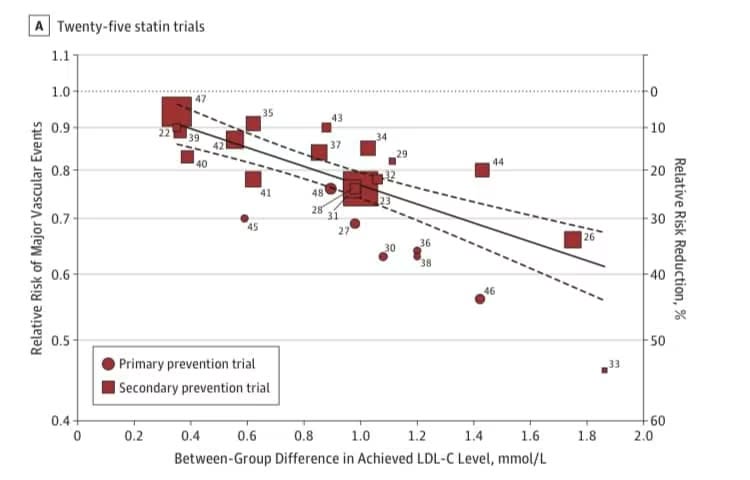
- A graph of 25 statin randomized trials through 2016 shows that lowering LDL by about 75 mg/dL (1.9 mmol/L) cut heart attack and stroke risk by about 40% on average compared with placebo, with larger relative reductions in the seven primary prevention trials than the 18 secondary prevention trials212223.
- In JUPITER, statins lowered heart attacks and strokes by 44% compared with placebo in 1.9 years, according to Louis12.
- STAREE, a trial in 9,971 adults aged 70 or older without cardiovascular disease, diabetes or dementia, reported that atorvastatin 40 mg cut major cardiovascular events by 30% (6.0% versus 8.3%) over a median of 5.9 years. There was no significant increase in dementia (hazard ratio 1.03), and serious adverse events were 2.7% in both groups. Disability-free survival did not differ significantly242526.
- On diabetes, Louis cites a pooled analysis in which treating 255 people for four years caused one extra diabetes case while preventing 5.4 cardiovascular events. In JUPITER, rosuvastatin advanced diabetes diagnosis by an average of 5.4 weeks1227.
- On absolute risk, statin trials of about five years show absolute reductions of 1.1% to 4.7%, which Louis sets against a lifetime heart attack risk of about 20%28.
Louis also shared a National Geographic article on statin skepticism spread by influencers, which frames statins as an "internet villain"; he says he sides with statins based on the science29.
What this means for you
The posts are written by group admins and are not medical advice. With that in mind, this is what the group's material suggests:
- The group's admins recommend discussing any suspected side effect with your doctor rather than stopping a medication on your own. Louis says genuine side effects should not be minimized5.
- Louis argues it is important to rule out nocebo effect properly if you have symptoms on a statin, since anyone can be fooled5.
- If symptoms occur, Louis lists options often discussed with doctors: lowering the dose, switching to a different statin (pitavastatin or pravastatin are often tolerated), or using non-statin LDL-lowering drugs that do not cause muscle pain. CoQ10 is described as harmless but usually ineffective for the genetic cause13.
- A clearly elevated CK after other causes are excluded suggests the symptoms are drug-related; Louis says this is a case where a doctor would typically stop the statin or reduce the dose with monitoring6.
- A single baseline liver test is the usual recommendation; routine repeat testing is not helpful for most people, according to the Harvard Health text Louis quotes17.
- Expect that people will describe both real and nocebo experiences convincingly. Louis suggests treating individual anecdotes cautiously and weighing blinded trial data more heavily113.
Frequently asked questions
Does the nocebo effect mean statin side effects are "all in your head"?
No. The posts are explicit that nocebo symptoms are physically real; they are generated by the brain's response to expecting harm rather than by the drug's chemistry14.
What did SAMSON actually test?
It tested people who had stopped statins because of side effects, giving each a randomly ordered set of four one-month bottles of statin, placebo and nothing. Symptoms on placebo were similar to those on statin and higher than with no tablet, and about half went on to restart statins3910.
Is it true that 90% of statin side effects are nocebo?
The figure comes from SAMSON's symptom-burden analysis and is repeated by Louis as "up to 90%"45. Pooled blinded trials of 123,940 people point the same direction, with about 1 in 15 first-year muscle complaints attributable to the statin3. The STOMP trial shows that muscle pain is still genuinely more common on a high-dose statin (9.4% versus 4.6%)16.
How can I tell a real statin effect from nocebo?
Louis says significantly elevated creatine kinase, with other causes excluded, indicates a real effect because nocebo does not raise it. Otherwise, a doctor can help test options such as a different statin or dose613.
Does nocebo happen with things other than statins?
Yes. The gluten review found that most self-reported gluten sensitivity was not explained by gluten, with FODMAPs and expectation effects the likelier causes1920.
Can placebo effects be used on purpose?
Louis notes that mind-body effects can be exploited as treatments1. A small trial of 90 older adults found that telling people the pill was a placebo still produced benefits, though one small study is far from settled evidence7.