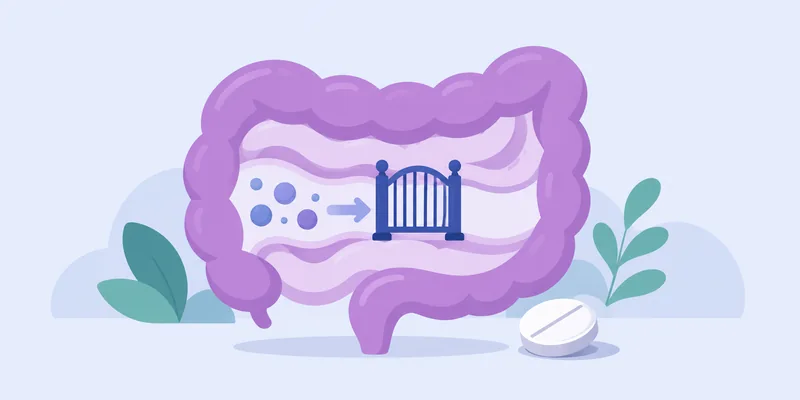
Statins are medicines that lower LDL cholesterol (the "bad" cholesterol carried in the blood by LDL particles) by slowing the liver's own cholesterol production. In the group's reading of the randomized trials, they reduce heart attacks, strokes and cardiovascular deaths, and the size of the benefit tracks how far LDL falls rather than which brand is used.123
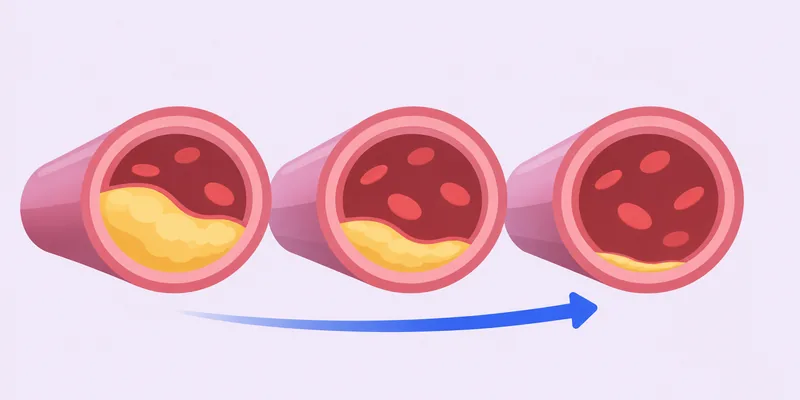
The benefit is not only about the blood test. Imaging trials in which people had their coronary arteries scanned before and after treatment show that intensive statin therapy can shrink the plaque in the artery wall, mainly the soft, cholesterol-rich part that is most likely to rupture.45 Louis also stresses that statins are cheap generics,67 and that the main downside, a small rise in blood sugar, is real but modest compared with the benefit in higher-risk people.89
This article summarizes what the group's posts say about how statins work, which trials support them, how big the effect is, and where the evidence is more nuanced. It is a summary of group discussion, not medical advice; decisions about starting, stopping or changing a dose belong with your own doctor.
How statins work
Your liver makes cholesterol through a chain of steps, and an enzyme called HMG-CoA reductase sets the pace. Statins block that enzyme, which is why a review shared in the group describes them as inhibitors of HMG-CoA reductase acting on the mevalonate pathway.13 With less cholesterol made in the liver, the body pulls more LDL out of the blood, and LDL falls.
LDL particles carry cholesterol into artery walls, where it can build up, oxidize and trigger inflammation; this is how atherosclerotic plaque forms.14 That is the reasoning behind lowering LDL as far as is practical in people at risk.
Beyond LDL: "pleiotropic" effects
Louis Nervegna, one of the group's admins, argues that statins do more than lower LDL. These additional actions are called pleiotropic effects. His main example is the use of atorvastatin 80 mg right after a heart attack, where the benefit appears within days to weeks, which he thinks is too fast to be explained by LDL lowering alone.1516 He also notes that some researchers argue these effects partly reflect lower LDL itself, since LDL that gets into the artery wall is inflammatory.15
Other posts describe statin-related drops in Lp-PLA2, a marker of inflammation inside plaque (statin plus ezetimibe lowered it more than statin alone),17 and statin activation of an energy-sensing pathway called AMPK, which Louis argues is a mild, beneficial "mitohormesis" stress rather than harm to mitochondria.18 These are mechanistic arguments; the strongest clinical evidence in the posts is still the outcome and imaging trials below.
Which statin, and which dose?
Atorvastatin at 40-80 mg and rosuvastatin at 20-40 mg are the two high-intensity options, each typically lowering LDL by at least 50%.19 Milligram for milligram rosuvastatin is more potent, but in the head-to-head LODESTAR trial (about 4,400 adults with coronary artery disease in South Korea, 2016-2019) the two had comparable three-year outcomes for the composite of death, heart attack, stroke or revascularization. Rosuvastatin reached lower LDL but was associated with more new-onset diabetes needing medication and more cataract surgery.319
Dose matters less than many people expect. Using a slide from lipid specialist Tom Dayspring, Louis points out that atorvastatin 10 mg lowers LDL by about 37% on average, 20 mg by 43%, 40 mg by 48% and 80 mg by 51%. Each doubling adds only 6%, 5% and then 3%.102021 His practical conclusion is that a lower dose is a better strategy than quitting if side effects appear, because most of the benefit remains.10
Statins also differ in whether they enter the brain: atorvastatin is lipophilic (fat-soluble) and crosses the blood-brain barrier, whereas rosuvastatin is hydrophilic and does so poorly.22
What the randomized trials show
Heart attacks, strokes and deaths
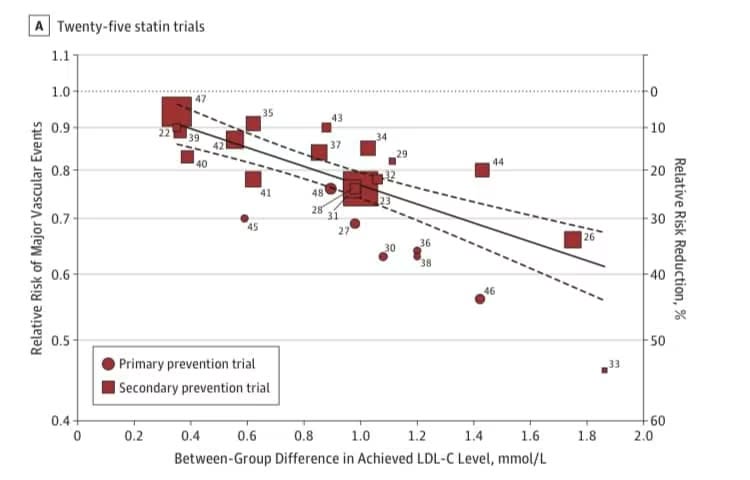
Louis shared a chart summarizing every randomized statin outcome trial up to 2016, excluding those shorter than six months or with fewer than 50 events. It had 25 trials, 7 in primary prevention (people with no prior heart attack or stroke) and 18 in secondary prevention. On average, lowering LDL by about 75 mg/dL reduced the risk of heart attack or stroke (MACE, "major adverse cardiac events") by about 40% compared with placebo, with larger relative reductions in the primary prevention trials.12 In his example, someone at an LDL of 100 on a statin would have about 40% lower risk than someone at 175 on placebo.1
For primary prevention Louis cites the JUPITER trial, in which rosuvastatin lowered heart attacks and strokes by 44% compared with placebo in just 1.9 years. He translates this into absolute terms: if your risk over two years is 3%, a halving would bring it to 1.5%.9
A pooled analysis of 27 trials from the Cholesterol Treatment Trialists' (CTT) Collaboration, covering about 174,000 participants with an average trial length of 4.9 years, found that statins work in women as well as men. Per 1 mmol/L (about 39 mg/dL) fall in LDL, major vascular events fell by 16% in women and 22% in men, and all-cause mortality by 9% and 10%, with no adverse effect on cancer incidence or non-cardiovascular mortality.23
Show data
| Women | Men | |
|---|---|---|
| Major vascular events | 16% | 22% |
| All-cause mortality | 9% | 10% |
Right after a heart attack
In PROVE IT-TIMI 22, atorvastatin 80 mg given early after an acute coronary syndrome was compared with pravastatin 40 mg. The 30-day composite of death, heart attack or rehospitalization was 3.0% versus 4.2% (hazard ratio 0.72), and in stable patients 9.6% versus 13.1%.1516 This is why Louis says patients are started on high-dose atorvastatin straight away in hospital, and advises not arguing about it while in immediate danger.15
Show data
| Atorvastatin 80 mg | Pravastatin 40 mg | |
|---|---|---|
| First 30 days | 3.0% | 4.2% |
| Stable patients | 9.6% | 13.1% |
Plaque: can statins shrink it?
Heart disease was long thought to be a one-way street. Imaging trials, which measure plaque with intravascular ultrasound (IVUS, a tiny camera inside the artery) or coronary CT angiography, suggest otherwise. Two measures appear in the posts: total atheroma volume (TAV, the total plaque volume) and percent atheroma volume (PAV, plaque as a share of the vessel).
- Six trials with statins. Louis lists total plaque reductions relative to baseline of about 5% (COSMOS), 5.5% (SATURN), 6.5% (ASTEROID), 7.5% (IBIS-4), 8% (STABLE) and 17% (JAPAN-ACS), taken from a 2022 JACC review.42425 In that review's chart, total plaque begins to regress once LDL falls below roughly 90 mg/dL.5
- Japan-ACS. About 300 patients with acute coronary syndrome were randomized to pitavastatin 4 mg or atorvastatin 20 mg. After 8-12 months non-culprit plaque volume changed by -16.9% and -18.1%, with LDL falling from about 130-135 to 80-85 mg/dL.2627
- REVERSAL and ASTEROID. High-dose atorvastatin (80 mg) halted progression (PAV +0.4%) versus +2.7% on pravastatin 40 mg over 18 months, and rosuvastatin 40 mg regressed PAV by 0.98% over 24 months.28
- SATURN. Rosuvastatin 40 mg and atorvastatin 80 mg both reduced plaque over two years in over 1,000 patients; rosuvastatin showed a somewhat greater reduction in total volume (-26.4 versus -24.4 mm3).29
- FLOWPROMOTE (JAMA Cardiology, 2026). 104 statin-naive people with coronary disease were randomized to atorvastatin 40 mg or rosuvastatin 40 mg plus ezetimibe 10 mg, with CT angiography at baseline, 9 and 18 months. LDL averaged 69.5 versus 42.5 mg/dL; total plaque fell 13.6% versus 21.1% and non-calcified (soft) plaque 20% versus 28.2%. Lower achieved LDL was linearly associated with more regression.113031
A 2021 meta-analysis of 31 IVUS studies (4,997 patients) found that lipid-lowering therapy significantly reduced plaque volume, with maximal regression at an LDL below 80 mg/dL.29 Gokhan Can's own review ranks statins, PCSK9 inhibitors and ezetimibe as the interventions with the strongest evidence for regressing or stabilizing plaque.32
Does shrinking plaque lower risk? A 2023 meta-analysis of 23 studies (7,407 patients) found each 1-percentage-point fall in PAV associated with about 19% lower odds of major cardiovascular events, but the authors of that summary stress this is an association, not proof.11 Another post puts the figure at about 20% per 1% PAV reduction.29
A puzzle: soft plaque shrinks, calcium does not
Reductions in total plaque come from losing the lipid-rich soft plaque; calcified plaque stays the same or rises.431 Several trials found statins did not slow coronary artery calcium scores (St. Francis Heart Trial, SALTIRE, BELLES), and a long-term veterans cohort reported higher odds of severe calcification with longer statin use. A review posted by Gokhan interprets this as plaque "healing", with fatty plaque turning into stable calcified scar.33 Louis makes a similar argument: calcified plaque is relatively stable, and statins help by preventing new soft plaque, regressing it and stabilizing the rest.1 This is an interpretation rather than a trial result, so people with a rising calcium score are best off asking their doctor how to read it.
Case reports are not the typical result
Louis shared a published case in which a Japanese man's severe left anterior descending artery narrowing became mild over four years on atorvastatin 10 mg, with LDL kept at 52-79 mg/dL. He is clear that this is an outlier, not what every statin user should expect; the randomized trials above show average reductions of 5% to 17%.34
Relative versus absolute benefit
A common criticism is that statin trials show only a 1-2% absolute risk reduction. Louis's reply is that these trials last about five years, during which the absolute risk of a heart attack or stroke is only 2-5% even in higher-risk people, so no treatment could reduce it by more than a few percentage points.3536
To look further out, he shared a graph combining randomized trials, prospective cohort studies and Mendelian randomization (studies that use genes that lower LDL for life). Lowering LDL by 39 mg/dL, which a very low dose statin can achieve, corresponds to more than 20% lower heart attack risk at 5 years (trials), more than 30% at 12 years (cohorts) and more than 50% at 52 years (genetic studies).35363738 With a lifetime heart attack risk of about 1 in 5 in the United States, he reasons that lowering LDL for decades could cut it from about 20% to about 10%.3537 He adds that this will not prevent every heart attack, and that diet, lifestyle and other therapies are needed for the remainder.38
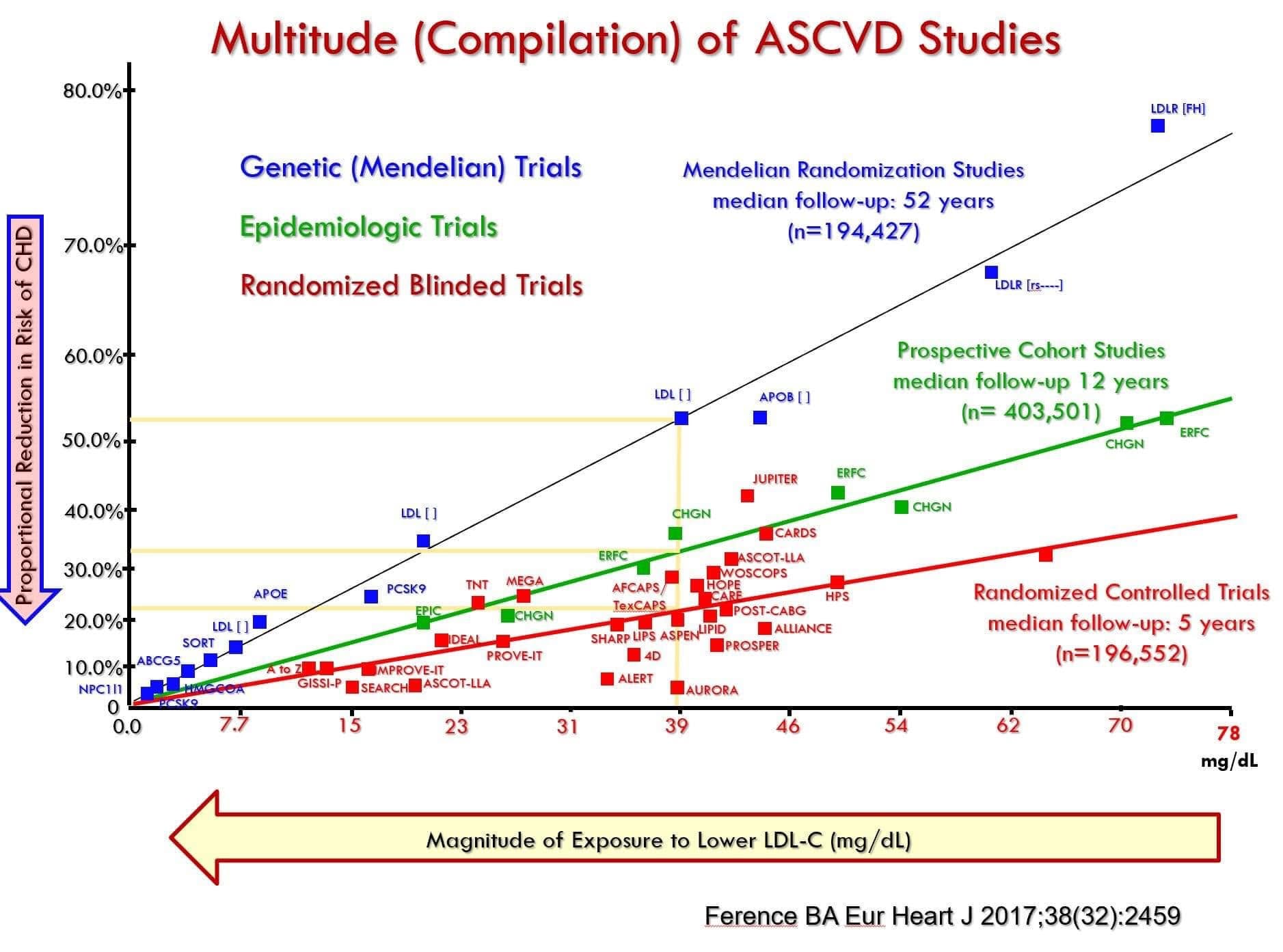
Gokhan reads the same style of chart as suggesting "the longer, the lower, the better": by his estimate a 70 mg/dL drop sustained for 30 years might lower lifetime risk by about 60%. He points out that effects beyond about 80 mg/dL of lowering are unknown.39 These lifetime figures are read from charts and rely on non-randomized evidence, so they are estimates rather than trial results.
Safety and trade-offs
Blood sugar
Statins modestly raise diabetes risk. In JUPITER (rosuvastatin 20 mg versus placebo, about 17,600 people, up to five years), people on the statin were diagnosed with diabetes on average 5.4 weeks earlier, and HbA1c rose by about 0.1 percentage points at 24 months. Louis's reading is that nobody got diabetes who would not otherwise have gotten it; it simply arrived earlier.840 A pooled analysis of 13 trials (91,140 patients) found that treating 255 people for four years caused one extra case of diabetes while preventing 5.4 cardiovascular events.9
A longer review posted by Gokhan adds that the risk rises with dose, is concentrated in people who already have risk factors such as impaired fasting glucose, obesity or HbA1c above 6%, and suggests ezetimibe, PCSK9 inhibitors and pitavastatin as options that limit glycemic harm.13 Some individuals report a rise in fasting insulin on rosuvastatin, and one reported an HbA1c rise that disappeared on pitavastatin. Louis cautions that rosuvastatin has the stronger trial evidence in high-risk people, so such switches should not be taken lightly.4142
Muscle aches, memory and other complaints
Muscle pain is the best-known complaint. A pooled analysis of 19 blinded trials (123,940 participants) found muscle pain or weakness in 27.1% on a statin versus 26.6% on placebo over about four years, with roughly 1 in 15 muscle complaints in the first year attributable to the statin.12 The SAMSON trial of people who had quit statins for side effects found symptoms almost as bad on placebo as on the statin, which Louis summarizes as mostly a nocebo effect (symptoms driven by expectation).912 The aches themselves are real, and some people do have genuine statin intolerance.
The CTT review also found no meaningful excess of memory loss or dementia, depression, sleep disturbance, erectile dysfunction, weight gain or fatigue, with a small (about 0.1%) increase in liver blood-test abnormalities but no increase in liver disease.43 Two randomized trials in people who already had Alzheimer's disease (simvastatin, 406 participants; atorvastatin in the LEADe trial, 640 participants) showed statins neither helped nor harmed progression.44 Whether statins can prevent dementia is being tested in two large trials: PREVENTABLE (about 20,000 adults aged 75 and over, atorvastatin 40 mg, still recruiting when posted) and STAREE (about 10,000 adults aged 70 and over); as of the group's May 2026 posts STAREE was complete, with results expected in the second half of 2026.4546 Louis infers from the fact that STAREE was neither stopped early for harm nor for benefit that the result is likely somewhere in between.47
Other points
- Kidneys. In the PLANET trials, rosuvastatin 40 mg was linked to lower eGFR and renal adverse events in people with proteinuria, while atorvastatin 80 mg reduced proteinuria; a post hoc analysis of six trials (30,621 patients) found atorvastatin improved kidney function in a dose-dependent way.4849 A later edit clarifies that atorvastatin improved proteinuria but had no effect on eGFR.50
- Cancer. Meta-analyses of randomized trials found no increase or decrease in cancer risk, for example an odds ratio of 0.99 for incidence in 35 trials.51 Observational data link statin use after high-risk prostate cancer diagnosis to 42% lower prostate cancer death, but that kind of data cannot prove cause and effect.5152
- Rare case reports. One case report described fully reversible hearing loss on atorvastatin 40 mg that did not recur on rosuvastatin.53
- Lp(a). One theory in the group is that atorvastatin's antioxidant action may blunt the harm of oxidized phospholipids on Lp(a) particles, offered as a possible reason the Lp(a) HORIZON trial did not show benefit. This is speculation from laboratory data.54
Cost and the "big pharma" objection
Louis points out that statins are off-patent. He reports paying about $7.70 for three months of atorvastatin 20 mg without insurance, about $8 for six months, and about $16 a year for his own 10 mg.6755 He argues that positive statin studies therefore do not help pharmaceutical companies, who earn more from newer patented drugs.69
What this means for you
- Louis treats statins as well supported for people at higher risk, including right after a heart attack; the sensible step is to discuss them with your own doctor rather than rely on social media claims either way.1415
- Remember that the biggest percentage drop in LDL comes from the lowest dose. Louis suggests lowering LDL as much as possible with diet and lifestyle first and then using the lowest statin dose that gets the job done.20 The target depends on your risk: the higher the risk, the lower to consider going.10
- If you have side effects, the group's admins suggest asking about a lower dose or a different statin instead of quitting outright.1041 Gokhan describes trying atorvastatin, rosuvastatin, then pitavastatin and ezetimibe or Repatha before finding a combination he tolerates.4156
- If you are at risk of diabetes, ask about monitoring HbA1c and fasting glucose; the added risk is concentrated in people who already have metabolic risk factors.813
- Think in long-term, cumulative terms. Short trials understate the lifetime effect of lowering LDL.35
- Ezetimibe and PCSK9 inhibitors can lower LDL further when a statin alone is not enough, or is not tolerated.3032
Frequently asked questions
Do statins actually reduce heart attacks, or only cholesterol?
The group's summary of 25 statin trials found about 40% fewer heart attacks and strokes on average for a 75 mg/dL LDL reduction, and JUPITER showed a 44% lower event rate in primary prevention.19
Can statins reverse plaque?
On average, six randomized trials found total plaque volume fell by 5% to 17% from baseline, mainly through loss of soft plaque, and FLOWPROMOTE found 13.6% to 21.1% over 18 months.411 Individual responses vary widely, and calcified plaque does not shrink.3334
Is atorvastatin or rosuvastatin better?
In LODESTAR, outcomes were comparable, though rosuvastatin lowered LDL more and was linked to more new-onset diabetes.3 Louis notes that the aim is to reach the appropriate LDL, not simply to pick the "stronger" drug.19
Do statins cause diabetes?
They modestly raise blood sugar. In JUPITER the effect was an average 5.4 weeks earlier diagnosis, and the cardiovascular benefit exceeded the diabetes hazard even in people at high diabetes risk.8
Is the muscle pain real?
The symptoms are real, but in blinded trials they occurred about as often on placebo, and only about 1 in 15 muscle complaints in the first year could be attributed to the statin.12
Do I need the highest dose?
Not necessarily. Atorvastatin 10 mg gives about 37% LDL reduction on average versus about 51% at 80 mg, though people with very high risk may be advised to aim for a lower LDL target by their doctor.1020