Statins do have genuine side effects, but they are far less common than most people think. Large blinded trials suggest that the majority of muscle aches, memory complaints and other symptoms reported on statins also appear in people taking a dummy pill. What is real, according to the group's posts, is a modest rise in muscle symptoms (mostly in the first year), a small nudge in blood sugar, and a small rise in liver blood tests.410
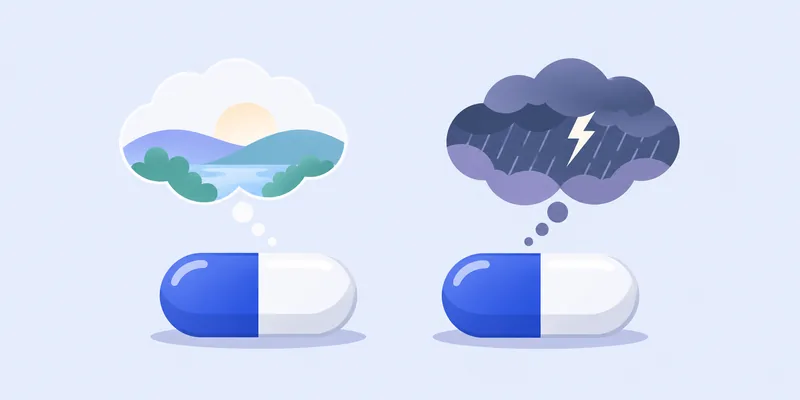
That does not mean your symptoms are imaginary. The group's admins stress that nocebo symptoms are "very real" but generated by expectation rather than by the drug itself, and that anyone can be fooled, including Louis Nervegna himself.1112 Because the two feel identical from the inside, the posts below focus on how to tell them apart and what to do about each.
This article summarizes what the group's posts say. It is a reading guide to the evidence the admins have collected, not personal medical advice; where the posts give an opinion, it is attributed.
What "statin side effects" actually covers
A few terms come up repeatedly.
- Myalgia is muscle pain or aching. It is distinct from muscle atrophy (wasting), and Louis notes that myopathy severe enough to cause atrophy is very rare on statins.13
- Myopathy is a muscle disease; in the group's usage, true myopathy is rare while benign aches are fairly common.14
- Rhabdomyolysis is severe muscle breakdown. Louis puts it at about 1 in 100,000 statin users, or perhaps 1 in 10,000 if being conservative.1315
- Creatine kinase (CK) is a "muscle enzyme" measured in blood. A significant rise is an objective sign of muscle injury.7
- Nocebo effect is the mirror image of placebo: expecting harm from a pill produces real physical symptoms generated by the mind, not by the pill.12
Part of the confusion is that reported rates depend on how you count. One video the admins shared notes that reported muscle symptoms on statins range from 1% to 25% depending on the definition.211 A pharmacology-focused summary Louis reposted says roughly 22% of statin patients have some musculoskeletal pain.16
What the evidence shows
The big picture: the CTT meta-analysis
The most comprehensive assessment the group has shared is a Lancet analysis (published online in February 2026) from the Cholesterol Treatment Trialists (CTT) Collaboration. It used individual participant data from 23 large double-blind randomized trials: 123,940 participants in 19 statin versus placebo trials, plus 30,724 in four trials of more versus less intensive statin therapy, followed for a median of nearly five years.10 It looked only at events listed on statin product labels.4
Of 66 label-listed outcomes, 62 showed no causal association. The ones that did were mild liver enzyme elevations (dose-dependent and clinically small), small changes in urine composition, oedema, and the already-known effects on muscle symptoms and new-onset diabetes.4 Reports of the following were similar on statin and placebo: memory loss or dementia, depression, sleep disturbance, erectile dysfunction, weight gain, nausea, fatigue and headache.10
The Oxford investigator quoted in a New Scientist report said "we can now be confident" that statins do not cause the vast majority of the issues listed in patient leaflets, and the report mentions calls to update statin packaging warnings.17 An essay urging over-the-counter statins, which Louis quoted, puts serious muscle injury at under 0.1% of users and liver toxicity about an order of magnitude rarer (0.01%).18
Muscle symptoms and the nocebo effect
Muscle pain is the side effect people worry about most, and the group has collected several lines of evidence.
SAMSON (n-of-1 trial). People who had stopped statins because of side effects received four one-month bottles of a statin, four of placebo and four empty bottles, in random order.19 Symptom intensity on placebo and on the statin were similar, and both were significantly greater than in the no-tablet months.3 About 60 patients took part; roughly 90% of the symptom burden attributed to statins also occurred on placebo, and about 10% was pharmacological.2 Half of the participants were able to restart statins.19 The study was published in NEJM in 2020.19
ASCOT. The shared video also cites ASCOT data in which side-effect reports jumped 41% when patients learned they were on a statin rather than a placebo.211
Pooled blinded trials. A pooled analysis of 19 blinded trials with 123,940 people found muscle pain or weakness in 27.1 per 100 on a statin versus 26.6 per 100 on placebo over about four years. In the first year, only about 1 in 15 muscle complaints among statin users was caused by the statin.1 The CTT summary Louis quoted similarly says statins caused muscle symptoms in only about 1% of people in the first year of treatment, with no excess thereafter.10
Louis summarizes this as "up to 90%" of statin side effects being nocebo, while insisting that real side effects exist and should not be minimized.811 Dr. Michael Richman, a cardiothoracic surgeon whose video Louis shared, makes the same point about why muscle pain is so readily blamed on the medicine.20
STOMP (performance). In a 6-month, double-blind trial of 420 healthy adults, atorvastatin 80 mg did not impair strength, VO2 max, endurance or physical activity across 14 measures. Muscle pain was twice as common on the statin than on placebo (9.4% vs 4.6%) but did not measurably change performance. The trial was short, in healthy adults and with one statin, so it may not generalize.21
Show data
| Statin | Placebo | |
|---|---|---|
| Muscle pain or weakness, 19 pooled trials (123,940 people) | 27.1% | 26.6% |
| Muscle pain, STOMP (atorvastatin 80 mg, 420 healthy adults) | 9.4% | 4.6% |
When muscle problems are real
Louis is clear that some muscle problems are genuine.
- Elevated CK. Nocebo does not raise CK "as far as I am aware," he says. If a significantly raised CK persists after exercise, infection, trauma and hypothyroidism are excluded, the statin is the likely cause. This is uncommon, more serious than ordinary myalgia, and usually prompts a physician to stop the statin or lower the dose with close monitoring.7 Louis assumed for illustration that about 0.2% of users have significant CK elevations.7
- Genetics. Louis argues that statin-related muscle pain in susceptible people is genetic. He shared an Atlantic article proposing that people at higher risk likely carry variants in genes coding for HMG-CoA reductase (the enzyme statins block), and that extreme versions of the same defects cause a rare muscle disorder, limb girdle muscular dystrophy.822 The shared source is journalism rather than a primary paper, and Louis hopes for a future genetic test.1322
Diabetes
The statin-diabetes link is established, but the group's posts consistently describe it as small in absolute terms.
- A meta-analysis of 13 trials (91,140 patients) found that treating 255 people with statins for 4 years led to 1 extra case of diabetes while 5.4 cardiovascular events were prevented.5 Gokhan's review gives the relative increase as about 9% (OR 1.09), with intensive-dose therapy about 12% higher than moderate-dose.6
- Louis cites roughly 5-year trials showing a 9% to 12% relative increase, and 20% to 36% for very high-intensity regimens. He deliberately framed this in the scariest way: if your 5-year diabetes risk is 1 in 1,000 it rises to about 1.12 in 1,000, whereas someone at 1 in 2 could be nudged over the diagnostic threshold.23
- In JUPITER (rosuvastatin 20 mg, about 17,600 people), statin allocation brought the diagnosis of diabetes forward by an average of 5.4 weeks and raised HbA1c by about 0.1 point at 24 months. Louis reads this as "no one got diabetes who was not going to get it anyway," and the underlying Lancet analysis concluded benefits exceeded the diabetes hazard even in people at high risk.24 JUPITER also showed a 44% reduction in heart attacks and strokes.5 Gokhan's review notes a 26-27% increase in physician-reported diabetes in that trial.6
- Who is affected: excess cases occur almost exclusively in people with baseline risk factors such as impaired fasting glucose (100-125 mg/dL), BMI over 30, metabolic syndrome or HbA1c over 6%; with normal glycemic markers and body weight the risk is described as negligible.623
- Genetics: Louis shared a Gemini-assisted post arguing that genetic variants that mimic statin and ezetimibe targets also show modestly higher glucose and diabetes risk, suggesting the effect is tied to LDL lowering itself rather than an off-target toxicity.25
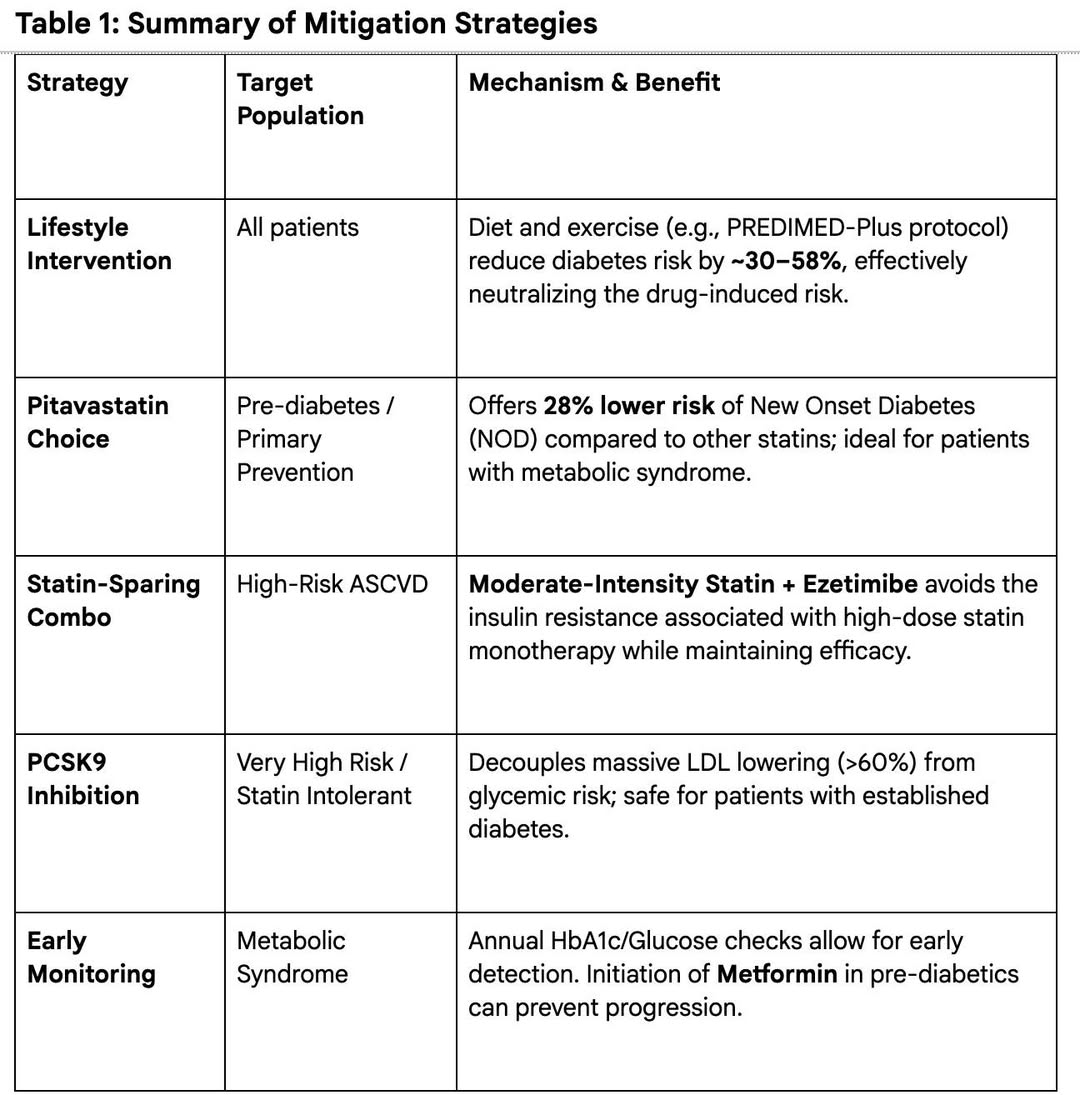
Louis also points out that a ketogenic diet reduces muscle insulin sensitivity temporarily and to a much larger degree than statins do, and that both effects reverse on stopping.26
Liver
Rises in liver enzymes are among the small number of effects the CTT analysis confirmed, but they were clinically small: about 0.1% more liver blood-test abnormalities, with no increase in hepatitis or liver failure.410 Louis quotes Harvard Health: about 1 in 1,000 statin users have an abnormal liver test attributable to the drug, abnormal results are about as common on placebo in some studies, and serious liver injury is rare and tends to occur in people who already have liver disease or take other interacting medications.2728 That source recommends one baseline liver test before starting and says routine repeat monitoring is not useful for most people.27 Louis adds that short-term enzyme rises usually resolve within weeks to months.28
A 2017 review Louis shared suggests statins may even benefit some chronic liver disease, though the authors say randomized trials are needed to confirm this.29
Memory, testosterone and sexual function
Beyond the CTT finding of 0.2% per year memory-complaint reports on both statin and placebo10, Louis cites a meta-analysis of 55 studies in over 7 million people linking statin use to lower dementia risk, and notes the PREVENTABLE trial of about 20,000 older adults is testing this directly.514 He adds that those worried about memory can choose rosuvastatin, which crosses the blood-brain barrier poorly.5
A post by Gokhan reports that meta-analyses show statins lower total testosterone by about 9-13 ng/dL against a normal range of 300-1,000 ng/dL, and that statins often improve erectile function scores in men with high cholesterol.30
How often the real effects occur
The frequencies quoted in the posts, side by side:
| Effect | How often, as reported in the posts |
|---|---|
| Muscle symptoms caused by the statin | About 1% of people, in the first year only10 |
| Significant creatine kinase (CK) rise | About 0.2% of users, Louis's illustrative assumption7 |
| Serious muscle injury | Under 0.1% of users18 |
| Rhabdomyolysis | About 1 in 100,000 users, or 1 in 10,000 to be conservative1315 |
| Abnormal liver test attributable to the drug | About 1 in 1,000 users27 |
| Liver toxicity | About 0.01% of users18 |
| New diabetes | 1 extra case per 255 people treated for 4 years5 |
Nuances, controversies and common misconceptions
"90% nocebo" is a headline, not a law. The 90% figure comes from SAMSON, which enrolled about 60 people who had already quit statins.2 The very large pooled analyses give a related but differently framed number: about 1 in 15 muscle complaints caused by the statin in year one.1 STOMP found muscle pain doubled on high-dose atorvastatin.21 These are best read together: most complaints are not drug-caused, but a minority are.
Real versus mind-made. Nocebo symptoms are not faked. Both the admins and the shared video say the aches and fatigue are real.211 Louis says he was fooled himself, and he suggests taking testimonials from people prone to conspiratorial thinking about medicine with a grain of salt.1119 Tim Spector, whose Telegraph account Louis shared, avoided statins for nearly a decade, then had a mini-stroke at 53 and said his muscle cramps had been nocebo.31
Mechanism claims are mostly hypotheses. Louis argues that statins cause beneficial mild mitochondrial stress (mitohormesis) via AMPK activation and may help sarcopenia (age-related muscle loss).131532 A 2025 review he shared calls this promising,33 but a Medical Hypotheses paper he cited is explicitly a hypothesis, and the posts present no randomized human trial showing a muscle benefit.15
Real individual experience matters. Gokhan reported that atorvastatin made him feel "spaced out" and "off" at every dose, while rosuvastatin was uneventful. He later added ezetimibe, then moved to pitavastatin 1 mg and Repatha and says he feels well. This is anecdote, not evidence.34
Alternatives are not free of side effects. Louis notes that PCSK9 inhibitors such as Repatha list flu-like symptoms, back pain and high blood sugar as common effects, and that their long-term safety record is shorter.35 He personally takes a low-dose statin because statin side effects are "known unknowns" after decades of study, while newer drugs have "unknown unknowns." This is his opinion.36 Even niacin, which Louis says can lower Lp(a), adds no outcome benefit on top of high-dose statins in two large trials while increasing side effects.37
Dropping a statin has a cost. In the STREAM trial of 1,880 adults aged 70 and older without known cardiovascular disease, those who stopped statins had 12.7% heart attack, ischemic stroke or death versus 9.2% on continued statins, about 38% more events in relative terms. The trial was called noninferior, but the commentary Louis shared stresses that this only means the difference fell inside a preset margin, that stopping did not meaningfully improve muscle pain, quality of life, falls or sarcopenia, and that the safety board advised discussing restarting. Stopping can be appropriate based on frailty, life expectancy, adverse effects or individual risk, but not simply because of age.38
Managing side effects: what the group suggests
The admins' suggestions, in rough order:
- Check it is not something else. For raised CK, rule out exercise, infection, trauma and hypothyroidism.7
- Consider nocebo honestly. Louis urges ruling it out before blaming the drug.811
- Lower the dose rather than quitting. Citing a Tom Dayspring slide, Louis shows diminishing returns: atorvastatin 10 mg lowers LDL about 37%, 20 mg 43%, 40 mg 48% and 80 mg 51%. Moving from 10 mg to 80 mg adds only about 14 more percentage points. He suggests lowering LDL with diet and lifestyle first, then using the lowest effective dose.9
- Try another statin. Many people who get myalgia on one statin tolerate another; he names pitavastatin and pravastatin, and says switching from lipophilic to hydrophilic statins often helps.813
- Use non-statin LDL-lowering drugs if needed. A moderate-intensity statin plus ezetimibe lowered LDL similarly to a high-intensity statin with significantly fewer muscle symptoms in patients 70 and older (NEJM summary).39 In a small study of 33 statin-intolerant patients, ezetimibe three times a week cut LDL-C about 20%, and 85% tolerated it.40 A bempedoic acid trial in 4,206 statin-intolerant primary-prevention patients showed a 30% reduction in its primary composite outcome and 27% lower all-cause mortality, with more gout and gallstones.41
- Check vitamin D. Louis suggests supplementing if levels are low, citing a small 6-month pilot in which 64% of vitamin D-deficient, statin-intolerant patients tolerated a statin re-challenge after correction. It is a pilot, not a definitive trial.16
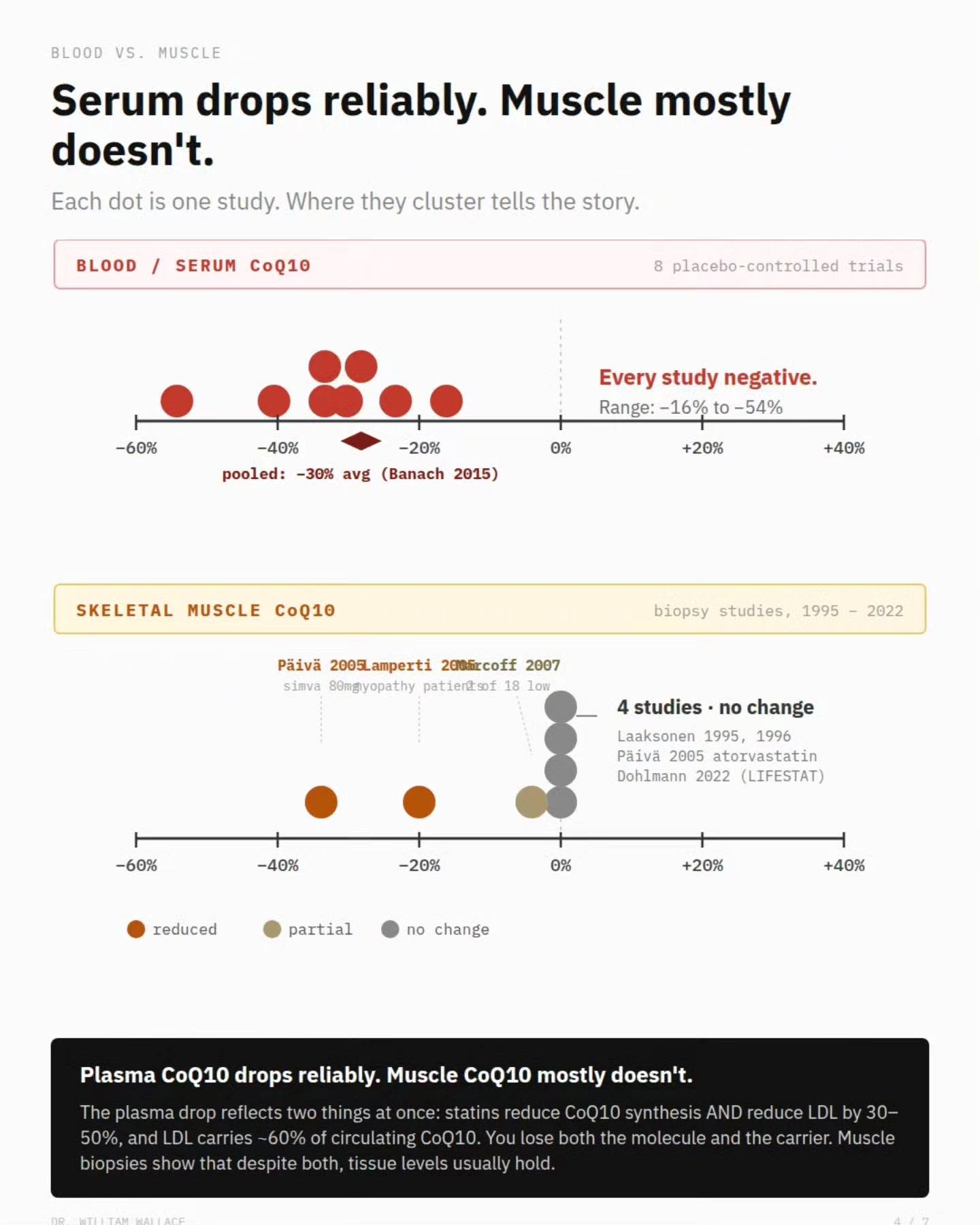
- CoQ10 is optional. Louis says it is harmless and may offset statin-lowered CoQ10, but most trials for statin muscle pain failed.8 A summary he shared says the best-designed trials show no benefit and muscle levels barely change.42
- Watch interactions. Grapefruit juice and some herbs and botanicals can raise statin levels through cytochrome P450; the grapefruit interaction applies only to certain statins.43
What this means for you
- The group's admins recommend discussing any new muscle pain or persistent weakness with your doctor rather than stopping or continuing on your own; a CK test is how a real muscle problem is separated from nocebo.7
- If symptoms are mild, a lower dose or a different statin often keeps most of the LDL benefit.89
- If you have prediabetes, obesity or metabolic syndrome, the diabetes nudge is most relevant to you, and the posts still describe cardiovascular benefit as outweighing it.624
- Do not assume a drug alternative is automatically safer; each has its own side-effect profile.3541
- Before stopping altogether, ask about the dose, switching and non-statin options, and about how stopping would change your risk.3138
- Liver testing: one baseline test, then routine repeat testing is generally unnecessary unless you are at high risk.27
Frequently asked questions
Does a statin cause muscle pain?
Sometimes. In pooled blinded trials, 27.1% on a statin and 26.6% on placebo reported muscle pain or weakness over about four years.1 High-dose atorvastatin did double pain in healthy volunteers in STOMP (9.4% vs 4.6%).21
How do I know if it is nocebo or real?
Louis notes SAMSON-style blinded re-challenge is how researchers separated them,19 and that a significantly raised CK after other causes are excluded points to a real effect.7
Will statins give me diabetes?
Mainly if you were already close to it. The 13-trial analysis found 1 extra case per 255 people over four years versus 5.4 cardiovascular events prevented.56
Should I have regular liver tests?
Harvard Health, as quoted by Louis, recommends one baseline test and says routine monitoring is not a good use of money and time.27
Can I take CoQ10 or vitamin D to prevent side effects?
CoQ10 has not reliably worked in trials.42 Low vitamin D has been linked to statin myalgia and correcting it helped some in a small pilot.16
Do statins cause memory loss?
The CTT analysis found memory-complaint reports at 0.2% per year on both statin and placebo.10