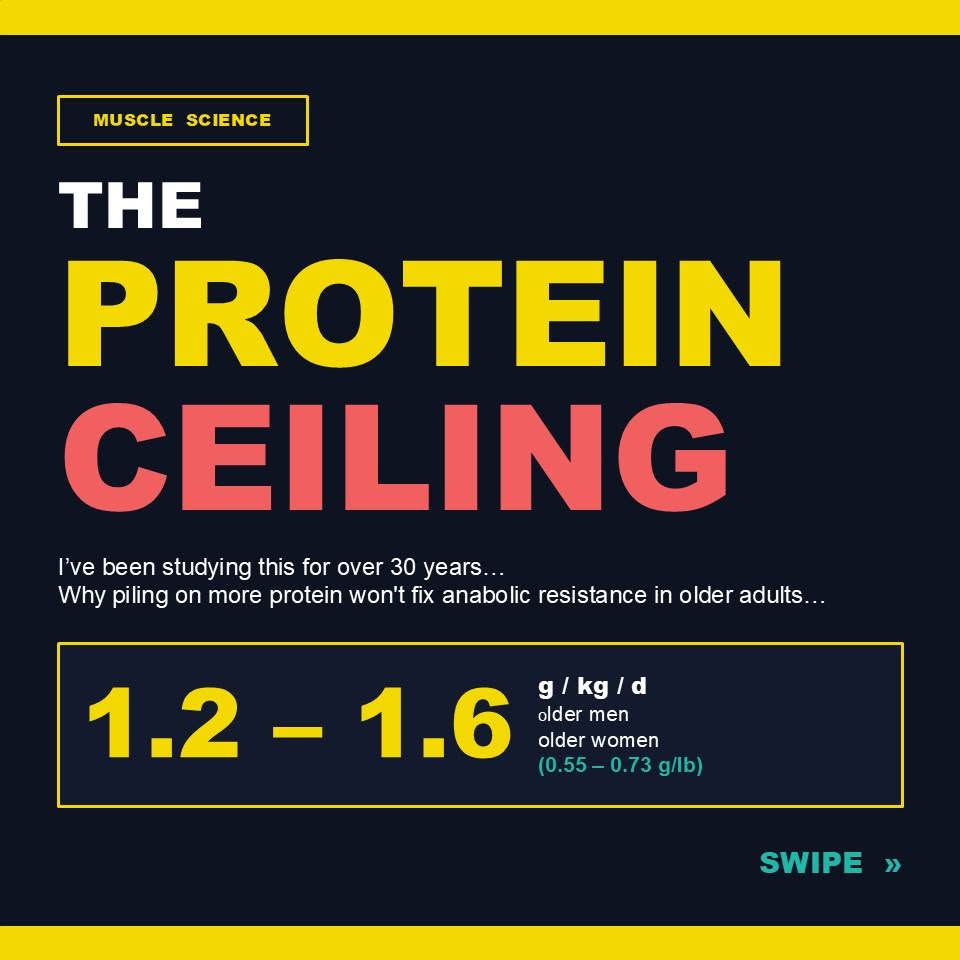
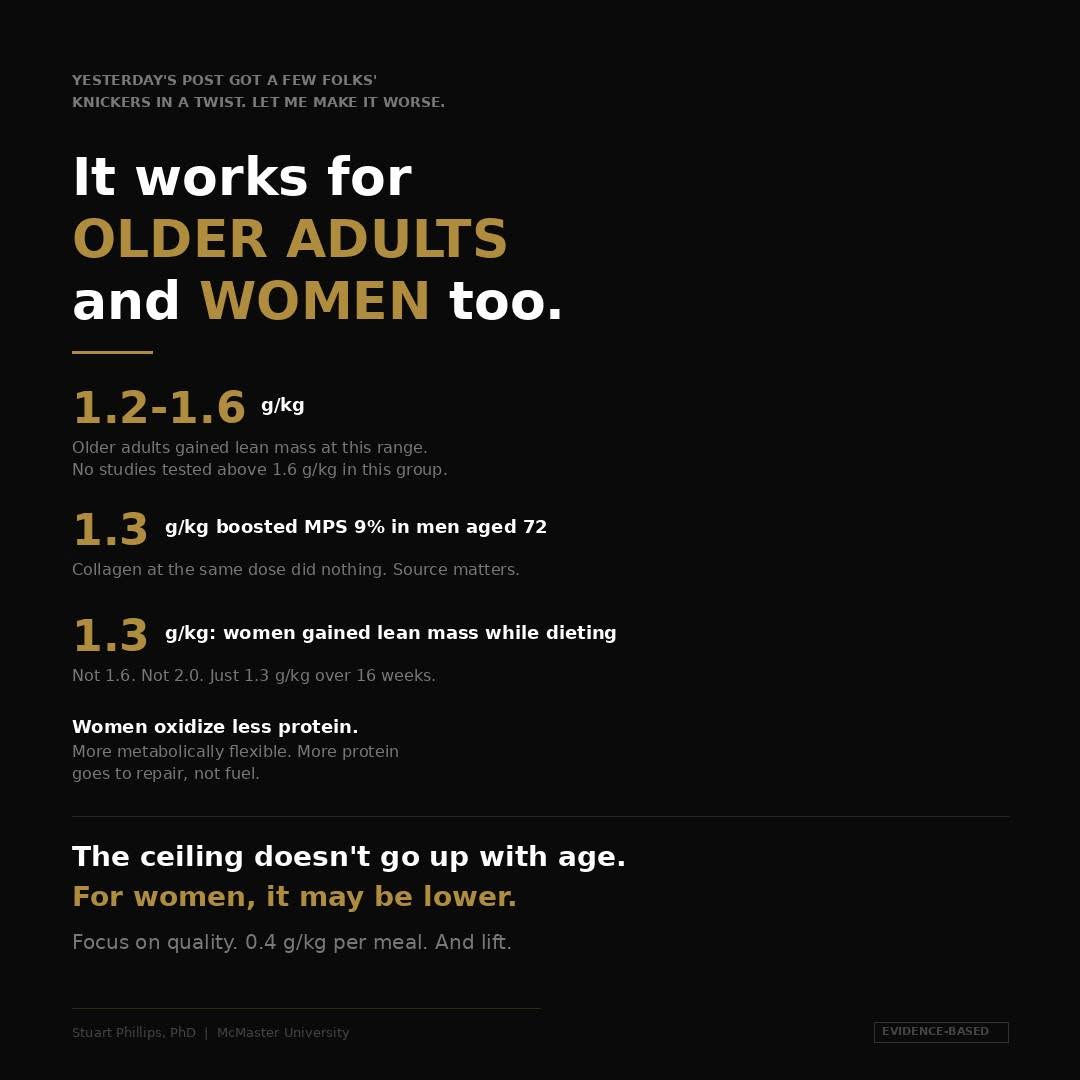
It’s still 1.6 g/kg... and there ain’t no data showing anything different!
Good questions. Good comments. Fair pushback. And credit where it’s due: Greg Nuckols wrote a great critique. Careful, transparent, and willing to show his working. It forced a useful re-examination of the 1.6 g/kg/day claim.
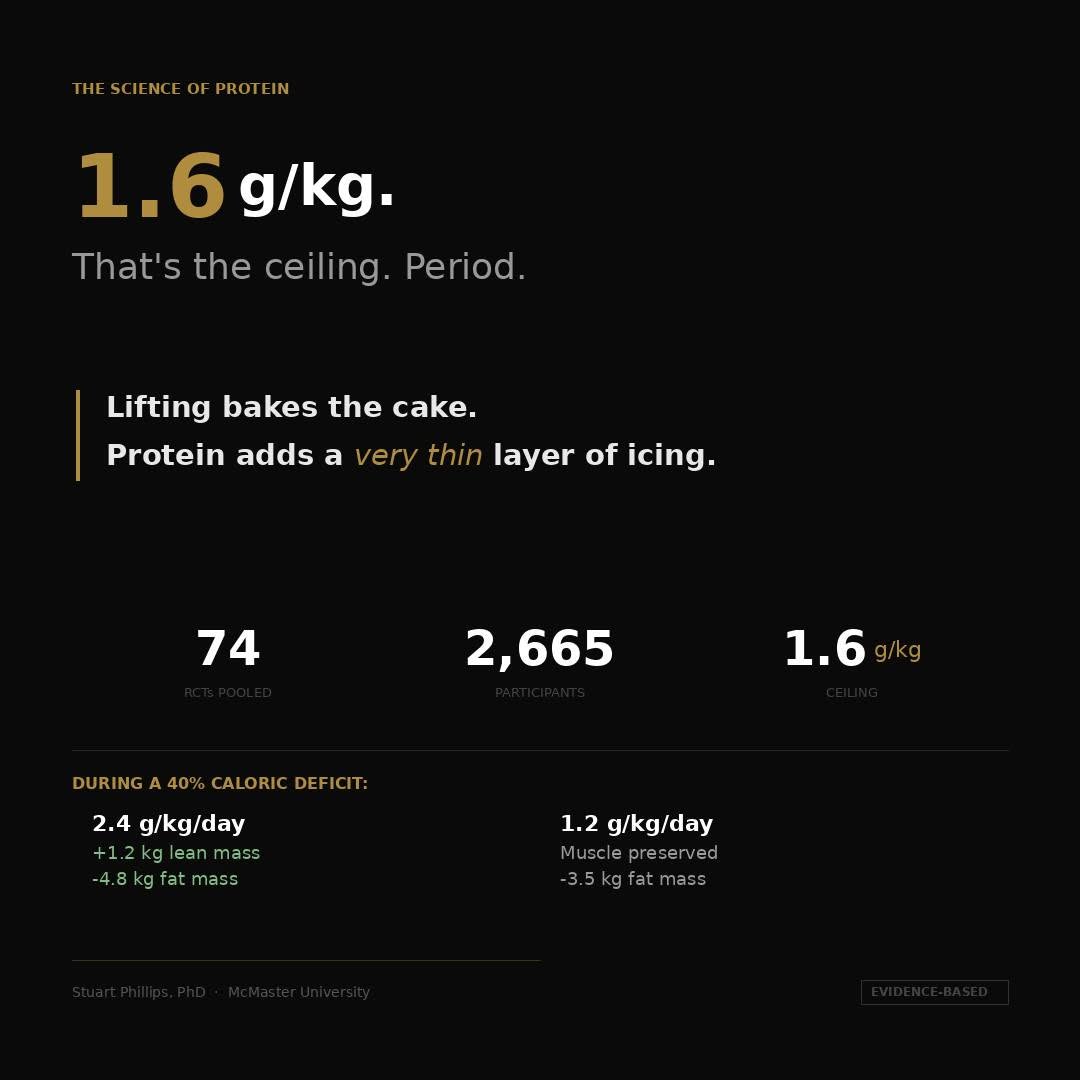
After that re-examination, the conclusion still stands: 1.6 g/kg/day appears sufficient for people who resistance train, whether the goal is fat loss, muscle gain, or both.
To be clear, 1.6 isn’t a magical biological cliff. It’s a sufficiency with a margin, the intake above which no additional benefit has been convincingly demonstrated using a method that actually measures muscle.
Someone then floated three weak new studies to claim that more protein yielded more benefit. The problems?
One used a single ultrasound site in 22 untrained men and reported body-composition numbers that didn’t add up. Another called a bioimpedance estimate “muscle” while reporting implausibly large muscle and bone changes in eight weeks. A third estimated runners’ “muscle” with a tape measure and skinfolds, without a placebo or blinding. None of them measured muscle. New papers aren’t automatically good papers.
Head-to-head trials comparing 1.6 with intakes as high as 3.2 g/kg/day have found no significant lean-mass advantage. Yes, those trials were too small to rule out a tiny benefit—and that is fair pushback. But a tiny, unproven possibility is not evidence of a meaningful additional muscle benefit.
So, the takeaway: good questions, good comments, fair pushback, lame new papers, but the conclusion holds.
“Lifting bakes the cake. Protein adds a very thin layer of icing.”
Resistance training accounts for most of the gain. Protein adds a small increment. A second layer of icing from intakes above 1.6 g/kg/day has yet to be shown with a method that actually measures muscle.
Read the (version 2.0) preprint:
sportrxiv.orgLink to sportrxiv.orgsportrxiv.org