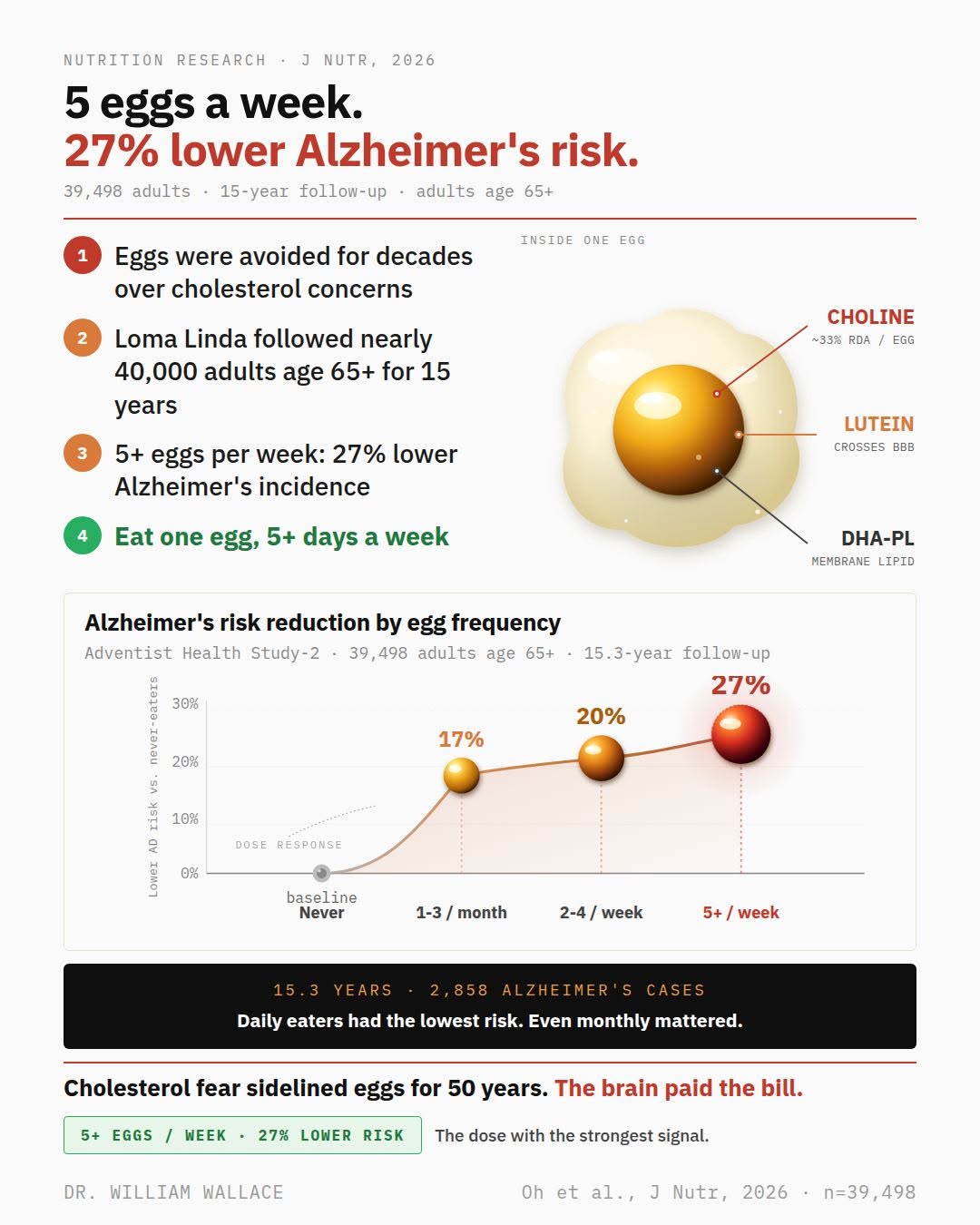
This was a high quality prospective cohort study. It’s not the first to link consumption of eggs with lower risk of dementia and Alzheimer’s. Eating eggs in moderation has long been a part of the traditional mediterranean diet.
Note that the form of choline in eggs (phosphatidylcholine) does not raise levels of TMAO: ↪ Eggs and phosphatidylcholine did not raise TMAO in an RCT, unlike choline bitartrate.
#eggsHD #dementiaHD #alzheimersHD
 PsyPost - Psychology NewsFrequent egg consumption linked to lower risk of Alzheimer’s dementia, study findsOlder adults who ate more than one egg per week had a lower risk of developing Alzheimer’s dementia and showed fewer Alzheimer’s-related brain changes. About 39% of this association was explained by higher dietary choline intake from eggs.psypost.org
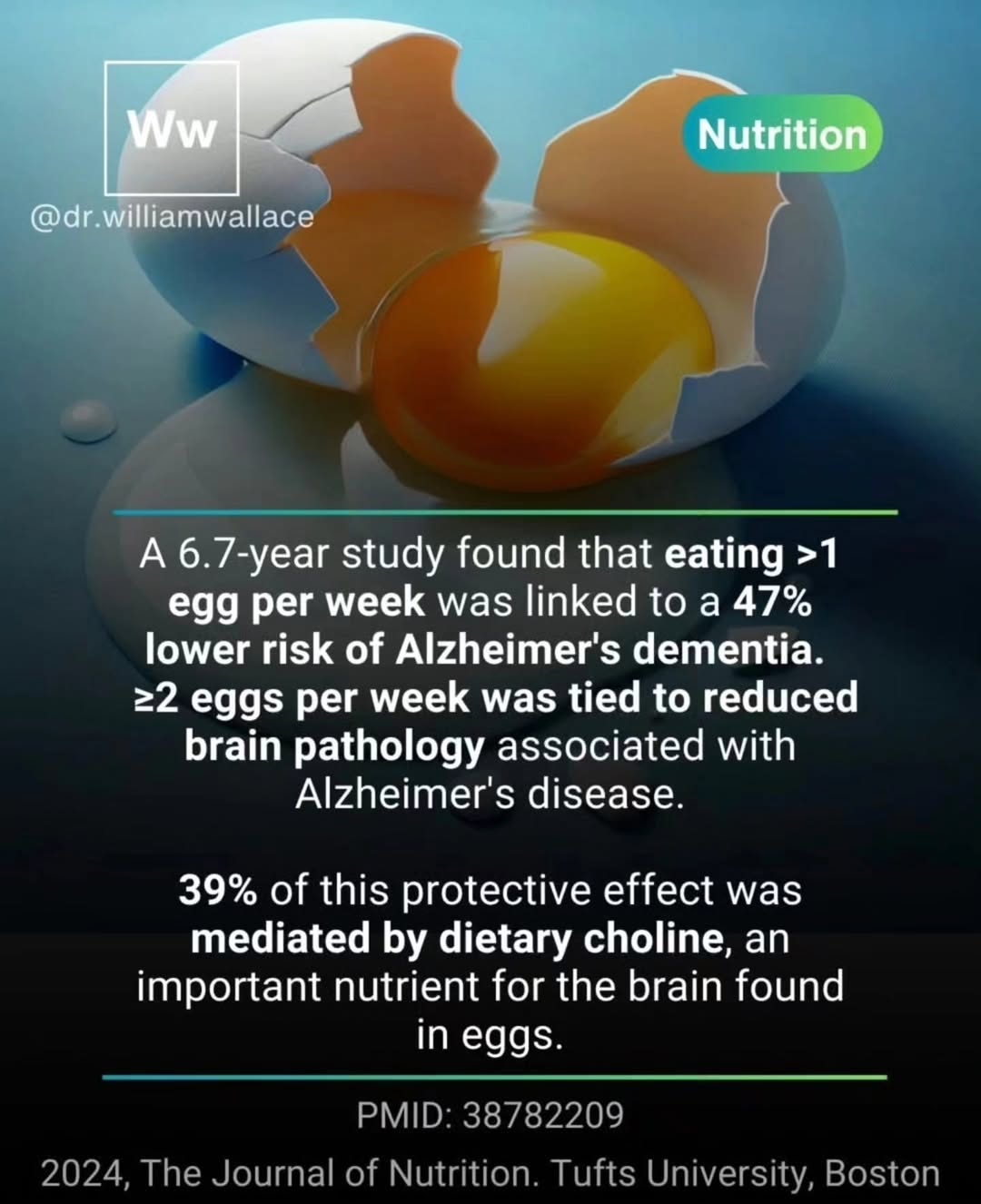
Older adults who eat eggs more than once a week may be less likely to develop Alzheimer’s dementia, according to a new study published in The Journal of Nutrition.
The researchers found that participants who ate eggs weekly had a lower rate of clinical diagnosis and fewer Alzheimer’s-related brain changes after death. The study also identified dietary choline, a key nutrient found in eggs, as one possible contributor to this protective effect.
The study provides evidence that frequent egg consumption is linked not only to better cognitive outcomes, but also to less underlying brain pathology. The findings support the idea that dietary choices in later life can influence brain aging, and highlight eggs as a potentially beneficial food for older adults.
Eggs are a natural source of several nutrients that support brain health, including choline, omega-3 fatty acids, and lutein. Prior studies suggested that egg intake may support cognitive performance, but few have examined its relationship to Alzheimer’s disease directly.
To investigate this link, the researchers analyzed data from 1,024 participants in the Rush Memory and Aging Project, a long-running study of older adults in the Chicago area. All participants were free of dementia at the time they completed a detailed dietary questionnaire. The survey, adapted from a well-known food frequency questionnaire developed at Harvard, asked about their typical diet over the previous year, including how often they ate eggs. Participants were then followed for an average of nearly seven years, during which they underwent yearly assessments for signs of Alzheimer’s dementia.
In addition to clinical evaluations, a subset of 578 participants donated their brains for research after death. These samples allowed the researchers to examine the biological features associated with Alzheimer’s disease and assess whether egg intake was related to the presence of those features.
The research team categorized participants into groups based on how often they consumed eggs: less than once per month, one to three times per month, once per week, and two or more times per week. They then used statistical models that took into account a wide range of other factors, including age, education, physical activity, genetics, and overall diet.
The results showed that both the once-a-week and two-or-more-times-per-week groups had about half the risk of developing Alzheimer’s dementia compared to those who consumed eggs less than once a month. These results remained statistically significant even after adjusting for a variety of potential confounding variables.
But the researchers caution that the study does not prove that eggs prevent Alzheimer’s disease. The study was observational, meaning it cannot establish cause and effect. There is also the possibility of reverse causation, since some people may change their diet in subtle ways as cognitive decline begins. The dietary questionnaire was only administered once, and it relied on self-reported data, which may introduce recall bias or inaccuracies. Additionally, the food frequency questionnaire only asked about whole egg consumption, not about eggs used as ingredients in other foods.
Another limitation is that the study population was predominantly female, highly educated, and over the age of 80, which may limit how broadly the results apply. The relatively short follow-up period of under seven years also means the study could have missed longer-term effects. Despite these caveats, the study’s strengths include its large sample, long-running cohort, and access to detailed clinical and postmortem data.
Funding for the study came from the National Institutes of Health and the Egg Nutrition Center, among other sources. Several of the authors disclosed financial relationships with food and nutrition organizations, including the egg industry, though the funding sources did not influence the analysis or interpretation of the results. The researchers adhered to transparency guidelines for nutrition research involving private sector funding.
Looking ahead, the authors suggest that additional studies should replicate these findings in other populations, and that randomized controlled trials could help clarify whether egg consumption directly influences Alzheimer’s risk.