For decades, eggs were treated as a heart-health threat because one egg holds roughly 200 mg of cholesterol. The logic was simple: dietary cholesterol raises LDL ("bad") cholesterol, and higher LDL raises cardiovascular risk. A recent editorial commentary shared in the group argues that this framework was always incomplete.7 The 1960s dietary guidelines capped cholesterol intake at 300 mg per day, which meant two eggs put you at the limit.5
The short answer from the group's posts is that, for most healthy people, eggs in moderation look neutral for heart disease. The quality of fats in the overall diet, especially saturated fat, appears to matter more for LDL than the cholesterol in the food itself.12 The group's admin Louis Nervegna adds an important caveat: a food that does not raise risk is not the same as a food that lowers it, so the overall pattern should still aim to lower risk.3
This article walks through what the posts say about eggs, LDL, heart disease, TMAO (a gut-bacteria-derived molecule linked to cardiovascular risk), and the newer research on eggs and dementia. Nothing here is personal medical advice; people with high cholesterol, diabetes or established heart disease should discuss eggs with their own doctor.
Why eggs were blamed in the first place
An egg contains about 200 mg of cholesterol and about 1.5 g of saturated fat.7 Because cholesterol is the substance that builds up in artery plaque, it seemed natural to assume that eating cholesterol would raise the cholesterol in the blood. Eggs were previously linked to heart disease risk for exactly this reason, according to the Harvard Nutrition Source passage Louis quoted.2
That passage goes on to say that a solid body of research shows that, for most people, cholesterol in food has a smaller effect on blood total cholesterol and LDL than the mix of fats in the diet does.2 Put simply: what you eat alongside the egg, and the fats you eat overall, tend to matter more than the yolk.
What the evidence shows
A trial that separated cholesterol from saturated fat
Louis quoted a report on a trial designed to pull these two factors apart. Researchers recruited 61 adults with matching baseline LDL and had them follow three diets for five weeks each; 48 completed all three.1
- A high-cholesterol, low-saturated-fat diet that included two eggs per day.
- A low-cholesterol, high-saturated-fat diet with no eggs.
- A diet high in both cholesterol and saturated fat, with one egg per week.
The diets high in saturated fat were associated with a rise in LDL. The high-cholesterol, low-saturated-fat diet with eggs produced a reduction in LDL. The authors' conclusion, as quoted, was that saturated fat, not egg cholesterol, was the real driver of the LDL elevation.1 The post identifies this trial only through a news report (ScienceAlert) rather than a journal citation, so readers who want the full paper may need to look for it themselves.
Long-term cohort studies and heart disease
Two Harvard-sourced posts quote the same conclusion. The Harvard Nutrition Source cites two large prospective cohorts (nearly 40,000 men and over 80,000 women) in which up to one egg per day was not associated with increased heart disease risk in healthy individuals.2 Harvard Health makes a similar statement: for most people an egg a day does not increase the risk of heart attack, stroke or other cardiovascular disease, based on huge studies following hundreds of thousands of people over decades.3
Louis also shared a commentary on an American Journal of Clinical Nutrition editorial describing eggs as largely neutral for cardiovascular disease in generally healthy populations, including in the major Harvard cohorts and later pooled analyses.7 His own summary is short: "In long term studies, eggs are neutral."7
In his larger summary of Harvard protein research (nearly 300,000 people followed for over 30 years in the Nurses' Health Studies and the Health Professionals Follow-up Study), eggs also came out roughly neutral for mortality, alongside dairy as a whole.89
The cholesterol comparison with sugar
One post highlighted a JAMA Internal Medicine analysis in which people getting 25% or more of their calories from added sugar had more than double the risk of dying from heart disease compared with those under 10%, regardless of age, sex, weight, activity or cholesterol levels. Louis clarified that the post was comparing sugar with dietary cholesterol, not with blood cholesterol.10
Where the Harvard source urges caution
The same Harvard Nutrition Source passage is not a blanket green light. It says the research does not endorse "daily three-egg omelets": a 2008 Physicians' Health Study report suggested that going much beyond an egg a day could increase the risk of heart failure later in life.2 It also makes two group-specific points:
- People who have difficulty controlling total and LDL cholesterol may want to be cautious with yolks and choose egg whites instead.2
- In the Nurses' Health Study and Health Professionals Follow-up Study, heart disease risk was higher among men and women with diabetes who ate one or more eggs a day. For people with diabetes and heart disease, the passage suggests limiting eggs to no more than three yolks per week.2
The passage also notes that the "trimmings" matter: scrambled eggs with salsa and a whole-wheat English muffin are a very different meal for the cardiovascular system than eggs with cheese, sausages, home fries and white toast.2
Eggs, choline and TMAO
TMAO (trimethylamine N-oxide) is a molecule made when gut microbes break down choline and L-carnitine from foods such as red meat, egg yolks and some fish, after which liver enzymes convert the result into TMAO. Gokhan Can shared a review noting that chronically elevated TMAO has been linked to atherosclerosis, heart attack and stroke, and that it is a biomarker of interest. He said TMAO is not the thing he cares about most, but it is worth knowing about, and that red meat and gut dysbiosis (an imbalanced gut microbiome) contribute to it.11
Because egg yolks are rich in choline, people have worried that eggs raise TMAO. Louis pointed to a Cleveland Clinic randomized trial, published in the American Journal of Medicine in 2021, that tested this directly. It was not funded by the egg industry, and one of its authors is Stanley Hazen, whose group first linked TMAO with cardiovascular disease in 2011.4 The quoted results:
- Plasma TMAO rose significantly in all three arms containing choline bitartrate (all p<0.0001), and platelet reactivity (a measure of how readily platelets clump) also rose (all p<0.01).4
- Daily ingestion of four large eggs did not significantly raise TMAO (p=0.20) or platelet reactivity (p=0.10).4
- Phosphatidylcholine supplements did not raise TMAO (p=0.27) or platelet reactivity (p=0.79).4
The authors concluded that the form and source of choline matters: phosphatidylcholine is the form typically found in whole foods, while choline bitartrate is a supplement form.4 The participants in this trial were healthy people with normal kidney function.4
The results side by side4:
| Choline source | Plasma TMAO | Platelet reactivity |
|---|---|---|
| Choline bitartrate supplement (three arms) | Rose significantly (p<0.0001) | Rose (p<0.01) |
| Four large eggs a day | No significant rise (p=0.20) | No significant rise (p=0.10) |
| Phosphatidylcholine supplement | No significant rise (p=0.27) | No significant rise (p=0.79) |
Louis used this trial in July 2026 to rebut a Daily Mail headline claiming eggs raise the risk of atrial fibrillation (AFib, an irregular heart rhythm). He explained that the Cleveland Clinic AFib study had associated blood TMAO with AFib, not egg intake, and that the same research group had earlier shown in humans that eggs do not raise TMAO.1213
Eggs and the brain: the dementia studies
A large share of the group's recent egg posts concern Alzheimer's disease rather than the heart. They matter here because they show how eggs behave in long-term cohorts, and because choline is central to the debate.
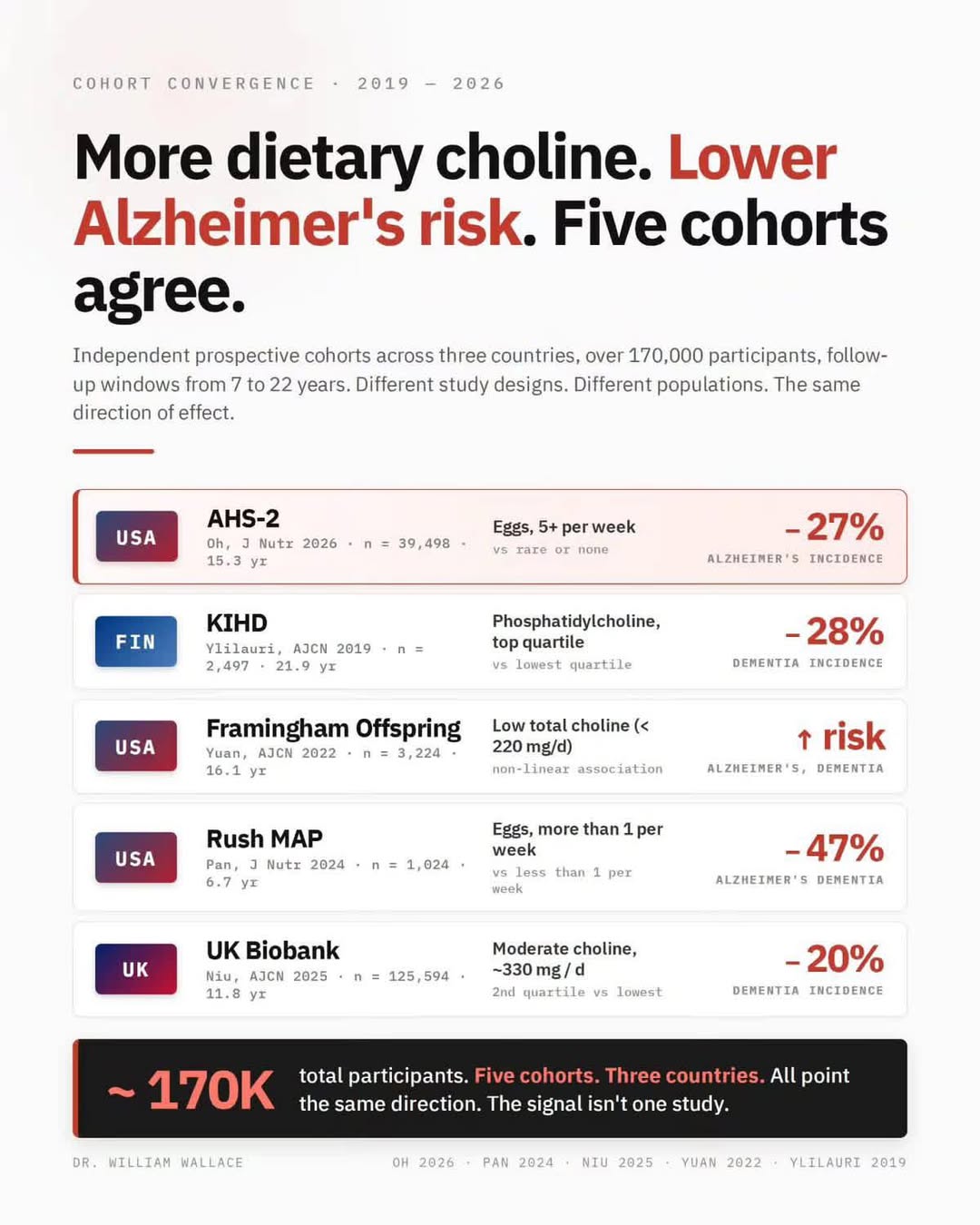
- A Rush Memory and Aging Project analysis (1,024 participants, about 81 years old, 6.7-year follow-up, published in The Journal of Nutrition) associated eating more than one egg a week with 47% lower risk of Alzheimer's dementia, and two or more a week with less Alzheimer's pathology in the brain. Dietary choline accounted for about 39% of the association. The shared summary lists the limitations: observational design, self-reported diet, and older US adults only.1415
- The Adventist Health Study-2 analysis followed 39,498 adults aged 65 and over for 15.3 years, during which 2,858 developed Alzheimer's. Compared with never eating eggs, 1-3 eggs a month was associated with 17% lower incidence, 2-4 a week with 20% lower, and 5 or more a week with 27% lower.516
- Louis counts this as the fifth large prospective cohort to link egg or choline intake with lower dementia or Alzheimer's risk, and says there appears to be a genuine signal.617
Important qualifiers
Louis was quick to note what the headlines missed. In the same Adventist analysis, nuts and beans were associated with just as large a protective effect as eggs. A shared post said roughly 12 almonds or a third of a cup of lentils matched the egg effect, even though a large egg has about 150 mg of choline and nuts and beans have almost none, which undermines a choline-only explanation.6 He also corrected a claim that daily eggs are needed, pointing out that even 1-3 per month was linked to a 17% lower risk.18
His takeaway: if you like eggs, use them in place of less healthy foods such as red and processed meat, not in place of nuts and beans, or you may lose any possible benefit.6
On mechanism, Louis noted that the older idea (dietary choline raising brain acetylcholine) never made much sense, because controlled feeding studies show only a very small effect on brain acetylcholine. He highlighted a newer proposal that choline, via phosphatidylcholine, protects the membranes of mitochondria and slows brain-cell aging. This is a hypothesis, not a proven mechanism.19
Separately, a shared post explains that severe choline deficiency can cause fat to accumulate in the liver in controlled feeding studies, which is reversible when choline is restored; eggs, liver, meat, fish and soybeans are listed as sources.20
Nuances, controversies and misconceptions
- Neutral is not the same as beneficial for the heart. Louis stresses that the aim is to lower risk, so a neutral food is fine if you enjoy it, but the pattern should lean on foods that likely reduce risk. He points out that the traditional Mediterranean diet allows moderate egg consumption but is built mainly on foods that likely lower risk.3
- Replacement matters. Harvard's own framing is that eggs may be a much better choice than sugary, refined-grain breakfasts such as sweetened cereal, pancakes, muffins or bagels, but they may fall short of options like steel-cut oats with nuts and berries. Its bottom line is that eggs fall somewhere in the middle on the spectrum of food choice, and that keeping intake moderate to low is best for most people while emphasizing plant protein.2 The same reasoning appears in Louis's comment on cheese, where cohort results depend on what the food replaces (usually a standard American diet heavy in refined starch and sugar).21
- Plant proteins rank above eggs. The Harvard Nutrition Source passage says plant protein sources such as nuts and seeds are related to lower cardiovascular and overall mortality, especially compared with red meat or eggs.2 Harvard's protein overview, shared separately, says healthy protein sources such as beans, nuts, fish or poultry in place of red and processed meat can lower the risk of several diseases, and lists poultry, eggs and some cheese as acceptable, better choices.22
- Eggs are not forbidden in the diets that reversed plaque. Louis lists the six randomized diet trials that have shown plaque reversal (the Lifestyle Heart Trial, STARS, SCRIP, PREDIMED, CORDIOPREV and DISCO). All were primarily plant-based, none was purely vegan, and the foods they emphasized included "some eggs and poultry." Even the Ornish diet allowed egg whites.23 A Cleveland Clinic comparison he quoted notes that the traditional Mediterranean diet includes egg yolks, which the largely vegan Ornish diet does not.24
- Eggs were a small part of traditional diets. Louis describes the traditional Mediterranean diet as about 90% plant foods, with the other 10% made up of seafood, yogurt, some cheese, poultry and eggs.25 He quotes Valter Longo saying fish, cheeses and eggs appeared less frequently in the true Mediterranean diet.26 Louis also notes that in Hong Kong, a population with a life expectancy of 86 years, dairy and eggs are low in the diet, though this is an ecological observation, not proof.27
- Viral claims deserve fact-checking. Louis urged members to check online health claims, including a viral eggs-versus-oatmeal video that a critique found misleading.28
- Other exposures. One post flagged a US study in which coffee, eggs and white rice were associated with higher PFAS levels in the body; Gokhan said the study should be checked out, and no conclusion was drawn in the thread.29
What this means for you
The group's posts point toward the following, not as rules but as points to discuss with a doctor:
- For generally healthy people, up to about one egg a day has not been associated with higher heart disease risk in large Harvard cohorts.23
- Saturated fat is the more important driver of LDL in the trial Louis shared, so look at the whole plate, including butter, sausage, cheese and processed meats served alongside eggs.12
- If you have trouble controlling LDL, or have diabetes, Harvard's passage suggests being more cautious, for example favoring egg whites or capping yolks at no more than three a week if you have both diabetes and heart disease.2
- Prefer a breakfast built on whole grains, fruit, nuts and berries over refined cereals; eggs are a reasonable step above sugary options but not the best option on Harvard's list.2
- Louis recommends substituting eggs for red and processed meat rather than for nuts and beans.6
- Do not read the choline or dementia findings as a reason to eat many eggs. Even small amounts were associated with benefit, and nuts and legumes appeared to work as well.1618
- For LDL itself, the group's posts emphasize overall diet quality, including fiber. A shared article describes "gel" fibers such as oats as lowering cholesterol and steadying blood sugar.30
Frequently asked questions
Do eggs raise LDL?
In the trial Louis quoted, two eggs a day within a low-saturated-fat diet did not raise LDL and the high-saturated-fat diets did. Harvard's summary is that, for most people, dietary cholesterol has a smaller effect on blood LDL than the mix of fats in the diet.12 Individual responses can differ, which is why Harvard advises more caution for people who have difficulty controlling LDL.2
How many eggs can I eat?
Up to one a day was not linked to higher heart disease risk in the Harvard cohorts, in healthy individuals. Harvard's text warns that much more than that might raise the risk of heart failure later in life, and suggests no more than three yolks per week for people with diabetes and heart disease.23
Do eggs raise TMAO or atrial fibrillation risk?
In the Cleveland Clinic randomized trial, four large eggs a day did not significantly raise TMAO, unlike choline bitartrate supplements.4 Louis argues that the recent AFib headline confused a TMAO finding with an egg finding.1213
Are eggs good for the brain?
Cohort studies, including the Rush Memory and Aging Project and the Adventist Health Study-2, associate egg intake with lower Alzheimer's risk, but these are observational studies, and nuts and beans showed similar associations in the Adventist analysis.5614
Are eggs part of a heart-healthy diet?
They can be. Diets that reversed plaque in randomized trials included some eggs, and the traditional Mediterranean diet includes them in modest amounts. Louis's framing is that eggs are acceptable and neutral, while the foundation of the diet should be foods that actively lower risk.32325
What about the egg and processed meat question?
In the Harvard cohort summary Louis shared, processed meat was the worst protein source for mortality and eggs were roughly neutral, so swapping bacon and sausage for eggs is the kind of substitution the posts favor, while swapping nuts and beans for eggs is not.69