Influencers are continuing to use this paper to claim that eating processed meat and red meat protects against cancer.
It is incredibly dishonest, and reflects how these people purposely lie to push their own selfish agendas— at the expense of the health of millions of people.
There’s a beef industry funded journal paper making the rounds on social media, claiming that red meat lowers the risk for cancer:
Paper · Appl. Physiol. Nutr. Metab. · 2025Animal and plant protein usual intakes are not adversely associated with all-cause, cardiovascular disease–, or cancer-related mortality risk: an NHANES III analysisWe used data from NHANES 1988–1994 to examine associations between animal and plant protein usual intakes and IGF-1 concentration with mortality from all causes, cancer, and cardiovascular disease (CVD). Adult data ( N = 15 937) were linked with mortality data ( N = 3843 events) through 2006. Usual intakes for protein were estimated using the multivariate Markov Chain Monte Carlo method. Hazard ratio (HR) models…cdnsciencepub.com
The funding was from the National Cattlemen’s Beef Association.
This was not really a study per se. It was an analysis of the public NHANES database.
Anyone with an internet connection can do this. It does not require actually running a study.
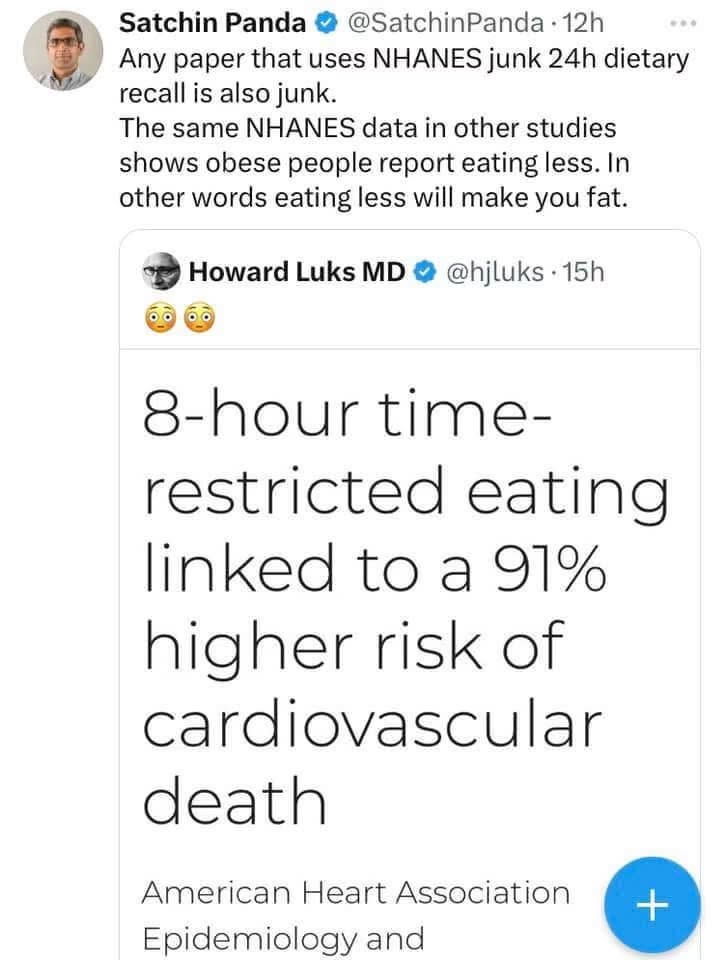
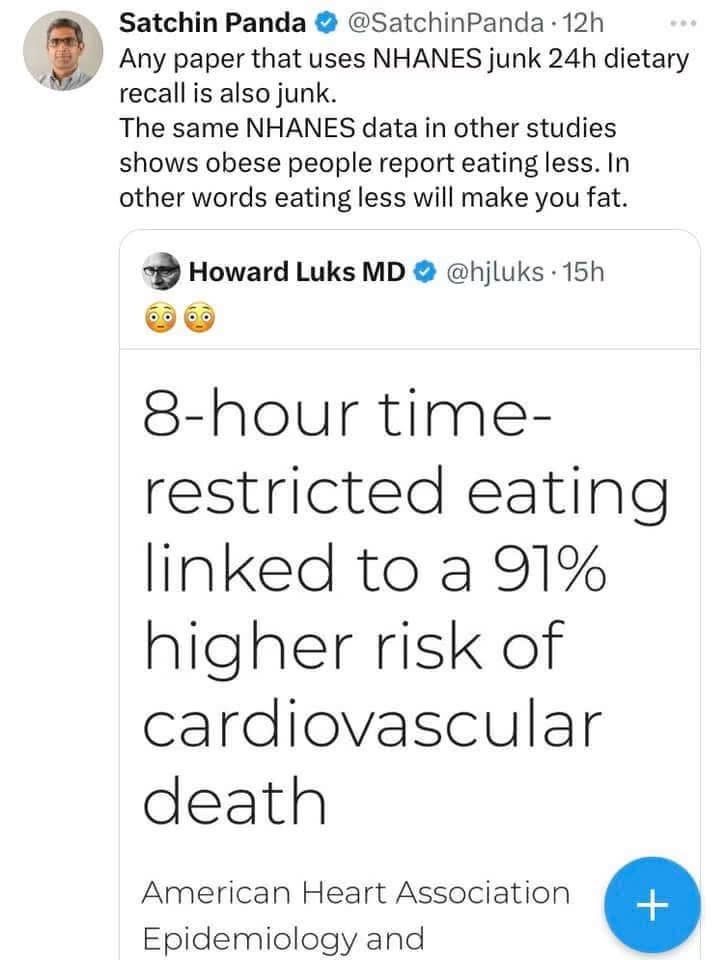
The dietary part of the NHANES dataset on which this analysis is based is very low quality. It was the same dataset used to recently claim that intermittent fasting increases risk of CVD by 91%. In the past, it has been used to claim that restricting calories makes people obese.
The authors are attempting to correlate 12-18 years of data on cancer and mortality with just 2 days of diet data taken during the very first year. They are literally basing this on what people reported eating over 2 days in their entire lives. There was no followup to see who even stayed on their reported 2-day diet for the next 12-18 years and who did not. Most of these people probably changed their diet significantly sometime in the next 12-18 years, as typically happens with diet.
It’s hilarious that the same people hyperbolizing this extremely low-quality analysis of just 2 days of diet data reject hundreds of high-quality prospective cohort studies that periodically track diet over long periods of time, and which show negative results for red meat (particularly processed red meat). Some of these people are just too ignorant to realize how incredibly low the quality of this analysis actually is, but most are outright lying about it to push their own agendas.
The number of high-quality prospective cohort studies showing a link between red meat and cancer is so large that the WHO has classified processed red meat as a definite carcinogen, and unprocessed red meat as a possible carcinogen.
#redmeatHD #cancerHD #nhanesHD