Red meat (beef, pork, lamb) and processed meat (bacon, ham, sausage, hot dogs, deli meat, jerky) are two different things in the group's posts, and the evidence is much stronger for the second. Processed meat is meat that has been chemically preserved, salted, cured, fermented or smoked.310 In the large prospective cohort studies the group cites, it is consistently associated with more heart disease, type 2 diabetes, colorectal cancer and dementia, and the risk appears to rise with every extra serving.311
Unprocessed red meat looks less harmful but is not neutral in the same sources: Louis Nervegna, one of the group's admins, describes it as a modest, dose-related risk that is small at around one serving a week.1 Independent randomized trials of unprocessed red meat have mostly shown worse cardiometabolic outcomes than comparison foods, while the exceptions were funded by the meat industry.812
This article walks through what the posts say, where the evidence is weaker or contested, and the swaps the admins favor. It is a summary of group discussion, not medical advice; people with heart disease, diabetes or other conditions should talk with their own doctor about diet.
What counts as red meat and processed meat
Red meat here means unprocessed beef, pork and lamb, such as steak, hamburger and pork chops. Processed meat is any meat chemically transformed to improve taste or shelf life. Examples listed in the posts include bacon, ham, hot dogs, sausages, corned beef, salami, canned meat and jerky.1011 Louis stresses that the "natural" or "uncured" versions are processed too, because they use celery juice, celery powder or sea salt to do the same chemical job as sodium nitrite.315
One post also notes that a Harvard analysis put "processed meat, poultry and fish" (bacon, hot dogs, breaded fish products, chicken sausages) in a single ultra-processed category, so processing rather than the animal species is the common thread.16 The American Cancer Society expert quoted in a New York Times piece shared in the group likewise said the main issue seems to be the processing itself rather than what the meat is made from.11
What the evidence shows
Heart disease and overall mortality
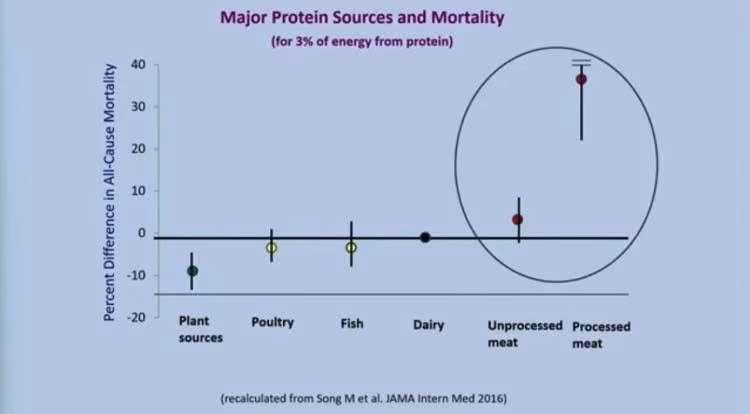
- Harvard cohorts (Nurses' Health Studies I and II and the Health Professionals Follow-up Study). Louis summarizes nearly 300,000 people tracked for over 30 years: the type of protein mattered more than the amount. Plant protein was protective, poultry and fish slightly protective, dairy and eggs neutral, unprocessed red meat modestly harmful, and processed meat very strongly harmful, "much worse than any other protein source."11718 He adds that apart from trans fats, no food category has worse hazard ratios in high-quality prospective cohorts than processed meat.219
- Plant versus animal protein. In the same cohorts, whole-food plant protein did better than animal protein, especially for heart disease, but the gap is small compared with fish, poultry and fermented dairy and large compared with red and processed meat.20 A newer post on over 200,000 participants followed about 30 years found the lowest heart disease risk in those with the highest plant-to-animal protein ratio and most total plant protein; the researchers said the risk reductions were driven largely by replacing red and processed meats.14
- Harvard's Nutrition Source. Louis quotes its statement that even small amounts of red meat, especially processed red meat, eaten regularly are linked to increased risk of heart disease, stroke and death from cardiovascular disease or any cause, and that replacing them with beans, soy foods, nuts, fish or poultry seems to reduce these risks.2122 Plant proteins are also more unsaturated and cholesterol-free, which lowers LDL.22
- Ultra-processed food. In an analysis of 10 ultra-processed food categories in the Harvard cohorts, only sugar-sweetened drinks and processed meat (including poultry and fish) were clearly linked to higher cardiovascular risk. When those two were excluded, most of the risk from ultra-processed food disappeared.16
- Guidelines. Louis shared the European Society of Cardiology / EAPC scientific statement on diet and cardiovascular disease, which says plant-based patterns rich in minimally processed foods lower risk, while patterns rich in ultra-processed foods, red meat, salt, sugar and saturated fat raise it.23
- Diet trials. In the Lyon Diet Heart Study, more than 600 heart attack survivors were randomized to a Mediterranean-style diet or an American Heart Association diet. After a mean of 27 months, cardiac deaths were 3 (Mediterranean) versus 16 (control) and non-fatal heart attacks 5 versus 17 (combined risk ratio 0.27, 95% CI 0.12-0.59); overall deaths were 8 versus 20. The Mediterranean arm used fish and poultry in place of processed and red meat and was very low in butter and cream. The trial was stopped early.242526 This was a whole-diet change, so the trial cannot isolate the effect of meat alone. Louis also notes that the six randomized trials that showed plaque reversal all limited large amounts of fatty red meat, along with junk food, refined grains and butter.27
Type 2 diabetes
Louis quoted the Harvard Nutrition Source summary on protein and diabetes. It cites a 2011 study in which each extra daily serving of red meat raised diabetes risk 12% and each serving of processed red meat 32%, and replacing a serving of red meat with nuts, low-fat dairy or whole grains was associated with an estimated 16% to 35% lower risk.5 The same passage reports a 50% higher risk over four years in people who increased their red meat intake, a 14% lower risk over 10 years in those who cut back, and 1.5 times higher risk in people who most often ate red meat and chicken cooked at high temperatures (over 289,000 people).5
The Nature Medicine burden-of-proof analysis (University of Washington's Institute for Health Metrics and Evaluation) found that the equivalent of one hot dog a day (about 50 g) was associated with an 11% higher risk of type 2 diabetes and a 7% higher risk of colorectal cancer versus none.410 Louis shared a related preliminary report from the EASD 2026 meeting: among 89,953 French adults followed about 7 years, those eating the most Neu5Gc, a sugar in beef and lamb that humans do not make, had a 63% higher type 2 diabetes risk. He suggests it may partly explain why cohorts link red meat to diabetes. The same post stresses that the results are observational, not peer reviewed, and that the link weakened when total red meat intake was accounted for.28
Cancer
The World Health Organization's cancer agency (IARC) classifies processed meat as a Group 1 carcinogen, based on sufficient evidence for colorectal cancer.1113 A shared explainer clarifies an easily misunderstood point: Group 1 describes how certain the evidence is, not how large the danger is, and bacon is not as risky as smoking even though both sit in the same category.13 Louis's post on the beef-industry analysis says the WHO classes processed red meat as a definite carcinogen and unprocessed red meat as a possible one.29
Louis cites a WHO estimate that every 50 g of cured meat eaten per day raises colon cancer risk by 18%, and uses it to calculate that someone eating ten 28 g jerky sticks daily would be doubling their risk. This is his extrapolation from a per-50-g figure, not a result measured in a study.30 The Nature Medicine analysis reports a smaller 7% increase for about 50 g a day, and rates the evidence as weak to moderate because it relies on observational data and self-reported diets.34
Dementia
Several posts link processed meat to dementia:
- About two weekly servings of processed meat were associated with 14% higher dementia risk, with no association for unprocessed meat.31
- In two reports of a large cohort study, each daily serving of processed red meat was associated with 13% higher dementia risk and 1.6 years of faster cognitive aging; replacing a daily serving with nuts or legumes was linked to 19-20% lower risk and with fish up to 28% lower.3233
- A review in the Annual Review of Nutrition reported that about two slices of deli meat a day was linked to a 44% higher dementia risk and 52% higher Alzheimer's risk.34
- A recent study found that nitrates from vegetables were tied to lower dementia risk, while nitrates from processed meat or drinking water were tied to higher risk.35
A Swedish observational study adds a nuance. In people carrying the APOE4 gene variants (3/4 and 4/4), eating unprocessed meat or fish was associated with lower dementia risk, with fish and poultry as good as red meat, while processed meat raised dementia risk in everyone regardless of APOE4 status. Louis says that the intakes involved were modest (a mean of 77 g of total meat a day), calls causation a "huge leap," and notes that most people on Mediterranean or MIND-style diets already eat enough fish or poultry to be in the top group.3637
Why processed meat may be harmful
Nitrates, nitrites and nitrosamines
Louis draws a firm line between nitrates, which he describes as healthy and found in vegetables, and nitrosamines, which form when nitrate or nitrite reacts with animal protein during curing and during high heat or acidic conditions.638 He says nitrosamines are carcinogenic and, in his words, "atherogenic and diabetagenic" (a claim of his, stated without a cited trial).3839
Specific points from the posts:
- Frying bacon or grilling sausage above 150 C (302 F) lets nitrites react with amino acids in the meat to form nitrosamines.40
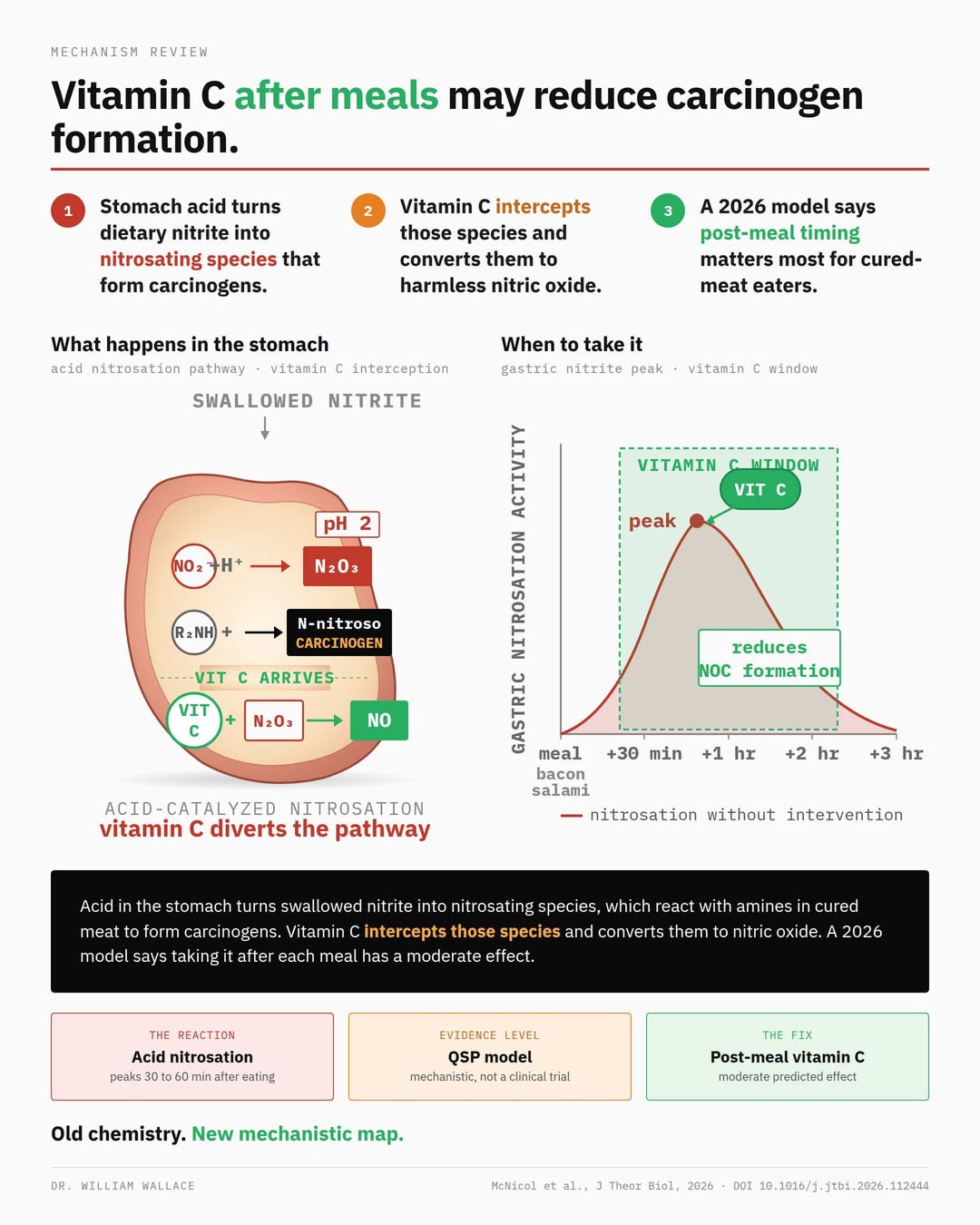
- Manufacturers now add antioxidants such as sodium erythorbate (a form of vitamin C) to curing mixes, which the post says makes modern cured meats lower in these compounds than in the 1970s.40
- A Journal of Theoretical Biology paper shared by Louis describes nitrite meeting stomach acid and forming nitrosamines (NDMA, NDEA, NMBA), a leading hypothesis for processed meat's link to stomach and colorectal cancer; vitamin C might reduce the reaction.7
- Gokhan Can shared a video making the contrast that processed meats can form N-nitrosamines, which is not typically a concern with vegetable nitrates, and that vegetables also bring antioxidants.41
- A shared summary of the Nature Medicine review lists nitrates, nitrites, heme iron and compounds formed during curing and high-heat cooking as likely mechanisms.3
"Uncured" and "nitrate-free" labels
Louis repeatedly warns that celery powder, celery juice and sea salt supply nitrates that chemically cure the meat just as sodium nitrite does, so the products are not meaningfully different.61538 He goes further in older posts, claiming natural versions may contain nitrosamine levels equal to or higher than regular ones, and points to a Tufts Health & Nutrition Letter on "no nitrate added" meats.64042 The dementia studies in the group are also described as including celery-cured products.3136 These are largely Louis's arguments; the posts do not provide a direct measurement comparing nitrosamine levels in the two kinds of product.
Other proposed pathways
Gokhan Can shared a review of TMAO (trimethylamine N-oxide), a metabolite made by gut microbes from choline and L-carnitine in red meat and egg yolks and linked to atherosclerosis; he says red meat and gut dysbiosis contribute to it, but it is not what he cares about most.43 Louis highlighted a six-month trial in people with metabolic syndrome where L-carnitine supplements (carnitine is abundant in red meat) increased carotid plaque stenosis compared with placebo, although total plaque volume did not change. He stresses the concern applies to the supplement whatever the mechanism.44 This is a supplement trial, not a trial of eating red meat.
Nuances, controversies and counter-arguments
Who funds the red meat studies?
Louis shared analyses on funding. In an analysis of 44 red meat trials (1980-2023), 29 were funded by industry groups and 15 were independent; the industry-funded trials were nearly four times as likely to report favorable or neutral cardiovascular results, and all independently funded trials reported worsened or neutral outcomes.8 A Harvard researcher's thread described 36 randomized trials of unprocessed red meat, noting that government- and academic-funded trials mostly found worse cardiometabolic health, with the exceptions funded by the beef and pork industries (23 comparisons were industry funded).12
Louis also criticized a beef-industry-funded analysis of NHANES III data claiming red meat does not raise cancer risk. His objections are that it linked 12-18 years of outcomes to only two days of reported diet and had no follow-up of dietary change.2945 Readers should note this is his critique; the paper's own methods are not described in more detail.
Can randomized trials settle it?
Louis argues that no food has been shown to cause cancer in a human randomized trial, just as none has shown that smoking causes lung cancer or trans fats cause heart disease. For long-latency diseases, prospective cohorts are the main high-quality evidence available.46 The Nature Medicine analysis itself rates the processed meat evidence as weak to moderate because of observational data and self-reported diets, so the honest summary is "consistent and strong in cohorts, but not proven by trials."3 The posts describe relative risks, and Harvard's Mingyang Song noted that the increases may seem small at first but are remarkably consistent, even at lower doses.4
Older and frail people
A nested case-control study of Chinese adults aged 80 and over found that avoiding meat was associated with lower odds of reaching 100 only in frail, underweight people; fish, egg or dairy eaters did equally well. Louis cautions that case-control studies rank low in the evidence hierarchy. Assuming the finding is real, he proposes that protein and IGF-1 matter in frail old age, adding that a diet best for preventing disease for most of life is not necessarily best for very old age.47
Influencers and anecdotes
Louis has repeatedly pushed back on influencers who defend processed meat, including a longevity physician who eats cured venison jerky and a carnivore influencer who called hot dogs healthy.304849 He also shared a video survey of the ages at death of over 100 health influencers, drawing the conclusion that those advocating high red and processed meat, low whole-grain diets did not live long. This is an anecdotal tally, not controlled evidence.5051
Protein concerns
On the "protein craze," Louis says there is no good human evidence that protein restriction slows aging, but that type matters: whole-food plant protein beats animal protein in mortality data, and among animal sources seafood, poultry and fermented dairy have the lowest mortality while processed meat is worst.52 The plant protein in the Harvard cohorts came from legumes, nuts, seeds and whole grains, not supplements, so the results may not apply to protein powders or bars.1 The benefit of plant protein is nowhere near enough to cancel the harm of processed meat; as Louis puts it, you cannot cancel out bacon by eating beans.1
What this means for you
The following reflects the group's posts, not personal medical advice:
- Processed meat is the priority to cut. A shared longevity summary says to keep processed meat "close to zero," and the Nature Medicine analysis found no safe level for diabetes and colorectal cancer.910
- For unprocessed red meat, think moderation. That same summary suggests staying under about 12-18 oz a week. Louis says eating it about once a week has little effect on risk in the Harvard cohorts.19
- Do not rely on "uncured," "natural" or "nitrate-free" labels. Louis argues they do not remove the nitrosamine issue.615
- Swap rather than just subtract. Louis recommends fresh unprocessed meat over cured meat if someone eats meat, and says seafood is better, with poultry the next best animal choice.30 Harvard's guidance is beans, nuts, seeds, seafood, whole grains and yogurt, with poultry, eggs and some cheese acceptable.2122
- Watch cooking temperature. High-temperature cooking of red meat and chicken was associated with 1.5 times higher diabetes risk in one Harvard-cited study, and nitrosamine formation rises above about 150 C.540
- Think in terms of the whole pattern. A Harvard Health list reposted by Gokhan puts tomatoes, olive oil, leafy greens, nuts, fatty fish, fruit and coffee on the "include" side and red and processed meat, refined carbohydrates, fried foods, sugary drinks and margarine, shortening and lard on the "avoid" side.53 A Mediterranean diet with walnuts, green tea and restricted red and processed meat lowered liver fat 39% in an 18-month randomized trial of 294 adults, versus 20% for a regular Mediterranean diet.54
- If you are older and frail, ask about protein. Discuss intake with a clinician, given the very-old-age findings above.47
Frequently asked questions
Is unprocessed red meat as bad as bacon or sausage?
According to Louis's summary of the Harvard cohorts, no. Unprocessed red meat modestly increases mortality, while processed meat is far worse.12 Still, Harvard's Nutrition Source links even small regular amounts of red meat to more heart disease, stroke and death.22
Does "uncured" bacon avoid the problem?
Louis says no: celery-based curing uses the same chemistry, and nitrosamines still form.67
How much processed meat is "safe"?
The Nature Medicine analysis found risk rising steadily with intake with no identifiable safe threshold for diabetes or colorectal cancer; one hot dog a day carried 11% and 7% higher risks.310 The IARC Group 1 label reflects certainty of evidence, not the size of the risk.13
Is the research just biased against meat?
Prospective cohorts, a burden-of-proof meta-analysis and independent trials point in the same direction, whereas Louis highlights that industry-funded trials were nearly four times as likely to report favorable results.812 Louis also shared studies in which meat looked beneficial in special groups (APOE4 carriers, frail very old adults), so the posts do not claim the picture is uniform.3647
Does eating more plant protein cancel out processed meat?
No. Louis points out that the benefit of plant protein is far smaller than the harm from processed meat, and that the best heart results came from replacing red and processed meats.114