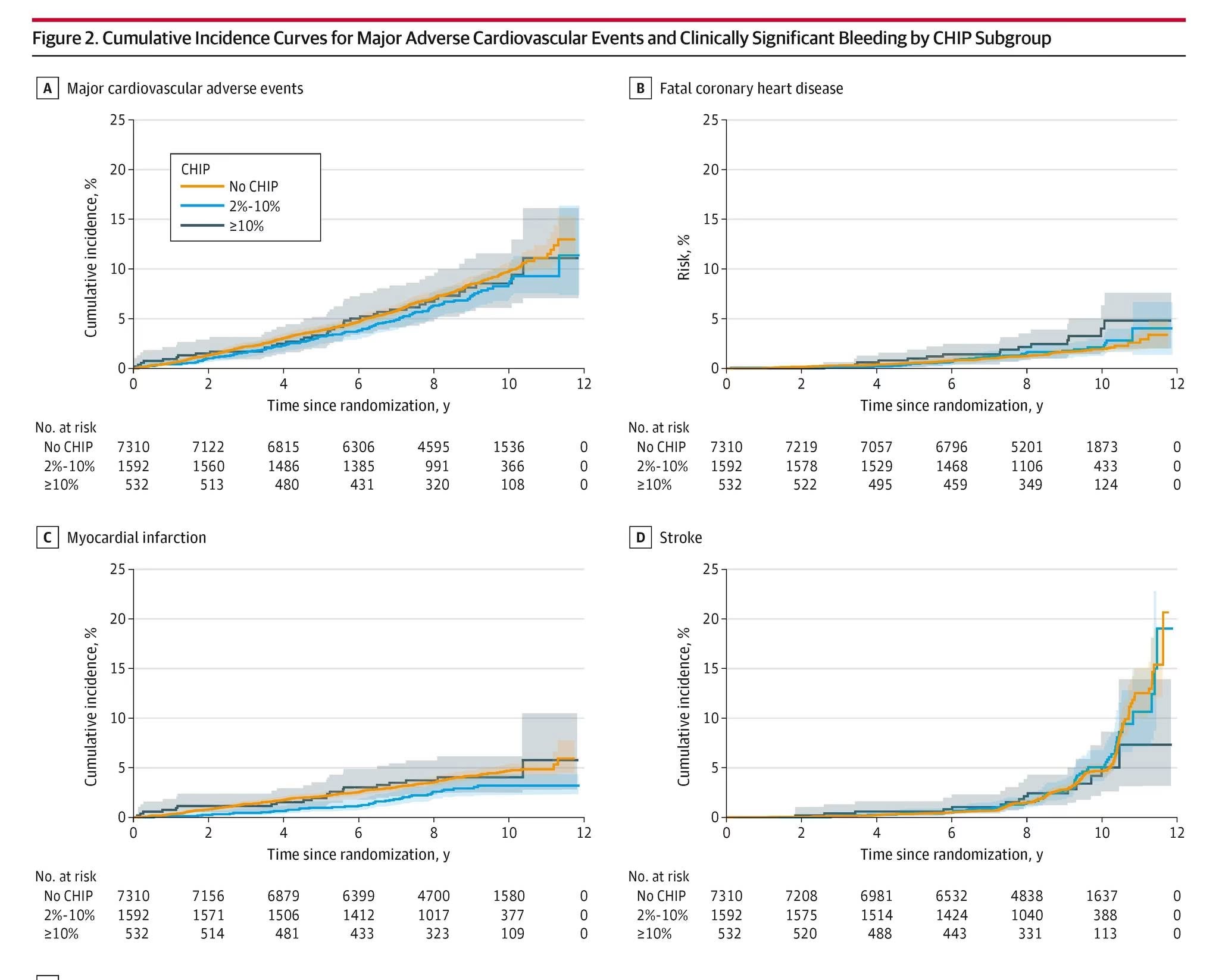
CHIP was not associated with increased risk for heart attack and stroke, in a recent large randomized trial for primary prevention.
However, it was associated with increased risk of bleeding.
Aspirin provided no additional benefit (or harm) for patients with CHIP in this trial.
————-
Clonal hematopoiesis of indeterminate potential, or CHIP, is a common aging-related phenomenon in which hematopoietic stem cells (produced by the bone marrow) or other early blood cell progenitor cells contribute to the formation of a genetically distinct mutated subpopulation of blood cells. This mutated subpopulation of blood cells is pathological and contributes to the formation of disease.
If we live long enough, all of us will ultimately develop CHIP. It appears to be an inevitable consequence of the aging process itself, except in rare cases. This may be one of the mechanisms by which aging itself causes diseases like CVD and cancer.
It can also be caused earlier in life by exposure to certain mutagenic agents, such as cytotoxic chemotherapy drugs for cancer treatment.
Quoted:
“Question- Is clonal hematopoiesis of indeterminate potential (CHIP) associated with increased risk of cardiovascular disease (CVD) events or clinically significant bleeding (CSB), and is there a differential effect of aspirin?
Findings- In this prespecified secondary analysis of a randomized clinical trial including 9434 participants, CHIP was not associated with increased risk of CVD events, but was associated with an increased risk of CSB. No evidence was found that aspirin effects on CVD events and CSB were different for individuals with CHIP compared to those without.
Meaning- The data do not provide evidence that aspirin is beneficial for older individuals with CHIP in the setting of primary prevention.”
cc: Gokhan Can