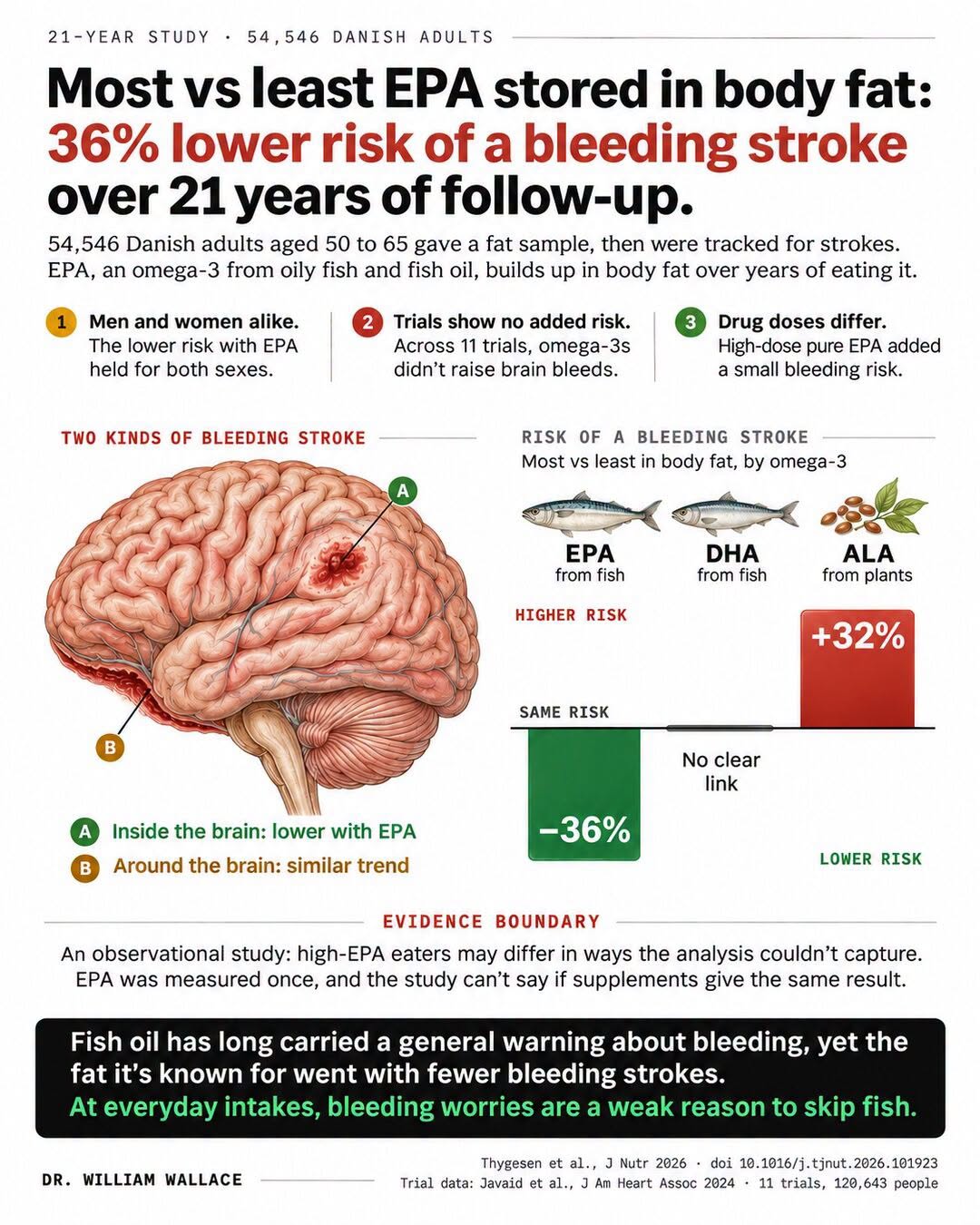
Over a 21 year period, people with the highest EPA level stored in fat had a 36% reduced chance of adverse bleeding compared to people with the lowest level.
The relationship with DHA was neutral.
While it is established that fish oil modestly increases risk of bleeding in the short term, this study seriously questions whether that actually happens in the long term. It appears to be the opposite.
The strength of this study is that they were directly measuring the levels of EPA and DHA in tissue, instead of relying on dietary questionnaires to determine intake.
#fishoilHD #omega3HD #bleedingHD #epaHD #dhaHD #hemorrhageHD #hemorrhagicstrokeHD
Fish oil has carried a general warning about bleeding for decades, mostly because omega-3 fats can make blood platelets slightly less sticky. That worry has led many people to assume that eating more oily fish, or taking fish oil, raises the risk of a bleeding stroke. When you look at the research as a whole, though, it hasn't held up for normal intakes.
The newest piece of evidence comes from a 21-year Danish study of 54,546 adults aged 50 to 65. Instead of relying on food questionnaires, the researchers took a small sample of each person's body fat, where EPA from fish builds up slowly over years of eating it, and then followed everyone for strokes. People with the most EPA stored in their fat had a 36% lower risk of a bleeding stroke than people with the least, and this was true for both men and women. DHA, the other main omega-3 in fish, showed no clear link either way, while ALA, the plant omega-3, went with a 32% higher risk, which is a finding that will need to be confirmed before anyone reads much into it.
The trial evidence tells a similar story. When researchers pooled 11 randomized trials covering more than 120,000 people, omega-3s didn't increase the risk of bleeding in the brain. The one exception is high-dose prescription pure EPA, which added a small bleeding risk, so a pharmaceutical dose shouldn't be confused with the amount people get from eating fish or taking a typical supplement.
Because the Danish study is observational, people with more EPA in their fat may differ from others in ways the researchers couldn't fully measure. EPA was also measured only once, and the study can't tell us whether supplements have the same effect as eating fish. Even so, taken together with the trials, it suggests that at everyday intakes, fear of bleeding is a weak reason to avoid fish.
Sources: Thygesen et al., Journal of Nutrition, 2026. Javaid et al., Journal of the American Heart Association, 2024.