Does taurine fuel cancer?
That’s what recent headlines claimed, but that framing badly misrepresents both taurine biology and the actual science.
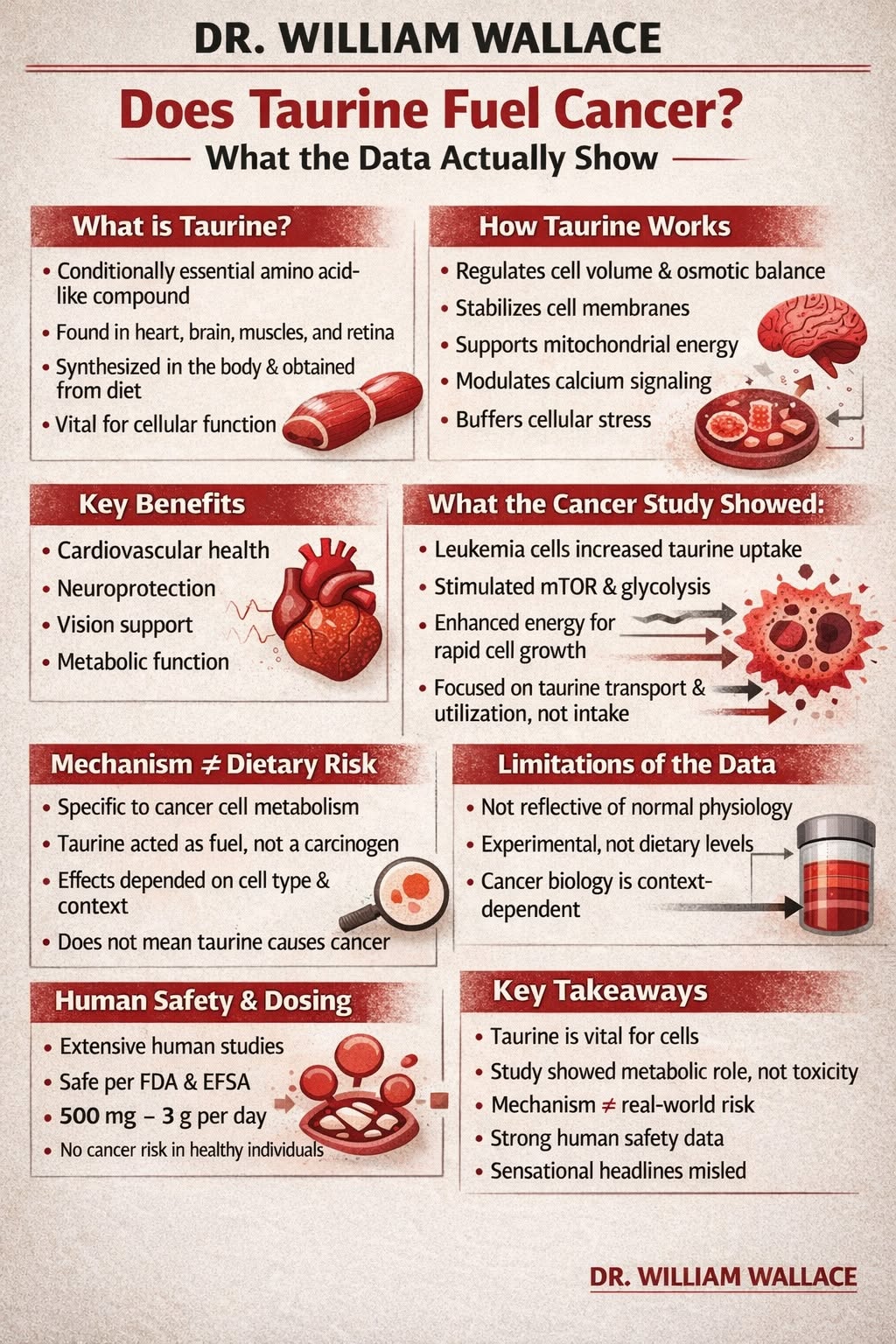
Taurine is a conditionally essential, amino-acid–like molecule that plays foundational roles in human health. It helps stabilize cell membranes, regulate calcium signaling, support mitochondrial energy production, and buffer cells against metabolic and oxidative stress. It is highly concentrated in the brain, heart, retina, and muscle, and it is required for normal cellular function across tissues.
The controversy comes from a recent Nature paper that did not study dietary taurine, supplements, or energy drinks. Instead, researchers examined leukemia metabolism inside the bone marrow microenvironment using genetically engineered mouse models. In that disease-specific setting, leukemia cells upregulated a taurine transporter and used locally produced taurine to support growth pathways like mTOR and glycolysis. When taurine transport or synthesis was genetically blocked in those models, leukemia progression slowed.
What the headlines missed is critical:
- Taurine was not introduced through diet or supplementation
- Taurine was not shown to cause or initiate cancer
- Taurine acted as a metabolic substrate, not a toxin
Cancer cells are known to hijack normal nutrients (glucose, glutamine, lipids, and amino acid derivatives) to fuel uncontrolled growth. That does not make those molecules carcinogens, nor does it translate into dietary risk.
Context matters even more here. Other high-quality research shows taurine can support anti-tumor immunity, including improving function in exhausted CD8⁺ T cells and enhancing responses to immunotherapy. Same molecule, completely different biological context.
Decades of human data also matter. Taurine has been extensively studied, is classified as safe by the FDA and EFSA, and shows no evidence of mutagenicity, carcinogenicity, or cancer promotion in humans. Typical intakes (~500 mg–3 g/day, sometimes higher in clinical trials) do not resemble the experimental conditions used in leukemia models.
What can we responsibly conclude?
- Taurine can be metabolically exploited by leukemia cells in controlled models
- That mechanism does not translate to dietary risk
- Taurine is not a carcinogen
- Human safety data remain strong
- Conservative caution may be reasonable only in active leukemia
This is a textbook example of why mechanism ≠ real-world risk — and why nutrition science should never be reduced to headlines.